
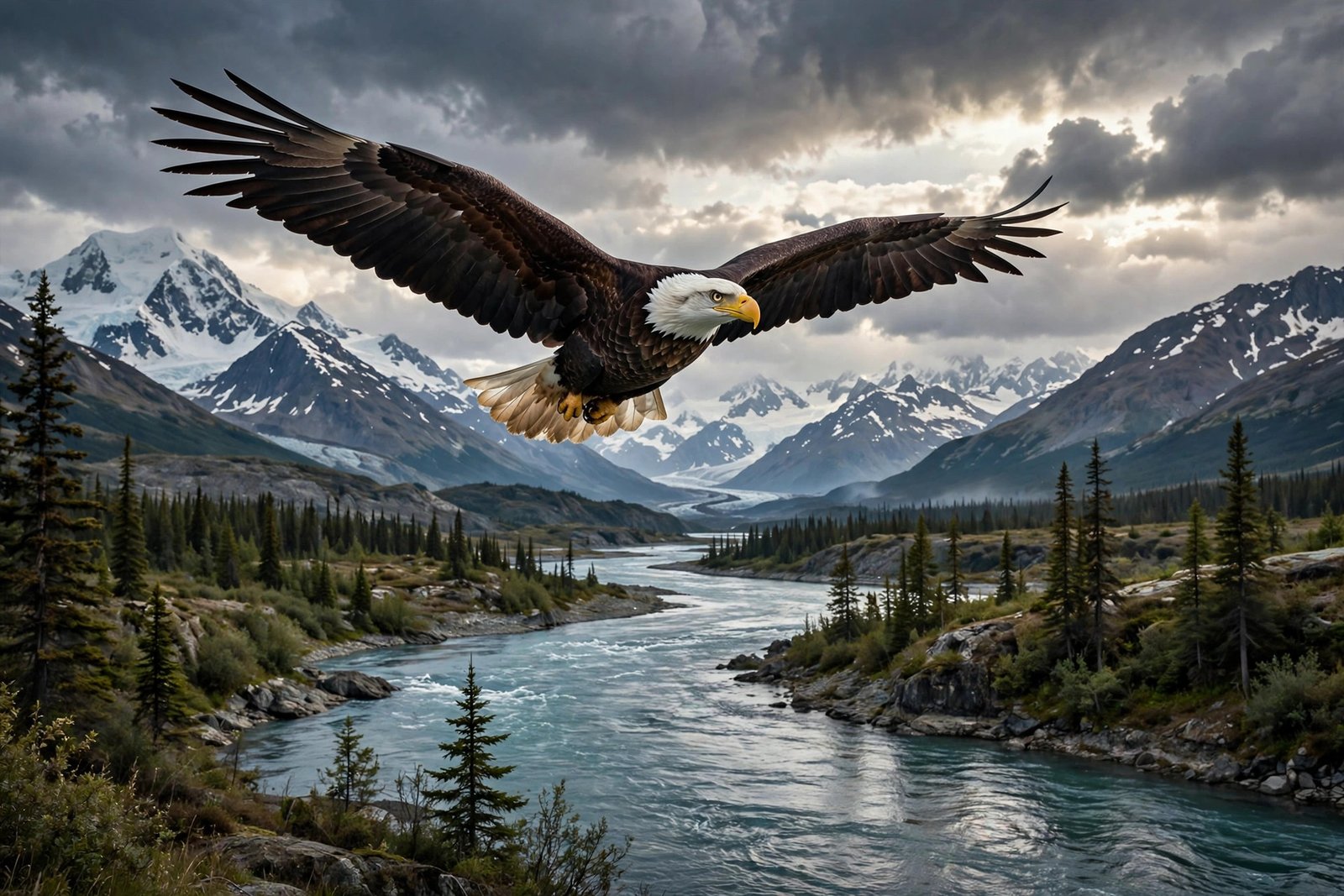
There is a moment every wildlife lover remembers: a flash of white against a gray winter sky, wings spanning wider than you are tall, riding the wind without a single flap. If you have ever wondered where to see bald eagles in the wild, you are asking one of America’s great wildlife questions \u2014 and the answer is more hopeful than it has been in a century.
The bald eagle, America’s national bird since 1782, once stood on the brink of vanishing from the lower 48 states. Today it soars over rivers, lakes, and coastlines from Alaska to the Gulf Coast. This guide tells the story of the bird’s remarkable comeback, then reveals twelve of the best places to watch bald eagles in America \u2014 with the best seasons and viewing tips for each. For more verified American wildlife wonders, see our guide to American animals you won’t believe are real.
The Bald Eagle’s Remarkable Comeback
Few conservation stories are as dramatic as the bald eagle’s. By the mid-twentieth century, a combination of habitat loss, hunting pressure, and \u2014 above all \u2014 the pesticide DDT had pushed the species to the edge. DDT accumulated in the food chain and caused eagles to lay thin-shelled eggs that broke before hatching. By the early 1960s, only a few hundred nesting pairs remained in the lower 48 states.
The turnaround began with legal protection. Bald eagles were listed under the Endangered Species Preservation Act in 1967, and the United States banned DDT in 1972. With the poison gone and nesting habitat protected, the population began a slow, steady climb that accelerated decade after decade. In 2007, the bald eagle was formally removed from the federal endangered species list \u2014 one of the greatest wildlife recovery successes in American history.
Today bald eagles are found across nearly every state, from the salmon rivers of Alaska to the reservoirs of the Southeast. They remain federally protected under the Bald and Golden Eagle Protection Act, which makes it illegal to disturb the birds, their nests, or their eggs. That protection is part of why the answer to “where to see bald eagles” keeps getting better every year.
Where to See Bald Eagles: The 12 Best Places in America
1. Chilkat Bald Eagle Preserve, Alaska. Near the town of Haines, this preserve hosts the largest seasonal gathering of bald eagles on Earth. Each late fall, a remarkably late salmon run draws thousands of eagles to the Chilkat River flats. The best viewing is typically late October through November along the Haines Highway, where roadside pullouts overlook the river. Bring a spotting scope, dress for cold rain, and give the birds plenty of space.
2. Skagit River, Washington. Every winter, hundreds of bald eagles descend on the upper Skagit River to feed on spawned-out chum salmon. The peak season runs roughly November through February. Eagles perch in riverside cottonwoods and snatch salmon from the shallows. Viewing is excellent from highway pullouts between Rockport and Marblemount, and local guides offer winter float trips for a water-level perspective.
3. Upper Mississippi River, Iowa and Illinois. The locks and dams of the Upper Mississippi keep water open all winter and stun fish passing through \u2014 a perfect eagle buffet. From December through March, stretches around the Quad Cities, Dubuque, and Keokuk host impressive concentrations. Several river towns hold winter eagle-watching festivals with guided viewing, making this one of the most accessible places to see bald eagles in the Midwest.
4. Conowingo Dam, Maryland. On the lower Susquehanna River, this hydroelectric dam is one of the East Coast’s premier eagle spectacles. Dozens of eagles hunt fish in the turbulent tailrace below the dam, often diving dramatically within view of the shoreline. Peak season is roughly November through January. Fisherman’s Park on the Harford County side offers close, free viewing \u2014 arrive early on winter weekends.
5. Klamath Basin, Oregon and California. The national wildlife refuges of the Klamath Basin \u2014 including Lower Klamath and Tule Lake \u2014 host one of the largest wintering concentrations of bald eagles in the lower 48 states. From November through February, eagles gather to feed on waterfowl. Auto tour routes let you watch from your car, which doubles as a perfect blind. Mornings offer the most activity.
6. Yellowstone National Park. Yellowstone supports resident nesting eagles plus seasonal migrants, making it one of the few places where to see bald eagles essentially year-round. Look along the Yellowstone River, in Hayden and Lamar Valleys, and around Yellowstone Lake. Winter concentrates birds near open water and elk winter range; spring and summer offer nesting pairs feeding chicks. Any park visit with binoculars is an eagle opportunity.
7. Glacier National Park, Montana. Each fall, kokanee salmon spawn in McDonald Creek on the park’s west side, drawing eagles in striking numbers. The peak typically falls in October and November. Eagles line the riverside trees along the creek, often dozens in view at once. Combine it with autumn color and snow-dusted peaks for one of the most beautiful wildlife settings in America.
8. Upper Delaware Scenic River, New York and Pennsylvania. The free-flowing Upper Delaware hosts a strong wintering eagle population drawn by open water and fish. December through March is prime time. The Eagle Institute and local viewing sites around Lackawaxen, Barryville, and the Mongaup River area offer guided winter watches. It is an easy weekend trip from New York City and Philadelphia.
9. Lake Guntersville, Alabama. The South has eagles too \u2014 and Guntersville is its winter capital. Eagles gather below Guntersville Dam to hunt fish in the tailwaters, with peak numbers typically in January and February. Lake Guntersville State Park runs eagle-awareness programs and viewing events, and the lakeside setting makes for comfortable watching even in winter.
10. Homer, Alaska. The fishing town of Homer on Kachemak Bay is famous for its winter eagles. For decades, a local resident fed eagles at the Homer Spit through the winter, creating an extraordinary \u2014 if controversial \u2014 gathering; though organized feeding has ended, wintering eagles still work the bay and spit in impressive numbers. January through March is best. Watch from the spit road pullouts and keep a respectful distance.
11. Reelfoot Lake, Tennessee. This cypress-swamp lake in northwest Tennessee, formed by the great earthquakes of 1811\u201312, is one of the South’s best winter eagle destinations. Eagles arrive in January and February to hunt the lake’s fish and waterfowl. Reelfoot Lake State Park offers guided eagle tours by boat and bus \u2014 the cypress knees and misty water make it hauntingly beautiful.
12. Starved Rock State Park, Illinois. Each winter, the Illinois River below the Starved Rock dam stays open and full of fish, drawing eagles from across the region. December through March, the park’s overlooks and the riverside trail offer superb viewing, and the park runs popular Eagle Watch programs with scopes set up for visitors. It is an easy day trip from Chicago.
Where to See Bald Eagles Responsibly: Viewing Etiquette
Knowing where to see bald eagles comes with a responsibility to watch them well. Eagles are wild predators that burn precious winter energy every time they are flushed from a perch. Follow these rules and the birds \u2014 and your fellow watchers \u2014 will thank you:
- Keep your distance. Use binoculars or a spotting scope instead of approaching. If an eagle stops feeding, looks at you repeatedly, or flies off, you were too close.
- Stay quiet and move slowly near roosts, perches, and especially nests. Never approach a nest tree.
- Never feed eagles. Feeding disrupts natural behavior, concentrates birds unnaturally, and can be illegal.
- Respect posted closures. Refuges and parks close areas around nests for good reason \u2014 honor every sign and rope line.
- Know the law. The Bald and Golden Eagle Protection Act makes it illegal to disturb bald eagles, their nests, or their eggs. Admiration from afar is not just polite \u2014 it is required.
- Time it right. Eagles are most active in the first few hours after dawn and again in late afternoon. Midday, they often sit motionless for hours \u2014 spectacular through a scope, but bring patience.
Start Planning Your Eagle Adventure
From Alaska’s salmon rivers to a Maryland dam tailrace, the question of where to see bald eagles has never had better answers. Pick a destination that fits your winter travel plans, check local conditions and festival dates before you go, and pack your binoculars \u2014 the sight of a bald eagle dropping from the sky to snatch a fish is something you will never forget.
For more inspiration, explore our hidden gems most Americans never visit \u2014 several sit in prime eagle country \u2014 and our mind-blowing USA facts for more stories that sound fake but are real. Then get outside: America’s national bird is waiting.