
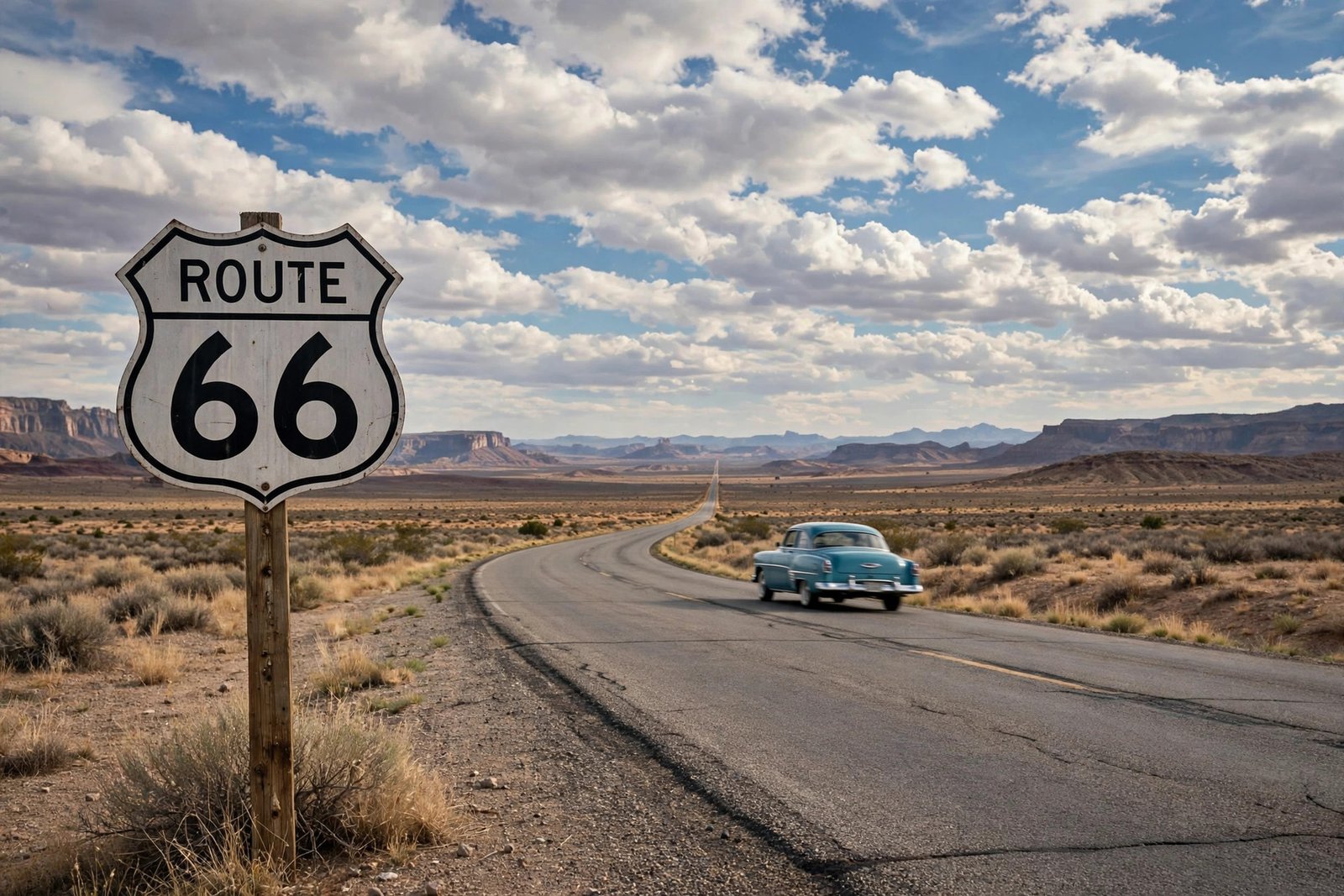
A Route 66 road trip is the great American adventure. Nearly 2,400 miles of neon signs, roadside diners, desert sunsets, and small towns that time forgot stretch from Chicago to the Santa Monica Pier. Since 1926, the Mother Road has carried dreamers westward, and today it remains the most storied drive in the United States. This ultimate guide covers the history of the highway, the best time to go, how long the drive takes, must-see stops in all eight states, where to eat and sleep, and practical tips to make your journey unforgettable.
Route 66 Road Trip History: The Mother Road
Route 66 was commissioned on November 11, 1926, as one of the original highways in the U.S. numbered highway system. It ran from Chicago, Illinois to Santa Monica, California, a distance commonly cited as 2,448 miles, stitching together existing local roads into a single diagonal path across the country. For the first time, an ordinary family could drive from the Midwest to the Pacific Coast on one continuous route.
The road earned its nickname during the Great Depression. In his 1939 novel The Grapes of Wrath, John Steinbeck called it the Mother Road, the path taken west by Dust Bowl families fleeing ruined farms in Oklahoma and Texas for the promise of California. Hundreds of thousands of migrants traveled it in the 1930s, and the highway became a symbol of hope and hardship woven into American identity.
After World War II, Route 66 entered its golden age. Car ownership exploded, and the highway filled with motor courts, neon-signed motels, drive-in restaurants, and quirky roadside attractions competing for travelers’ attention. It was the road of family vacations and teenage freedom, immortalized in song and on television. But the party could not last. The Interstate Highway System, launched in 1956, built faster, straighter freeways that bypassed the old towns. One by one, the interstates replaced Route 66, and in 1985 it was officially decommissioned as a U.S. highway.
What happened next is one of the great comebacks in travel history. Preservationists, small-town boosters, and nostalgic travelers refused to let the Mother Road die. States began marking it with brown Historic Route 66 signs, museums opened, and neon signs were relit. Today a Route 66 road trip is a bucket-list journey for travelers from around the world, proof that the slowest road can be the most rewarding one.
Planning Your Route 66 Road Trip: When to Go
Timing matters more on Route 66 than on most American road trips, because the route crosses deserts, plains, and high mountains. Late spring, from May through June, and early fall, from September into early October, are the sweet spots. Temperatures are comfortable across most of the route, summer crowds have thinned, and nearly all roadside attractions, museums, and diners are open for the season.
Summer brings intense heat to the desert Southwest. Daytime temperatures in Arizona, New Mexico, West Texas, and the Mojave Desert regularly climb past 100 degrees Fahrenheit, which makes midday sightseeing uncomfortable and puts extra strain on older cars. If summer is your only option, plan outdoor stops for early morning, carry far more water than you think you need, and never let your fuel tank drop low in remote stretches.
Winter brings the opposite problem. Higher elevations along the route, including Flagstaff, Arizona and the mountains of New Mexico, can see snow and ice, and the plains of Oklahoma and the Texas Panhandle get winter storms. Some seasonal businesses close from late fall through early spring. A winter Route 66 road trip is possible and wonderfully crowd-free, but check road conditions daily and keep your itinerary flexible.
How Long Does a Route 66 Road Trip Take?
Two weeks is the ideal pace for driving the full route. That gives you time to actually stop, explore small towns, linger over pie in a 1950s diner, and take detours without feeling rushed. Three to four weeks is even better if you want a slow journey with major side trips, such as the Grand Canyon, which sits a very manageable detour north of Flagstaff, Arizona.
Can you do it in one week? Yes, but be honest with yourself about what that means. You will spend most of each day driving and will have to skip a lot. If a week is all you have, consider driving half the route, either Chicago to Oklahoma City or Albuquerque to Santa Monica, and saving the rest for next time. The road rewards those who slow down.
A good rule of thumb is four to six hours of driving on most days, with full rest days built in at great stopping cities like St. Louis, Amarillo, Albuquerque, and Flagstaff. Resist the urge to measure the trip in miles. The best Route 66 road trip memories come from unplanned stops: a conversation with a motel owner, a sunset at a roadside overlook, a slice of pie you did not know you needed.
Route 66 Road Trip Stops: State by State
Eight states, hundreds of worthy stops. These are the highlights no first-timer should miss, traveling west from Chicago.
Illinois
Your journey begins in downtown Chicago at the “Begin” sign at the corner of Adams Street and Michigan Avenue, the traditional eastern terminus and the spot for the obligatory photo. Before leaving the city, fuel up at Lou Mitchell’s, the classic diner near the route’s start that has been feeding travelers since 1923. South of Chicago, the town of Pontiac is a mandatory stop, home to the Route 66 Hall of Fame and Museum, packed with memorabilia, vintage signs, and stories from the road’s first decades.
Missouri
Missouri gives you the Gateway Arch in St. Louis, the gleaming steel monument to westward expansion that pairs perfectly with a Mother Road journey. Just west of the city, stop at Ted Drewes Frozen Custard, a St. Louis institution serving its famous concretes since 1929, right on the historic route. Further along, Meramec Caverns near Stanton has been drawing road-trippers underground since the 1930s with its massive cave formations, once advertised on barns all across the Midwest.
Kansas
Kansas holds only about 13 miles of Route 66, the shortest stretch in any state, but it punches above its weight. In Galena, stop at Cars on the Route, an old Kan-O-Tex service station restored as a tribute to Pixar’s Cars, complete with the rusty tow truck said to have inspired the character Mater. Nearby Baxter Springs offers a beautifully preserved stretch of the original 1920s roadbed, a rare chance to drive on the actual pavement early travelers used.
Oklahoma
Oklahoma has more drivable miles of Route 66 than any other state, and it shows. In Catoosa, the Blue Whale, a giant smiling whale built in the early 1970s as a swimming hole attraction, is one of the most photographed oddities on the entire route. In Arcadia, the Round Barn, built in 1898, is an architectural curiosity lovingly restored by volunteers. In Clinton, the Oklahoma Route 66 Museum walks you through the road decade by decade, from Dust Bowl hardship to neon-soaked heyday.
Texas
The Texas Panhandle delivers some of the most iconic miles of the whole drive. Just west of Amarillo, Cadillac Ranch is a public art installation from 1974: ten Cadillacs buried nose-first in a field, covered in layers of spray paint. Bring a can and add your own tag. In Adrian, the Midpoint Cafe marks the official halfway point of the route between Chicago and Los Angeles, a classic photo stop. And in Amarillo itself, The Big Texan is famous far beyond Texas for its 72-ounce steak challenge, free if you finish it within the hour.
New Mexico
New Mexico may be the most atmospheric state on the route. In Santa Rosa, the Blue Hole is a stunning natural swimming hole, a near-perfect circle of impossibly blue water in the middle of the high desert. Tucumcari is a neon wonderland of restored motels and hand-painted murals, anchored by the Blue Swallow Motel, a 1940 motor court whose glowing neon sign is pure Route 66. In Albuquerque, Old Town’s adobe streets and plaza sit just off the route and are well worth an afternoon of wandering.
Arizona
Arizona is where the landscape turns truly cinematic. Petrified Forest National Park preserves 225-million-year-old fossilized trees scattered across painted desert badlands, and the historic route runs right through it. In Holbrook, the Wigwam Motel lets you sleep in a concrete teepee, a 1950 novelty that has become a beloved landmark. Near Winslow, Meteor Crater, a mile-wide impact crater nearly 50,000 years in the making, sits just off the route. And in Winslow itself, the Standin’ on the Corner Park pays tribute to the Eagles lyric every classic rock fan knows.
California
The final state is a study in contrasts, from empty desert to the Pacific. In Amboy, deep in the Mojave Desert, Roy’s Motel and Cafe stands as a beautifully restored monument to roadside America, its tall neon sign visible for miles. In Oro Grande, Elmer’s Bottle Tree Ranch is a folk-art forest of glass bottles that catches the desert light. Then, at last, the Santa Monica Pier, where the “End of the Trail” sign marks the western terminus. Dip your toes in the Pacific. You drove nearly 2,400 miles to earn it.
Where to Eat and Sleep on Your Route 66 Road Trip
Food is half the fun of the Mother Road. This is diner country: chicken-fried steak, mile-high pies, green chile cheeseburgers in New Mexico, and deep-dish pizza to launch your trip in Chicago. The golden rule is to eat where the locals eat and to never pass up pie. Many of the best stops, from small-town cafes to barbecue joints, have been serving travelers for generations, and a meal in a 1950s booth tastes better for the history in the walls.
For sleeping, the neon-signed motor courts are the signature Route 66 experience. Family-run motels like the Blue Swallow in Tucumcari and the Wigwam Motels in Holbrook and San Bernardino offer clean rooms, vintage charm, and owners who love the road as much as you do. Book ahead in summer and around festivals, when the most famous motels fill up fast. On other nights, you can often just roll into town and find a vacancy sign glowing.
Practical Tips for Your Route 66 Road Trip
- Respect the fuel gauge. Fill up before long, empty stretches, especially across the Mojave Desert and the plains of western Texas and eastern New Mexico. When you see a station in a remote area, use it.
- Navigate like it is 1926, with 2026 tools. Historic Route 66 is not one continuous signed highway, and it is easy to lose the old alignment. Use a dedicated Route 66 guidebook or app, and download offline maps, because cell service disappears in rural stretches.
- Carry cash. Many small-town diners, gift shops, and roadside attractions are cash-friendly, and some are cash-only. Small bills make quick stops smoother.
- Get your car checked first. A pre-trip inspection, good tires, and a basic emergency kit matter on a 2,400-mile drive. Carry extra water whenever you cross desert country, for you and for the radiator.
- Check seasonal hours. Some museums, caverns, and attractions reduce hours or close in winter. A quick check before you detour saves disappointment.
- Talk to people. Motel owners, diner waitresses, and museum volunteers are the living history of the Mother Road. Ask them their favorite stop. Their answers are often better than any guidebook.
Start Your Route 66 Road Trip Adventure
A Route 66 road trip is more than a drive. It is a journey through the American century: Depression-era hope, postwar optimism, roadside ingenuity, and small towns that refused to fade away. Whether you take two weeks or two months, the Mother Road has a way of slowing you down and reminding you that getting there was never the point.
Ready to hit the road? Share this guide with your favorite travel companion, and tell us in the comments which stop you are most excited to see. For more American adventures, discover the hidden gems most Americans never visit, explore the legends behind America’s most famous stories, and see what about American life surprises the rest of the world.