
You have seen the Grand Canyon on postcards. You have heard of Yellowstone, Yosemite, and the Statue of Liberty. But America is enormous, and some of its most jaw-dropping places barely make it onto anyone's bucket list.
These are the spots that locals whisper about and travelers stumble onto by accident. Ice caves on a frozen lake. The tallest sand dunes on the continent. A Civil War-era fortress you can only reach by boat or seaplane. Every single one is real, open to visitors, and far less crowded than the famous parks — which means you get the views without the traffic jams, the parking lots, and the selfie sticks.
Pack your curiosity. Here are 12 hidden gems in the USA most Americans never visit.
1. Apostle Islands Ice Caves, Wisconsin
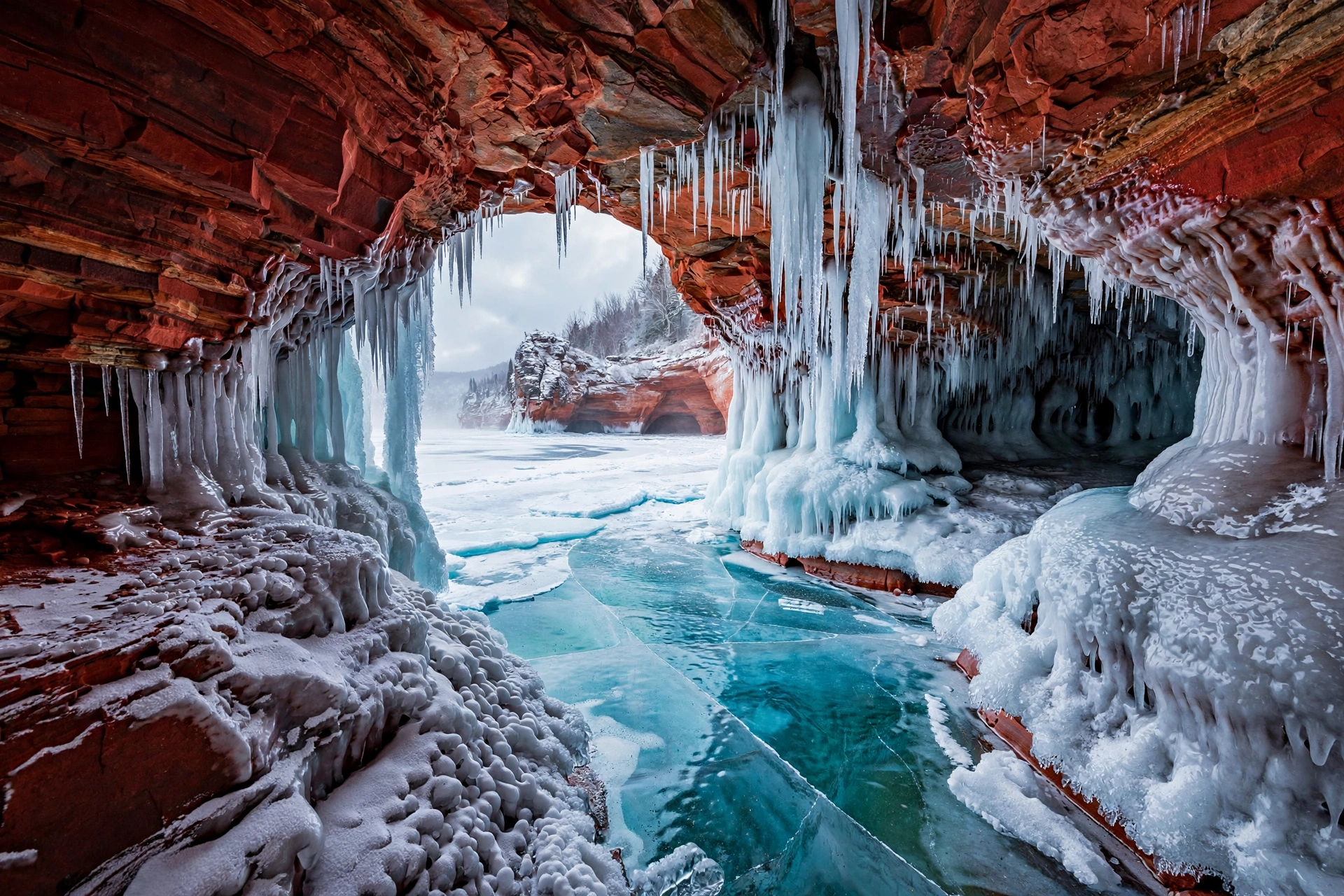
When Lake Superior freezes hard enough, the red sandstone cliffs near Bayfield, Wisconsin, transform into something out of a fantasy film. Waves carve sea caves into the shoreline all year, but in deep winter, dripping water freezes into curtains of icicles, frozen waterfalls, and glassy ice formations inside the caves.
On the coldest years, visitors can walk right out onto the frozen lake to explore them. It does not happen every winter — the lake has to freeze solid, which is rare — but when it does, thousands make the pilgrimage. Even in summer, the mainland sea caves are stunning by kayak, with water so clear you can see straight down.
2. Great Sand Dunes, Colorado
The tallest sand dunes in North America sit in southern Colorado, of all places, with the 13,000-foot Sangre de Cristo Mountains rising directly behind them. Star Dune climbs about 750 feet from the valley floor, and there is nothing around it but open high desert.
Kids and adults sandboard and sandsled down the slopes. In late spring, Medano Creek flows at the base of the dunes and turns into a surreal beach. At night, the park is an International Dark Sky Park, and the Milky Way pours over the dunes. It feels like two landscapes that should not exist side by side — and yet there they are.
3. Caddo Lake, Texas and Louisiana
On the Texas-Louisiana border lies one of the strangest and most beautiful lakes in America. Caddo Lake is a maze of bayous, sloughs, and ponds draped in Spanish moss, where ancient bald cypress trees rise straight out of dark, still water.
Paddling through it at dawn feels like entering another century. Alligators slide silently off the banks, herons stalk the shallows, and the cypress knees poke up like a submerged forest. It is the kind of place that makes you understand why every Southern ghost story involves a swamp.
4. Channel Islands, California
Just off the coast of Southern California sits a national park that most Californians have never visited. The Channel Islands are often called the Galapagos of North America because so many of their plants and animals exist nowhere else on Earth.
Island foxes the size of house cats trot through the grass. Seals and sea lions crowd the beaches. Sea caves riddled along the cliffs glow blue when the light hits them right. There are no cars, no crowds, and on a clear day you can see the mainland skyline while standing in total wilderness.
5. Dry Tortugas, Florida
Seventy miles west of Key West, past the end of the road, past the last marina, a massive brick fortress rises out of impossibly blue water. Fort Jefferson, built in the 1800s, is one of the largest brick structures in the Americas — and it sits on a tiny island in the Gulf of Mexico.
You can only get there by ferry or seaplane, which keeps the crowds thin. The snorkeling around the fort walls is superb, with sea turtles, coral, and tropical fish. At night, the stars are outrageous. It is the most remote-feeling place in the eastern United States.
6. North Cascades, Washington
Washington's North Cascades National Park is one of the least-visited major national parks in the country, which is absurd once you see it. Jagged granite peaks, more than 300 glaciers, and turquoise alpine lakes stretch across some of the wildest terrain in the Lower 48.
The park has been called the American Alps, and the name fits. Diablo Lake glows an almost unreal shade of turquoise from glacial flour. Trails like Cascade Pass deliver high-alpine drama without the permit lotteries of busier parks. If you want the mountain West without the crowds, this is it.
7. Great Basin, Nevada
Tucked against the Utah border in eastern Nevada, Great Basin National Park packs an absurd amount of wonder into one quiet park. Lehman Caves wind underground in chambers full of stalactites, stalagmites, and rare shield formations. Above ground, Wheeler Peak rises past 13,000 feet.
The park's bristlecone pine groves hold some of the oldest living organisms on Earth — trees that were already ancient when the pyramids were built. In fall, the aspen groves turn gold against the limestone. You will share the trails with a fraction of the visitors that places like Zion get.
8. Congaree, South Carolina
Just outside Columbia, South Carolina, lies the largest intact expanse of old-growth bottomland hardwood forest in the southeastern United States. Congaree National Park protects towering loblolly pines and bald cypress trees, some of the tallest in the eastern US.
The Boardwalk Loop trail winds through the forest at canopy level in places, and synchronous fireflies light up the swamp in late spring. It is a cathedral of trees — quiet, green, and ancient. Most Americans have never heard of it, which is exactly why it still feels wild.
9. Hoh Rainforest, Washington
Yes, the United States has a rainforest. The Hoh, in Olympic National Park, is one of the largest temperate rainforests in the country, drenched in up to 14 feet of rain a year. Everything is green: moss drapes every branch, ferns carpet the ground, and Sitka spruce trees tower hundreds of feet overhead.
The Hall of Mosses trail is short and otherworldly — you half expect something mythical to step out from behind a nurse log. Roosevelt elk graze in the meadows. It rains often, but that is the point. This is the Pacific Northwest at its most primeval.
10. New River Gorge, West Virginia
America's newest national park, designated in 2021, centers on one of the oldest rivers on the continent. The New River has been cutting through the Appalachian Plateau for hundreds of millions of years, carving a gorge 1,000 feet deep.
The New River Gorge Bridge arcs 876 feet above the water — once the world's longest steel arch span. Below it, the river serves up some of the best whitewater rafting in the East. Hawks nest on the cliffs, and fall turns the whole gorge into a corridor of fire-colored forest.
11. Rattlesnake Canyon, Arizona
Everyone photographs Antelope Canyon, but the slot canyons near Page, Arizona, include quieter siblings with a fraction of the foot traffic. Rattlesnake Canyon — along with nearby Owl Canyon and Mountain Sheep Canyon — offers the same sculpted sandstone walls, the same shafts of light, and the same swirling rock, without the shoulder-to-shoulder crowds.
The canyons are narrower and wilder-feeling than their famous neighbor. You still need a Navajo guide, and you still need to book ahead, but the experience feels like a discovery rather than a tour. For photographers, the light play is just as magical.
12. Pictured Rocks, Michigan
On the shore of Lake Superior in Michigan's Upper Peninsula, Pictured Rocks National Lakeshore stretches for miles of cliffs stained in impossible colors. Mineral-rich groundwater seeps through the sandstone, painting it in bands of red, orange, yellow, blue, and green.
Kayak beneath 200-foot cliffs, hike to waterfalls that pour directly into the lake, and watch the colors shift with the sun. In winter, the waterfalls freeze into curtains of blue ice. It is one of the most colorful landscapes in America, and most of the country has no idea it exists.
How to Plan a Hidden-Gems Road Trip
The beauty of these places is that they reward the traveler who plans just enough and leaves room for surprise. Start with one region rather than trying to cross the country — the Southwest alone could fill two weeks with slot canyons, dunes, and desert parks.
Check seasonal conditions before you commit. Ice caves need a hard freeze, desert parks are brutal in midsummer, and the Hoh Rainforest lives up to its name most of the year. National park websites post current conditions, and rangers answer the phone — use them.
Book the constrained experiences early. Dry Tortugas ferries, Channel Islands boats, and Navajo-guided canyon tours all sell out, sometimes weeks ahead. Everything else — the dunes, the lake, the gorge — you can mostly walk into.
Finally, give each place a full day. Hidden gems reveal themselves slowly: the light shifting on Pictured Rocks, the fog lifting in the Hoh, the stars coming out over Great Basin. The crowds went to the famous parks. You get the quiet ones.