
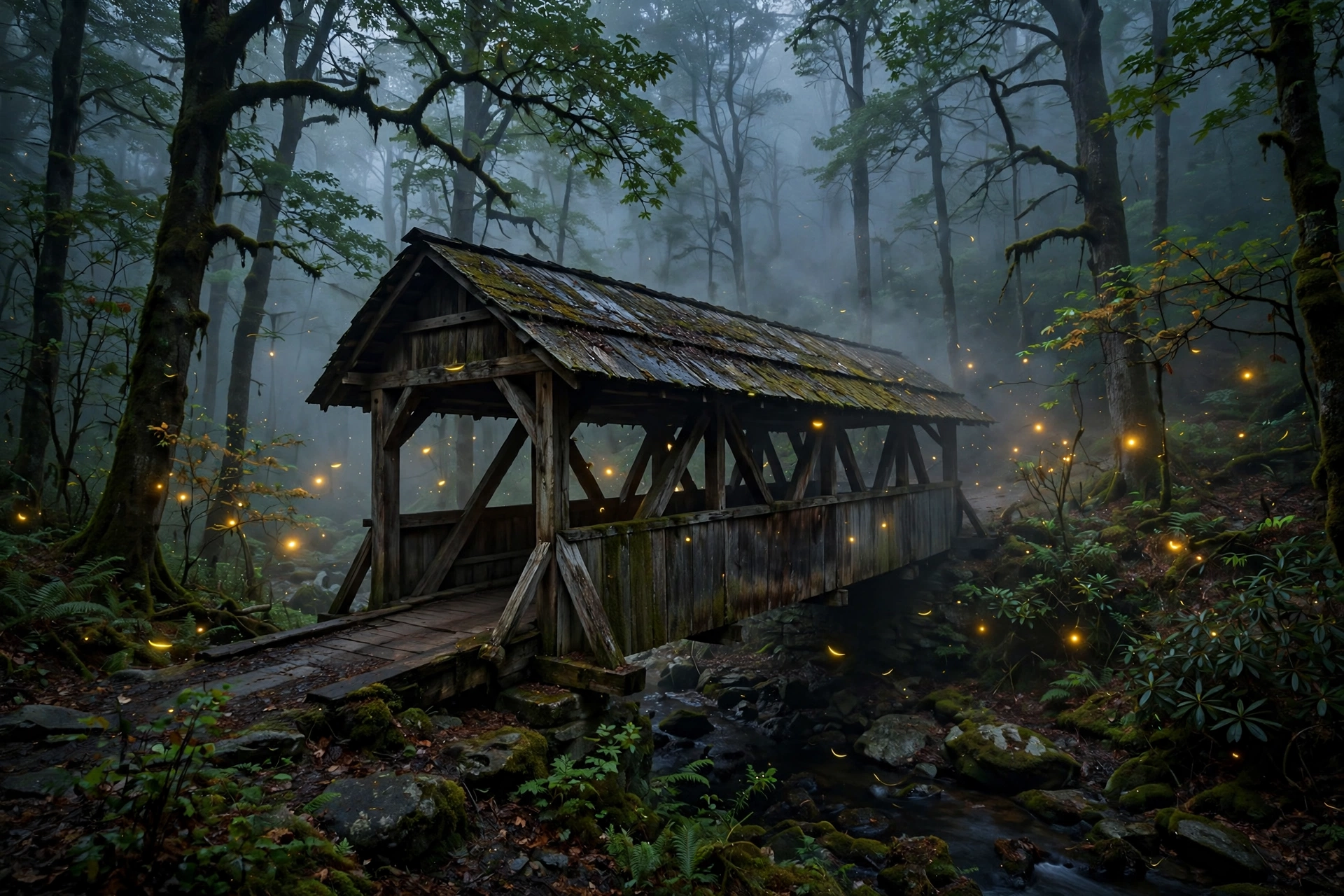
Every country has its legends, but America's are special — they grew up alongside the country itself, in logging camps and frontier cabins, in small towns and on lonely highways. Some of these legends turn out to be true. Some are half-true. And some are pure invention that somehow became more famous than the facts. Here are eight of the greatest American legends, with the real stories behind each one — folklore clearly separated from fact.
Johnny Appleseed: The Legend Was Real
The legend says Johnny Appleseed wandered the frontier in a tin pot hat, scattering apple seeds everywhere he went, a friend to every animal and child. The truth? Almost all of it.
Johnny Appleseed was John Chapman, born September 26, 1774, in Leominster, Massachusetts. He really did spend decades walking the American frontier — through Pennsylvania, Ohio, Indiana, and Illinois — planting apple nurseries. He wasn't randomly scattering seeds; he was a savvy nurseryman who planted orchards, fenced them, left them in the care of neighbors, and returned years later to sell the trees. He owned or leased real land.
He was also genuinely eccentric: he wore simple clothes, went barefoot even in winter, preached his Swedenborgian faith to settlers, and was reportedly kind to animals. He died on March 18, 1845, near Fort Wayne, Indiana. Verdict: the legend is essentially true — one of the rare cases where the man lived up to the myth.
Paul Bunyan: Pure Invention (and Brilliant Marketing)
Paul Bunyan — the giant lumberjack with his blue ox, Babe — feels ancient, like something pioneers told around campfires for a hundred years. In reality, he was largely invented in the 20th century.
Bunyan tales did circulate orally in logging camps in the late 1800s, but the character as you know him was created by an advertising man. William B. Laughead, working for the Red River Lumber Company, wrote a series of promotional pamphlets starting in 1914 that gave Bunyan his famous proportions, his blue ox, and his tall-tale exploits — carving the Grand Canyon by dragging his axe, creating the Great Lakes as Babe's watering holes. The pamphlets were so successful that the "legend" spread nationwide.
There was no real Paul Bunyan. He is folklore's greatest corporate mascot. Verdict: invented — though built from genuine lumberjack storytelling traditions.
John Henry: The Man Against the Machine
The ballad tells of John Henry, a steel-driving man who raced a steam drill to prove human strength could beat the machine — and won, only to die with his hammer in his hand. Was he real?
Probably — at least in part. The legend is tied to the Big Bend Tunnel on the Chesapeake and Ohio Railroad in West Virginia, built in the early 1870s. Historians have found records of an African-American laborer named John Henry working on railroad tunnels in that era, and the details in the oldest versions of the song match the Big Bend Tunnel's construction too closely to be coincidence.
What can't be verified is the famous contest itself. No company record documents a man-versus-machine race, though it's entirely plausible that steel drivers informally competed against early steam drills. The song first appeared in print in the 1870s and became one of America's most enduring folk ballads. Verdict: likely based on a real worker; the race itself is unproven but plausible.
The Bell Witch: America's Most Famous Haunting
In 1817, in Adams, Tennessee, the family of John Bell began experiencing strange phenomena — knocking sounds, chains dragged across floors, an invisible entity that spoke and claimed to be "Kate Batts," a neighbor with a grudge against Bell. The haunting reportedly tormented the family for four years, and legend says it poisoned John Bell, killing him in 1820 — making it the only ghost in American folklore credited with causing a death.
What's documented: the Bell family was real, John Bell really died in 1820, and the story was widely reported in the 19th century, including in an 1894 book by a Bell descendant. What's not documented: any of the supernatural events. Skeptics note that "Kate Batts" was a real neighbor involved in a land dispute with Bell, which gives the legend a plausible human origin — a family feud dressed up as a haunting.
The Bell Witch Cave in Adams is now a tourist attraction. Verdict: real family, real death, unverified haunting — a genuine American ghost legend, whatever its cause.
The Jersey Devil: Three Centuries of Terror
The legend: in 1735, Deborah Leeds of the Pine Barrens in New Jersey gave birth to her thirteenth child and, exhausted, cursed it — whereupon it transformed into a winged, hooved demon and flew up the chimney. Since then, the Jersey Devil has supposedly terrorized South Jersey for nearly 300 years.
The 1735 birth is almost certainly invented, but the legend exploded into something very real in January 1909, when hundreds of people across New Jersey and Pennsylvania reported seeing a winged creature, and mysterious hoofprints appeared in snow across the region. Newspapers ran the story for weeks. Schools closed. Factories shut down. The Philadelphia Zoo reportedly offered a $10,000 reward for its capture.
What did people see? Likely candidates include a sandhill crane far outside its range, or mass hysteria feeding on itself. The Leeds family was real — Daniel Leeds was a prominent early New Jersey settler — and family political and religious feuds may have seeded the original story. Verdict: the 1735 origin is folklore; the 1909 panic was real, whatever caused it.
Mothman: The Omen of Point Pleasant
On the night of November 15, 1966, two young couples near Point Pleasant, West Virginia, reported being chased by a tall, winged creature with glowing red eyes. Over the next thirteen months, dozens of similar sightings followed. Then, on December 15, 1967, the Silver Bridge connecting Point Pleasant to Ohio collapsed during rush hour, killing 46 people.
The legend says Mothman was a harbinger — appearing to warn of the disaster. The bridge collapse is an undisputed historical fact, and the 1966–67 sightings were genuinely reported by named witnesses to police and newspapers. What the witnesses actually saw is unknown; theories range from a large sandhill crane or barred owl to misidentified aircraft.
Writer John Keel's 1975 book The Mothman Prophecies turned the local reports into a national legend, later a 2002 film. Point Pleasant now hosts an annual Mothman Festival every September, drawing thousands of visitors to a town that embraced its monster. Verdict: real sightings, real tragedy — the connection between them is legend.
The Lost Colony of Roanoke: History's Greatest Vanishing
This one isn't folklore at all — it's a genuine historical mystery. In 1587, 115 English colonists settled on Roanoke Island, off what is now North Carolina, led by John White. When supplies ran low, White sailed back to England for help. War with Spain delayed his return for three years.
When White finally came back in 1590, the colony was gone. Every man, woman, and child had vanished. The houses were dismantled, not destroyed. The only clue: the word "CROATOAN" carved into a fence post — the name of a nearby island and its Native tribe.
What happened? The leading theories: the colonists moved to Croatoan Island and assimilated with the local tribe; they were killed by hostile tribes; or they tried to sail home and were lost at sea. Modern archaeology has found tantalizing hints — including a 2012 discovery of a hidden fort symbol on one of White's own maps — but no definitive answer. It remains the oldest unsolved mystery in American history. Verdict: completely real, completely unsolved.
Skinwalker Ranch: The Modern Legend
In 1994, the Sherman family bought a 512-acre ranch in Utah's Uintah Basin and reported a barrage of bizarre events: cattle mutilations, strange lights, unidentified creatures — including, they claimed, a wolf-like animal that shrugged off multiple rifle shots. They said the property sat on a "path of the skinwalker," referencing Navajo legend.
In 1996, billionaire Robert Bigelow bought the ranch and installed a scientific team through his National Institute for Discovery Science. The team reported its own share of strange observations over nearly a decade. The ranch has since changed hands again, and a television show now documents ongoing investigations there.
Skeptics note that extraordinary claims need extraordinary evidence, and none has been produced that survives scrutiny. Believers counter that multiple credentialed observers reported anomalies. The Navajo skinwalker legend itself is genuine Indigenous folklore — a harmful witch figure — though its connection to this particular ranch is the modern invention. Verdict: real property, real reports, unproven phenomena — a legend being written in real time.
Why These Legends Endure
Look closely and you'll see a pattern. The legends that last are the ones with a grain of truth: a real nurseryman, a real vanished colony, a real bridge collapse, real reported sightings. Americans have always been storytellers, and the frontier gave those stories room to grow — each retelling adding a layer until the tale became bigger than the truth.
But here's the thing worth remembering: the fact that some of these legends turned out to be real should make you think twice about dismissing the rest. Roanoke proves that sometimes the mystery is the history.