
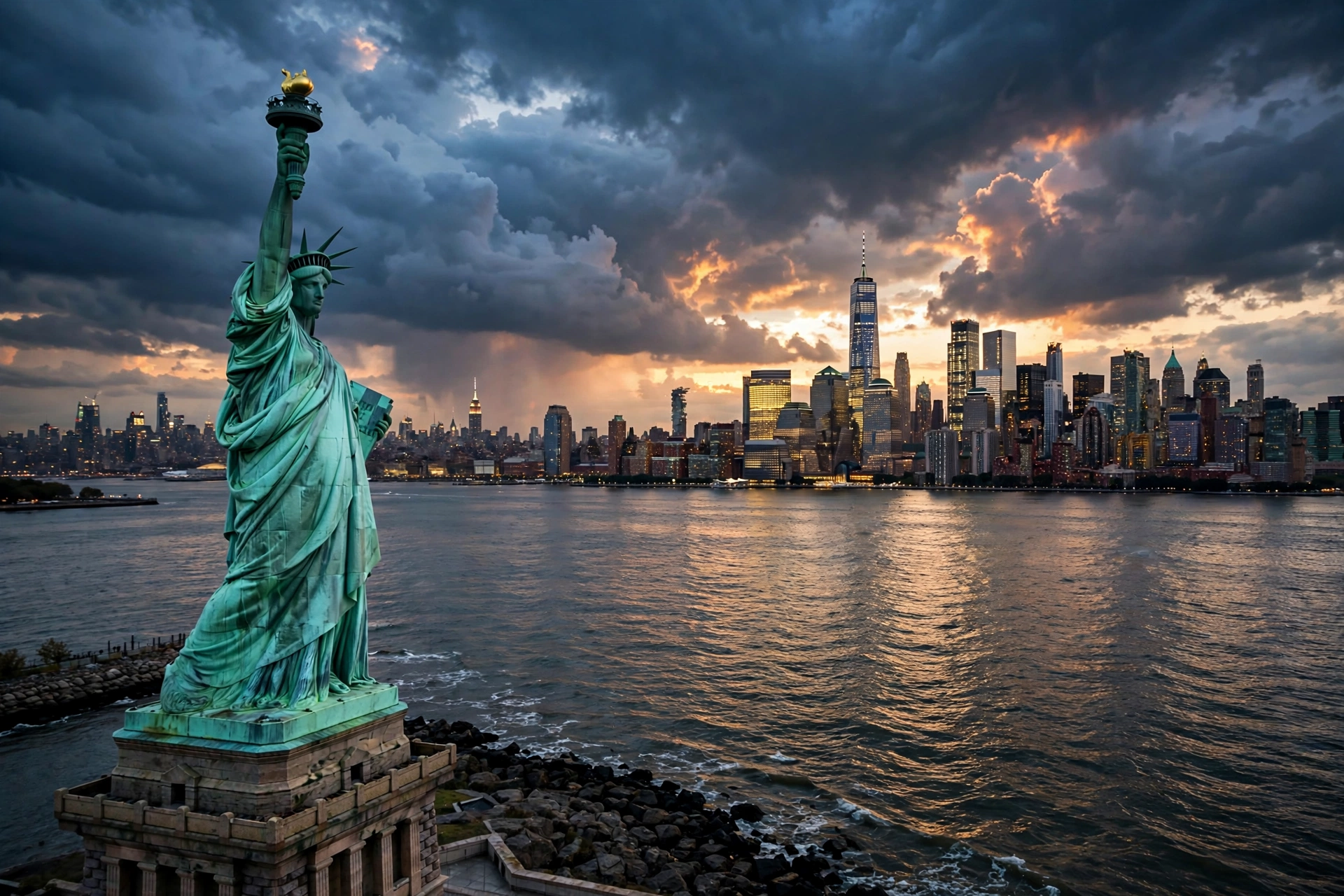
The United States did not become a superpower overnight. Two and a half centuries ago it was a loose collection of thirteen colonies on the edge of the known world, dependent on European trade and European protection — a young nation that most European capitals barely took seriously. Its population was smaller than London's. Its army was tiny. Its navy barely existed.
Today it holds the world's largest economy, the most powerful military ever assembled, and a cultural footprint that reaches into nearly every home on the planet. American movies dominate global box offices, the dollar underpins world trade, and American universities attract students from every continent. No other country in history has combined economic, military, technological, and cultural leadership so completely — and held it for so long.
How did that happen? History rarely turns on a single moment. America's rise was built on a series of turning points — decisions, accidents, and transformations that stacked on top of each other until the country stood alone at the top. Each one mattered on its own. Together, they were unstoppable. Here are ten of the moments that mattered most.
1. The Transcontinental Railroad Connects a Continent (1869)
When the golden spike was driven at Promontory Summit, Utah, in May 1869, the Atlantic and Pacific coasts of America were joined by rail for the first time. A journey that had taken months by wagon or by ship around South America now took days.
The railroad did more than move people. It stitched a continental economy together — moving coal, timber, cattle, and grain from the interior to the coasts and the world. Towns sprang up along the tracks. Markets that had been isolated became national. It was the first great infrastructure project of the American age, and it taught the country a lesson it would repeat: whoever connects the continent controls its future.
2. America Becomes the World's Workshop (Late 1800s)
In the decades after the Civil War, the United States industrialized at a speed the world had never seen. Steel mills rose in Pittsburgh, oil refineries in Pennsylvania and Texas, automobile factories in Detroit. By the turn of the twentieth century, the United States had surpassed Britain as the world's leading industrial nation and its largest economy.
This was the economic engine everything else was built on. Industrial might meant jobs, wealth, and — crucially — the capacity to produce at a scale no other country could match. American factories didn't just make more; they made things cheaper through mass production, a method Henry Ford's assembly lines would perfect. When the world went to war twice in the next fifty years, that capacity would prove decisive.
3. Winning World War II (1945)
World War II was the forge of American superpower status. While Europe and Asia lay in ruins, American factories had been humming around the clock — building ships, planes, tanks, and trucks in quantities that stunned even its allies. By the war's end, the United States accounted for roughly half of the entire world's manufacturing output.
The war also gave America the atomic bomb, the world's largest navy, and bases scattered across the globe. But the deeper victory was economic: the war ended the Great Depression for good and left the United States as the only major power whose homeland was untouched. From 1945 on, every other nation was rebuilding. America was already built.
4. The Dollar Becomes the World's Money (1944)
A year before the war ended, delegates from 44 nations met at Bretton Woods, New Hampshire, and made the US dollar the anchor of the global financial system. Other currencies would be pegged to the dollar; the dollar would be convertible to gold.
This was a quiet revolution. It meant that the world's trade would flow through American currency, that central banks would hold dollars as reserves, and that the United States could borrow more cheaply than anyone else — a privilege economists later called America's "exorbitant privilege." Even after the gold standard ended in 1971, the dollar's dominance stuck — and it remains the world's reserve currency today, one of the deepest sources of American power.
5. The Interstate Highway System (1956)
President Dwight D. Eisenhower signed the Federal-Aid Highway Act in 1956, launching the largest public works project in American history: a planned 41,000 miles of high-speed highways crisscrossing the nation.
The interstate system reshaped American life — suburbs, trucking, road trips, fast food on every exit. But it was also a strategic asset. Eisenhower, who had seen Germany's autobahns during the war, wanted highways that could move troops and supplies in an emergency. The result was a logistics network that made the American economy the most internally connected on earth, and a template for car-centered prosperity the whole world would copy.
6. The GI Bill Builds a Middle Class (1944)
The Servicemen's Readjustment Act of 1944 — the GI Bill — offered returning veterans low-cost mortgages, business loans, and, most importantly, paid college tuition. Millions of Americans who could never have afforded higher education earned degrees.
The effect was transformative. It created the modern American middle class, seeded the suburbs, and turned the United States into the best-educated large workforce in the world. Universities swelled with students, and the research coming out of those universities — funded increasingly by the federal government — would drive American science for generations.
7. Winning the Space Race (1969)
When Neil Armstrong stepped onto the moon in July 1969, it was more than a scientific achievement. The space race against the Soviet Union had been a contest of systems — and the moon landing was America's answer.
The Apollo program employed hundreds of thousands of people and spun off technologies that quietly rebuilt the modern world: advances in computing, materials science, telecommunications, and medicine. But its greatest product was psychological. It convinced the world — and Americans themselves — that there was nothing the country could not do if it decided to do it.
8. Winning the Cold War (1991)
For nearly half a century, the world was divided between two superpowers. When the Soviet Union dissolved in 1991, the United States stood alone — the world's sole superpower, in a moment historians called the "unipolar moment."
America's victory came not from a single battle but from the cumulative weight of everything on this list: a larger, more innovative economy; alliances across Europe and Asia; technological superiority; and a cultural appeal that made American music, movies, and ideas irresistible worldwide. People on the other side of the Iron Curtain wore American jeans and listened to American rock — soft power that no missile could match. The Cold War ended without a direct war between the superpowers — itself a remarkable fact.
9. The Tech Boom and the Internet Age (1990s–2000s)
The personal computer, the internet, the smartphone — the defining technologies of modern life were largely invented, commercialized, or scaled in the United States, many of them in California's Silicon Valley.
This gave America a second industrial revolution, this time in bits instead of steel. American companies came to dominate software, search, social media, and e-commerce, generating enormous wealth and giving the US an outsized voice in how the digital world is governed. If the twentieth century was won with factories, the twenty-first is being contested with code — and America started with the lead.
10. Immigration: The Engine That Never Stops
Every turning point on this list was powered, in part, by immigrants. German engineers, Irish laborers, Chinese railroad workers, Jewish scientists fleeing Europe, Indian and Chinese tech founders, Latin American workers — wave after wave of newcomers brought skills, ambition, and hunger.
The United States is one of the few great powers in history built substantially by people who chose to come there. That constant renewal — new talent, new ideas, new energy arriving every year — is arguably America's most durable advantage. Empires age; America keeps getting reinvented.
What These Ten Moments Have in Common
Look at the list again and a pattern emerges. Nearly every turning point was about connection or capacity: the railroad connected markets, industrialization built productive capacity, the highways connected cities, the GI Bill built human capacity, the internet connected the world. American power has always grown by making things flow — people, goods, money, ideas — faster and at greater scale than anyone else.
The other pattern is that American power compounds. The railroad made industrialization possible; industrialization made the WWII arsenal possible; the war's end made the dollar's dominance possible; prosperity funded the universities that produced the tech boom. Each layer didn't replace the last — it stacked on top. That is why American power has proven so durable: it isn't one advantage, it's a dozen advantages reinforcing each other.
And that brings us back to immigration, the quiet engine behind all of it. Every era of American ascent was powered by newcomers who arrived with nothing and built something — from the railroad crews of the 1860s to the startup founders of today. As long as the country keeps attracting the ambitious and the restless, the compounding continues.