
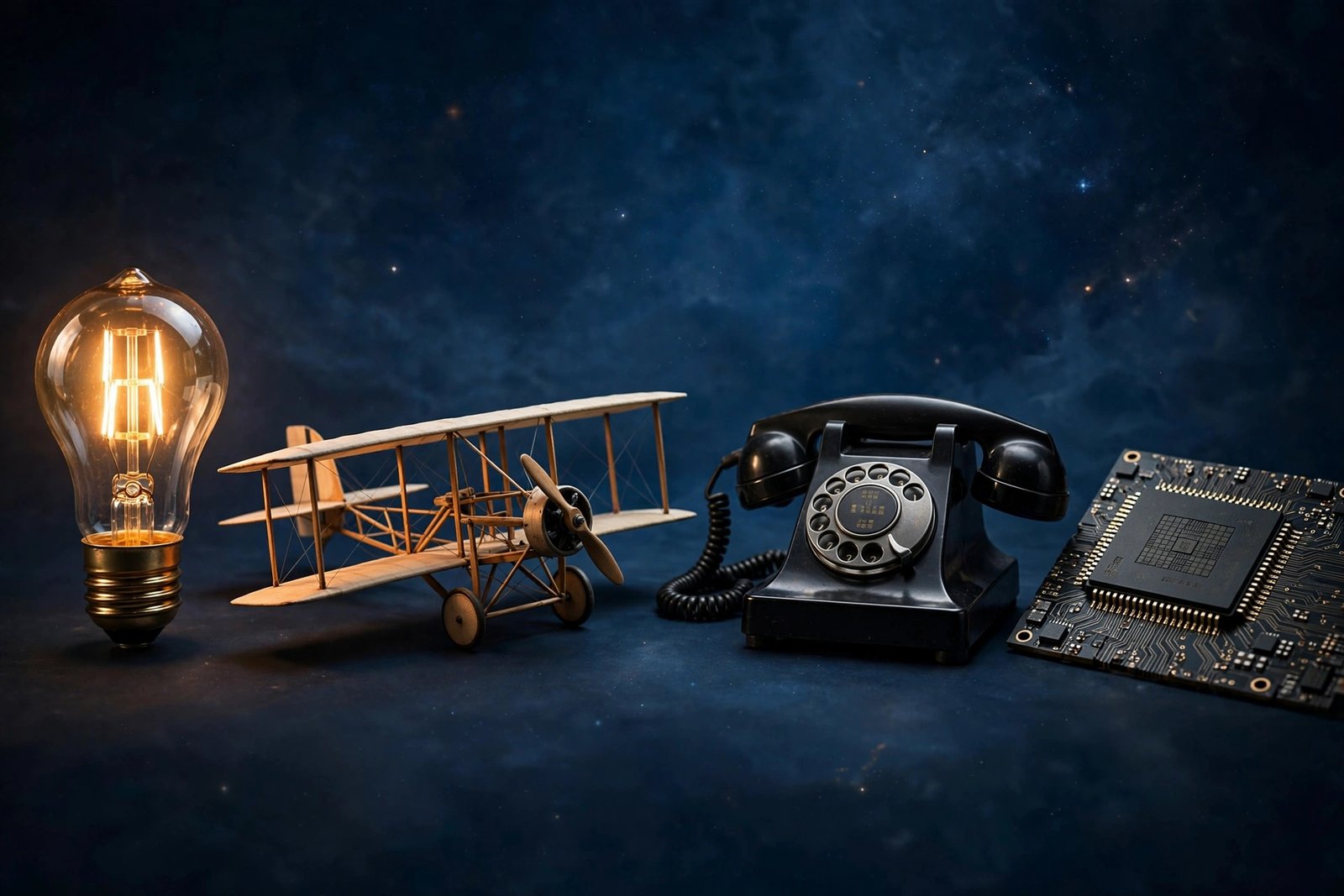
When the sun goes down and the lights come on in every city on Earth, you are looking at one of the great american inventions that changed the world. The United States has produced an astonishing share of the breakthroughs that define modern life — from the glow of the light bulb to the phone in your pocket. What makes the American story of invention special is not just individual genius, but a system that rewarded tinkerers, funded big laboratories, and turned wild ideas into products the whole planet could use.
In this article, we count down ten breakthroughs born in America that reshaped how humanity lives, works, and connects. Each one carries a real, documented story — and where credit is shared with inventors abroad, we say so honestly.
Why These American Inventions That Changed the World Matter
Before diving in, it helps to understand why so many world-changing ideas came from one country. The United States combined vast natural resources, a huge domestic market, strong patent protection, and elite research institutions like Bell Labs. Immigrants and homegrown inventors alike found funding, factories, and customers. The result: american inventions that changed the world did not just appear in laboratories — they were manufactured, marketed, and shipped across the globe at a speed no other nation could match in the 20th century.
The Practical Light Bulb — Thomas Edison, Menlo Park, 1879
Thomas Edison did not invent the very first electric bulb — British inventor Joseph Swan and others demonstrated glowing filaments before him. What Edison and his team at Menlo Park, New Jersey, achieved in 1879 was the first practical incandescent lamp: affordable, long-lasting, and safe enough for homes. Their carbon-filament bulb burned for over 13 hours, and later bamboo filaments lasted more than 1,000 hours.
Just as important, Edison built the entire system around it — generators, wiring, meters, and the Pearl Street power station in New York, which lit up lower Manhattan in 1882. Night turned into usable time. Factories could run around the clock, cities became safer after dark, and entirely new industries — from cinema to nightlife — became possible. Few american inventions that changed the world can match the light bulb for sheer everyday impact.
The Airplane — The Wright Brothers, Kitty Hawk, 1903
On December 17, 1903, on the windy dunes of Kitty Hawk, North Carolina, Orville Wright lifted off in the Wright Flyer and stayed airborne for 12 seconds, covering 120 feet. It was the first sustained, controlled, powered heavier-than-air flight in history. Others had glided and others would soon fly — including Alberto Santos-Dumont in France — but the Wright brothers solved the three riddles of flight together: lift, power, and three-axis control.
Their wing-warping control system was the true breakthrough, and it became the basis of all modern aircraft steering. Within decades, airplanes shrank the planet: mail, passengers, and freight began crossing oceans in hours instead of weeks. Aviation made global business, mass tourism, and rapid disaster relief possible — and it set the stage for the Space Age itself.
The Telephone — Alexander Graham Bell, Boston, 1876
On March 7, 1876, the U.S. Patent Office granted Alexander Graham Bell patent number 174,465 for “an apparatus for transmitting vocal or other sounds telegraphically.” Three days later, Bell reportedly summoned his assistant with the famous first words: “Mr. Watson — come here — I want to see you.” Bell was a Scottish-born immigrant working in Boston, and his patent victory was controversial — fellow inventor Elisha Gray filed a similar patent claim on the very same day, sparking one of history’s great invention disputes.
Regardless of the controversy, it was American industry that turned the telephone into a world-changing network. Bell’s company wired cities, then the nation, then undersea cables linked continents. Real-time voice communication transformed business, journalism, and emergency response, and the telephone network became the foundation on which the internet itself would later be built.
The Transistor — Bell Labs, New Jersey, 1947
In December 1947, physicists John Bardeen, Walter Brattain, and William Shockley at Bell Telephone Laboratories in Murray Hill, New Jersey, demonstrated the first working transistor — a tiny semiconductor device that could amplify electrical signals. It won them the 1956 Nobel Prize in Physics and quietly launched the digital age.
Before the transistor, electronics depended on bulky, hot, fragile vacuum tubes. Transistors were smaller, cheaper, nearly indestructible, and sipped power. They made possible the hearing aid, the pocket radio, and eventually the integrated circuit — the microchip. Every computer, smartphone, and satellite in existence descends from that 1947 breakthrough. Without the transistor, the modern world simply does not exist.
The Internet — ARPANET, U.S. Department of Defense, 1969
The internet was born as ARPANET, a project of the U.S. Department of Defense’s Advanced Research Projects Agency. On October 29, 1969, the first message was sent between computers at UCLA and Stanford — the system crashed after two letters (“LO” of “LOGIN”), but the network worked. American researchers Vint Cerf and Bob Kahn later developed TCP/IP, the communication protocols that let networks interconnect.
An honest note: the World Wide Web — the system of web pages and links most people mean by “the internet” — was invented by British scientist Tim Berners-Lee at CERN in Switzerland in 1990. But the underlying network, the protocols, and the first killer applications (email, search, e-commerce) were overwhelmingly American creations. The internet rewired commerce, knowledge, and human relationships on a planetary scale.
The Personal Computer — Altair 8800, Apple II, IBM PC, 1975–1981
Computing belonged to giant corporations and universities until American hobbyists and entrepreneurs dragged it onto the desktop. The MITS Altair 8800 kit, sold from Albuquerque, New Mexico in 1975, ignited the home-computer revolution. Apple Computer’s Apple II (1977) made personal computing friendly and colorful, and IBM’s PC (1981) — running Microsoft’s MS-DOS — made it a business standard.
Each step was American: the garage startups of California, the software written in Seattle and Redmond, the open architecture that let a thousand clone-makers bloom. The personal computer put a universe of tools — word processing, spreadsheets, games, and eventually the web — on every desk. It democratized computing power that once belonged only to governments and giant firms.
GPS — U.S. Military Navstar Program, 1978–1995
The Global Positioning System began as Navstar, a U.S. Department of Defense project. The first satellite launched in 1978, and the full constellation of 24 satellites was complete by the mid-1990s. After Korean Air Lines Flight 007 was shot down in 1983, President Ronald Reagan opened the system to civilian use; in 2000, President Bill Clinton removed the deliberate signal degradation, giving civilians full accuracy.
Today GPS guides airplanes, ships, ambulances, and farm tractors. It underpins ride-sharing, food delivery, and every “blue dot” map on every smartphone. Entire industries — logistics, precision agriculture, emergency response — run on this free American utility beamed from orbit. It may be the most generous gift the U.S. military ever gave the civilian world.
Air Conditioning — Willis Carrier, Brooklyn, 1902
In 1902, a 25-year-old engineer named Willis Carrier designed the first modern electrical air-conditioning system — not for comfort, but to control humidity in a Brooklyn printing plant whose paper kept wrinkling. Carrier’s “Apparatus for Treating Air” could precisely control temperature and humidity, and he founded the Carrier Corporation to sell it.
The consequences were enormous. Air conditioning made the American Sun Belt — from Phoenix to Miami to Houston — livable year-round, triggering one of the great internal migrations in U.S. history. It enabled skyscrapers with sealed glass walls, protected medicines and electronics, and made modern data centers possible. Entire cities, industries, and ways of life exist because one engineer hated muggy paper.
The Moving Assembly Line — Henry Ford, Highland Park, 1913
Ransom Olds used a stationary assembly line to build his Curved Dash Oldsmobile as early as 1901 — so Ford did not invent the concept. But in 1913, Henry Ford’s engineers at Highland Park, Michigan, perfected the moving assembly line, where the car chassis traveled past stationary workers. Assembly time for a Model T collapsed from about 12 hours to roughly 93 minutes.
The moving line made cars affordable to ordinary workers — especially after Ford’s famous $5-a-day wage in 1914 — putting America on wheels. More broadly, it invented mass production itself: standardized parts, continuous flow, and relentless efficiency. The techniques spread to every industry on Earth, from electronics to fast food, creating the modern consumer economy.
Email — Ray Tomlinson, BBN, 1971
In 1971, American engineer Ray Tomlinson, working on ARPANET for the firm Bolt, Beranek and Newman, sent the first network email and chose the “@” symbol to separate the user’s name from the host computer — simply because it was an underused key that made sense as “at.” The first test message was forgettable (Tomlinson later joked it was something like “QWERTYUIOP”), but the idea was revolutionary.
Email became ARPANET’s killer app and then the world’s. It gave humanity instant, nearly free written communication across any distance, flattening hierarchies inside companies and letting anyone reach anyone. Decades before social media or instant messaging, email proved that the internet’s greatest power was connecting people — a principle every later platform inherited.
The Legacy of American Inventions That Changed the World
Look at the pattern across these ten breakthroughs. Again and again, american inventions that changed the world followed the same arc: a brilliant insight, then the laboratories, factories, and markets that scaled it to the planet. Edison did not just make a bulb — he built the grid. The Wrights did not just fly — they founded an industry. Cerf and Kahn did not just network two computers — their protocols networked billions.
That system of invention — universities, corporate labs, startups, and patent law — remains America’s quiet superpower. If you want the bigger story of how the nation built this engine of innovation, explore our guide to how America became a superpower. And for more astonishing truths about the country behind these breakthroughs, browse our collection of mind-blowing facts about the USA — several of them involve the very inventors you just met.
The next world-changing idea is probably being sketched on a napkin somewhere in America right now. Given this track record, betting on American ingenuity has historically been a very good wager. Which of these ten inventions do you think changed your own life the most? Share this article with a fellow history lover, and keep exploring the stories behind the modern world with us.