
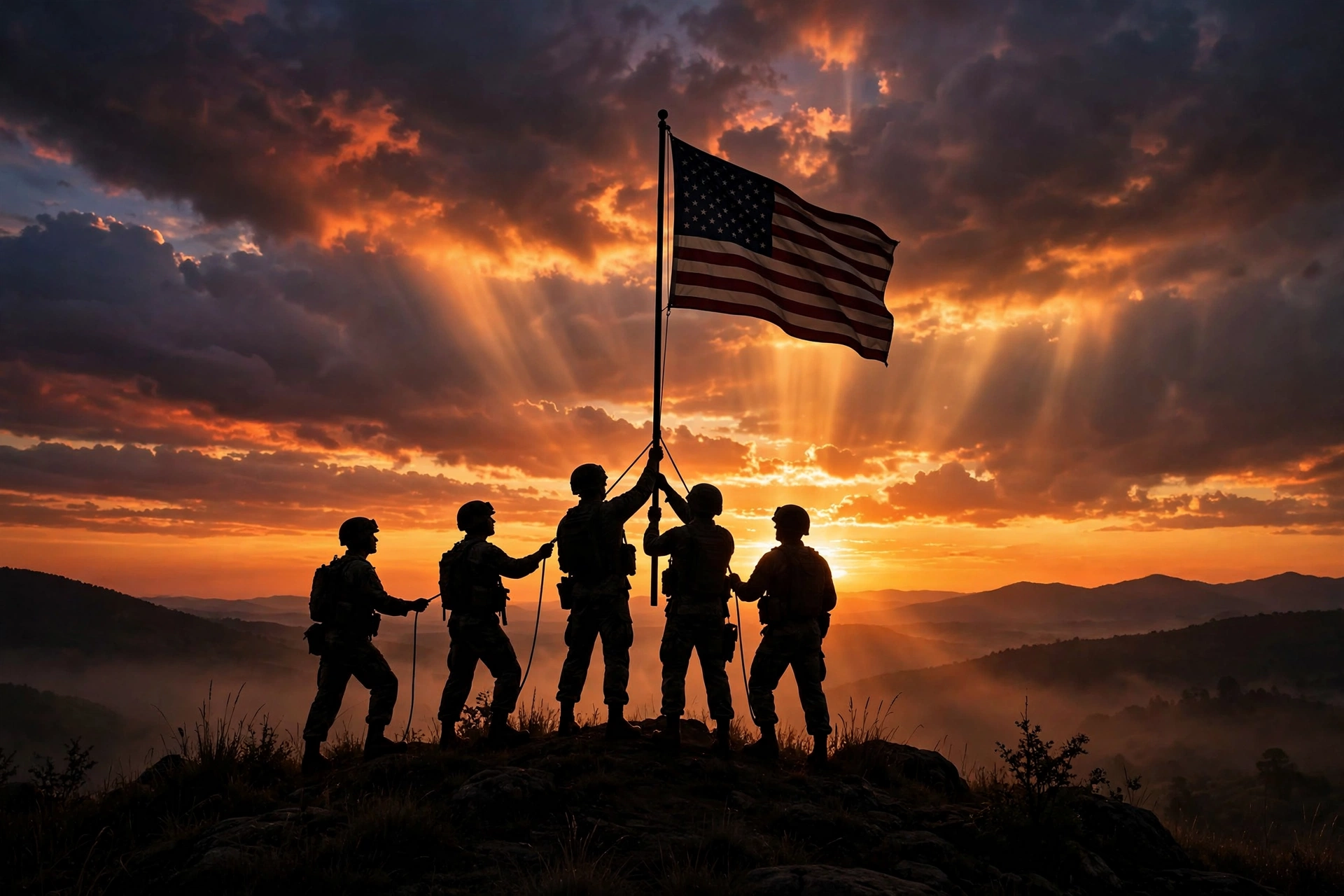
Some stories sound like Hollywood scripts. The difference with these seven is that every one of them is a matter of public record — documented in Medal of Honor citations, Army after-action reports, and eyewitness testimony. These are American service members who did things so extraordinary that, as President Ronald Reagan once said about one of them, if this were a movie, you wouldn't believe it.
The Teenager Who Held Off an Army: Audie Murphy
Audie Murphy was nineteen years old on January 26, 1945, a second lieutenant in Company B, 15th Infantry Regiment, near Holtzwihr, France. His company was ordered to withdraw under a German armored counterattack. Murphy refused to leave his wounded men behind.
He ordered his men back, took up a position at his command post, and directed artillery fire by telephone — at one point calling strikes down on his own position. When one of the company's tank destroyers took a direct hit and caught fire, Murphy climbed onto the burning vehicle and manned its .50-caliber machine gun. The vehicle could have exploded at any moment. He held that position for an hour, mowing down German infantry attacking from three sides. When his ammunition ran out, he made his way back to his company, refused medical attention for a leg wound, and organized a counterattack that forced the remaining enemy troops to withdraw.
His Medal of Honor citation states that he single-handedly held off the enemy attack and killed about fifty German soldiers. Murphy went on to become the most decorated American combat soldier of World War II, receiving 33 U.S. military decorations. He later played himself in the 1955 film of his memoir, To Hell and Back.
The Medic Who Wouldn't Carry a Gun: Desmond Doss
Desmond Doss was a Seventh-day Adventist from Virginia whose faith forbade him from carrying a weapon. He enlisted anyway — as a combat medic. His fellow soldiers mocked him. Officers tried to discharge him. He held his ground, and the Army let him serve unarmed.
At Okinawa in May 1945, on the Maeda Escarpment — the sheer cliff American troops called Hacksaw Ridge — Doss's unit was cut to pieces by Japanese artillery, mortars, and machine guns. When the order came to fall back, Doss stayed. Alone and unarmed, he moved through the kill zone again and again, treating the wounded and carrying them one by one to the edge of the escarpment, where he lowered each man down on a rope-supported litter. By the Army's official accounting, he rescued approximately 75 men.
On October 12, 1945, President Harry Truman presented him with the Medal of Honor — the first ever awarded to a conscientious objector. Doss simply said he wanted to save lives, and that was what he did.
The Farm Boy Who Captured 132 Men: Alvin York
Alvin York was a backwoods marksman from Tennessee who had once opposed war on religious grounds. Drafted into the Army in 1917, he wrestled with his conscience and finally decided that fighting to stop a greater evil was justified. On October 8, 1918, during the Meuse-Argonne Offensive, his patrol walked into a German machine-gun nest that killed or wounded most of the squad.
York, a corporal at the time, was left nearly alone against more than a hundred enemy soldiers. Using the sharpshooting skills he'd learned hunting in the Tennessee hills, he picked off machine gunners one by one, then worked his way behind the German lines. When a group of Germans charged him with bayonets, he drew his pistol and dropped them. Then he began taking prisoners — and more prisoners, until the count reached 132 German soldiers captured, along with 35 machine guns. He marched them all back through American lines.
General John J. Pershing called his feat the greatest single achievement by any soldier in the entire war. York received the Medal of Honor and returned home to Tennessee, where he spent the rest of his life building schools and helping his community.
The Man Who Refused to Die: Roy Benavidez
On May 2, 1968, Master Sergeant Roy Benavidez was at a forward operating base near Loc Ninh, Vietnam, when he heard a radio call: a twelve-man Special Forces reconnaissance team was surrounded by a North Vietnamese battalion and being torn apart. Three rescue helicopters had already tried to reach them and been driven off.
Benavidez was not ordered to go. He volunteered anyway. Armed with only a knife and a medical bag, he boarded a returning helicopter, and when it couldn't land, he jumped from the hovering aircraft and ran roughly 75 yards through open ground under direct enemy fire. He was shot in the leg before he even reached the team.
What followed was six hours of continuous combat. Benavidez organized the defense, treated the wounded, distributed ammunition, called in air support, and personally carried and dragged men to the extraction helicopters. He was wounded again and again — shot, hit by shrapnel, and stabbed by a bayonet in close combat. When an enemy soldier attacked him hand-to-hand, Benavidez killed him with his knife. By the end, he had sustained 37 separate wounds. His Medal of Honor citation credits him with saving the lives of at least eight men.
When the battle ended, medics thought he was dead. As a doctor reached to zip up the body bag, Benavidez — unable to speak or open his eyes — spat to show he was alive. President Reagan presented him with the Medal of Honor in 1981 and said the story sounded like a movie script. Benavidez lived until 1998.
The Senator Who Threw a Grenade With One Good Arm: Daniel Inouye
Daniel Inouye was a second lieutenant in the 442nd Regimental Combat Team — the segregated Japanese-American unit that became the most decorated unit in U.S. military history for its size and length of service. On April 21, 1945, near San Terenzo, Italy, Inouye led his platoon against a ridge guarded by three German machine-gun nests.
Shot in the stomach as he stood to attack, Inouye kept moving. He crawled to within five yards of the first machine gun and destroyed it with grenades, then stood up and neutralized the second with his Thompson submachine gun. As he raised his arm to throw a grenade at the third position, a German rifle grenade struck his right elbow, nearly severing his arm. His own primed grenade was clenched in the ruined hand. Inouye pried the live grenade free with his left hand, transferred it, and threw it into the bunker, destroying the third gun. He continued to direct his platoon until the ridge was taken. His right arm was later amputated.
He was first awarded the Distinguished Service Cross. In 2000, after a review found that Asian-American soldiers had been denied proper recognition because of their race, President Bill Clinton upgraded it to the Medal of Honor. Inouye went on to become Hawaii's first member of Congress and served in the U.S. Senate for nearly fifty years.
The Harlem Hellfighter Who Fought With a Bolo Knife: Henry Johnson
In the early hours of May 15, 1918, Private Henry Johnson of the 369th Infantry Regiment — the African-American unit known as the Harlem Hellfighters — was on sentry duty in the Argonne Forest with Private Needham Roberts. A German raiding party of at least a dozen men attacked their outpost, hoping to capture prisoners.
Roberts was wounded and knocked unconscious. Johnson fought on alone. He fired his rifle until it jammed, then used it as a club until it broke apart. Then he drew his bolo knife and fought the Germans hand to hand, killing several and driving the rest off. He sustained 21 wounds. When relief arrived, Johnson refused to leave until Roberts was carried to safety.
France recognized him immediately, awarding him the Croix de Guerre with Gold Palm — one of the first Americans to receive it. His own country took nearly a century: Johnson was posthumously awarded the Medal of Honor in 2015, presented to his family by President Barack Obama.
The Woman Who Led the Counterattack: Leigh Ann Hester
On March 20, 2005, in Iraq, Sergeant Leigh Ann Hester's supply convoy was ambushed by insurgents with machine guns, mortars, and rocket-propelled grenades. Hester was a team leader in the Kentucky Army National Guard's 617th Military Police Company.
When the ambush began, Hester didn't take cover and wait — she led her squad forward through the kill zone, flanking the attackers. She and her squad leader assaulted a trench line with grenades and rifle fire, clearing it room by room. Hester personally killed at least three insurgents. Her actions broke the ambush and saved the convoy.
For this, she received the Silver Star — the first woman to earn the medal for direct combat action since World War II, and at the time the highest combat decoration awarded to a woman in the Iraq and Afghanistan wars.
What These Stories Have in Common
None of these seven people set out to become legends. Murphy was a poor Texas farm boy who enlisted at seventeen. Doss was a medic who refused to touch a gun. York was a reluctant draftee. Benavidez was a staff sergeant who heard men dying on the radio and couldn't sit still. Inouye fought for a country that had put his fellow Japanese Americans in internment camps. Johnson fought for a country that wouldn't honor him for nearly a hundred years. Hester was driving a supply truck.
What they shared was simpler than heroism: when the moment came, they moved toward the danger instead of away from it. Every detail above comes from official citations and Army records. No embellishment is needed — the truth is already hard to believe.