
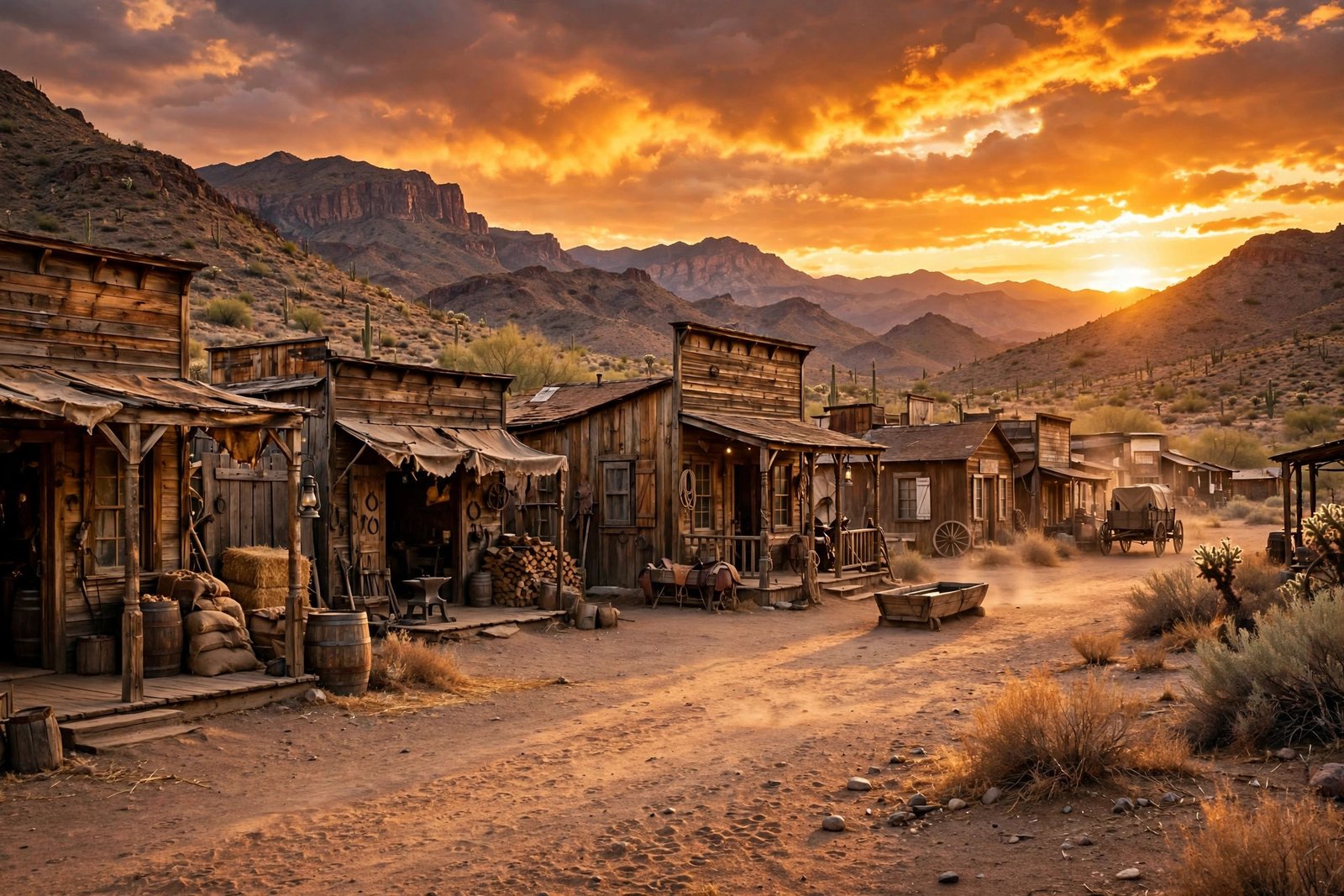
When you picture the Wild West, you probably see dusty main streets, high-noon showdowns, and outlaws galloping toward the horizon. Hollywood has spent a century turning the American frontier into myth — but the real wild west true stories are often stranger and more dramatic than anything on screen. Between the California Gold Rush of 1849 and the closing of the frontier around 1890, the West was a raw, dangerous, fast-changing place where fortunes were made and lost in a single season. The ten stories below all really happened, drawn from court records, newspapers, and historians’ accounts. Some are famous gunfights, others are tales of endurance and ambition — and every one of them is true. So holster your skepticism and ride along — history doesn’t get wilder than this. From the thirty-second shootout at the O.K. Corral to a mail service that lasted barely eighteen months, these wild west true stories show the frontier as it really was: brutal, bold, and utterly unforgettable.
Wild West True Stories: Gunfighters and Outlaws
1. The Gunfight at the O.K. Corral (1881)
On October 26, 1881, in the silver-mining boomtown of Tombstone, Arizona, one of the most famous shootouts in American history exploded in a vacant lot near the O.K. Corral. On one side stood lawmen Virgil and Wyatt Earp, joined by their brother Morgan and the tubercular dentist-turned-gambler Doc Holliday. Facing them were Billy Clanton and Frank and Tom McLaury, cowboys accused of breaking the town’s firearms ordinance. The fight lasted about thirty seconds. When the gun smoke cleared, three cowboys lay dead and Virgil and Morgan Earp and Holliday were wounded. Historians still debate who fired first, and the Earps faced murder charges but were cleared by a judge. Wyatt Earp lived until 1929, long enough to see his legend grow in early Hollywood films. The shootout has been dramatized in dozens of films, making it the most reenacted gunfight of the Old West.
2. Jesse James, America’s Most Notorious Outlaw
Jesse James began as a Confederate guerrilla fighter during the Civil War and became America’s most notorious outlaw afterward. Alongside his brother Frank and the Younger brothers, his gang robbed banks, stagecoaches, and trains across the Midwest from 1866 onward, killing several people. Newspapers turned him into a Robin Hood figure, though historians note he stole mostly for himself. The gang’s luck ran out in 1876 during a disastrous raid on Northfield, Minnesota, where townspeople fought back and most of the gang was killed or captured. Jesse kept robbing with a new gang until April 3, 1882, when member Robert Ford shot him in the back of the head at his home in St. Joseph, Missouri, to collect the reward. Ford was branded a coward in song and story, while Jesse became an immortal folk legend.
3. Billy the Kid and the Lincoln County War
Henry McCarty, better known as Billy the Kid, became the most famous outlaw of the New Mexico frontier before his twenty-second birthday. He rose to notoriety during the Lincoln County War, a violent feud between rival business factions, where he rode with one side as a gunman. In April 1881 he made a legendary escape from the Lincoln County jail, killing two deputies in the process. Sheriff Pat Garrett tracked him for months and finally shot him dead on the night of July 14, 1881, at Fort Sumner. Newspapers claimed Billy had killed 21 men — one for each year of his life — but historians believe the real number was closer to four to nine. The truth hardly mattered: the Kid became an eternal symbol of youthful rebellion in the American imagination.
4. Butch Cassidy and the Sundance Kid
Robert LeRoy Parker, alias Butch Cassidy, led the Wild Bunch, the last great outlaw gang of the Old West. With Harry Longabaugh — the Sundance Kid — and their crew, he robbed banks and trains across the Rockies in the 1890s, eluding posses with careful planning and famously fast horses. As railroads hired the relentless Pinkerton detectives and posses grew larger, the gang’s luck faded. In 1901, Butch, Sundance, and Sundance’s companion Etta Place fled to South America, hoping to start over. They robbed payrolls in Argentina and Bolivia until, most historians believe, they died in a 1908 shootout with Bolivian soldiers. A few romantics insist they survived and returned home — but no proof has ever surfaced. Their story inspired one of Hollywood’s most beloved Westerns, cementing their fame far beyond their crimes.
Wild West True Stories: The Frontier That Built America
5. The Pony Express: 18 Months of Legend
For just eighteen months, from April 1860 to October 1861, the Pony Express carried mail across the American frontier at breakneck speed. Riders galloped roughly 1,900 miles from St. Joseph, Missouri, to Sacramento, California, in about ten days — astonishingly fast for the era. They rode day and night through deserts, mountains, and hostile territory, switching to fresh horses every ten to fifteen miles at relay stations. Riders were typically young, wiry teenagers, and the job was genuinely dangerous. The service ended almost overnight when the transcontinental telegraph line was completed in October 1861, instantly making horseback mail obsolete. Though it lost money and lasted barely a year and a half, the Pony Express became one of the most romanticized symbols of the Wild West. Buffalo Bill Cody claimed to have ridden for the Pony Express as a boy, a story historians still argue about.
6. The California Gold Rush (1848–1855)
In January 1848, carpenter James Marshall spotted shiny flakes in the millrace at Sutter’s Mill in California, sparking the California Gold Rush. Word spread slowly at first, then exploded: by 1849, around 300,000 fortune-seekers — the famous “forty-niners” — had flooded into California from across America and around the world. Boomtowns like San Francisco mushroomed almost overnight, growing from a tiny settlement into a major city. Few miners struck it rich; the merchants who sold them picks, shovels, and blue jeans — including a young Levi Strauss — made the real fortunes. The rush transformed California so completely that it became a US state in 1850, just two years after the discovery, and reshaped the nation’s economy and imagination. The Gold Rush also brought tragedy, as Native Californian communities were devastated by disease, violence, and displacement during the stampede.
7. The Golden Spike: A Nation Joined (1869)
On May 10, 1869, at Promontory Summit in Utah Territory, railroad officials drove a ceremonial golden spike to join the Central Pacific and Union Pacific railroads — completing America’s first transcontinental railroad. Thousands of workers, including huge crews of Chinese and Irish immigrants, had graded, tunneled, and laid track through brutal deserts and the Sierra Nevada. When the final spike was hammered home, telegraph wires flashed a single word across the nation: “DONE.” The railroad slashed coast-to-coast travel from dangerous months-long journeys to about a week, binding the country together and unleashing a new era of settlement, trade, and — for Native peoples and the great bison herds — devastating change. The golden spike itself was quickly removed for safekeeping and replaced with an ordinary iron one; today it sits in a California museum.
8. The Donner Party’s Harrowing Winter (1846–1847)
In 1846, a group of 87 emigrants led by George Donner set out for California and made a fateful decision to take an untested shortcut called the Hastings Cutoff. The “shortcut” cost them precious weeks, and by the time they reached the Sierra Nevada, early winter snows had trapped them. Stranded for months in brutal cold with food gone, the travelers resorted to eating their oxen, then their dead companions — an act of desperation that horrified the nation. Rescue parties finally reached the camps in early 1847. Of the 87 who had set out, only 48 survived. The Donner Party’s ordeal became the darkest cautionary tale of westward migration, a reminder of how unforgiving the frontier could be. Children survived at notably higher rates than adults, a grim detail historians still study.
Battles and Legends of the Wild West
9. Custer’s Last Stand at the Little Bighorn (1876)
On June 25, 1876, Lieutenant Colonel George Armstrong Custer led the 7th Cavalry into Montana’s Little Bighorn Valley — and into one of the most famous defeats in American military history. Waiting there was a massive encampment of Lakota, Northern Cheyenne, and Arapaho warriors, led by chiefs including Sitting Bull and Crazy Horse, gathered to resist US forces after gold was discovered in the Black Hills. Custer fatally divided his already outnumbered regiment. Within hours, Custer and more than 200 of his men were dead; not a single soldier in his immediate command survived. The Native victory was stunning but short-lived: public outrage fueled a massive military campaign, and within a year the resistance had been crushed and the tribes forced onto reservations. Today the battlefield is a national monument honoring the fallen on both sides.
10. Annie Oakley, the Sharpshooter Who Wowed the World
Born Phoebe Ann Mosey in 1860 in rural Ohio, Annie Oakley became the most celebrated sharpshooter of the Wild West. As a girl she hunted game to feed her struggling family, and her astonishing skill with a rifle soon drew crowds. In 1885 she joined Buffalo Bill’s Wild West show, where she thrilled audiences by shooting cigarettes from her husband’s lips, splitting playing cards edge-on, and hitting targets tossed in the air. She toured the world, performing before European royalty, and used her fame to champion women’s independence and marksmanship. Oakley died in 1926, but her legend endures — the musical “Annie Get Your Gun” immortalized her as the sharpshooter who, as the song says, could do anything better than the boys. Her real-life trick shots were so precise that fellow performers called her shooting pure magic.
The Real West Was Wilder Than the Movies
The Wild West lasted only a few decades, but it left a permanent mark on America’s imagination. These wild west true stories remind us that the frontier was real — not just a movie set — and that the people who lived it were tougher, braver, and more complicated than any legend. Want more real American history? Explore the forgotten moments that shaped the nation, discover the true stories behind America’s legends, and see how a young country became a superpower. Which story surprised you most? Share this article with a fellow history lover and keep exploring the real American West.