
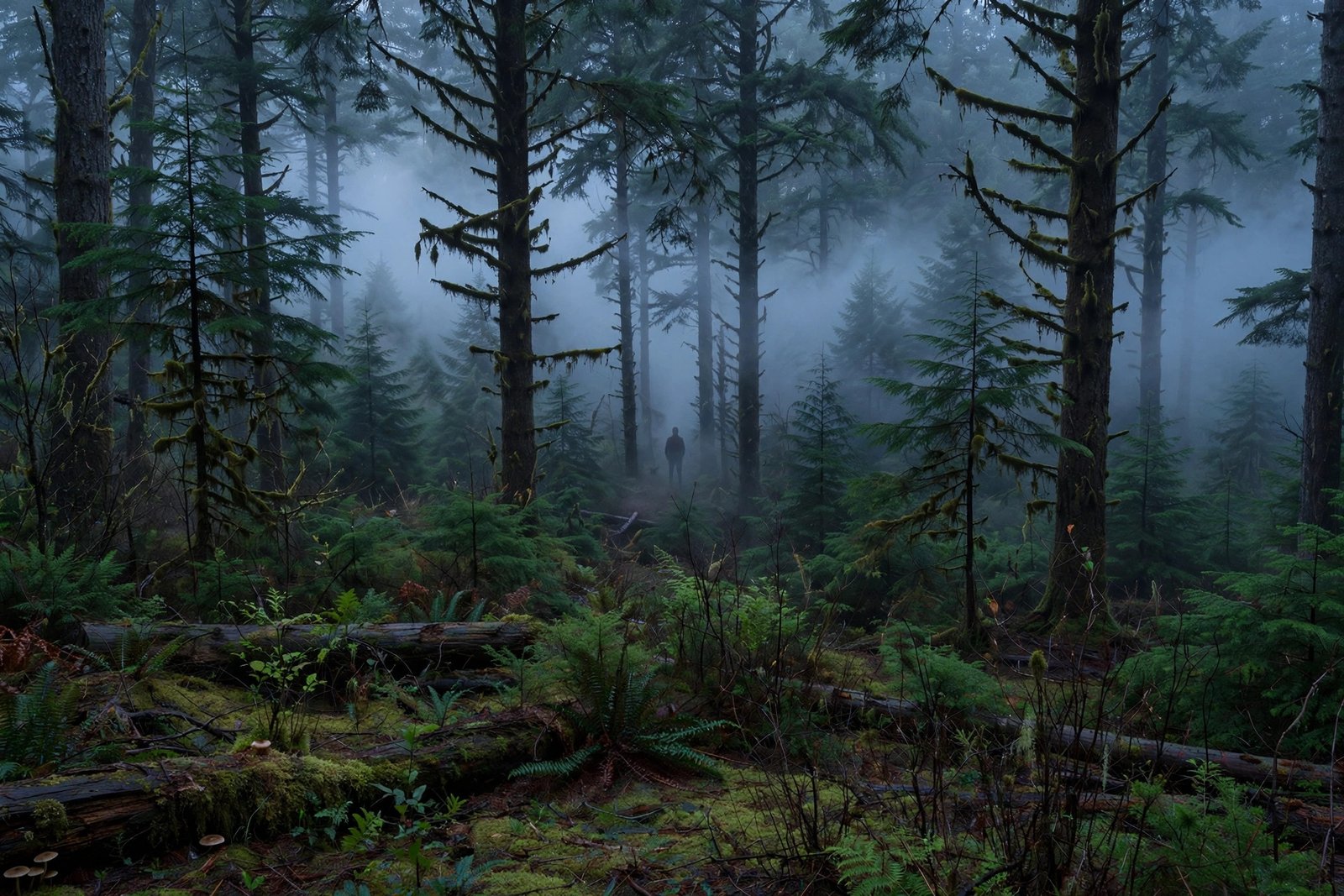
Deep in the mist-shrouded forests of the Pacific Northwest, a towering, ape-like figure is said to stride silently between the ancient redwoods. It leaves behind footprints the size of dinner platters, fleeting glimpses on grainy film, and a mystery that has refused to die for more than sixty years. The bigfoot legend is America’s most famous unsolved mystery \u2014 a story told around campfires, debated by scientists, and celebrated at festivals across the country.
But how much of the bigfoot legend is fact, and how much is folklore? In this guide, we walk through the real history behind the legend \u2014 from Indigenous traditions and a 1958 newspaper story to the most analyzed minute of film in cryptozoology \u2014 and separate what we know from what we only wish we knew. If you love American mysteries, you will also enjoy our look at the true stories behind America’s greatest legends.
The Origins of the Bigfoot Legend
Long before the name “Bigfoot” existed, many Indigenous peoples of North America told stories of large, wild, hairy beings that lived in the forests and mountains. These were traditional stories \u2014 cultural narratives passed down through generations \u2014 not scientific claims, and they varied widely from nation to nation. Some described shy forest dwellers; others told of powerful, dangerous giants.
The word most Americans associate with the creature \u2014 “Sasquatch” \u2014 comes from the Halkomelem word “s\u00e1sq\u2019ets,” used by the Sts\u2019ailes people of what is now British Columbia. Early twentieth-century writers popularized the term in English, and it stuck as a synonym for Bigfoot. What matters here is the distinction: these traditions are genuine cultural heritage, but they are stories, not evidence. Folklorists study them as folklore; biologists require something more.
Keeping that line clear is the key to the whole story. Respect the traditions for what they are \u2014 rich, meaningful stories \u2014 without treating them as proof of a biological animal. That honest framing will guide everything that follows.
1958: The Year Bigfoot Got Its Name
The modern bigfoot legend began with footprints \u2014 enormous ones. In 1958, Jerry Crew, a bulldozer operator working at a logging site near Bluff Creek in Northern California, repeatedly found huge human-like footprints around his equipment in the mornings. Crew made plaster casts of the prints, which measured about sixteen inches long, and eventually brought the story to the Humboldt Times newspaper.
The paper ran the story, and it was a coworker at the logging operation who reportedly coined the nickname “Big Foot” \u2014 later written as one word, “Bigfoot.” The story was picked up by newspapers across the country, and the name entered American popular culture almost overnight. Overnight, a local logging-camp curiosity became a national phenomenon.
Here is where honesty requires a footnote. Years later \u2014 after the death in 2002 of Ray Wallace, another man connected to the logging operation \u2014 Wallace’s family claimed he had faked the 1958 footprints using carved wooden feet. That claim is itself debated: some researchers accept it, while others point out that not all the prints from that era can be explained by it. What is documented fact is the newspaper coverage and the plaster casts; who made every print remains disputed. The legend was born in this fog of claim and counterclaim \u2014 and it has never quite left it.
The Patterson-Gimlin Film of 1967
The single most famous piece of Bigfoot evidence is less than a minute of shaky 16mm film. On October 20, 1967, Roger Patterson and Bob Gimlin \u2014 two men from Yakima, Washington, who had traveled to Northern California specifically hoping to find Bigfoot \u2014 were riding horseback near Bluff Creek when they spotted a large, dark, ape-like figure walking along the creek bank. Patterson grabbed his movie camera and filmed it.
The resulting footage, roughly a minute long, shows a tall, muscular, hair-covered figure striding away with a distinctive swinging gait, glancing briefly toward the camera. It has been analyzed, stabilized, digitized, and debated for nearly sixty years. Believers point to the figure’s apparent muscle movement and body proportions as beyond the costume technology of 1967. Skeptics argue it is a person in a suit, noting Patterson’s financial interest in the Bigfoot story and inconsistencies in the men’s accounts.
The documented facts are these: the film exists, it was shot when and where Patterson and Gimlin said it was, and no one has ever produced a definitive confession or a matching costume that settles the matter. Claims of confessions have surfaced over the years and been disputed in turn. The film remains exactly what it was in 1967 \u2014 intriguing, inconclusive, and the beating heart of the bigfoot legend.
Where the Bigfoot Legend Lives: Famous Sighting Regions
If you map reported Bigfoot sightings across North America, one region dominates: the Pacific Northwest. Washington, Oregon, and Northern California account for the densest clusters of reports \u2014 vast, wet, heavily forested country where a large animal could plausibly go unseen. The region’s endless timberland and thin human presence in remote areas make it the natural home of the legend.
But reports are not confined to the Northwest. Sightings have been claimed in nearly every US state, and regional names reflect local flavors of the same idea. Florida has its “Skunk Ape,” said to haunt the Everglades and named for its foul odor. The Midwest, the Ozarks, and Appalachia all have long traditions of “wild man” reports. Enthusiast organizations maintain databases holding thousands of these accounts.
The honest framing matters enormously here: a reported sighting is a story someone told, not a confirmed event. Eyewitness testimony is sincere in many cases \u2014 people genuinely believe they saw something \u2014 but human perception is fallible, especially in dark forests at dusk, and bears standing upright account for a share of reports. The legend thrives in the gap between what people experience and what can be verified.
For more creatures that blur the line between real and rumored, see our guide to American animals you won’t believe are real \u2014 every one of them documented, verified, and genuinely astonishing.
What Science Says About Bigfoot
Now for the blunt truth: mainstream science has found no verified physical evidence that Bigfoot exists. No body has ever been recovered. No DNA sample attributed to Bigfoot has ever been confirmed as anything other than known animals \u2014 typically bears, in the cases that have been tested. There is no fossil record of an unknown great ape in North America. Footprint casts exist by the hundreds, but they are disputed: some show anatomical details that enthusiasts find compelling, while skeptics note how easily prints can be faked, misidentified, or distorted by melting snow and mud.
That does not mean every scientist dismisses the question out of hand. A small number of credentialed researchers have argued the evidence deserves serious study, and primatologists have occasionally weighed in on the biomechanics shown in the Patterson-Gimlin film. But the scientific consensus is clear: without a type specimen \u2014 a body, a skeleton, or unambiguous DNA \u2014 Bigfoot remains outside the bounds of confirmed zoology.
This is the line the legend walks. Extraordinary claims require extraordinary evidence, and after more than half a century of searching with trail cameras, drones, environmental DNA sampling, and organized expeditions, the evidence cupboard is still bare. Believers respond that absence of evidence is not evidence of absence \u2014 especially across millions of acres of wilderness. Both statements can be true at once, and the intellectually honest position is to hold them both without flinching.
Why the Bigfoot Legend Endures
So why does the legend refuse to fade? Part of the answer is the wilderness itself. America still contains vast stretches of forest that few humans ever enter. The idea that something large could live out there, just beyond the treeline, speaks to a deep human hope: that the world is not fully mapped, fully known, and fully tamed.
Part of it is community. Bigfoot has inspired festivals, museums, research groups, podcasts, and television shows. For many enthusiasts, the search itself is the point \u2014 weekends in the woods with friends, listening for strange knocks and howls, belonging to something larger than a hobby. The legend is social glue, and the friendships are real even if the creature is not proven.
And part of it is simply that the story is good \u2014 the rare mystery that asks nothing of you but wonder. It does not threaten; Bigfoot is almost always described as shy, peaceful, and eager to avoid people. In a noisy, cynical age, a gentle giant hiding in the last wild places is a story people want to be true \u2014 and wanting it may be the most human part of all.
Best Places Associated With Bigfoot Lore
You cannot go looking for a creature science has not confirmed \u2014 but you can absolutely visit the places where the legend was made. These are the landmarks of the lore, and each is worth the trip for its scenery and history alone:
- Willow Creek, California. This small Humboldt County town calls itself the “Bigfoot capital of the world,” and it leans into the title. The local museum, the Willow Creek\u2013China Flat Museum, displays Bigfoot-related exhibits, including casts and memorabilia connected to the 1958 footprint finds. The town embraces its role in the legend with statues and themed events.
- Bluff Creek, California. The remote creek drainage where Jerry Crew found the 1958 footprints and where Patterson and Gimlin shot their famous film nine years later. It lies within Six Rivers National Forest \u2014 deep, rugged, spectacular country that is worth visiting whether you believe or not.
- The Mount St. Helens area, Washington. The volcano’s blast zone and surrounding forests have generated decades of sighting reports, and the region leans into the lore with Bigfoot statues, gift shops, and trailhead chatter. The landscape itself \u2014 recovering forest beneath a steaming volcano \u2014 feels appropriately mysterious.
- The Olympic Peninsula, Washington. The temperate rainforests of Olympic National Park are among the densest, darkest woods in America \u2014 classic Sasquatch country in the stories, and a genuinely spectacular destination for hiking, hot springs, and wild coastline.
Visit these places for the scenery, the history, and the sheer fun of the legend \u2014 and keep your camera ready, just in case. For more verified wonders of the American wild, browse our collection of mind-blowing facts about the USA that sound fake but are completely real.
Why the Legend Belongs to All of Us
The legend has survived newspaper sensations, scientific skepticism, confessed hoaxes, and sixty years of empty trail-camera footage. It survives because it is more than a claim about an animal \u2014 it is a story America tells about its wilderness, its past, and its capacity for wonder.
Is Bigfoot real? Science says the evidence is not there. Thousands of witnesses say they know what they saw. Between those two statements lies one of the great campfire debates of American life \u2014 and it is not ending anytime soon.
Have you ever had an unexplained encounter in the American wild, or visited Bigfoot country yourself? Share your story in the comments, and keep exploring the legends, history, and hidden places of the USA with us.