
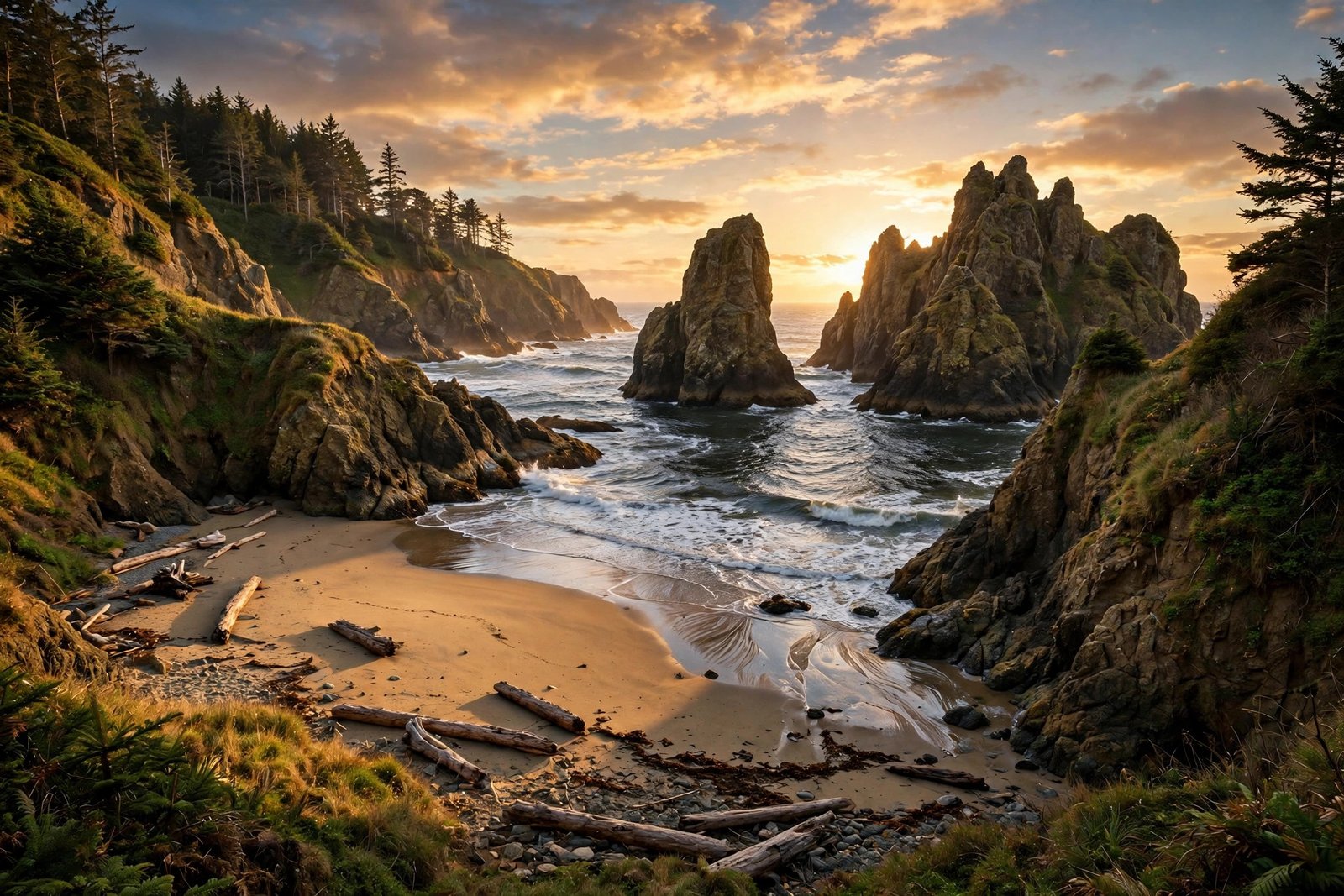
The Oregon coast is famous for Cannon Beach and its haystack rocks, but drive a little farther, turn down a few unmarked roads, and you will find a wilder, quieter shoreline. This guide to hidden gems Oregon coast travelers love is all about those secret beaches, sea stacks, viewpoints, and small towns that most visitors drive right past.
Oregon’s entire coastline is public, which means you can explore more than 360 miles of beaches, headlands, and tidepools. The places below are not all easy to reach, and some require timing your visit with low tide, but each one rewards the effort with scenery that feels untouched. Bring layers, watch the tides, and never turn your back on the ocean.
Hidden Gems Oregon Coast: Secret Beaches Worth Finding
Samuel H. Boardman State Scenic Corridor, near Brookings in the far south, is arguably the coast’s greatest hidden treasure. This 12-mile stretch of rugged shoreline hides pocket beaches, natural rock arches, and sea stacks draped in Sitka spruce. Secret Beach, reached by a short, steep trail, is a small cove framed by cliffs and offshore rocks. Nearby, Natural Bridges offers viewpoints over a series of rock arches carved by the sea, best visited in calm weather and from the marked viewpoints.
Farther north, Hug Point, just south of Cannon Beach, is a beach with sea caves and a historic stagecoach road carved into the headland at low tide. Time your visit for a minus tide to walk around the point and explore the caves. Short Sand Beach, inside Oswald West State Park, is a sheltered cove reached by a gentle forest walk, popular with surfers but still quieter than the big-name beaches. For more secluded sand, see our roundup of hidden beaches in the USA.
Sea Stacks, Tidepools, and Natural Wonders
The southern coast around Bandon is a sea-stack wonderland. Face Rock State Scenic Viewpoint looks out over stacks that local legend says are the face of a maiden turned to stone — a story to enjoy as folklore, not fact. At low tide, the beaches below Bandon reveal tidepools full of starfish, anemones, and scurrying crabs. Walk carefully, step on bare rock rather than living creatures, and return any animals you lift gently to the water.
Devil’s Punchbowl, near Depoe Bay, is a hollowed-out rock formation where waves crash and churn inside a natural bowl. It is best seen at high tide or during a storm swell, from the safe viewing areas above. Just south, Cape Perpetua is home to Thor’s Well, a sea-carved sinkhole that appears to drain the ocean at high tide. It is spectacular and dangerous: stay behind barriers and visit at a safe distance, never on the rocks around it.
Quiet Coastal Towns and Harbors
Port Orford, on the southern coast, is the oldest town on the Oregon coast and one of its least crowded. Its working harbor uses a unique dolly dock system to lift fishing boats from the water, and the Port Orford Lifeboat Station museum tells the story of the Coast Guard crews who braved these waters. Cape Blanco, just north of town, is the westernmost point in Oregon, with a historic lighthouse and windswept headland trails.
Yachats, a small village on the central coast, is a favorite base for slow travelers. Its rocky shoreline, the 804 Trail along the oceanfront, and nearby Cape Perpetua trails offer days of walking without crowds. Depoe Bay, the world’s smallest natural navigable harbor, is a good place to watch gray whales, which feed close to shore here for much of the year. Gold Beach, where the Rogue River meets the sea, offers jet boat trips up a wild and scenic river canyon.
Hidden Gems Oregon Coast: Viewpoints and Coastal Drives
Some of the coast’s best hidden gems are viewpoints you reach by car. Cape Arago, near Coos Bay, has a loop road with viewpoints over sea lions, sea stacks, and the rugged headland, plus nearby Shore Acres State Park, where a former estate’s gardens meet crashing waves on sandstone cliffs. In winter, Shore Acres is known for its holiday light display, while storm season turns the cliffs into a dramatic wave-watching stage.
The Three Capes Scenic Loop, west of Tillamook, links Cape Meares, Cape Lookout, and Cape Kiwanda. Cape Meares has a short trail to a historic lighthouse and the famous Octopus Tree, a Sitka spruce with candelabra-like limbs. Cape Lookout’s trail runs along a narrow headland with sweeping views, and Cape Kiwanda’s sandstone cliffs glow gold at sunset. For more unforgettable routes, check out our guide to the most beautiful coastal drives in the USA.
Forests, Rivers, and Wildlife Encounters
The hidden Oregon coast is not just beaches. The Siltcoos River area near Florence has quiet lakes, dunes, and birdwatching, while the Oregon Dunes National Recreation Area, stretching between Florence and Coos Bay, holds some of the largest coastal dunes in North America. You can hike the dunes on foot or ride with a guided tour, and the landscape of wind-sculpted sand beside the ocean feels almost desert-like.
Wildlife watching is a year-round reward here. Gray whales migrate along the coast in winter and spring, and a resident group feeds near Depoe Bay in summer. Harbor seals haul out on rocks and beaches, sea lions bark from offshore rocks, and shorebirds crowd the estuaries. Bring binoculars, keep your distance from wildlife, and never approach seal pups resting on the beach.
Planning Tips for the Hidden Oregon Coast
Exploring the hidden coast takes a little planning. Cell service is patchy on the southern coast, so download offline maps before you go. Many trailheads are unmarked or signed only with small brown posts, so research directions ahead of time. Check tide tables for beach walks around headlands and for tidepool visits, and always know when the tide turns.
- Visit at low tide for tidepools, sea caves, and headland walks like Hug Point.
- Visit at high tide for the drama of Devil’s Punchbowl and Thor’s Well, from safe viewpoints.
- Pack rain gear and layers: coastal weather changes fast, even in summer.
- Book stays early in small towns like Yachats and Port Orford, where lodging is limited.
- Respect private land near trailheads and never climb on unstable cliffs.
Safety on the Oregon Coast
The Oregon coast’s beauty comes with real hazards. Sneaker waves can surge far up the beach without warning, logs in the surf can roll, and cliffs can crumble. Never turn your back on the ocean, keep children close to you near the water, and stay off rocks at Thor’s Well and similar features. If you see a tsunami evacuation route sign, note the way to high ground. Most visits are perfectly safe when you respect the ocean and follow posted warnings.
Another quiet pleasure of the hidden coast is its food and local craft. Small towns along Highway 101 serve clam chowder, fresh-caught fish and chips, and saltwater taffy, and farmers markets and roadside stands sell berries, mushrooms, and local cheese in season. Stop for a meal in a harbor town, chat with the people behind the counter, and ask what they recommend nearby — locals often know about a beach access path or viewpoint that no map marks.
A Sample Hidden Coast Itinerary
If you have three days, here is a relaxed way to enjoy the hidden gems Oregon coast road trippers love most. Start in the north with Hug Point at low tide and Short Sand Beach in Oswald West State Park, then spend the night in a central coast town such as Yachats or Depoe Bay. On day two, explore Cape Perpetua, Devil’s Punchbowl, and the tidepools near Bandon, watching for whales and sea lions along the way. Finish in the south with the Samuel H. Boardman corridor, Port Orford, and Cape Blanco, where the crowds thin out and the cliffs grow wilder.
This kind of trip works best at a slow pace. The coast highway is made for unplanned stops: a viewpoint you did not expect, a trailhead with a hand-painted sign, a beach that appears between two headlands. Keep your tank topped up, since gas stations are sparse on the southern coast, and carry snacks and water for the stretches between towns. The hidden gems Oregon coast visitors treasure are not hard to find once you slow down — they are simply the places most travelers rush past on their way somewhere else.
Conclusion: Go Find Your Own Secret Shore
The hidden gems Oregon coast travelers remember most are rarely the ones in the guidebook headlines. They are the cove you reached by a muddy trail, the lighthouse you had to yourself at sunset, the tidepool full of color at a minus tide, and the small-town cafe where locals told you where to go next. Use this guide as a starting point, then leave room for discovery. Drive the coast slowly, stop at the unmarked viewpoints, and let Oregon’s wild shoreline surprise you — then plan your next trip before the first one is even over.