
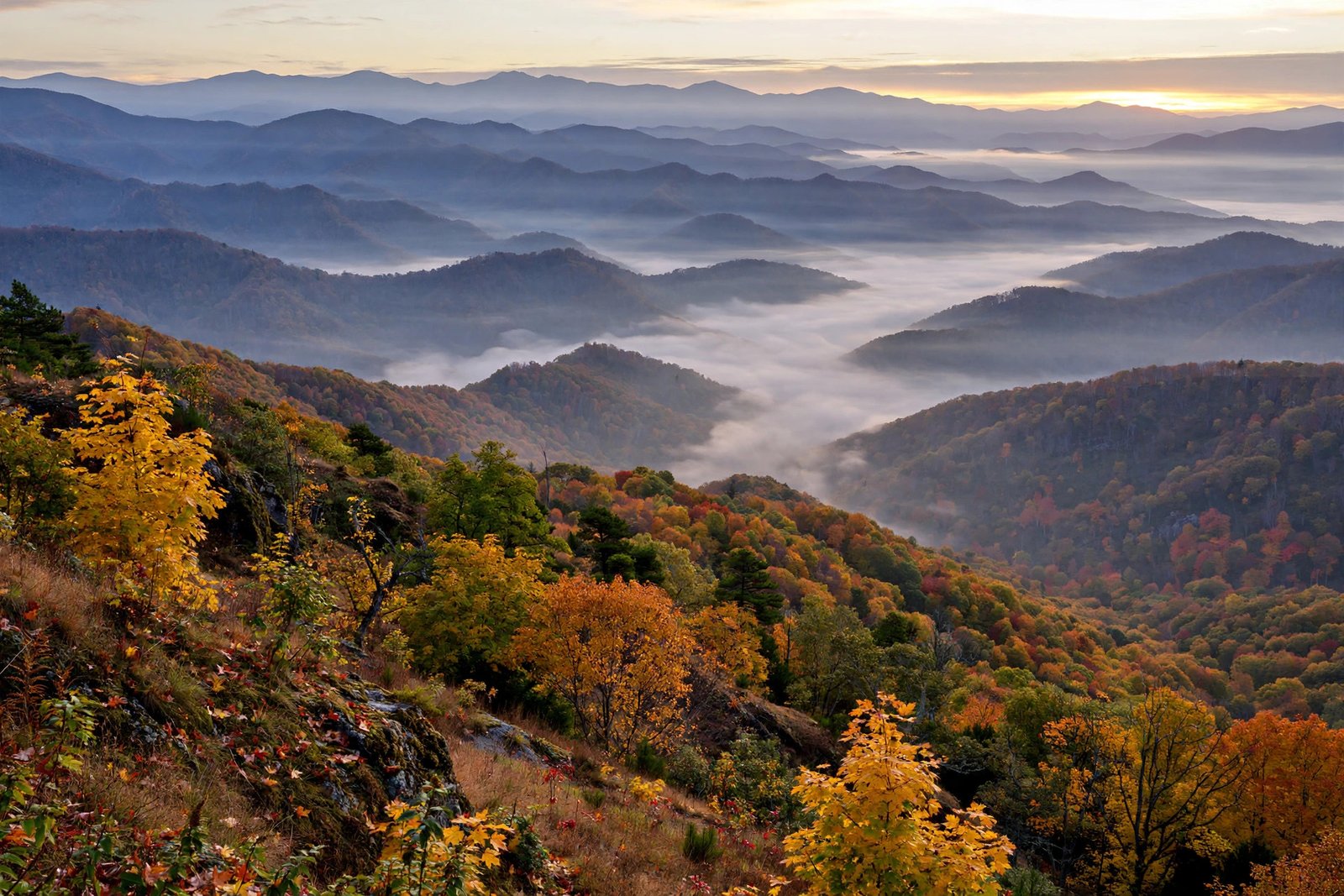
There is a mountain range in the eastern United States that is older than the dinosaurs, older than most of the rocks beneath your feet, and still full of life today. These Appalachian Mountains facts will change the way you see a landscape many Americans drive through without ever really noticing. From misty peaks in Georgia to rugged ridges in Maine, the Appalachians stretch across an astonishing sweep of the country, shaping weather, wildlife, music, and small-town life along the way.
Most people picture the Appalachians as one long, green ridge. In reality, they are a vast system of ranges, valleys, plateaus, and forests, with a human story just as layered as the geology. Indigenous peoples lived in and traveled through these mountains for thousands of years before European settlers arrived. Later, pioneers, miners, farmers, musicians, and hikers all left their mark. Today, millions of people visit every year to hike, drive scenic byways, watch fall color, and simply breathe in mountain air.
In this guide, you will discover how the range formed, where it runs, what lives there, and how to experience it for yourself. Whether you are planning a road trip, helping a child with a school project, or just curious about America’s oldest mountains, this is a place to start.
Appalachian Mountains Facts: How Old Are They Really?
The Appalachian Mountains are among the oldest mountain ranges on Earth. They began forming hundreds of millions of years ago, when ancient continents collided and pushed up enormous folds of rock. Geologists generally place the main Appalachian mountain-building episodes in the Paleozoic Era, long before the Rocky Mountains existed. That deep age is one reason the Appalachians look so different from the younger, sharper Rockies: millions of years of wind, water, ice, and plant roots have worn them down into rounded, forested ridges.
One of the most surprising Appalachian Mountains facts is that the range was once far taller than it is today. Scientists believe some ancient Appalachian peaks may have rivaled the modern Himalayas in height. Over time, erosion slowly lowered them, while the rocks themselves tell a story of oceans, volcanoes, and shifting continents. If you pick up a stone in parts of the Appalachians, you may be holding material that was once part of an ancient seafloor.
The range is also famous for its folded and faulted rock layers. In places such as the Appalachian Valley and Ridge province, you can see long, parallel ridges that look like waves frozen in stone. Those patterns are the visible result of enormous pressure over immense spans of time. For geology lovers, a simple road cut or cliff face in the Appalachians can feel like an open-air museum.
Another fascinating detail is that the Appalachians are not limited to the United States. The same ancient mountain system continues northeast into Canada, where it is known as part of the Appalachian region of Newfoundland and the Maritime provinces. In the distant past, parts of this system were also connected to mountains in Scotland and Scandinavia, before the Atlantic Ocean opened and separated the continents. That is why some rocks on opposite sides of the Atlantic still match.
Where the Appalachian Mountains Run
The Appalachian Mountains run for roughly 2,000 miles, from Alabama and Georgia in the south to Maine in the north, with the system continuing into Canada. They pass through or touch about 14 U.S. states, depending on how the boundaries are drawn, including Georgia, North Carolina, Tennessee, Virginia, West Virginia, Maryland, Pennsylvania, New York, Vermont, New Hampshire, and Maine.
Within that long system are many smaller ranges with their own character. The Blue Ridge Mountains, home to Shenandoah National Park and parts of the Blue Ridge Parkway, are known for their blue haze and sweeping overlooks. The Great Smoky Mountains, straddling Tennessee and North Carolina, are the most visited national park area in the country and are famous for fog, biodiversity, and fall color. The White Mountains of New Hampshire include Mount Washington, known for extreme weather. The Catskills in New York, the Alleghenies in Pennsylvania and West Virginia, and the Green Mountains of Vermont each add a distinct landscape.
The highest peak in the Appalachian system in the United States is Mount Mitchell in North Carolina, which rises to 6,684 feet above sea level. It is the highest point east of the Mississippi River. While that is modest compared with the 14,000-foot peaks of Colorado, the Appalachians make up for height with depth: deep valleys, dense forests, waterfalls, and long, rolling horizons that seem to go on forever.
For travelers, the range is also defined by its great trails and roads. The Appalachian Trail runs for more than 2,190 miles from Georgia to Maine, crossing many of the most beautiful sections of the range. The Blue Ridge Parkway and Skyline Drive offer slower, scenic driving, with overlooks, visitor centers, and trailheads every few miles. You do not need to be a long-distance hiker to enjoy the mountains; many of the best views are a short walk from a parking area.
Appalachian Mountains Facts About Wildlife and Forests
The Appalachians are one of the most biologically diverse temperate regions in the world, especially in the southern portion of the range. The Great Smoky Mountains National Park alone is known for an extraordinary variety of plants and animals, including hundreds of species of trees, wildflowers, birds, and salamanders. In fact, the southern Appalachians are considered a global center for salamander diversity, with many species found nowhere else on Earth.
Forests change as you move north or climb higher. In the south, you may walk through lush, deciduous forests filled with oak, hickory, tulip poplar, and rhododendron. Higher elevations bring spruce and fir forests that feel more like Canada than the American South. In autumn, those deciduous forests turn into a patchwork of red, orange, and gold that draws visitors from around the world. Spring brings wildflowers, including trillium, lady slippers, and mountain laurel.
Wildlife in the Appalachians includes black bears, white-tailed deer, wild turkeys, raccoons, foxes, bobcats, and a wide range of birds, from warblers to hawks and owls. Black bears are common in many parts of the range, especially in national parks, and visitors are reminded to store food properly and keep a safe distance. Birdwatchers prize the region during spring migration, when colorful warblers pass through the forests in large numbers.
One of the more remarkable Appalachian Mountains facts is how much life depends on water here. Countless streams, rivers, and waterfalls thread through the mountains, feeding forests and farms downstream. Rivers such as the New River, which despite its name is considered geologically ancient, cut through the mountains and create gorges popular for rafting. Protecting these watersheds matters not only for wildlife, but for the millions of people who live downstream.
People, Music, and Culture in the Mountains
Long before the Appalachians became a vacation destination, they were home. Indigenous nations, including the Cherokee and other peoples, lived in these mountains and valleys, hunting, farming, trading, and building communities. Their knowledge of the land, plants, and trails shaped the region for centuries, and their descendants remain connected to the Appalachian homeland today.
Later, settlers from Europe and enslaved African Americans brought traditions that blended into a distinctive mountain culture. That culture is heard most clearly in music. Old-time string band music, bluegrass, and early country music all have deep roots in Appalachia. Instruments such as the fiddle, banjo, guitar, and mandolin became central to community gatherings, church services, and front-porch jam sessions. Towns such as Bristol, on the Tennessee-Virginia border, are celebrated in the history of early country music recording.
Appalachian food and craft traditions are equally distinctive. Cornbread, beans, greens, apple butter, and dishes built around what could be grown, hunted, or preserved reflect a history of making do with local ingredients. Quilting, woodcarving, basket weaving, and pottery remain living arts in many mountain communities, sold at craft fairs and shops along scenic routes. Visiting a local farmers market or craft center is one of the best ways to support mountain towns directly.
It is also important to separate legend from fact when talking about Appalachian culture. Stories about the mountains are rich, but not every tall tale is history. Folklore, ghost stories, and local legends are part of the region’s charm, and they should be enjoyed as stories rather than presented as documented fact. The real history — of Indigenous resilience, migration, mining, farming, labor struggles, and musical creativity — is compelling enough on its own.
Best Places to Experience the Appalachians
If you are planning your first trip, start with the places that show the range at its best. Great Smoky Mountains National Park offers easy scenic drives, historic cabins, waterfalls, and wildlife viewing. Shenandoah National Park in Virginia pairs Skyline Drive with dozens of short hikes to overlooks and waterfalls. The Blue Ridge Parkway, which connects Shenandoah to Great Smoky Mountains National Park, is itself a destination, with mileposts marking overlooks, trails, and cultural sites.
For hikers, sections of the Appalachian Trail in Virginia, North Carolina, and New Hampshire offer very different experiences, from gentle ridge walks to rugged, rocky climbs. If you are new to hiking, choose a short day hike rather than a multi-day trek, and check trail conditions before you go. Many state parks in the Appalachians, such as those in West Virginia, Pennsylvania, and Georgia, offer excellent trails without national-park crowds.
Small towns are another highlight. Places such as Gatlinburg and Townsend in Tennessee, Blowing Rock and Asheville in North Carolina, Harpers Ferry in West Virginia, and Stowe in Vermont each offer a different slice of mountain life, from outdoor gear shops and art galleries to farm-to-table restaurants and live music. Spending a night in a mountain town, rather than just driving through, gives you time to talk with locals and discover places that never appear in a guidebook.
These Appalachian Mountains facts point to a simple truth for travelers: you do not have to see the whole range to love it. Pick one region, slow down, and let the mountains reveal themselves. A single sunrise over a fog-filled valley, a walk through an old-growth forest, or an evening of live music in a small town can be enough to understand why people return year after year. For more inspiration on forested landscapes across the country, explore our guide to the most beautiful national forests in the USA.
Planning a Visit: Seasons, Safety, and Tips
Each season shows a different side of the Appalachians. Spring brings wildflowers and rushing streams, but also rain and muddy trails. Summer is lush and green, ideal for hiking and camping, though afternoons can be humid and thunderstorms are common. Fall is the most popular season, with cool air and brilliant foliage, but also the busiest roads and lodges. Winter brings quiet trails, snow at higher elevations, and crisp views, but also icy roads and closed facilities in some parks.
Safety matters in any mountain environment. Tell someone your hiking plan, carry water, snacks, a map, and a charged phone, and check the weather before you set out. Mountain weather can change quickly, especially on exposed ridges such as Mount Washington, where high winds are famous. Stay on marked trails, keep a respectful distance from wildlife, and follow Leave No Trace principles: pack out trash, stay on durable surfaces, and leave wildflowers and rocks where you found them.
Families will find plenty of accessible options. Many parks offer junior ranger programs, easy nature trails, picnic areas, and visitor centers with exhibits on geology, wildlife, and history. Scenic drives are a good option for travelers with limited mobility, and many overlooks are accessible. If you are traveling with children, turn the trip into a scavenger hunt: look for a waterfall, a historic cabin, a salamander, a mountain overlook, and a local craft shop.
Budget travelers can enjoy the Appalachians without spending a fortune. National park entry is free in the Smokies, many state parks charge only a small fee, and camping is often far cheaper than a hotel. Packing picnic lunches, staying in a small-town motel, and choosing free overlooks and trails can keep costs down while still delivering the full mountain experience.
Conclusion: Why the Appalachians Endure
The Appalachian Mountains endure because they are more than a line on a map. They are ancient geology, living forests, flowing water, music, food, and community, all layered together over hundreds of millions of years and thousands of years of human history. They remind us that America’s natural wonders are not only found in the far West, and that some of the country’s most beautiful places are close to where millions of people live.
Whether you hike a mile or drive a scenic parkway, visit in fall color or summer green, the Appalachians reward curiosity. Start with one park, one town, or one trail, and let that first visit lead to the next. Share this guide with someone who loves road trips, national parks, or American history, and plan your own Appalachian adventure. The oldest mountains in America are waiting, and they have stories worth hearing.