
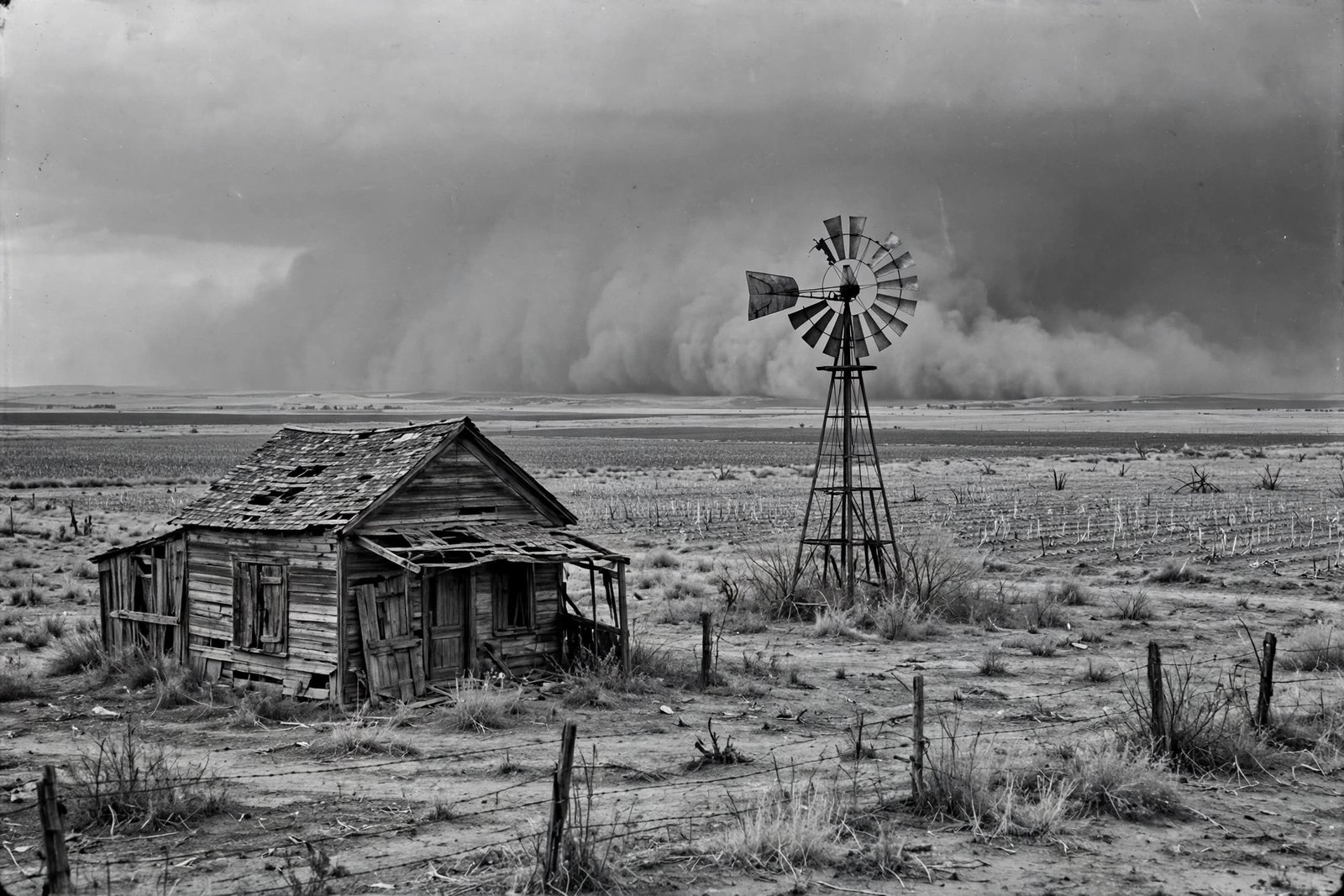
Breadlines stretching around city blocks. A sky over Kansas so thick with dust that noon looked like midnight. Families piling everything they owned into battered cars and driving west toward a rumor of work. These are the images that define the Great Depression, but the great depression true stories behind them — the documented events, the government programs, and the ordinary people who endured them — are more remarkable than any single photograph. Between the stock market crash of 1929 and America’s entry into World War II, the United States lived through the hardest economic decade in its history, and the nation that emerged was transformed forever.
This is not fiction. Every story below is drawn from the historical record: the crash, the Dust Bowl, the New Deal, the veterans who marched on Washington, and the migrant mother whose face became the symbol of an era. These great depression true stories matter because they show how America breaks — and how it rebuilds.
Great Depression True Stories Start on Black Tuesday, 1929
The decade’s defining disaster began in lower Manhattan. On Thursday, October 24, 1929 — Black Thursday — a record of nearly 13 million shares changed hands on the New York Stock Exchange as prices collapsed and panic swept the trading floor. A group of bankers pooled money to steady the market, and for a few days it seemed to work. Then came Black Monday, October 28, and finally Black Tuesday, October 29, when more than 16 million shares were traded and billions of dollars in paper value vanished in a single day.
The crash itself did not single-handedly cause the Great Depression — historians agree the economy was already fragile. American farms had been in distress for years, factories were overproducing goods that consumers could not afford, and the banking system was a house of cards: thousands of small banks failed in the early 1930s, wiping out the savings of ordinary families because no federal deposit insurance existed yet. The Smoot-Hawley Tariff of 1930, which raised import duties to record levels, choked off international trade just when the world economy needed it most. The stock market, which had peaked in September 1929, would lose nearly 90 percent of its value before bottoming out in 1932.
The human cost mounted with terrifying speed. By 1933, roughly one in four American workers was unemployed — a figure that still staggers the imagination. Factories closed, construction halted, and wages for those lucky enough to keep jobs were slashed. In the cities, men who had been executives a year earlier stood in breadlines. In the countryside, the crisis was about to get a second, even more brutal chapter.
The Dust Bowl: When the Day Turned to Night
If the crash broke the cities, the Dust Bowl broke the heartland. Throughout the 1930s — the decade Americans called the Dirty Thirties — a catastrophic drought settled over the Great Plains. But drought alone did not create the disaster. Years of deep plowing had stripped away the native grasses that held the prairie soil in place, and when the rains failed, the exposed topsoil simply took flight. The worst years were 1934 through 1936, when storm after storm of wind-driven dust buried farms, killed livestock, and filled lungs with grit.
The most infamous day was Black Sunday, April 14, 1935. A gigantic dust storm — a black blizzard — rolled across the Oklahoma and Texas panhandles and into Kansas, turning day into night. Survivors described a wall of dust thousands of feet high that blotted out the sun; chickens went to roost at midday, and static electricity in the air was so intense that people received shocks shaking hands. The storms carried away millions of tons of topsoil, and a condition doctors called dust pneumonia sickened and killed residents who breathed the fine particles day after day.
The human migration that followed was one of the largest in American history. Hundreds of thousands of ruined farmers and their families — mocked as Okies regardless of which state they came from — packed their belongings into trucks and cars and headed west to California, chasing rumors of farm work. Many found only more hardship: low wages, squalid labor camps, and hostility from locals. Their journey became the subject of John Steinbeck’s 1939 novel The Grapes of Wrath — a work of fiction, but one rooted in the real suffering Steinbeck had witnessed firsthand. The federal government eventually responded with soil conservation programs and massive tree-planting shelterbelts, lessons learned at an enormous price. For more tales of Americans heading west through hardship, read our account of the true story of the Oregon Trail.
Breadlines, Soup Kitchens, and Hoovervilles
In the cities, the Depression had its own bleak landmarks. Breadlines — long queues of hungry men waiting for a handout of bread or soup — became a fixture of urban life, nowhere more famously than in New York City. Private charity and churches did what they could, but the scale of need overwhelmed them. In Chicago, even the notorious gangster Al Capone opened a soup kitchen in 1931 that served thousands of free meals to the unemployed — a widely documented episode that shows how deep the crisis ran when a crime boss became one of the city’s notable philanthropists.
For those who lost their homes entirely, there were the Hoovervilles — shantytowns of scrap wood, tin, and cardboard that sprang up in every major city, bitterly named for President Herbert Hoover, whom many blamed for the catastrophe. A Hooverville occupied part of New York’s Central Park. The language of the era carried the same bitterness: a newspaper used as a blanket was a Hoover blanket, and empty pockets turned inside out were Hoover flags. Men in suits sold apples on street corners for a nickel. The 1931 song Brother, Can You Spare a Dime? — with music by Jay Gorney and lyrics by Yip Harburg — gave voice to the bewilderment of veterans and workers who had done everything right and lost everything anyway.
FDR’s New Deal: The CCC, the WPA, and the TVA
When Franklin D. Roosevelt took the oath of office on March 4, 1933, the banking system had essentially collapsed and despair was the national mood. His inaugural address gave the country its most quoted line of the decade: the only thing we have to fear is fear itself — nameless, unreasoning, unjustified terror which paralyzes needed efforts to convert retreat into advance. Then he got to work. The first Hundred Days produced a blizzard of legislation: a national bank holiday to stop the panic, emergency banking laws, and the first wave of what Roosevelt called the New Deal.
Among the most beloved New Deal programs was the Civilian Conservation Corps, created in 1933. The CCC enrolled young unemployed men, put them to work in the nation’s forests and parks, and paid them a dollar a day — most of which was sent home to their families. Over its nine-year life, roughly three million young men served in the CCC, planting an estimated three billion trees, building trails and campgrounds, and fighting forest fires. The parks and forests Americans enjoy today still bear the CCC’s handiwork.
The Works Progress Administration, launched in 1935, was even larger. At its peak it employed more than eight million Americans building the country’s infrastructure: hundreds of thousands of miles of roads, more than a hundred thousand bridges, and tens of thousands of schools, hospitals, and public buildings. The WPA also put artists, writers, and musicians to work — its Federal Art Project covered public buildings in murals, and its Federal Writers’ Project collected first-person narratives, including invaluable interviews with formerly enslaved Americans. The Tennessee Valley Authority, created in 1933, built dams across the Tennessee River system, bringing electricity, flood control, and jobs to one of the poorest regions in the nation.
The New Deal also built the modern American safety net: the Glass-Steagall banking reforms and federal deposit insurance in 1933, and the Social Security Act of 1935. It was controversial from the start — conservatives called it socialism, radicals called it too timid, and the Supreme Court struck down key pieces — but it undeniably changed the relationship between Americans and their government. These great depression true stories of government action remain the template for every crisis response since.
The Bonus Army March of 1932
One of the most dramatic great depression true stories unfolded in the summer of 1932, when tens of thousands of World War I veterans converged on Washington, D.C. Congress had promised them bonuses in 1924, payable in 1945 — but with the Depression raging, the veterans demanded early payment. Some 43,000 marchers, including veterans’ wives and children, traveled to the capital by hopping freight trains and hitchhiking. They built a sprawling camp at Anacostia Flats and waited, peacefully but determinedly, for Congress to act.
When the Senate rejected the bonus bill, most marchers stayed put — and President Hoover ordered the Army to clear them out. On July 28, 1932, troops led by General Douglas MacArthur, with Major Dwight D. Eisenhower serving as his aide, advanced on the camp with cavalry, tanks, and tear gas. MacArthur exceeded his orders — accounts hold that he ignored Hoover’s instruction to stop at the bridge — and soldiers burned the veterans’ shacks to the ground as news cameras rolled. The images of American soldiers driving American veterans from the capital horrified the nation and helped doom Hoover’s reelection. Four years later, Congress overrode President Roosevelt’s veto to pay the bonuses early, finally closing the chapter.
Migrant Mother: The Photograph That Moved a Nation
No single image captures the Depression like Migrant Mother. In March 1936, photographer Dorothea Lange — working for the federal Farm Security Administration’s documentary project — stopped at a pea pickers’ camp in Nipomo, California. There she photographed Florence Owens Thompson, a 32-year-old mother of seven, huddled with her children under a makeshift tent. The pea crop had frozen, there was no work, and the family was surviving on frozen vegetables and birds the children killed.
Lange’s photograph, published in the San Francisco News, electrified the public. The government rushed food aid to the camp, and the image became one of the most reproduced photographs in American history — the defining face of Depression-era suffering. Remarkably, Thompson’s identity remained unknown for decades; it was only revealed in 1978 when she came forward in a newspaper interview, tired of never receiving a penny from the image that had made history. Her story is a reminder that behind every iconic photograph of the era stood a real person, and that the great depression true stories that endure are ultimately stories of families, not statistics. Ghost towns across the West still carry the echoes of this era — explore the best ghost towns in America and their stories to see what the hard times left behind.
Great Depression True Stories: How America Finally Recovered
Recovery did not come quickly or smoothly. Just as the economy seemed to be healing, the sharp recession of 1937 — sometimes called the Roosevelt recession — threw millions back out of work when the administration prematurely cut spending. Historians still debate exactly what ended the Depression: the New Deal undoubtedly relieved suffering and reformed the financial system, but unemployment remained stubbornly high throughout the 1930s.
What finally broke the deadlock was World War II. Beginning in 1941, the mobilization for war put America to work on a scale nothing else had achieved. Factories that had stood idle roared back to life building ships, planes, and tanks; unemployment fell below two percent; and millions of women entered the workforce, symbolized by the Rosie the Riveter imagery of the era. Government spending at wartime levels did what a decade of debate could not. By the war’s end, the United States produced roughly half of the world’s manufactured goods, and the Depression was over — replaced by the greatest economic boom in American history. For more overlooked turning points, see our 10 forgotten moments in American history.
The great depression true stories of 1929 to 1941 are ultimately stories of endurance. Ordinary Americans stood in breadlines with dignity, rebuilt ruined farmland, built the parks and roads we still use, and held their families together on almost nothing. The safety nets we take for granted — insured bank deposits, Social Security, unemployment insurance — were forged in that decade’s fire. Remembering how America survived its hardest years is not just history; it is a reminder of what the country is capable of when it refuses to give up.
Did your family live through the Great Depression? Share their story in the comments, pass this article to someone who loves American history, and keep exploring the events that shaped the nation we know today.