
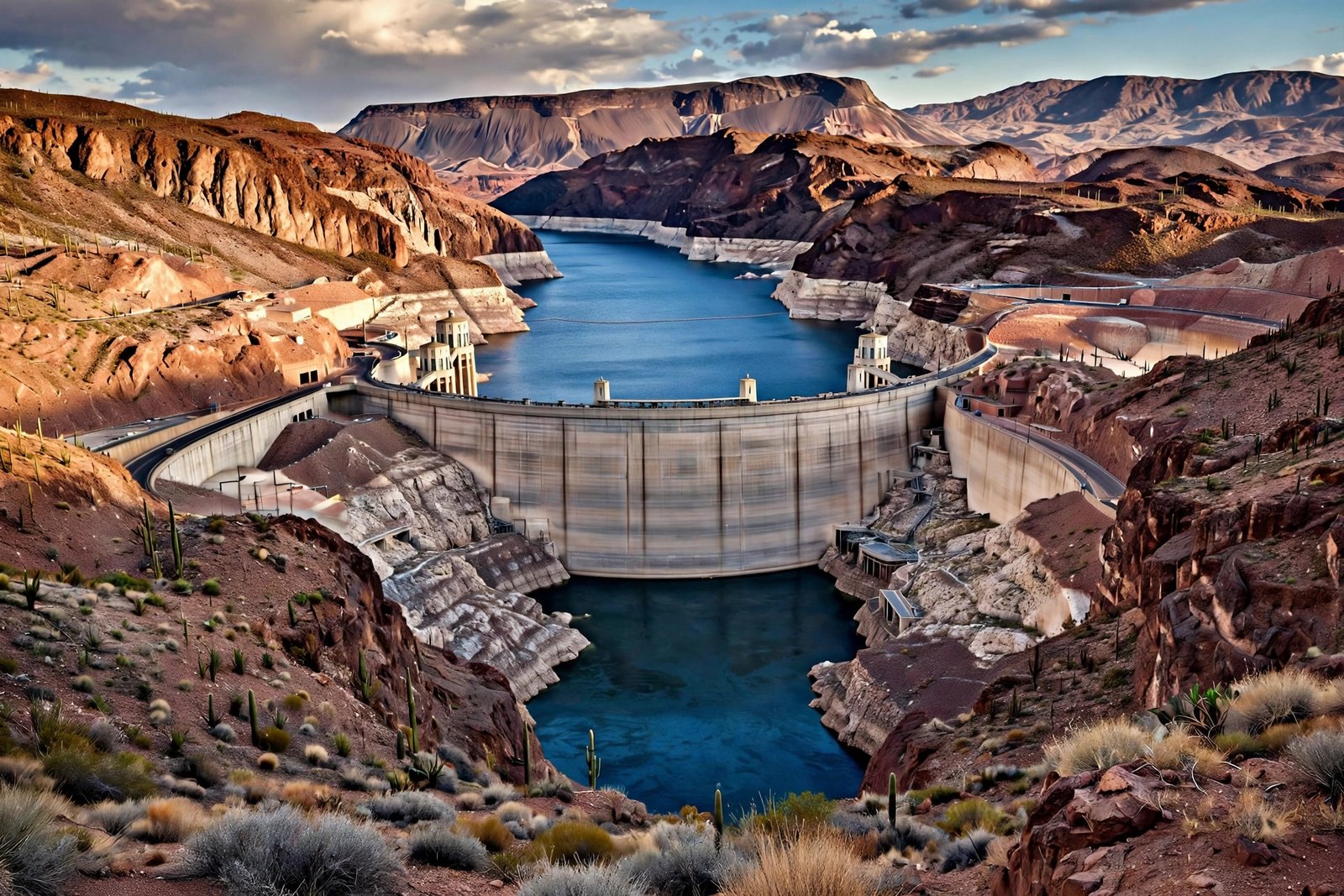
Rising out of a deep desert canyon on the border between Nevada and Arizona, the Hoover Dam looks almost impossible: a curved wall of concrete taller than a sixty-story building, holding back one of the largest reservoirs in the country. Yet this engineering marvel was built in less than five years, during the Great Depression, by thousands of workers laboring in brutal desert heat. The history of the Hoover Dam is a story of ambition, hardship, and ingenuity, and it changed the American West forever.
Before the dam existed, the Colorado River was both a lifeline and a threat. It watered farms and promised hydroelectric power, but its floods regularly devastated communities in the Imperial Valley of California, and its flow swung wildly between spring floods and low summer water. Taming the river became one of the great goals of the early twentieth century, and the dam that rose in Black Canyon was the answer. Today it supplies water and power to millions of people, and it remains one of the most visited engineering landmarks in the United States.
The History of the Hoover Dam Begins With a Wild River
The history of the Hoover Dam begins long before construction, with the problem of the Colorado River itself. The river runs for about 1,450 miles from the Rocky Mountains to the Gulf of California, carving the Grand Canyon along the way and watering a vast, dry region. In the early 1900s, farmers in the Imperial Valley depended on its water, but they also lived in fear of its floods. In 1905, a canal failure sent the river pouring into the valley for months, creating the Salton Sea and showing just how dangerous an uncontrolled river could be.
Engineers and politicians began to argue that only a large dam on the lower Colorado could solve the problem. A dam could store floodwater, release it steadily for irrigation, and generate electricity at the same time. Several sites were considered, but Black Canyon, a narrow gorge of dark volcanic rock downstream from Boulder Canyon, was chosen because its steep walls offered a strong foundation and a natural place to anchor a high dam. The project was authorized by the Boulder Canyon Project Act, signed into law in December 1928.
The dam was originally called Boulder Dam, after the canyon first studied for the project, and it was later renamed for President Herbert Hoover, who had championed the project as Secretary of Commerce and as president. The name changed back and forth in political debates for years, but in 1947 Congress officially settled on Hoover Dam, the name used today.
History of the Hoover Dam: Building in the Great Depression
Construction began in 1931, at the depth of the Great Depression, when jobs were desperately scarce. The contract went to a group of construction firms working together as Six Companies, Inc., and the man who ran the job day to day was Frank Crowe, a superintendent famous for his experience building dams across the West. Thousands of unemployed workers and their families flocked to the desert, hoping for work, and many lived at first in rough camps along the river.
Conditions were harsh. Summer temperatures in Black Canyon regularly soared above 110 degrees Fahrenheit, and workers labored on steep canyon walls, in tunnels, and on the riverbed itself. The federal government built a new town, Boulder City, to house workers and their families, with homes, schools, and stores, and it banned alcohol and gambling there in an effort to keep order. Life in Boulder City was strict but far better than in the early tent camps, and the town still exists today as a gateway for dam visitors.
The first great task was to tame the river itself. Workers drilled four huge diversion tunnels, two on each side of the canyon, so the Colorado could be routed around the construction site. Once the river was diverted, crews excavated down to bedrock and began pouring concrete. Because a single solid block of concrete that size would have taken more than a century to cool, engineers poured it in interlocking blocks and ran cold water through pipes inside the concrete to carry away the heat. It was a brilliant solution, and it is one reason the dam remains so strong today.
The workforce peaked at more than five thousand men, working around the clock in shifts. They drilled, blasted, poured concrete, and built the powerplant and intake towers that would control the water. High scalers, workers who dangled from ropes on the canyon walls to knock loose rock, became legends of the project. The work was dangerous, and according to the United States Bureau of Reclamation, 96 workers died during construction, a somber figure recorded on a memorial plaque at the site. Their sacrifice is part of the dam’s story, and visitors today can see the memorial and reflect on the human cost behind the concrete.
An Engineering Wonder Takes Shape
The finished dam is an arch-gravity structure, meaning its curved shape presses against the canyon walls while its enormous weight holds back the water. It stands about 726 feet tall from foundation to crest and stretches about 1,244 feet across the canyon at the top. Its base is about 660 feet thick, narrowing to about 45 feet at the crest, where a roadway carries traffic across the river. Behind it, Lake Mead, named for Elwood Mead, the Commissioner of Reclamation who oversaw the project, became the largest reservoir in the United States by volume when full.
The dam’s powerplant is another marvel. Water drops through penstocks to turbines in powerhouses on both sides of the river, generating electricity for Nevada, Arizona, and California. The plant has long been one of the largest hydroelectric facilities in the country, and its power helped cities like Los Angeles, Las Vegas, and Phoenix grow through the twentieth century. Even today, after nearly ninety years of service, the plant continues to generate clean, renewable electricity, though its output varies with the level of Lake Mead.
Filling Lake Mead took years, and the reservoir transformed the desert landscape. Boating, fishing, and recreation grew around its shores, and the Lake Mead National Recreation Area now draws millions of visitors a year. The water stored behind the dam also made large-scale farming possible in the desert Southwest and secured drinking water for fast-growing cities. For all these reasons, the dam is often described as the project that made the modern American Southwest possible.
Dedication and the Dam in American Life
The dam was completed ahead of schedule. The last concrete was poured in 1935, and President Franklin D. Roosevelt formally dedicated the project on September 30, 1935, before a crowd of thousands. In his speech, he praised the workers and called the dam a monument to American ingenuity and perseverance. The final construction work, including the powerplant, continued into 1936, but the dedication marked the moment the nation celebrated what had been achieved.
In the decades that followed, the Hoover Dam became a symbol of what large public works could accomplish. It appeared in films, photographs, and travel guides, and it drew tourists from around the world. Engineers studied its design, and its construction methods influenced later dams across the globe. For many Americans during the Depression, it was proof that the country could still build great things in hard times, and that spirit is still part of its appeal today.
The dam also changed how Americans thought about the West. Before it, the desert Southwest was seen as a harsh, thinly settled frontier. After it, cities boomed, farms spread across irrigated valleys, and millions of people made their homes in a region that depends on the Colorado River to this day. That dependence also brings challenges, as drought and growing demand have lowered Lake Mead in recent years, but the dam itself remains a vital part of the region’s water and power system.
Visitors who love America’s great landscapes often pair a dam trip with the natural wonders nearby. The Grand Canyon, carved by the same Colorado River the dam holds back, is a natural companion stop, and its story is told in guides to facts about the Grand Canyon. Wildlife watchers heading to the region may also enjoy learning where to see bald eagles in the USA, since eagles and other birds gather around the lakes and rivers of the West. And for travelers planning a wider western journey, the autumn colors of the region feature in guides to the best fall foliage destinations in the USA.
The Dam Today: Power, Water, and a Changing River
Today, the Hoover Dam is both a working piece of infrastructure and a major tourist attraction. Nearly a million people a year have visited in busy years, touring the powerplant, walking across the crest, and looking down into Black Canyon from the Mike O’Callaghan-Pat Tillman Memorial Bridge, which opened in 2010 and carries highway traffic high above the dam. The bridge itself is an engineering achievement, with the longest single-span concrete arch in the Western Hemisphere at the time of its completion.
The dam’s role has also evolved. As the Southwest has grown and the climate has changed, managing the Colorado River has become more complex. Seven states and Mexico share the river’s water under agreements that date back to the dam’s era, and those agreements are now under strain from long-term drought. Lake Mead’s level has fallen far below its full mark at times, revealing old shorelines and even the remains of a town flooded when the reservoir filled. Engineers have adapted the dam’s operations, and discussions about the river’s future now involve every state that depends on it.
Despite these challenges, the dam endures. Its concrete continues to hold back the river, its turbines continue to spin, and its story continues to inspire. Preservation work keeps the structure and its Art Deco details in good repair, from the bronze sculptures and terrazzo floors of the visitor areas to the towers that rise from Lake Mead. The dam is listed as a National Historic Landmark, recognizing its importance to American history and engineering.
Why the Hoover Dam Still Matters
The history of the Hoover Dam matters because it is about more than concrete and water. It is about a nation that, in its hardest economic decade, chose to build something lasting. It is about workers who risked their lives in a desert canyon and a town that grew up to support them. And it is about the choices Americans made to reshape a river, choices that brought prosperity to millions but also created responsibilities that continue today.
For anyone visiting the American West, the dam is a must-see stop. Stand on its crest and look down at the river far below, tour the powerplant deep inside the canyon walls, and take a moment at the memorial to the workers who built it. You will come away with a deeper appreciation for the ambition and the cost behind one of America’s greatest engineering achievements.
Plan your visit, bring water and sun protection for the desert heat, and set aside time to explore Lake Mead and Boulder City too. The story of the Hoover Dam is best understood where it happened, in the canyon, on the water, and in the town that still honors the people who built it.