
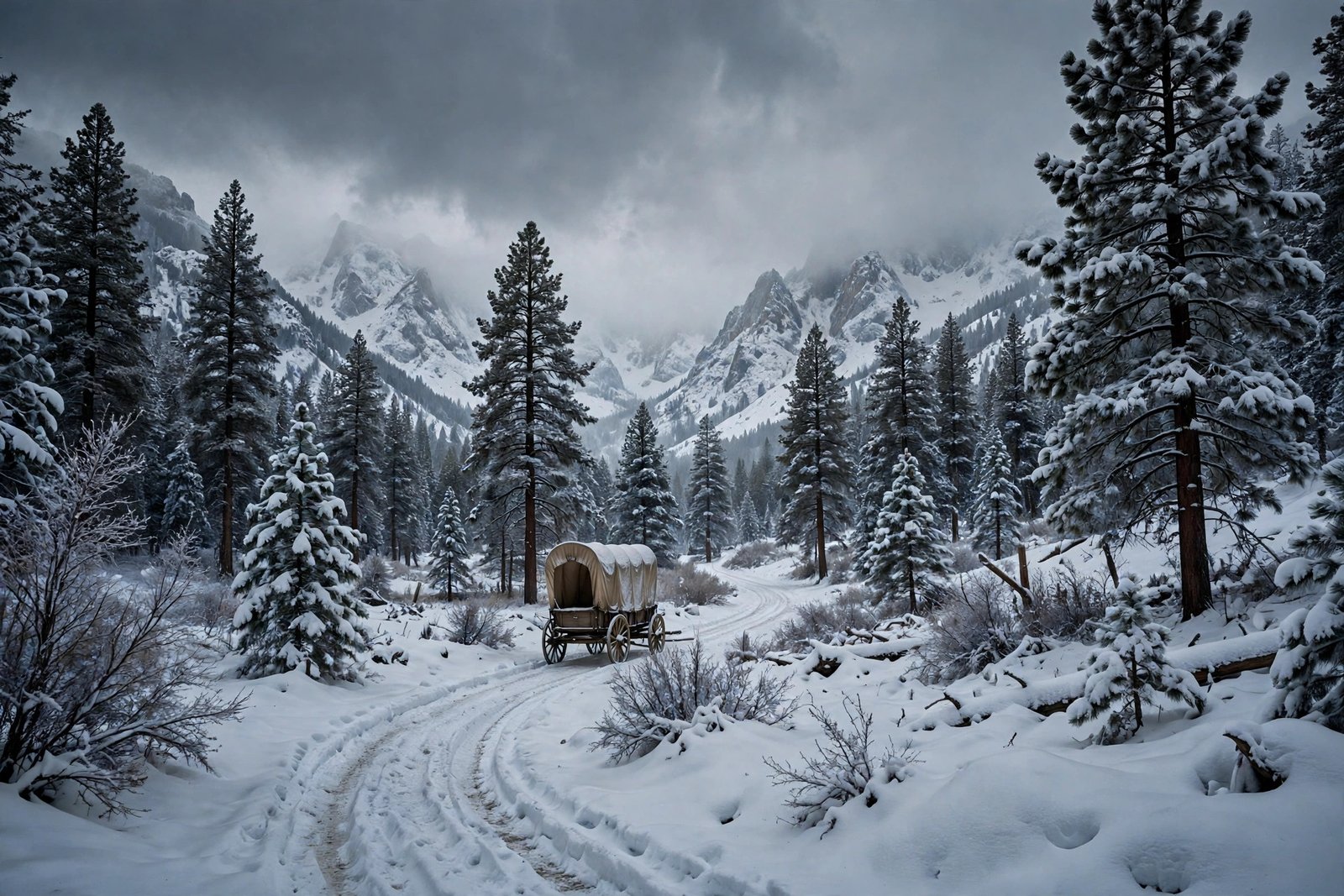
The Donner Party true story is one of the darkest chapters in American westward expansion — a tale of bad decisions, brutal weather, and desperate survival in the winter of 1846–47. What began as an optimistic wagon journey to California ended with a group of pioneers trapped by deep snow in the Sierra Nevada, forced to endure months of starvation. Stripped of myth and sensationalism, the real history is even more harrowing than the legend. This is what actually happened.
The Donner Party True Story Begins: A Fateful Decision
In the spring of 1846, a group of families and single men — eventually known as the Donner-Reed party — set out from Independence, Missouri, bound for California. The party was led in part by two brothers, George Donner and Jacob Donner, wealthy Illinois farmers, and by James F. Reed, an Illinois businessman traveling with his family in a famously large and comfortable wagon.
The group followed the established Oregon Trail westward for hundreds of miles without serious trouble. But in Wyoming, they made the decision that sealed their fate: they chose to take an untested shortcut called Hastings Cutoff, promoted by an emigrant guidebook author named Lansford Hastings. Hastings claimed the route would shave hundreds of miles off the journey to California. In reality, he had never traveled the cutoff himself with wagons.
Hastings was not even there to guide them. When the party arrived at the cutoff’s entrance, Hastings had ridden ahead with another group. He left a note advising the Donner party to wait — a note they received only after costly delays. Against the advice of experienced mountain men, the party pressed on into the Wasatch Mountains of present-day Utah.
Lost Weeks in the Desert: The Hastings Cutoff Disaster
The Hastings Cutoff proved to be a nightmare. The route forced the wagons through:
- The Wasatch Mountains, where the party had to hack a road through dense forest and steep canyons — work that cost them roughly two to three weeks.
- The Great Salt Lake Desert, an 80-mile waterless crossing where wagons sank in salt mud, oxen died of thirst, and the party lost many of its remaining supplies.
- The Ruby Mountains of Nevada, where difficult terrain and dwindling provisions further slowed them down.
By the time the Donner-Reed party rejoined the established California Trail along the Humboldt River in Nevada, they were weeks behind schedule, their oxen were dying, their food was running low, and tensions were boiling. Along the Humboldt, a teamster named Hardkoop was abandoned to die after he could no longer walk, and James Reed — after a dispute in which he fatally stabbed another man, John Snyder, during an argument — was banished from the party and forced to ride ahead to California alone.
Trapped: The Donner Party True Story of the Sierra Winter
In late October 1846, the party reached the eastern foot of the Sierra Nevada near present-day Truckee, California. They needed to cross the pass before winter snows closed it. They were agonizingly close — but an early, heavy snowstorm struck while they were still climbing.
Attempting the pass in deep snow proved impossible. The wagons could not move, and the oxen were too weak. The party retreated and made winter camp: most families sheltered near Truckee Lake (today’s Donner Lake), while the Donner brothers’ families, delayed by a broken wagon axle, camped several miles back at Alder Creek.
What followed was one of the worst winters on record in the Sierra Nevada. Snow piled many feet deep — historical accounts describe drifts burying the cabins the pioneers hastily built. Their food ran out. They ate their oxen, then boiled hides and bones for soup, then mice, bark, and anything remotely edible. Starvation set in as December turned to January and then February.
The Forlorn Hope: A Desperate Escape Attempt
In mid-December 1846, with starvation closing in, fifteen of the strongest members of the camp — men, women, and older children — set out on foot on crude snowshoes, hoping to cross the mountains and bring back rescue. This group became known as the Forlorn Hope.
Their journey was catastrophic. Caught in a blizzard, lost and starving in the deep snow, members of the Forlorn Hope began to die one by one. The survivors resorted to eating the flesh of those who had died — the first instances of cannibalism in the Donner Party true story. After more than a month of unimaginable suffering, only a handful of the fifteen reached a ranch in California’s Sacramento Valley, where they raised the alarm.
Rescue Efforts and the Final Toll
News of the stranded party reached California settlements in early 1847, and several rescue parties — known as the First, Second, Third, and Fourth Reliefs — fought their way through the snow to the camps between February and April 1847. Each relief brought out survivors, with the rescuers themselves barely surviving the return trips.
The final toll was devastating. Of the roughly 80 to 90 people who had been trapped in the mountains that winter, around half died — men died at a far higher rate than women and children, a pattern historians attribute to differences in body fat, exertion, and exposure. The Donner brothers, George and Jacob, both perished at Alder Creek. James Reed, who had been banished months earlier, organized one of the rescue efforts and was reunited with his surviving family.
The survivors were brought to Sutter’s Fort and other California settlements, many of them permanently scarred — physically and psychologically — by what they had endured.
Fact vs. Legend in the Donner Party True Story
The Donner Party true story has been retold so many times that myth and fact have blurred. Here is what historians generally agree on, versus what is exaggerated:
- Fact: The party took Hastings Cutoff, lost weeks in the Wasatch and the salt desert, and was trapped by an early, severe Sierra winter.
- Fact: Starvation drove both the Forlorn Hope and the camp survivors to cannibalism of those who had already died. There is no credible evidence of murder for food in the main camps, though the topic was sensationalized for decades.
- Legend: Tales of the party resorting to cannibalism immediately or preferring it are false — it was a last resort after every other food source, including boiled leather and bones, was exhausted.
- Legend: Some 19th-century accounts portrayed certain survivors as villains. Modern historians treat these stories cautiously, noting they were often based on gossip and anti-immigrant or anti-Catholic prejudice of the era.
- Fact: The tragedy directly influenced later emigration: guidebooks were rewritten, the Hastings Cutoff was discredited, and future wagon trains were warned never to attempt the Sierra so late in the season.
Why the Donner Party Still Matters
The Donner Party true story endures because it is a warning about the razor’s edge between ambition and catastrophe. The pioneers were not reckless fools — they were ordinary families who trusted a guidebook, fell behind schedule through no single person’s fault, and then ran into one of the harshest winters of the century. Their story reminds us how thin the margin of survival was on the American frontier.
Today, Donner Memorial State Park in Truckee, California, preserves the site of the winter camps, with a museum telling the story through artifacts recovered from the site. The Oregon Trail true story and the California Gold Rush true story cover the same era of westward migration from different angles, and our wild west true stories collection explores more of the frontier’s real history.
The Donner Party’s tragedy is a solemn reminder of what the pioneers risked for a new life in the West. Share this true story, visit the memorial if you travel through the Sierra, and keep exploring America’s real history with Beauty of USA.