
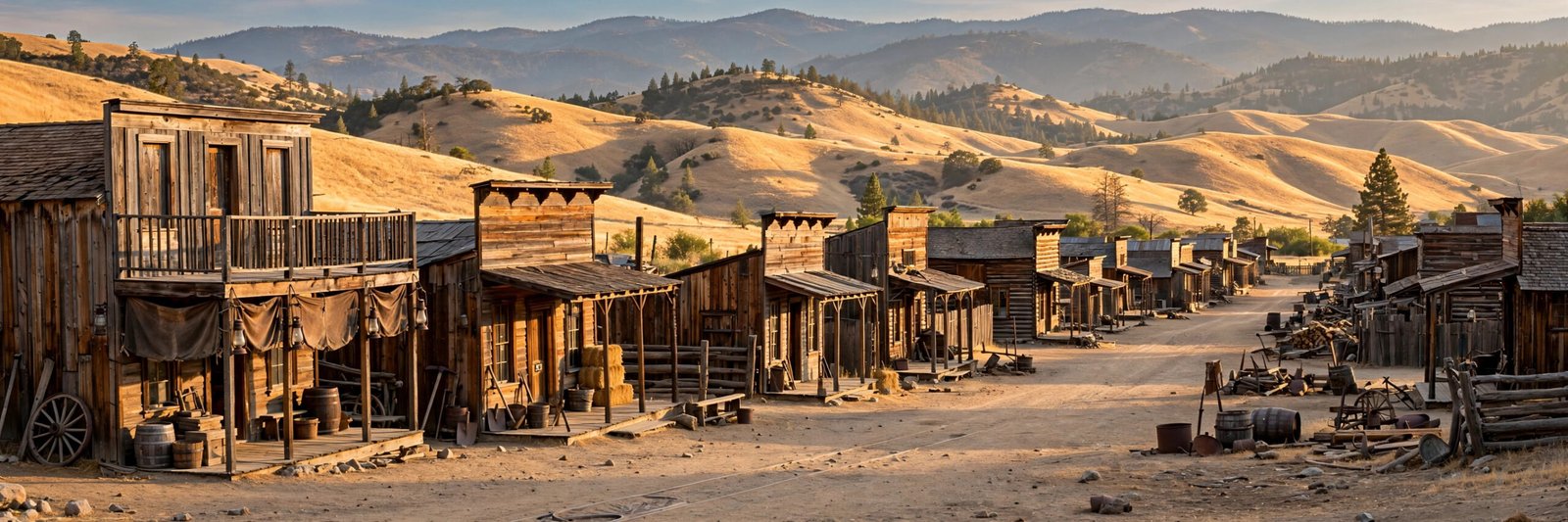
On a cold January morning in 1848, a carpenter checking a sawmill in the foothills of California spotted a few shiny flakes in a stream of water. He did not know it yet, but he had just set off one of the largest mass migrations in American history. The California Gold Rush would pull hundreds of thousands of people across oceans, deserts, and mountains, build cities almost overnight, and push California into the Union far faster than anyone expected. It was a story of hope and hard work, but also of greed, loss, and lasting damage.
In this article, we trace the true story from the first discovery at Sutter’s Mill to the boomtowns, the gold fields, and the legacy that still shapes California today. You will meet the forty-niners, the merchants who got rich without ever digging, the immigrants who crossed the world for a chance, and the Native peoples and longtime residents whose lives were upended. If you love tales of the frontier, our collection of wild west true stories is a great place to keep exploring.
How the California Gold Rush Began
The California Gold Rush began at Sutter’s Mill, a sawmill on the American River near present-day Coloma, California. The mill belonged to John Sutter, a Swiss-born settler who had built a large farming and trading settlement called Sutter’s Fort near what is now Sacramento. In January 1848, his carpenter James Marshall was inspecting the mill’s tailrace, the channel that carried water away from the mill wheel, when he noticed glittering pieces in the water. Tests confirmed what Marshall suspected: it was gold.
Sutter tried to keep the discovery quiet. He worried that a gold rush would ruin his farms, scatter his workers, and bring chaos to the settlement he had spent years building. He was right to worry. Word leaked out within weeks, first to nearby towns and then to San Francisco, where shopkeepers and soldiers left their jobs to search for gold. By the spring of 1848, newspapers in California were full of gold fever, and the story was already traveling east.
At first, many people on the East Coast did not believe the reports. That changed in December 1848, when President James K. Polk confirmed in an address to Congress that gold had been found in California in large amounts. His announcement, along with samples of gold sent back east, turned curiosity into a stampede. The year 1849 would bring the largest wave of newcomers, and those who arrived that year became known as forty-niners.
A World Rushes West
Historians estimate that about 300,000 people arrived in California during the Gold Rush years, coming from across the United States and from around the world. Some traveled overland on wagon trails, a journey that could take four to six months and crossed deserts, rivers, and mountain passes. Many followed routes connected to the Oregon Trail before turning south toward California. For more on that long overland journey, see our account of the Oregon Trail true story. Others chose sea routes, either sailing all the way around South America and up the Pacific coast, or taking a ship to Panama, crossing the isthmus on foot and by canoe, and boarding another ship for San Francisco.
The travelers were a mix of farmers, shopkeepers, soldiers, sailors, teachers, doctors, and teenagers looking for adventure. Most were young men, but women and families came too, and they played a vital role in building schools, churches, businesses, and towns. People arrived from Mexico, Chile, Peru, China, Hawaii, Australia, France, Germany, Ireland, and many other places. California, which had been a sparsely settled Mexican territory just a few years earlier, suddenly became one of the most international places on earth.
San Francisco changed fastest of all. At the start of 1848, it was a small settlement with fewer than a thousand residents. Within two years, tens of thousands of people had poured in, and the harbor filled with abandoned ships whose crews had run off to the gold fields. Tents, wooden shacks, saloons, hotels, and stores sprang up across the hills. Prices soared because everything had to be shipped in, and a simple meal or a shovel could cost many times what it cost back east. The city was rough, crowded, and muddy, but it was also full of energy and possibility.
Life in the Gold Fields
Most newcomers headed for the gold country in the Sierra Nevada foothills, where rivers and creeks carried gold dust and nuggets washed down from the mountains. The earliest miners used simple tools: a metal pan, a shovel, and a strong back. Panning meant scooping gravel from a streambed, swirling it in water, and letting the lighter sand wash away until only heavier gold flakes remained. It was slow, cold, wet work, and a good day might still leave a miner with only a small amount of gold.
As the easiest surface gold was picked up, miners built more complex tools. Sluice boxes used flowing water to sort gravel over wooden riffles that caught the gold. Rocker boxes worked like a cradle, rocking back and forth to separate gold from sand. Later, teams dug shafts, built dams to redirect rivers, and used high-pressure water hoses to wash away entire hillsides in a method called hydraulic mining. That method could recover more gold, but it also tore up landscapes and choked rivers with mud and debris.
Mining camps sprang up wherever gold was found, with names that told their own stories. Some camps grew into lasting towns, while others faded to ghost towns once the gold ran out. Life in camp was hard. Men slept in tents or rough cabins, cooked over open fires, and faced disease, accidents, and harsh weather. Fresh food was scarce and expensive, and many miners suffered from poor diets. Yet camps also had a rough sense of community, with shared rules, makeshift courts, and celebrations when someone struck a rich pocket.
Boomtowns, Prices, and Everyday Life
One of the great surprises of the Gold Rush is that many of the people who made fortunes never mined at all. Merchants, cooks, innkeepers, ship owners, and tool sellers often did better than the miners themselves. A storekeeper who sold pans, boots, flour, and tents at boomtown prices could earn a steady income, while a miner might dig for months and find almost nothing. The old saying that the surest way to get rich in a gold rush is to sell shovels turned out to be largely true.
Among the best-known business stories is that of Levi Strauss, who arrived in San Francisco in 1853 and built a dry-goods business. Years later, he and tailor Jacob Davis patented sturdy work pants with metal rivets, the ancestor of the modern blue jean. Gold Rush workers needed tough clothing that could stand up to hard labor, and denim became part of California’s working identity. Other lasting businesses, banks, newspapers, and shipping lines also trace their roots to the boom years, when California needed everything at once.
Everyday life in Gold Rush California was expensive and unpredictable. A loaf of bread, a pair of boots, or a night in a hotel could cost many times the price back east. Gambling halls and saloons were everywhere, and many miners lost their earnings at card tables. At the same time, theaters, churches, schools, and libraries began to appear as families settled and towns grew more stable. Women who ran boarding houses, bakeries, laundries, and schools often earned more reliable incomes than miners, and some became successful business owners in their own right.
The Human Cost
The Gold Rush was not a fair or happy story for everyone. For Native Californians, it was a disaster. Gold miners poured onto tribal lands, diverted streams, destroyed hunting and fishing grounds, and brought diseases that spread quickly. Violence was widespread, and tens of thousands of Native Californians died from disease, starvation, and attacks during and after the Gold Rush years. The population loss and land loss reshaped California’s Native communities for generations, and historians today describe this period as one of the darkest chapters in California history.
Longtime Mexican and Californio residents also faced pressure and loss. California had become part of the United States after the Mexican-American War, and the Treaty of Guadalupe Hidalgo promised to protect the property rights of Mexican landholders. In practice, many Californio families faced expensive legal fights over their land claims, squatters, taxes, and new laws. Some lost ranchos their families had held for generations.
Immigrant miners faced prejudice as well. Latin American, Chinese, French, and other foreign-born miners were sometimes driven from claims or forced to pay special taxes. California passed a Foreign Miners’ Tax in 1850 that charged foreign miners a monthly fee, and enforcement often fell hardest on Mexican and Chinese miners. Chinese immigrants, who arrived in large numbers and built businesses, roads, and later railroads, faced harsh discrimination and violence. Their resilience and contributions are now recognized as a central part of the Gold Rush story, even though many were treated unfairly at the time.
How the California Gold Rush Changed America
The California Gold Rush sped up California’s path to statehood. The flood of newcomers made it clear that California could not remain a thinly settled territory for long. In 1849, Californians drafted a state constitution, and in September 1850, California entered the Union as the 31st state, skipping the usual territorial stage. That rapid admission raised new questions about slavery in the West, and it became part of the Compromise of 1850, a set of laws that tried to settle disputes between free and slave states. The Gold Rush therefore reached far beyond California and into national politics.
The Gold Rush also changed how Americans thought about movement, opportunity, and the West. The idea that an ordinary person could head west and change their life became a powerful part of the American story. Newspapers, letters, songs, and later books and films spread the image of the prospector with a pan and a dream. At the same time, the rush pushed the United States to think more seriously about connecting East and West. The demand for faster mail, travel, and trade helped build support for a transcontinental railroad, which was completed in 1869, and for telegraph lines, steamship routes, and new roads.
California’s economy changed, too. Mining remained important for years, but farming, ranching, timber, shipping, banking, and manufacturing grew quickly as people stayed and built new lives. The port of San Francisco became a major gateway to the Pacific, linking the United States to trade with China, Japan, Hawaii, and South America. Sacramento, Stockton, and other river towns grew as supply centers for the gold country. The Gold Rush did not just move gold east; it helped tie California to the rest of the country and to the wider Pacific world.
What It Left Behind
The California Gold Rush did not last forever. By the mid-1850s, the easy surface gold was mostly gone, and mining became more industrial, expensive, and corporate. Many individual miners left disappointed, moved on to later rushes in Nevada, Colorado, and Alaska, or settled into farming and town life. Hydraulic mining continued for decades until courts restricted it because of the damage it caused to rivers and farmland. Today, visitors can still see the scars of old mining in parts of the Sierra foothills, along with preserved towns, museums, and parks that tell the story.
One of the best places to see where it all started is Marshall Gold Discovery State Historic Park in Coloma, where James Marshall first found gold at Sutter’s Mill. Museums across California preserve pans, tools, photographs, letters, and diaries from the Gold Rush years, and many old mining towns still welcome visitors with main streets that look much as they did in the 1850s. Those places offer a chance to stand where history happened and to imagine the noise, mud, hope, and hardship of a gold camp.
The Gold Rush also left a mixed legacy that Americans still debate. It built cities, filled libraries and museums, and gave California its Golden State identity. It also brought environmental damage, dispossession, and violence that cannot be ignored. The full story includes both the excitement of a young carpenter finding gold in a millrace and the losses suffered by the people who were already living on the land. Remembering both sides is what makes the history honest and worth telling.
Today, the Gold Rush remains a reminder of how quickly the world can change. A single discovery transformed a quiet valley into a global destination, turned a small port into a great city, and helped shape a state that still draws dreamers from around the world. Whether you visit Coloma, explore a gold-country museum, or simply read the letters of a forty-niner, the story still has the power to amaze. Share this article with a history lover, plan a trip to California’s gold country, and keep exploring the real stories that built the American West.