
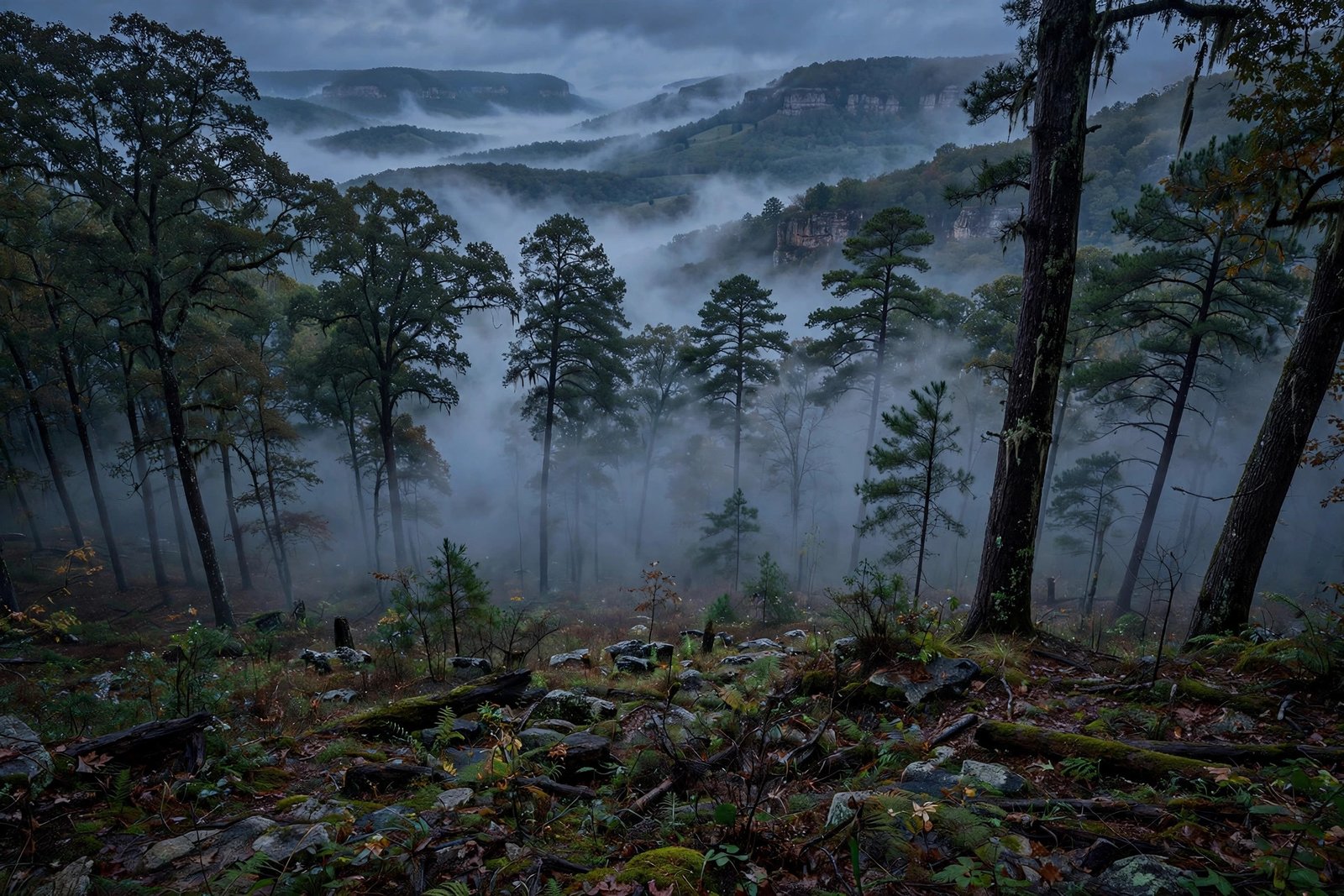
On a quiet night deep in the Ozark Mountains, the story goes, a sound rolls out of the dark trees that does not belong to any animal most people can name. It is loud, it is strange, and it is said to make even experienced hunters stop and listen. That sound sits at the heart of the Ozark Howler legend, a piece of American folklore that has been told around campfires, in small towns, and on back roads across Arkansas, Missouri, and Oklahoma for generations. Whether you first heard it from a grandparent, a local storyteller, or a late-night tale swapped at a campground, the Howler has a way of sticking in your memory long after the story ends.
This guide explains the legend clearly, separates folklore from fact, and explores why this creature still captures imaginations today. You will not find confirmed proof here, because there is none that science accepts. What you will find is the story itself, how it likely grew, what people say they have heard and seen, and how to enjoy the Ozarks — the real mountains, forests, and towns behind the tale — safely and respectfully. If you love American legends, this is one of the most atmospheric ones you can explore.
What Is the Ozark Howler Legend?
At its simplest, the Ozark Howler is described in folklore as a large, cat-like creature said to roam the Ozark Mountains. Storytellers often describe it as bigger than a bobcat or a mountain lion, with dark fur, glowing eyes in some versions, and a cry that sounds like a mix between a wolf howling, a woman screaming, and an animal in distress. The details change from teller to teller, which is itself a clue about how folklore works: each community adds its own details, and each retelling sharpens the parts that frighten or fascinate listeners most.
In many versions, the creature is shy and nocturnal. It is heard far more often than it is seen, which helps explain why the legend endures. A strange sound in the woods at night is easy to remember and hard to explain, especially before modern recording equipment and wildlife guides were widely available. A sound you cannot identify can feel much larger and stranger than the animal that actually made it. Over time, those unexplained sounds gathered a name, a shape, and a story.
It is important to be clear from the start: the Ozark Howler is folklore, not a confirmed animal species. No specimen, verified photograph, or peer-reviewed scientific study has established that such a creature exists. Wildlife agencies do not list it as a real species. That does not make the stories worthless. Folklore tells us a great deal about a place, its people, its fears, and its sense of humour, even when the creature at the centre of the tale is not real in a biological sense.
Origins of the Ozark Howler Legend
The origins of this folklore are difficult to pin to a single date or a single person, and that is typical of oral tradition. Tales of strange creatures in the Ozarks have circulated for a long time, passed along by families who lived close to the forest and spent long evenings without electric light or modern entertainment. In that world, stories were a way to teach caution, to entertain children, and to make sense of a landscape that could feel vast, dark, and unpredictable after sunset.
Some storytellers connect the Howler to older frontier tales of wild cats and wolves in the region. The Ozarks were once home to animals that are now rare or gone from the area, and the memory of large predators may have lingered in local stories long after the animals themselves became scarce. Other versions draw on the broader American tradition of cryptid tales — stories of hidden or mysterious creatures — that flourished in the twentieth century as newspapers, radio, and later television gave local legends a wider audience.
Another likely ingredient in the Ozark Howler legend is misidentification. The Ozarks are home to real animals that can sound startling at night, including coyotes, foxes, owls, and bobcats. A bobcat scream, a coyote chorus echoing through a hollow, or a fox call in the dark can sound far stranger than expected, especially to someone who is tired, far from home, or already listening for something unusual. If you want to know what real wild cats in the region sound and look like, our guide to where to see bobcats in the USA is a useful reality check. Folklore often starts with a genuine experience — a sound, a shadow, a track — and then grows around it.
What Witnesses Describe
Accounts attributed to witnesses vary widely, which is another reason folklorists treat the Howler as legend rather than fact. Some people describe a large black cat-like animal moving quickly through the underbrush. Others describe only a sound: a long, wavering howl that rises and falls, sometimes described as almost human. Still others describe glowing eyes caught in a flashlight beam, a common experience in the woods, since many real animals have reflective eyes that shine brightly at night.
The creature is often said to be most active at night, near rivers, hollows, and dense forest. That setting matters. The Ozarks are full of steep hollows, thick woods, and winding waterways where sound carries in odd ways and visibility is limited. A sound made some distance away can seem close. A shape glimpsed for a second can seem much larger in memory than it was in life. These are normal features of human perception in wild places, not signs of something supernatural.
Some retellings add dramatic details: livestock disturbed at night, dogs barking at nothing visible, or a feeling of being watched. Again, these details are familiar from many folklore traditions around the world. They make a good story, and they express a very real human feeling — the unease of being alone in a large, dark forest. Good folklore captures a feeling, even when it invents a creature to carry it.
The Howler in Ozark Culture and Storytelling
Beyond campfire tales, the Howler has become part of local identity in parts of the Ozarks. Like other regional legends, it gives communities a story that belongs to them. Local storytellers, festivals, and small-town lore keep such tales alive, and visitors often enjoy hearing them as part of the experience of a place. A legend can be a kind of cultural landmark, as distinctive as a river, a mountain, or a historic building, even though you cannot photograph it in the same way.
The Howler also sits comfortably alongside other famous American legends. Readers who enjoy this kind of tale may also enjoy our explainer on another well-known creature of folklore, the Mothman legend explained, which follows a similar pattern: striking sightings, a community that keeps the story alive, and a clear line between what is legend and what is verified fact. Comparing legends is a good way to see how folklore works across different regions.
For writers, artists, and musicians, the Howler is a rich source of inspiration. Its cry, its shadowy form, and its forest home lend themselves to songs, paintings, short stories, and local theatre. That creative afterlife is part of why the legend survives. Each new song or story introduces the Howler to a new audience, who then retell it in their own words, keeping the tradition moving forward.
Folklore vs Fact: What We Actually Know
It helps to draw the line plainly. What we know is that the Ozarks are a real, beautiful mountain region with a long history of storytelling, rich wildlife, and communities that value their local traditions. What we do not know — because no reliable evidence supports it — is that a giant howling cat-creature lives there. The absence of evidence is not a flaw in the story. It is simply the difference between folklore and zoology.
Scientists who study wildlife rely on repeatable evidence: tracks that can be measured, photographs that can be checked, DNA, remains, and observations by trained researchers. The Ozark Howler legend has produced stories, but not that kind of evidence. That is true of most cryptid legends, and it is why museums and wildlife agencies do not treat them as real species. Enjoying the story does not require believing it literally, and questioning it does not require dismissing the people who tell it.
There is also a practical point. If you hear a strange sound in the Ozarks at night, the most likely explanations are ordinary and interesting in their own right. Coyotes communicating across a valley, owls calling to each other, foxes, and even deer can all produce sounds that surprise first-time visitors. Learning to recognise those real sounds is part of becoming a more confident outdoors person, and it makes the forest less frightening, not less magical.
Exploring the Real Ozarks Behind the Legend
The best way to enjoy this legend is to visit the landscape that inspired it. The Ozark Mountains stretch across northern Arkansas and southern Missouri, with the Ouachita Mountains nearby in Arkansas and Oklahoma, offering forests, rivers, caves, and small towns with deep musical and craft traditions. The Buffalo National River in Arkansas, the Mark Twain National Forest in Missouri, and the many state parks of the region are excellent places to hike, paddle, camp, and listen to the real sounds of the forest.
Plan a visit with the same care you would bring to any mountain trip. Choose marked trails, check weather and park information, carry water, tell someone your plans, and keep a respectful distance from wildlife. If you camp, store food properly and keep your campsite clean. The real Ozarks reward slow travel: a morning walk along a river, an evening listening to frogs and owls, a visit to a local diner or music venue, and a conversation with a local storyteller will teach you more about the region than any monster hunt.
Local museums, visitor centres, and libraries are also worth a stop. They can point you to books on Ozark history and folklore, and staff can often recommend storytellers and events where legends are shared in their proper context — as entertainment, heritage, and community memory. If you attend a storytelling event, listen with respect. These stories belong to the people who tell them, and the best response is curiosity, not mockery.
Why Legends Like This Endure
Legends endure because they do more than one job at once. They entertain, they warn, they bind a community together, and they give a landscape a sense of mystery. A child who hears about the Howler learns to respect the forest at night. An adult who retells the story keeps a family tradition alive. A visitor who hears it gains a reason to look more closely at the hills and hollows, and to ask questions about the place they are visiting.
The Howler also taps into a universal human experience: the feeling of hearing something you cannot explain. Everyone has had a moment when a sound in the dark made them pause. Folklore gives that moment a name and a shape, and turns a private unease into a shared story. That is why similar legends appear all over the world, from lake monsters to forest spirits, each shaped by its own landscape and culture.
In the end, the value of the legend is not in proving a creature exists. It is in what the story reveals about the Ozarks and the people who love them: a region of deep forests, strong communities, vivid imaginations, and a storytelling tradition that is still very much alive. Whether you believe, doubt, or simply enjoy the tale, it offers a doorway into a remarkable part of America.
Plan Your Ozark Adventure
If this story has sparked your curiosity, start with the real Ozarks. Pick a state park or national forest, plan a day hike, and spend an evening in a nearby town. Talk to locals, visit a farmers market, listen to live music, and take time to learn the names of the trees, birds, and animals around you. The more you know about the real forest, the richer the legend becomes — because you will understand exactly why people looked at those dark hills and imagined something extraordinary moving through them.
Share the story responsibly. When you retell the Ozark Howler legend, keep the folklore label attached. Say clearly that this is a legend, not a confirmed sighting, and enjoy it for what it is: a wonderful piece of American storytelling. That honesty protects both the tradition and the wildlife of the region, and it lets new listeners enjoy the tale without confusion. Then, when night falls and the forest sounds begin, listen carefully. You may hear a coyote, an owl, or a fox — and you will understand, in a small way, how a legend is born.