
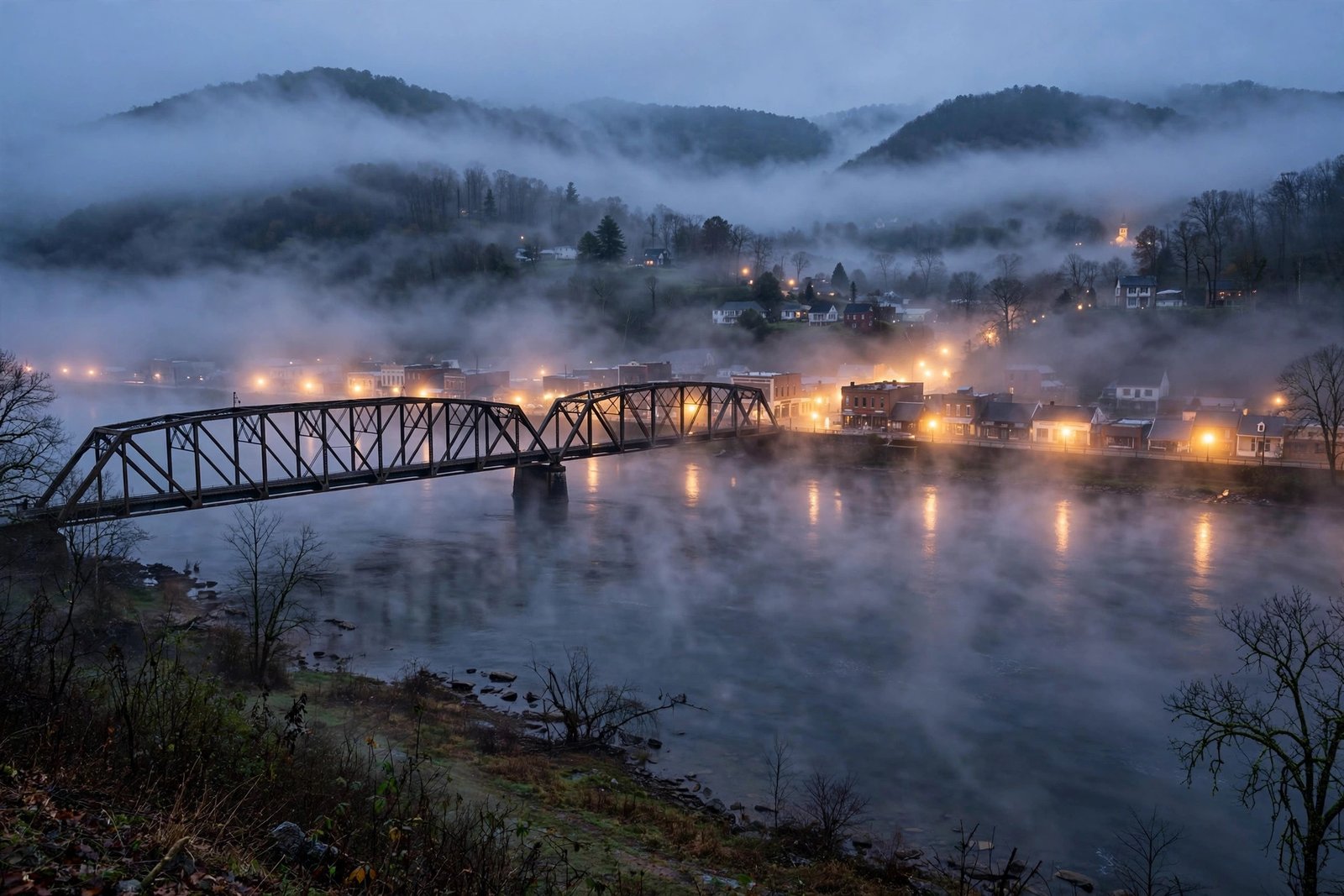
On a quiet November night in 1966, two young couples driving near the small Ohio River town of Point Pleasant, West Virginia, said they saw something that would haunt American folklore for decades. The Mothman legend began that night, with reports of a tall, winged figure with glowing red eyes standing near an abandoned industrial site outside town. Within a year, the strange sightings had spread through the region, newspapers had picked up the story, and a local mystery had become one of the most enduring pieces of American folklore.
What makes this story so fascinating is not just the creature itself. It is the way a handful of unexplained reports, a real and terrible tragedy, and a small town trying to make sense of it all became tangled together. Some people treat the tale as a spooky campfire story. Others believe something genuinely unexplained visited Point Pleasant. And many residents simply embrace it as part of their town’s identity, complete with a statue, a museum, and an annual festival.
This article separates what is documented from what is legend. We will walk through the original reports, the setting, the real historical event that became attached to the story, and why the tale still draws thousands of curious visitors to West Virginia every year. Whether you are a skeptic, a believer, or simply curious, the story of Point Pleasant is worth understanding on its own terms.
The Mothman Legend Begins in Point Pleasant
Point Pleasant sits where the Ohio and Kanawha rivers meet, in the western corner of West Virginia. In 1966 it was a quiet farming and river town of a few thousand people, the kind of place where everyone knew everyone else and where a strange story could travel fast. That November, local newspapers began printing accounts from residents who said they had seen something unusual near the so-called TNT area, a stretch of wooded land outside town that had once housed a World War II munitions plant.
The first widely reported sighting is dated to November 15, 1966. According to newspaper accounts from the time, two couples driving through the TNT area late at night said they encountered a large, gray, winged figure standing near an old building. They described it as roughly human in shape but far taller than a man, with wings folded against its back and a pair of large, bright red eyes that seemed to glow in their headlights. Frightened, they drove away at high speed and reported the encounter to local authorities.
In the weeks that followed, more residents came forward with similar accounts. Some said they saw the figure standing beside roads or near the old bunkers and igloo-shaped storage structures left over from the munitions plant. Others said they saw it in flight, gliding low over the trees or keeping pace with their cars. Local newspapers gave the creature a name that stuck: Mothman. The name was reportedly coined by a newspaper writer, drawing on a popular comic book character of the era, and it turned a frightening local report into a headline-ready story.
It is important to remember what these accounts are. They are reports, not proven facts. No photograph, physical evidence, or scientific documentation of the creature has ever been produced. What is documented is that people in and around Point Pleasant reported seeing something they could not explain, that local newspapers covered those reports, and that the story grew from there. Everything beyond that belongs to folklore, speculation, and storytelling.
What Witnesses Said They Saw
Across the reported sightings, certain details repeat often enough to form the classic description of the creature. Witnesses generally described a figure standing roughly six to seven feet tall, with a broad, human-like body and large wings. The most consistent detail, repeated in account after account, was the eyes: large, round, and glowing red, often described as reflecting light like an animal’s eyes in headlights.
Other details varied. Some witnesses said the creature had no visible head, with the eyes set directly into its chest or shoulders. Some said it had no arms, or that its wings served as arms. Some described it as walking clumsily on the ground, while others said it rose into the air without flapping its wings, gliding smoothly like a bird riding a current. A few said it could keep pace with cars traveling at highway speeds, a claim that has fueled decades of debate about what, if anything, people actually saw.
Skeptics have offered many natural explanations for these reports over the years. Large birds, especially owls and sandhill cranes, have been suggested as the most likely source of confusion. A sandhill crane can stand several feet tall, has a wingspan of six feet or more, and has a patch of red skin around its eyes that can appear to glow in bright light. An owl startled at night, seen briefly in headlights, can also look far larger and stranger than it is. None of these explanations has been proven for any specific sighting, but they show how an unfamiliar animal glimpsed in the dark could be misread as something extraordinary.
Believers, on the other hand, point to the consistency of the reports and the number of people who came forward. They argue that too many witnesses described similar features for every sighting to be a simple mistake. That disagreement, between natural explanations and unexplained mystery, is at the heart of why the story has lasted so long. Neither side has produced proof that settles the question, and that unresolved tension is part of the tale’s appeal.
The TNT Area: Where the Reports Clustered
Many of the sightings were centered on the TNT area, a sprawling tract of land north of Point Pleasant that once served as the West Virginia Ordnance Works, a munitions manufacturing site during World War II. After the war, the plant was abandoned, leaving behind a network of concrete bunkers, storage igloos, crumbling buildings, and overgrown roads. By the 1960s, the area was largely deserted, used by teenagers for joyrides, by hunters and fishermen, and by anyone looking for a quiet place outside town.
The setting matters because it shaped how the story was told. The TNT area already had a reputation as a spooky, off-limits place, the kind of landscape where teenagers dared each other to go at night. Old industrial ruins, dense woods, and a maze of dark roads made it easy to imagine something lurking there. When the first reports emerged from that landscape, they fit neatly into a place that already felt eerie to locals.
The area also attracted wildlife, which matters for the skeptical explanations. The woods and wetlands around the old plant are home to owls, herons, cranes, and other large birds, as well as deer and other animals that can startle drivers at night. A large bird rising suddenly from a roadside ditch, caught in headlights, can look enormous for a split second. In a place already primed for ghost stories, that split second could become the seed of a legend.
Today, parts of the old TNT area are preserved within a wildlife management area, and the concrete bunkers still stand among the trees. Visitors who explore the area find a quiet, wooded landscape that feels far removed from the sensational stories attached to it. For many, walking the same roads where the reports originated is the most atmospheric part of a trip to Point Pleasant, a chance to see the real place behind the folklore.
The Silver Bridge Collapse
Just over a year after the first reported sighting, Point Pleasant suffered a genuine catastrophe. On December 15, 1967, the Silver Bridge, which carried U.S. Route 35 across the Ohio River between Point Pleasant and Gallipolis, Ohio, collapsed during evening rush hour. The bridge fell into the river, taking cars and trucks with it. Forty-six people were killed in the disaster, a devastating loss for two small river communities.
The collapse was a real historical event with a documented cause. An investigation found that the failure of a single eyebar in the bridge’s suspension chain triggered the collapse. The disaster led to major changes in how bridges are inspected in the United States, including more rigorous national inspection standards. A memorial to the victims stands in Point Pleasant today, and the tragedy remains a solemn part of the town’s history.
Over time, popular retellings of the Mothman story connected the creature to the bridge collapse, suggesting that the sightings had been a warning or a harbinger of the disaster. Some versions of the tale claim that the creature was seen near the bridge before it fell, or that the sightings stopped after the collapse. These connections were popularized by books, documentaries, and later by the 2002 film The Mothman Prophecies, which blended the reported sightings with the bridge disaster into a single dramatic narrative.
It is essential to be clear here: the connection between the creature and the bridge is part of the folklore, not part of the documented record. The bridge collapse had a known engineering cause, and there is no evidence that the reported sightings had anything to do with it. What happened is that a real tragedy and an unexplained local mystery, occurring in the same small town within about thirteen months of each other, became fused together in storytelling. That fusion is what turned a regional curiosity into a nationally known legend, but it should never overshadow the real loss suffered by the victims’ families.
From Local Reports to a National Story
The story might have faded as a local curiosity if not for a writer named John Keel, who investigated the Point Pleasant reports and published a book about them in 1975, The Mothman Prophecies. Keel interviewed witnesses, collected accounts, and wove them into a sweeping narrative that included not just the creature but also claims of strange lights, mysterious visitors, and prophetic warnings. His book brought the story to a national audience and shaped how it would be told for decades afterward.
Keel’s book is a work of paranormal writing, not a work of journalism or history, and many of its more dramatic claims have never been corroborated. But its influence is undeniable. It established the basic shape of the story as most people know it today: the sightings, the creature, the bridge, and the idea that something uncanny was unfolding in Point Pleasant. Later books, television shows, podcasts, and documentaries have largely followed the path Keel laid out.
The 2002 film The Mothman Prophecies, starring Richard Gere and based loosely on Keel’s book, gave the story its biggest boost. The film was a work of fiction inspired by the legend, not a documentary, but it introduced millions of people to the name and the image of the red-eyed creature. After the film, interest in Point Pleasant surged, and the town began to embrace its strange claim to fame in earnest.
Today, the story lives on through books, podcasts, YouTube documentaries, and online folklore communities. It has also inspired similar tales in other places, as people in different towns report their own winged figures and attach them to local events. Like Bigfoot and other American cryptids, the creature has become a flexible symbol: part monster, part mystery, and part mirror for whatever fears or fascinations a community brings to it.
Why the Mothman Legend Still Fascinates America
Part of why the Mothman legend endures is that it sits at the intersection of several things Americans love: a good mystery, a spooky creature, a small town with a secret, and a real event that gives the story weight. Unlike purely fictional monsters, this tale is anchored in a real place you can visit, with real newspaper archives, a real memorial, and real people who remember the era. That grounding makes the story feel more vivid than a simple ghost tale.
The story also benefits from its ambiguity. Because the original reports were never explained, every generation can reinterpret them. In the 1960s, the creature was framed as a monster or an omen. In later decades, it has been described as everything from an undiscovered animal to an alien visitor to a supernatural warning. Each retelling adds a new layer, and the story grows more elaborate with every version. Folklore works this way: it survives because it adapts.
There is also a community dimension. Point Pleasant did not just inherit this story; the town chose to embrace it. Residents built a museum, commissioned a statue, and organized a festival that now draws visitors from across the country. That embrace transformed a frightening set of reports into a source of local pride and a driver of tourism. The story belongs to the town now, and the town has made it its own in a way that keeps it alive.
Finally, the tale taps into a universal feeling: the sense that the world still holds mysteries. In an age when nearly every place has been mapped and photographed, the idea that something unexplained could appear on a dark road in West Virginia is strangely appealing. Whether you believe the reports or not, the story reminds us that people have always tried to make sense of things they cannot explain, and that the attempt itself can become a lasting piece of culture.
Visiting Point Pleasant Today
If you want to see the real place behind the story, Point Pleasant is a welcoming small town on the Ohio River, and it has leaned into its folklore with warmth and humor. Today, visitors drawn by the Mothman legend can start at the Mothman Museum, which displays newspaper clippings, witness accounts, memorabilia, and exhibits about the sightings and the bridge disaster. It is a small, earnest museum that presents the story as local history and folklore, not as proven fact.
Outside the museum stands one of the town’s most photographed landmarks: a large metal statue of the creature, with wings spread and red eyes gleaming. Visitors pose for photos with the statue, and it has become a symbol of the town every bit as much as the riverfront or the historic downtown. Nearby shops sell books, T-shirts, and souvenirs, and local restaurants welcome the steady stream of curious travelers.
Each September, the town hosts the Mothman Festival, a weekend event featuring guest speakers, vendors, live music, food, and tours. The festival draws thousands of visitors and has become one of West Virginia’s best-known small-town events. It is a family-friendly celebration, more folklore festival than horror convention, and it is a good time to visit if you want to experience the community side of the story.
Beyond the folklore, Point Pleasant itself is worth exploring. The riverfront offers views of the Ohio River, the town has historic homes and a pleasant downtown, and the surrounding countryside is classic Appalachian scenery. Pairing a folklore trip with a broader look at the region makes for a richer visit, much like exploring other small towns in America where local stories and real history sit side by side.
How to Separate Legend From Fact
When you read or hear the Mothman story, it helps to keep a simple framework in mind. First, ask what is documented. The documented facts are: residents reported sightings of an unexplained figure in 1966 and 1967, local newspapers covered those reports, and the Silver Bridge collapsed on December 15, 1967, killing 46 people. Those are the anchors of the story, and they are supported by newspaper archives and official records.
Second, ask what is folklore. The folklore includes the idea that the creature caused or predicted the bridge collapse, that it was a supernatural being or an alien, and that it has appeared in other places or times. These are stories people have told about the reports, not facts established by evidence. They are interesting as folklore, and they are worth telling as folklore, but they should always be labeled as such.
Third, ask what is fiction. The 2002 film, many documentaries, and much of the popular storytelling around the creature add dramatic scenes, dialogue, and plotlines that never happened. Enjoying those works is fine, but they are entertainment, not evidence. The same rule applies to other American legends, from the Legend of Sleepy Hollow to the tales of the Wild West: the best stories blend a kernel of real history with generous amounts of imagination.
Keeping these categories straight does not spoil the story. It makes the story better, because it lets you appreciate both the real history of a small town that endured a terrible loss and the creative power of folklore that helped that town tell its story to the world.
So is the Mothman real? No one can prove that it is, and no one can prove what every witness saw on those dark roads in 1966. What is certain is that the people of Point Pleasant saw something they could not explain, that their town suffered a real tragedy, and that the story born from those two facts has become one of America’s most beloved pieces of modern folklore. Whether you visit Point Pleasant as a skeptic or a believer, you will find a town that welcomes your curiosity and a story that still refuses to be fully explained. Plan a trip, visit the museum, take a photo with the statue, and decide for yourself what you believe.