
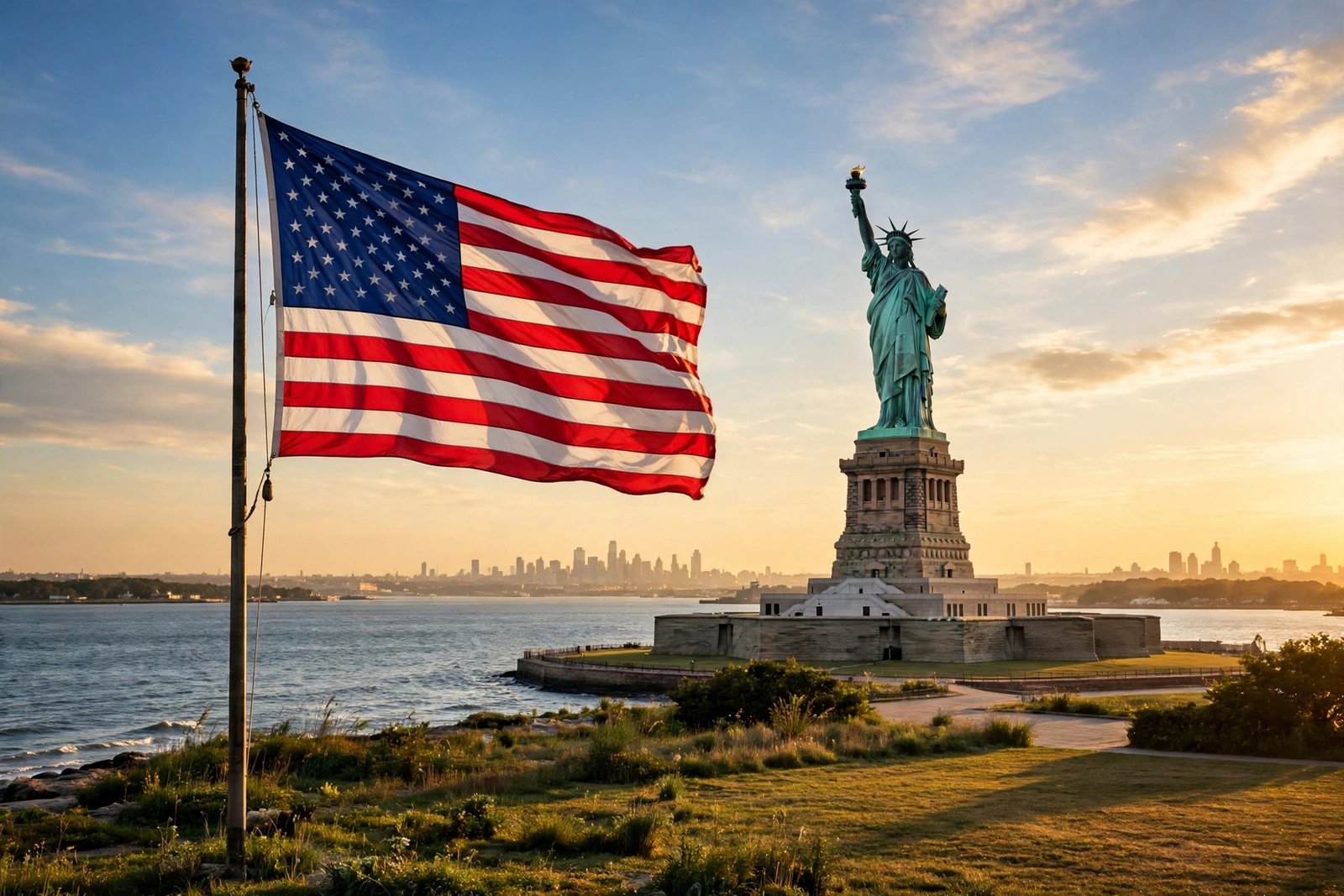
From the flag flying over a small-town courthouse to the bald eagle soaring above a mountain lake, American national symbols are everywhere in the United States — and most Americans pass them every day without knowing the stories behind them. These emblems were not chosen by accident. Each one carries a piece of the country’s history, its ideals, and the long argument about what America should stand for. This guide to American national symbols explains what each major emblem means, how it was chosen, and where you can still see it today.
Some symbols were adopted by Congress. Others grew slowly out of tradition, songs, and stories until they became official centuries later. A few began as folklore. Sorting out which is which makes the symbols more interesting, not less, because the debates behind them reveal how the nation saw itself at different moments in time.
American National Symbols: The Flag and the Great Seal
The American flag is the most recognized of all American national symbols. It has thirteen horizontal stripes, alternating red and white, for the thirteen original colonies, and fifty white stars on a blue field, one for each state. The flag’s design has changed twenty-seven times as new states joined the Union, with the current fifty-star version dating to 1960, after Hawaii became a state.
Congress adopted the first flag design on June 14, 1777, a date now celebrated as Flag Day. The resolution described thirteen stripes and thirteen stars but did not fix the arrangement, which is why early flags show stars in circles, rows, and other patterns. The familiar story that Betsy Ross sewed the first flag at George Washington’s request is beloved tradition, but historians treat it as legend rather than documented fact — there is no contemporary record proving it. What is certain is that the flag became a powerful unifying emblem during the Civil War and the world wars that followed.
The Great Seal of the United States, adopted in 1782, is the nation’s official emblem and appears on government documents, passports, and the one-dollar bill. Its front shows a bald eagle with a shield, holding an olive branch in one talon and thirteen arrows in the other — a deliberate balance of peace and readiness to defend. Above the eagle, thirteen stars form a constellation, and a banner in its beak carries the Latin motto E pluribus unum, meaning “out of many, one.” The reverse of the seal shows an unfinished pyramid beneath the Eye of Providence, with the mottos Annuit coeptis and Novus ordo seclorum. For a deeper look at the flag’s own story, see our guide to American flag facts and history.
The Bald Eagle: America’s National Bird
No creature is more closely tied to American identity than the bald eagle. Chosen for the Great Seal in 1782 because of its strength, long life, and independence, the eagle has appeared on coins, military insignia, and official seals ever since. Yet for more than two centuries it was the national bird only by tradition. That changed in December 2024, when legislation formally designated the bald eagle as the official national bird of the United States, closing a 242-year gap between symbol and statute.
The eagle’s own history mirrors the country’s conservation story. By the mid-twentieth century, habitat loss and the pesticide DDT had driven bald eagle numbers to alarming lows. After DDT was banned in 1972 and the species gained protection under endangered species laws, populations recovered dramatically, and the bald eagle was removed from the endangered species list in 2007. Today the birds are found in every state except Hawaii, with large populations in Alaska, Florida, and the Pacific Northwest. Seeing one in the wild — along rivers, lakes, and coastal estuaries — remains a bucket-list moment for many travelers.
The Statue of Liberty and the Liberty Bell
The Statue of Liberty, dedicated in New York Harbor in 1886, is a gift from the people of France celebrating American independence and the friendship between the two nations. Designed by Frédéric Auguste Bartholdi, with an internal structure engineered by Gustave Eiffel, the copper statue stands over 300 feet tall from base to torch. The tablet in her left arm is inscribed with July 4, 1776, in Roman numerals, and the broken chain at her feet symbolizes freedom from oppression. Emma Lazarus’s sonnet “The New Colossus,” with its famous line about the “huddled masses yearning to breathe free,” was added to the pedestal in 1903 and helped transform the statue into a symbol of welcome for immigrants arriving through nearby Ellis Island.
The Liberty Bell, housed in Philadelphia, tells a different part of the story. Cast in 1752 for the Pennsylvania State House, now Independence Hall, the bell developed its famous crack sometime in the nineteenth century — the exact moment is uncertain, and several popular accounts of when it cracked are unproven. Its inscription, “Proclaim Liberty throughout all the land unto all the inhabitants thereof,” comes from the Bible, and abolitionists adopted the bell as a symbol in the 1830s, long before it became a national icon. Read more about the statue’s full story in our Statue of Liberty history and facts guide.
American National Symbols in Everyday Life
Beyond flags and monuments, American national symbols show up in daily American life through songs, pledges, and words. “The Star-Spangled Banner,” written by Francis Scott Key in 1814 after watching the bombardment of Fort McHenry during the War of 1812, became the national anthem by law in 1931. The Pledge of Allegiance, written by Francis Bellamy in 1892 for a school flag ceremony, is recited in classrooms across the country, and the phrase “under God” was added in 1954. The national motto, “In God We Trust,” first appeared on coins during the Civil War and was formally adopted as the official motto in 1956, while the older motto E pluribus unum remains on the Great Seal.
Even the country’s colors carry meaning. The red, white, and blue of the flag are often described as standing for hardiness and valor, purity and innocence, and vigilance and justice, respectively — an interpretation that traces back to Charles Thomson, secretary of the Continental Congress, in 1782. Uncle Sam, the tall figure in a top hat pointing from recruitment posters, grew out of early nineteenth-century tradition linking the character to Samuel Wilson, a meat packer who supplied the Army during the War of 1812. Historians note that the connection is traditional rather than proven, but the figure was so popular that Congress recognized Uncle Sam as a national symbol in 1961.
Lesser-Known Symbols: The Oak, the Rose, and the Bison
Not every national symbol is a bird or a bell. Congress has also chosen official symbols from the natural world, and each one reflects a different American value:
- The rose — designated the national floral emblem in 1986, the rose was chosen for its long association with love, beauty, and devotion, and it appears in American gardens, ceremonies, and even the White House Rose Garden.
- The oak tree — named the national tree in 2004 after a public vote organized by the Arbor Day Foundation, the oak symbolizes strength and endurance, and it has supplied timber for ships, homes, and barns since colonial times.
- The American bison — declared the national mammal in 2016, the bison recalls the vast herds that once roamed the Great Plains and the conservation effort that brought the species back from near extinction.
- The bison’s cousin on coins — the Buffalo nickel, minted from 1913 to 1938, remains one of the most beloved coin designs in American history and helped cement the animal’s place in the national imagination.
These natural symbols matter because they connect national identity to the land itself — to prairies, forests, and gardens rather than only to government buildings. They also remind visitors that American identity includes conservation: the eagle, the bison, and the oak all survived periods when they were threatened, and all recovered through deliberate protection.
How to Experience These Symbols Across the USA
The best way to understand these emblems is to see them where they live. Washington, D.C. concentrates many of them: the National Archives displays the Declaration of Independence, the Constitution, and the Bill of Rights; the National Museum of American History holds the original Star-Spangled Banner flag; and the National Mall gathers monuments from the Lincoln Memorial to the Washington Monument. Philadelphia offers Independence Hall and the Liberty Bell Center, while New York Harbor pairs the Statue of Liberty with the Ellis Island immigration museum.
For nature lovers, national parks and wildlife refuges offer the living side of the story. The National Eagle Center in Wapasha, Minnesota, sits along the Mississippi River, one of the best winter eagle-watching spots in the country. Yellowstone and other western parks protect bison herds descended from the animals that survived the nineteenth-century slaughter. And every Fourth of July, towns across America stage parades, fireworks, and flag ceremonies that turn these symbols into shared celebration — proof that national emblems are not museum pieces but living parts of American life.
Why These Symbols Still Matter
American national symbols endure because they are flexible enough to carry new meanings. The flag has flown over civil rights marches, space launches, Olympic victories, and disaster relief efforts. The Statue of Liberty has welcomed generations of immigrants and inspired movements for freedom far beyond America’s borders. The bald eagle’s recovery from near extinction became a symbol of what conservation can achieve. Each generation reinterprets the emblems it inherits, and that ongoing reinterpretation is itself part of the American story.
Understanding the real history behind these symbols — including the legends that did not quite happen — makes them richer, not weaker. The flag’s disputed first seamstress, the bell’s uncertain crack, and the eagle’s long road to official status all show a country still working out what it stands for. That is exactly why these symbols deserve a closer look.
Plan your own symbols tour: start with the flag and seal in Washington, D.C., add Philadelphia and New York Harbor, then head to a national park to see the living emblems — eagles, bison, and oak forests — in the wild. Share this guide with a fellow traveler, and tell us in the comments which American symbol means the most to you.