
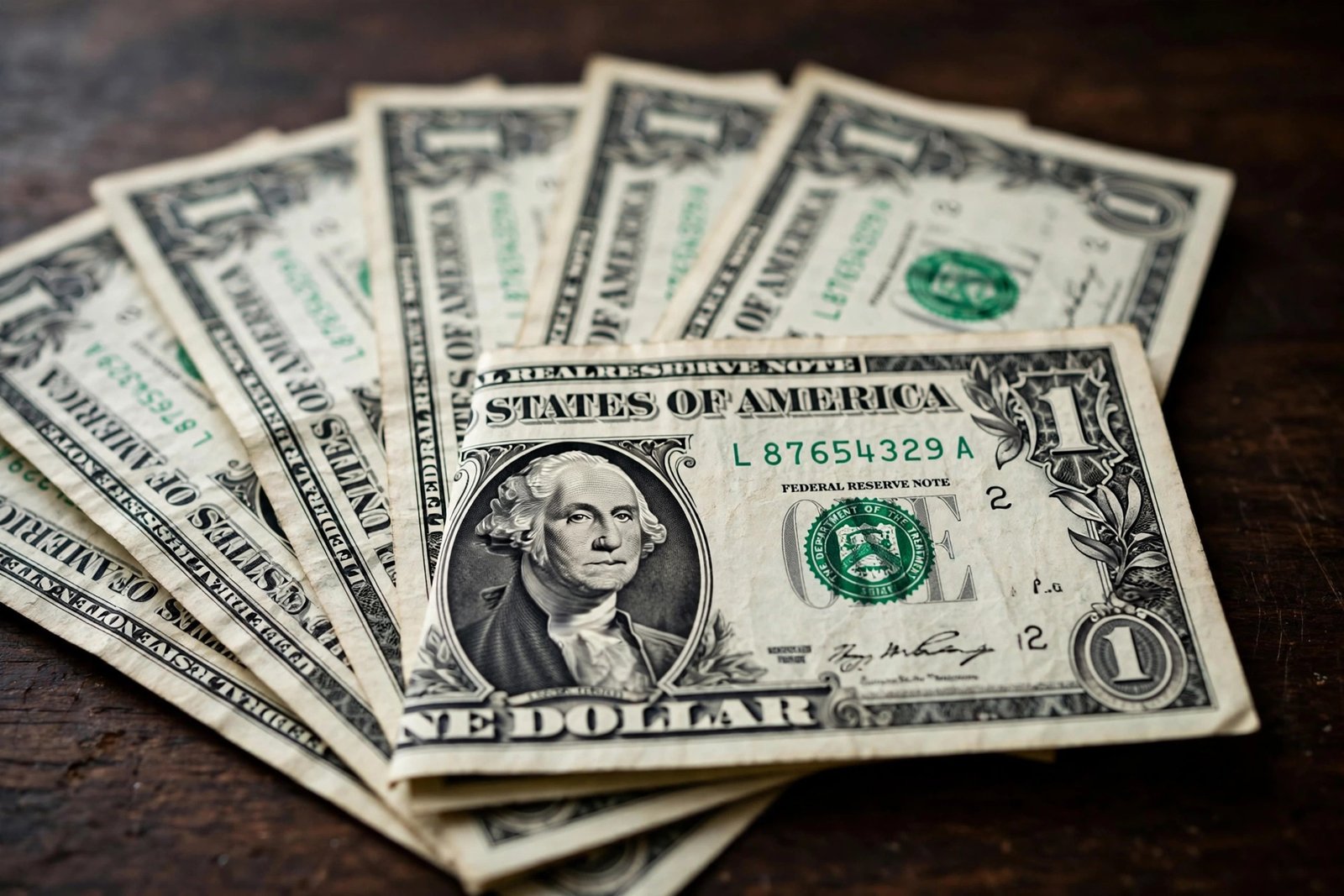
Pull a dollar bill from your wallet and take a close look at it. That familiar green rectangle carries more history, symbolism, and stranger-than-fiction stories than almost anything else you touch every day. These interesting facts about US currency range from a $100,000 banknote almost no American has ever seen, to the European roots of the word “dollar,” to secret symbols printed on the one-dollar bill for nearly a century. The cash in your pocket is a pocket-sized museum of American history — and by the end of this article, you will never look at it the same way again.
Where the Word “Dollar” Really Comes From
Long before the United States existed, colonists were already spending “dollars.” The word comes from “thaler,” short for Joachimsthaler — a large silver coin minted in the 1500s in Joachimsthal, a town in what is now the Czech Republic. The Dutch version of the word, “daler,” traveled to the New World with traders, and by the 1700s the Spanish silver peso — roughly the same size and weight — was nicknamed the Spanish dollar, or “piece of eight.” It was the most trusted coin in the American colonies, accepted from Boston to New Orleans.
When the young nation needed its own money system, it reached for the familiar. In 1785 the dollar was officially adopted as the money unit of the United States, and the Coinage Act of 1792 created the US Mint and defined the dollar in terms of silver and gold. If you want the bigger picture of how this colonial coin became the most powerful money on earth, read our guide on why the dollar became the world’s reserve currency.
Why American Money Is Green
There is a practical reason your cash is green, and it dates to the Civil War. In 1861, with the Union desperate for funds, the federal government issued its first national paper money — Demand Notes, soon nicknamed “greenbacks” because their backs were printed in green ink. Green was chosen partly because early photography could not reproduce the color well, making the new notes harder to counterfeit with cameras. The nickname stuck, and so did the color.
Even today, when bills carry watermarks, color-shifting ink, and security threads, the green remains. It is tradition now, but it began as an anti-counterfeiting trick. Other countries print their money in rainbow colors, yet the United States has kept its cash stubbornly, recognizably green for more than 160 years.
The $100,000 Bill Almost Nobody Has Seen
The largest denomination of US currency ever printed was the $100,000 Gold Certificate, Series of 1934, bearing the portrait of President Woodrow Wilson. Here is the catch: it was never meant for the public. These notes were printed solely to move money between Federal Reserve Banks, and private ownership of them is illegal. Only a handful of examples survive, locked away in museums and government collections.
Large bills were not always so exclusive. For decades, Americans could legally carry much bigger notes than the $100:
- $500 bill — portrait of President William McKinley
- $1,000 bill — portrait of President Grover Cleveland
- $5,000 bill — portrait of President James Madison
- $10,000 bill — portrait of Treasury Secretary Salmon P. Chase
- $100,000 bill — portrait of President Woodrow Wilson, never circulated publicly
In 1969 the Treasury discontinued the $500 through $10,000 notes, saying they were mostly used by banks and rarely seen by ordinary people. Any that remain are still legal tender, and collectors now pay far more than face value for them.
Interesting Facts About US Currency Hidden in Plain Sight
The one-dollar bill is the most information-packed piece of paper in America. Its reverse side carries the Great Seal of the United States, adopted in 1782 but not printed on currency until 1935. On the left sits an unfinished pyramid of 13 stone layers — one for each original state — topped by the all-seeing Eye of Providence. Beneath it, the Roman numerals MDCCLXXVI spell out 1776, the year of independence.
Two Latin phrases frame the pyramid. “Annuit Coeptis” means “He favors our undertakings,” and “Novus Ordo Seclorum” means “New order of the ages.” On the right, the American bald eagle clutches 13 arrows and an olive branch with 13 leaves, beneath a ribbon reading “E Pluribus Unum” — “Out of many, one.” Above the eagle, 13 stars form a constellation. Count the number 13 anywhere on the bill and you will find it again and again: a quiet tribute to the 13 original colonies. For more on the symbols America chose for itself, see our American flag facts and history guide.
“In God We Trust” Has Not Always Been There
It feels ancient, but the national motto is younger than you might think. “In God We Trust” first appeared on American coins in 1864, during the Civil War, and it did not reach paper money until 1957, when it was added to the one-dollar silver certificate. A 1955 law required the motto on all currency, and in 1956 Congress made it the official national motto of the United States, replacing the unofficial “E Pluribus Unum,” which had served in that role since the founding era.
Before the motto arrived, the dollar bill looked noticeably plainer. The $1 Federal Reserve Note was redesigned in 1963 to carry the phrase, which is why older bills in collections sometimes surprise people with its absence.
More Interesting Facts About US Currency That Collectors Love
Look at the serial number on any bill. If it ends with a star instead of a letter, you are holding a “star note” — a replacement bill printed when a damaged or misprinted note had to be pulled from a print run. Star notes are printed in smaller quantities, which makes them catnip for collectors, and some rare ones sell for many times their face value.
The color of the seal and serial numbers also tells a story. Modern Federal Reserve Notes use a green seal, but older types of American money looked different: Silver Certificates carried blue seals, United States Notes carried red seals, and Gold Certificates carried gold seals. Each color marked a different kind of promise — silver certificates could once be redeemed for silver dollars, a promise that ended in the 1960s.
And here is a small detail hiding on every modern bill: the tiny printed letters and numbers near the portrait identify which of the 12 Federal Reserve Banks issued the note, from A for Boston to L for San Francisco. Your cash literally carries a map of the Federal Reserve System.
What Your Cash Is Actually Made Of
One of the most interesting facts about US currency is that it is not paper at all. American banknotes are printed on a blend of 75 percent cotton and 25 percent linen, with tiny red and blue security fibers mixed into the sheet. That cloth-like blend is why a dollar bill survives an accidental trip through the washing machine far better than a sheet of printer paper ever would.
The special stock is made by a single company, Crane Currency, under close government supervision. Because of how money circulates, small bills wear out fastest: the Federal Reserve estimates that a $1 bill lasts about six to seven years in circulation, while a $100 bill — handled more carefully and passed around less — can survive more than two decades.
Bills That Vanished — and the $2 Bill That Refuses To
It is one of the most interesting facts about US currency that the $2 bill has survived decades of jokes about being cursed, rare, or fake. The two-dollar note is still printed today in limited runs, still bears the portrait of Thomas Jefferson, and is 100 percent legal tender. Its modern reverse shows the signing of the Declaration of Independence, replacing the earlier Monticello design in 1976. Cashiers who have never seen one sometimes mistake it for play money — it is real, and the Treasury keeps making it.
Women have appeared on American paper money too, though rarely. The first was Martha Washington, whose portrait graced the $1 Silver Certificate in 1886 — decades before women won the right to vote nationally. Her appearance remains one of the most overlooked milestones in the history of American money.
The Almighty Dollar Around the World
More than half of all US currency by value circulates outside the United States. Travelers in remote corners of the world have paid for meals, rooms, and rides in dollars, and several countries use the American dollar as their official currency. That global trust is the foundation of the dollar’s role at the center of world finance — a story we explore in depth in our article on why the dollar is the world’s reserve currency.
Even the slang has history. Most historians trace the word “buck” for a dollar to buckskin — deer hides that served as a unit of trade on the American frontier. A skilled hunter’s “buck” was literally worth money, and the nickname outlived the fur trade by two centuries.
Counterfeits, Security Threads, and Modern Tricks
The United States Secret Service was founded in 1865 for one job: fighting counterfeit money. At the time, an estimated one-third to one-half of all currency in circulation was fake. Today the fight continues with an arsenal of hidden features: watermarks visible when a bill is held to light, security threads that glow under ultraviolet light, color-shifting ink on the numerals, microprinting too small to photocopy, and raised printing you can feel with a fingertip.
The $100 bill is the most counterfeited American denomination worldwide — its high value makes it worth a forger’s effort. That is why the $100 received the most dramatic redesign in 2013, with its blue 3D security ribbon and the famous “bell in the inkwell.” If you handle cash for a living, learning these features is one of the most practical interesting facts about US currency you can know.
Why These Stories Belong in Every American’s Pocket
These interesting facts about US currency prove that money is never just money. Every bill is a compressed history lesson: a 16th-century European coin in the word “dollar,” a Civil War emergency in the color green, the 13 colonies in the pyramid’s stones, and a Cold War-era promise in the motto above the portrait. The next time you pay for coffee, take ten seconds to really look at what is in your hand — you are holding the story of America itself.
Want more stories like this? Explore our full collection of interesting facts about the USA, from flag history to presidential trivia. And the next time someone hands you a $2 bill, do not spend it — start a collection. Future you will be glad you did.