
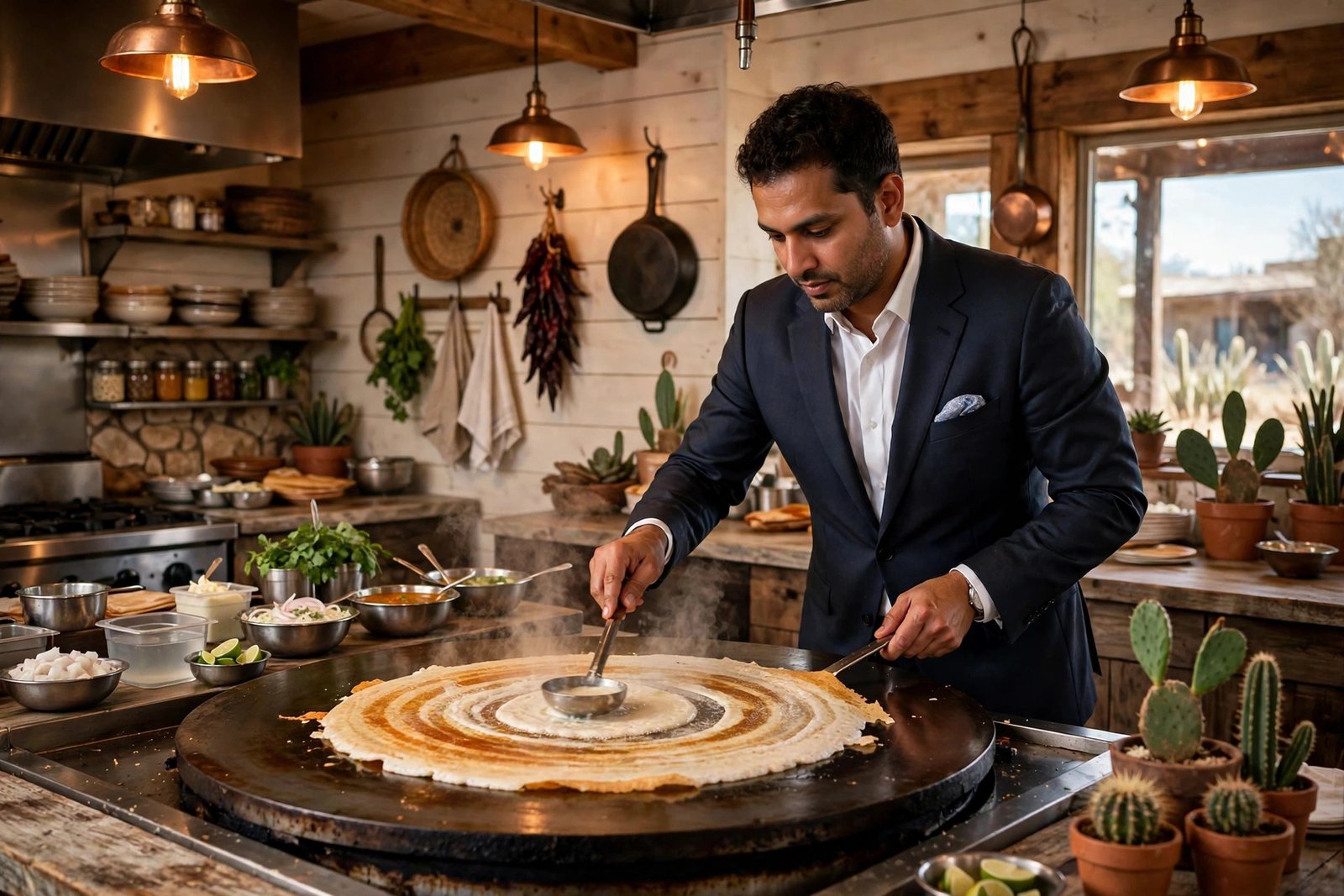
Some campaign moments are planned down to the last detail, and some happen over a plate of food. In late October 2026, a video of Texas US Senate candidate James Talarico making a masala dosa at a restaurant in Irving, Texas, spread quickly across social media, and the James Talarico viral dosa video became one of the most talked-about clips of the Texas campaign season. It was a simple scene, a candidate learning to cook a South Indian dish, but it landed at a moment when Texas politics, food culture, and community outreach were colliding in a very public way.
What made the clip travel was not slick production or a scripted punchline. It was the sight of a statewide candidate stepping into a local restaurant kitchen, rolling up his sleeves, and taking part in a tradition beloved by millions of Indian Americans. In a campaign where candidates are constantly looking for ways to connect with voters, the video showed a different kind of outreach: one that meets people where they eat, celebrate, and gather.
What Happened in the James Talarico Viral Dosa Video
According to reporting by WFAA, the video shows James Talarico making a masala dosa at Madira N Masala, a restaurant in Irving, Texas. A masala dosa is a South Indian dish made from a thin, crisp crepe of fermented rice and lentil batter, typically filled with spiced potatoes and served with chutneys and sambar. It is a staple of South Indian cooking and a favorite at Indian restaurants across the United States, including the many Indian restaurants in the Dallas-Fort Worth area.
The video was published by WFAA and went viral on social media around October 30-31, 2026. As reported, the visit was part of outreach to the Indian-American community ahead of the November 3, 2026 midterm elections. Talarico is the Democratic candidate in the Texas US Senate race, running against Republican nominee Ken Paxton, the Texas Attorney General. The timing mattered: with Election Day days away, every public appearance was a chance to reach voters who might otherwise never see a candidate up close.
Irving itself is a fitting backdrop for the moment. The city sits in the heart of the Dallas-Fort Worth metroplex, one of the most diverse regions in Texas, and it is home to a large and growing South Asian community. Restaurants like Madira N Masala are gathering places for that community, and a candidate visit there sends a message that goes beyond any single dish: it says these voters, their culture, and their neighborhoods matter to the campaign.
Why the James Talarico Viral Dosa Video Resonates
Food has always been a shortcut to connection in American politics. Candidates have long stopped at diners, barbecue joints, and taco trucks to show voters they understand everyday life. The dosa video follows that tradition but updates it for a Texas that looks very different from the one of a generation ago. Texas is home to one of the largest Indian-American populations in the country, and its voters, like all voters, notice when a candidate makes the effort to show up in their community rather than simply asking for their support from a distance.
There is also something disarming about cooking on camera. A candidate who is willing to try something unfamiliar, in front of strangers and cameras, comes across as approachable in a way that a speech never can. The video’s appeal lies in that informality: a kitchen, a hot griddle, a dish that takes skill to get right, and a candidate learning in real time. It is the kind of authentic, unscripted moment that social media rewards, because it feels real rather than rehearsed.
For the Indian-American community, the moment carried an extra layer of meaning. Seeing a statewide candidate engage respectfully with a beloved dish, in a local restaurant, can feel like recognition. It is a small gesture, but in a long campaign full of television ads and debates, small gestures that show cultural awareness tend to stick with people.
The Texas Senate Race Behind the Clip
The video arrived in the final stretch of a closely watched Texas US Senate race. James Talarico, the Democratic nominee, was campaigning against Ken Paxton, the Republican nominee and Texas Attorney General, with voters headed to the polls on November 3, 2026. In a state as large and diverse as Texas, campaigns must speak to many communities at once, and outreach to fast-growing groups such as Indian Americans has become an increasingly important part of the electoral map.
Texas politics has always been shaped by its changing population. New arrivals from across the United States and around the world have transformed the suburbs of Dallas, Houston, Austin, and San Antonio into some of the most diverse communities in the country. Candidates who want to win statewide must build coalitions that cross cultural and geographic lines, and that work often happens in places like restaurants, temples, community centers, and small businesses rather than in grand arenas.
The James Talarico viral dosa video fits into that broader strategy. It was not a policy announcement or a debate performance; it was a community visit, captured on video and shared online, where it reached far more people than were in the room. In modern campaigns, that is often the point: a local moment becomes a statewide message when it travels on social media.
Food, Culture, and Campaigning in Modern Texas
Texas food culture itself tells a story of blending traditions. Barbecue, Tex-Mex, and Southern cooking sit alongside Vietnamese pho shops, Korean barbecue, and South Indian dosa houses in cities across the state. A campaign stop at an Indian restaurant in Irving reflects that reality, and it mirrors how everyday Texans actually eat: a mix of old favorites and new discoveries, often in the same neighborhood.
Social media has changed how these moments spread. A generation ago, a candidate’s restaurant visit might have been covered by a local television crew and forgotten by the next news cycle. Today, a clip can be shared thousands of times within hours, reaching voters who never watch local news. The James Talarico viral dosa video is a good example of that shift: a local restaurant visit became a statewide talking point because the clip itself was easy to watch and easy to share. Campaigns know this, and they increasingly plan stops with shareability in mind, choosing places and moments that feel genuine enough to earn attention on their own merits.
- Community visits show candidates in real neighborhoods, not just on stages.
- Food moments feel personal and relatable across cultural lines.
- Local restaurants gain visibility when a campaign stop goes viral.
- Short video clips can reach voters who skip traditional campaign ads.
- Cultural outreach signals respect for a community’s traditions and voters.
None of this means a single video decides an election. Voters weigh policies, records, and debates far more heavily than any one clip. But in a close race, the ability to connect, to be seen, and to be remembered can matter at the margins, and a memorable moment in a local restaurant is one more way to earn that attention.
What the Video Says About the 2026 Campaign Season
The broader 2026 midterm season has been defined by candidates searching for authentic ways to break through a crowded media environment. Traditional advertising still matters, but voters increasingly encounter politics through short videos, social feeds, and clips shared by friends. A candidate making a dosa fits that environment perfectly: it is visual, it is brief, it is a little unexpected, and it invites people to share it with a comment of their own.
It also reflects a shift in how campaigns think about Texas. The state’s suburbs are younger and more diverse than ever, and the communities that once sat on the edges of statewide strategy are now central to it. A visit to an Irving restaurant is not a side trip; it is a recognition of where Texas voters actually live, work, and eat.
For readers following the campaign season, the lesson is simple: pay attention to where candidates spend their time, not just what they say on stage. The stops a campaign chooses reveal who it is trying to reach and what kind of coalition it hopes to build. And sometimes, the most revealing moment of a campaign happens not at a podium but at a griddle, with a plate of dosa on the line.
Texas Beyond the Campaign Trail
Beyond the headlines, Texas is a state full of stories worth exploring, from its small towns to its big-city food scenes. If you enjoy discovering what makes America distinctive, a look at small-town life in America captures the quieter side of the country, while surprising facts about the USA round up details you may not know. And if you are following the season’s biggest spectacles, the Milwaukee Brewers World Series parade shows how American cities celebrate their biggest wins.
Whether the James Talarico viral dosa video is remembered as a footnote or a turning point, it has already done something notable: it brought a Texas restaurant, a South Indian dish, and a statewide campaign together in a single shared moment. In a political season that often feels divided, a video about food, community, and a candidate willing to try something new offered voters a brief, human glimpse of the campaign trail. Keep an eye on Texas as Election Day approaches, and keep watching the places where politics meets everyday life, because that is where the most interesting stories tend to happen.