
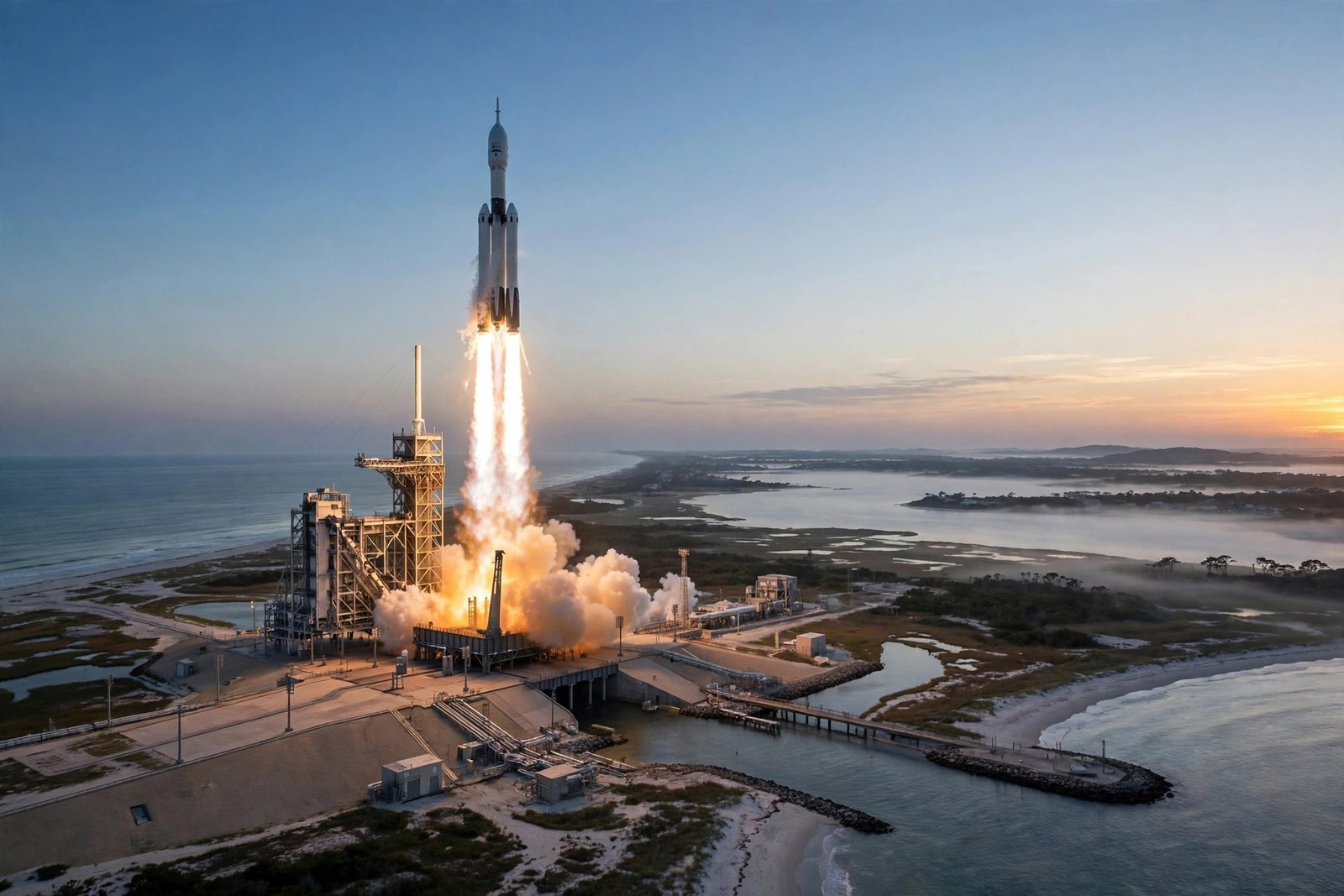
Look up at the night sky on a clear evening and you are looking at a domain where the United States has spent more than six decades building an unmatched presence. From the satellites that guide your drive to work to the astronauts living aboard the International Space Station, US space power touches American life every single day, often in ways most people never notice. It is not only about rockets and astronauts. It is about science, security, commerce, and the ability to see, communicate, and navigate across the entire planet.
The story of how America came to lead in space begins with a rivalry, accelerates through a Moon landing watched by the world, and continues today with a new race back to the Moon and a booming private space industry. Understanding US space power means understanding how government agencies, private companies, and the military each play a part in keeping the United States at the forefront of the final frontier.
What US Space Power Really Means
When experts talk about space power, they are not only talking about who has the biggest rocket. Space power covers a wide range of capabilities: launching satellites, operating them safely, gathering information from orbit, protecting those assets from interference, and exploring beyond Earth. The United States leads in nearly all of these areas, and that leadership did not happen by accident. It is the result of decades of sustained investment, scientific talent, and a culture that encourages both government exploration and private risk-taking.
Consider the Global Positioning System, better known as GPS. Originally developed for military use, GPS is now a free global utility that guides airplanes, ships, farm equipment, and smartphones around the world. Weather satellites operated by American agencies help forecasters track hurricanes days before landfall, giving communities time to prepare. Communications satellites connect rural towns, support disaster response, and carry television and internet signals across continents. These are everyday benefits of a space program that many people take for granted.
Space power also has a security dimension. Satellites watch for missile launches, monitor troop movements, and keep military forces connected across the globe. In an era when rivals are developing ways to jam, blind, or destroy satellites, protecting those assets has become a central mission for the United States. That is one reason space is now treated as a warfighting domain in its own right, alongside land, sea, air, and cyberspace.
From Apollo to Artemis: The American Journey
No story of American space leadership is complete without Apollo. On July 20, 1969, Apollo 11 landed the first humans on the Moon, a feat that remains one of the greatest technological achievements in history. The Apollo program was born from Cold War competition with the Soviet Union, but it left a legacy far larger than any rivalry: a generation of engineers, a body of scientific knowledge, and proof that the United States could achieve what many believed impossible.
After Apollo, the focus shifted closer to home. The Space Shuttle flew for three decades, building and servicing the International Space Station, a laboratory in orbit built in partnership with other nations. The Hubble Space Telescope, launched in 1990, transformed our view of the universe, capturing images of distant galaxies and helping scientists measure the expansion of the cosmos. The James Webb Space Telescope, launched in late 2021, now peers even further back in time, studying the earliest galaxies and the atmospheres of distant planets.
Today, the Artemis program carries the torch forward. Its goal is to return astronauts to the Moon and establish a sustainable presence there, this time with international partners and commercial companies playing larger roles. Artemis is designed not as a single flags-and-footprints mission but as a stepping stone toward future journeys to Mars. The program’s first uncrewed test flight circled the Moon and returned safely, demonstrating the new heavy-lift rocket and crew capsule built for deep-space travel.
US Space Power and NASA’s Artemis Program
The Artemis program sits at the heart of modern US space power. It combines the experience of NASA with the innovation of private companies that build landers, rockets, and support systems. This partnership model is one of America’s great advantages: the government sets ambitious goals and provides steady funding, while companies compete to deliver hardware faster and more affordably than a government-only program could manage.
Artemis also reflects how space exploration has become a team effort among allies. Partner nations contribute hardware, scientific instruments, and astronauts, strengthening diplomatic ties while sharing costs. This coalition approach gives American-led lunar exploration a legitimacy and staying power that a go-it-alone effort would struggle to match. When astronauts return to the lunar surface under Artemis, they will do so as part of an international effort led by the United States.
Beyond the Moon, the program points toward Mars. The technologies being tested now, from long-duration life support to in-space refueling, are the same ones a Mars mission will require. By building a sustained presence on the Moon first, the United States is learning how to live and work on another world, one step at a time.
The Space Force and National Security in Orbit
In December 2019, the United States established the Space Force as a separate military service, the first new branch of the armed forces in more than seven decades. Its mission is to organize, train, and equip forces to protect American and allied interests in space. The creation of the Space Force signaled that orbit is no longer a quiet support zone but a contested environment where adversaries actively seek advantages.
The threats are real and growing. Other nations have tested anti-satellite weapons, developed jamming systems, and built satellites capable of approaching and interfering with other spacecraft. In response, the United States has invested in more resilient satellite networks, better tracking of objects in orbit, and the ability to replace damaged satellites quickly. Spacepower is now treated as essential to deterrence: the ability to see, communicate, and navigate from orbit underpins nearly every modern military operation.
This military dimension complements the civilian program rather than replacing it. NASA explores and discovers; the Space Force protects the domain that makes that exploration and everyday life possible. Together, they form a whole-of-nation approach that few other countries can match.
How US Space Power Shapes Everyday Life
For most Americans, space power shows up in small, practical ways. The weather forecast on your phone draws on satellite data. Your bank transaction may be timestamped by satellite signals. Farmers use satellite imagery to monitor crops and manage water. Emergency responders rely on satellite communications when storms knock out cell towers. Even the maps that reroute you around traffic depend on a constellation of satellites maintained by the United States.
The economic impact is equally significant. The commercial space industry now launches rockets, builds satellites, and provides imagery and data services to customers around the world. American companies have dramatically lowered the cost of reaching orbit by developing reusable rockets, opening the door to new businesses in satellite internet, Earth observation, and space tourism. Thousands of jobs, from engineers in California to technicians in Florida and Texas, depend on this growing sector.
- Navigation: GPS guides planes, ships, vehicles, and smartphones worldwide.
- Weather and climate: satellites track storms, wildfires, and changing coastlines.
- Communications: satellite networks connect remote communities and support disaster response.
- Science: telescopes and probes expand our understanding of the universe and our own planet.
- Security: orbital systems warn of missile launches and keep forces connected.
This blend of civilian benefit, commercial opportunity, and security capability is what makes American leadership in space so durable. It is not built on a single rocket or a single mission but on a broad ecosystem that keeps generating new capabilities.
Private Companies and the New Space Race
One of the most striking changes in recent years is the rise of private space companies. Firms founded by entrepreneurs have built rockets that land themselves, capsules that carry astronauts to the space station, and satellite networks that beam internet to remote corners of the globe. NASA now buys rides to orbit as a service rather than owning every vehicle, a shift that has saved money and accelerated progress.
This commercial revolution has also made space more accessible to other countries and smaller companies, which can now buy launches and satellite services on the open market. Yet the United States remains the center of gravity: the largest launch providers, the most ambitious satellite networks, and the deepest pool of space engineering talent are American. That commercial edge reinforces the government’s programs, creating a cycle where public investment sparks private innovation, which in turn lowers costs for future public missions.
Challenges remain. Space debris is accumulating in low Earth orbit, and every new satellite adds to the risk of collisions. Launch costs, while falling, are still high. And international competition is intensifying as other nations invest heavily in their own programs. Maintaining leadership will require continued funding, smart regulation, and a commitment to keeping space open and safe for all.
What Comes Next for America in Space
The coming years will test whether the United States can turn its current advantages into lasting leadership. Crewed Artemis missions aim to put astronauts back on the Moon. New telescopes and robotic missions will explore Mars, the outer planets, and asteroids. Commercial stations may succeed the International Space Station when it retires, keeping a continuous American presence in low Earth orbit. Each of these efforts builds on the last, and each depends on the choices made today.
For readers curious about other ways the United States shapes the world, see how Hollywood spreads American culture around the globe and how nuclear power fits into America’s energy strength. If you enjoy discovering what makes this country remarkable, these surprising facts about the USA are a great place to start.
The story of American space leadership is still being written, and it belongs to everyone who looks up and wonders what comes next. Support science education, follow the missions, and stay curious about the frontier above us. The next giant leap may be closer than you think, and it will carry the same spirit that took twelve Americans to the Moon and brought them safely home.