
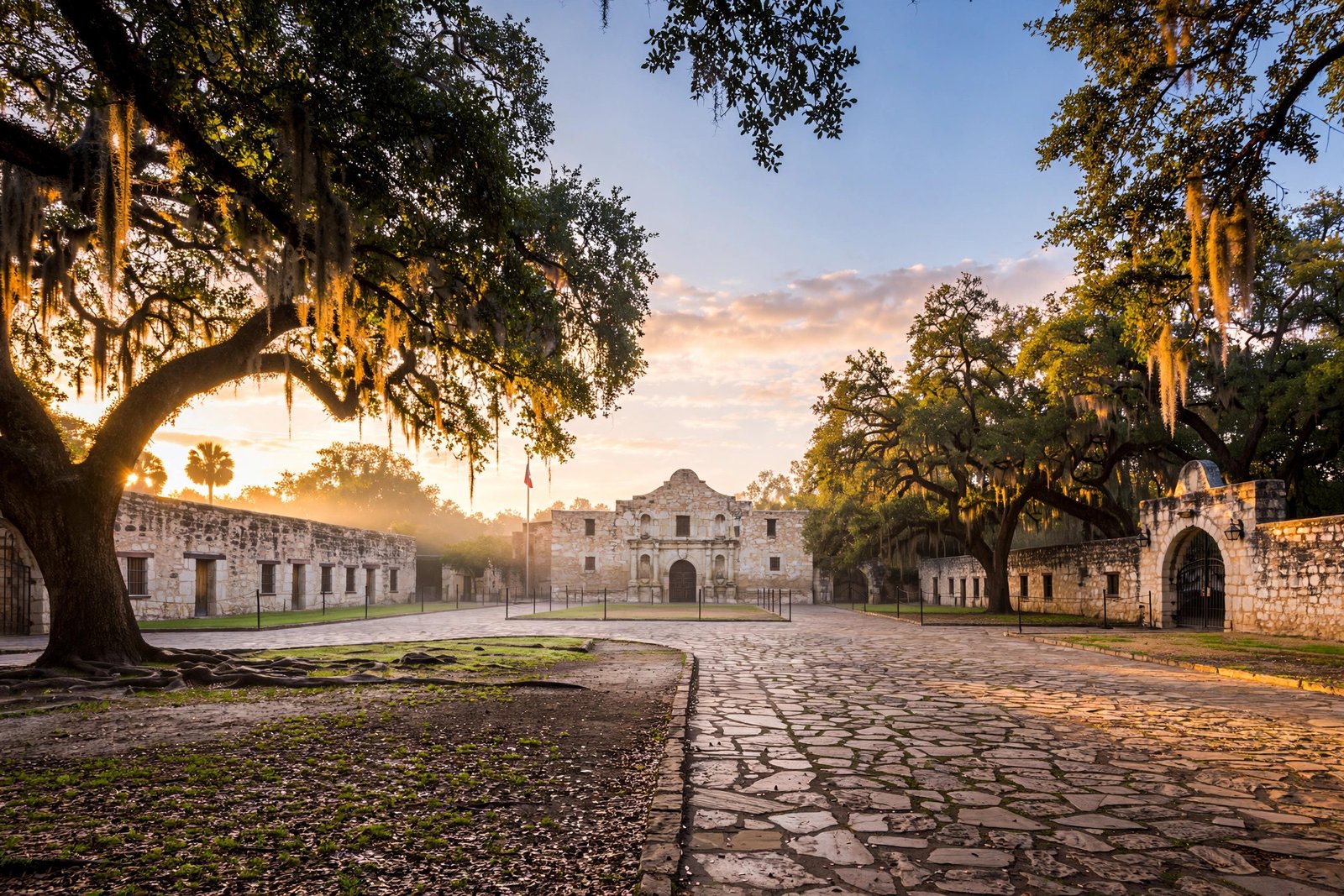
In the heart of modern San Antonio stands a small limestone mission where, in the spring of 1836, fewer than 200 defenders held off a Mexican army for thirteen days. The Alamo story is one of the most retold tales in American history — part documented fact, part frontier legend — and its rallying cry, “Remember the Alamo!,” helped create the state of Texas. Here is what really happened inside those walls, who fought there, and how a lost battle became a victory that echoes to this day.
A Mission Long Before It Was a Fortress
The Alamo began not as a fort but as a church. Founded in 1718 by Franciscan missionaries, Mission San Antonio de Valero was established to convert local Native Americans and anchor Spain’s presence in Texas. For decades it was a working mission with farms, workshops, and a growing community. By 1793 the mission was secularized, its lands distributed, and its buildings repurposed.
The name “Alamo” — Spanish for cottonwood tree — became attached to the site in the early 1800s, when a Spanish cavalry unit from the town of Alamo de Parras was stationed there. The soldiers called their post after their hometown, and the name stuck to the old mission forever. When Texas settlers rebelled against Mexican rule in 1835, the abandoned mission’s thick stone walls made it a natural stronghold — and a trap.
The Spark: “Come and Take It” at Gonzales
The road to the Alamo began about 70 miles east, in the small town of Gonzales. In 1835 Mexican authorities demanded the return of a small cannon they had lent the settlers for defense against raids. The Texians refused. On October 2, 1835, they raised a homemade flag showing the cannon above the words “Come and Take It” — and fired the first shots of the Texas Revolution. If you enjoy true stories of American defiance, you will also like our retelling of the Boston Tea Party true story, another rebellion that began with a refusal.
By December, Texian forces had captured San Antonio itself in the Siege of Béxar. But most of the volunteer army then went home or marched off on a doomed expedition, leaving a small garrison behind in the old Alamo mission. It was a fateful decision.
The Alamo Story: Thirteen Days of Siege
On February 23, 1836, General Antonio López de Santa Anna — the president of Mexico and commander of its army — arrived at San Antonio with the advance of a force that would number roughly 1,800 men. His troops raised a red flag above the town, the traditional signal that no quarter would be given. Inside the Alamo, about 200 defenders under the joint command of Colonel William B. Travis and Colonel James Bowie prepared for a siege they could not win.
Travis sent out riders begging for reinforcements, including his famous letter of February 24, 1836, addressed “To the People of Texas & All Americans in the World.” In it he pledged: “I shall never surrender or retreat… Victory or Death.” The letter is one of the most celebrated documents in Texas history, and its desperate tone tells you everything about the odds. A few dozen men from Gonzales slipped through enemy lines to join the garrison — the only reinforcements that ever came.
For thirteen days, Mexican artillery pounded the old mission walls while the defenders rationed powder and waited. Santa Anna’s engineers dug trenches closer each night. Everyone inside understood the math: help was not coming, and the final assault was only a matter of time.
The Men Inside: Travis, Bowie, and Crockett
The Alamo story endures largely because of the men who chose to stay. Three names tower above the rest:
- William B. Travis (26) — the young commander whose “Victory or Death” letter made him the revolution’s voice. A lawyer and firebrand, he took formal command of the garrison’s regular troops and organized the desperate defense.
- James Bowie (40) — the legendary knife-fighter of the Sandbar Fight, already famous across the frontier. He arrived with volunteers and shared command with Travis, but fell seriously ill during the siege — likely with typhoid or pneumonia — and spent the final days confined to a cot.
- Davy Crockett (49) — the former Tennessee congressman, frontiersman, and folk hero who arrived in Texas in February 1836 with a dozen Tennessee volunteers. His sharpshooting and fame lifted the defenders’ spirits.
Alongside them stood Tejanos, European immigrants, and young adventurers — a cross-section of the frontier. They flew handmade flags over the walls, including banners proclaiming independence, defying an empire with cloth and paint. The spirit of those homemade banners lives on in the story of the nation’s own flag, which we trace in our American flag facts and history article.
The Final Assault: March 6, 1836
Santa Anna attacked before dawn on Sunday, March 6, 1836. Columns of Mexican soldiers advanced silently through the darkness, then charged the walls with scaling ladders as bugles sounded the dreaded degüello — the traditional call signaling no mercy. The defenders’ cannon and rifles cut down the first waves, and twice the attackers were thrown back.
But numbers told. On the third assault, Mexican troops poured over the north wall, where Travis was among the first to fall. The fighting collapsed into brutal room-to-room combat through the mission’s chambers and the Long Barrack. Within about ninety minutes, every defender was dead — roughly 200 men, including the bedridden Bowie, killed where he lay.
Accounts of Davy Crockett’s death differ, and historians still debate them. Some Mexican officers later claimed a handful of defenders, possibly including Crockett, were captured and executed after the battle. Other accounts describe him falling in the fighting. The truth is lost to history — one reason the Alamo story blends fact and legend to this day.
Santa Anna spared the noncombatants: Susanna Dickinson, her infant daughter Angelina, Travis’s enslaved servant Joe, and a few others. He sent them to the Texian settlements to spread word of the slaughter — a psychological weapon meant to terrify Texas into surrender. It backfired completely.
“Remember the Alamo!”: San Jacinto and Revenge
News of the massacre electrified Texas instead of breaking it. Settlers who had been divided now united behind General Sam Houston, and “Remember the Alamo!” became the revolution’s battle cry — joined by “Remember Goliad!”, for the Texian prisoners executed at Goliad weeks later. That is how the Alamo story turned a crushing defeat into the fuel for victory.
On April 21, 1836 — just 46 days after the Alamo fell — Houston’s roughly 900 men surprised Santa Anna’s camp at San Jacinto during the Mexican army’s afternoon rest. Shouting “Remember the Alamo!,” the Texians routed a larger force in about 18 minutes, one of the most decisive battles in American history. Santa Anna himself was captured the next day, hiding in a private’s uniform. The Treaties of Velasco that followed secured the independence of the Republic of Texas, a new nation that would stand alone for nearly a decade before joining the United States in 1845.
The Alamo Story: Legend vs. Fact
Like all great frontier tales, the Alamo story picked up embellishments over the years, and honest history means separating them from the record. The most famous is the “line in the sand”: the tale that Travis drew a line with his sword and asked every man willing to stay and die to step across it. It is a magnificent image — but the story did not appear in print until decades after the battle, and most historians treat it as legend rather than fact.
The casualty numbers are also debated. Texian dead are usually estimated at around 189 to 257, while Mexican losses are far less certain, with estimates ranging from about 400 to 600. Santa Anna’s own reports minimized his losses; Texian accounts inflated them. What is certain is the core of the story: a small garrison, a thirteen-day siege, a final assault on March 6, 1836, and a rallying cry that won a revolution.
Other details hold up well under scrutiny. Travis’s “Victory or Death” letter is genuine and preserved. Bowie’s illness is documented. The red flag of no quarter was real. And the Alamo’s transformation from obscure mission to sacred ground happened almost immediately — Texians were making pilgrimages to the ruins within years.
Visiting the Alamo Today
Today the Alamo stands in downtown San Antonio, surrounded by a modern city that grew up around it — a striking contrast visitors never forget. The site includes the famous chapel with its curved gable, the Long Barrack museum with artifacts from the battle, and the Cenotaph, a 1939 monument honoring the defenders. In 2015 the Alamo and the four other San Antonio missions were designated a UNESCO World Heritage Site, recognizing their global historical importance.
More than a million people visit each year, making it one of the most visited historic sites in Texas. Admission to the church and grounds is free, and the site’s living-history demonstrations bring the 1836 garrison to life. Stand in the quiet chapel where the final fighting raged, and the Alamo story stops being a textbook chapter — it becomes something you can feel.
Why the Alamo Still Matters
The Alamo story endures because it is about a choice. The defenders knew reinforcements were not coming. They stayed anyway — not for conquest, but for an idea of liberty they believed was worth their lives. Whether you see it as heroic sacrifice, tragic miscalculation, or a bit of both, the thirteen days in San Antonio changed the map of North America and gave Texas its founding myth.
History this vivid deserves to be explored further. Discover the Statue of Liberty’s history and facts — another American symbol born from revolutionary ideals — and browse our full History collection for more true stories of the people and battles that shaped the United States. And if this story moved you, share it: “Remember the Alamo” has been worth remembering for nearly 200 years.