
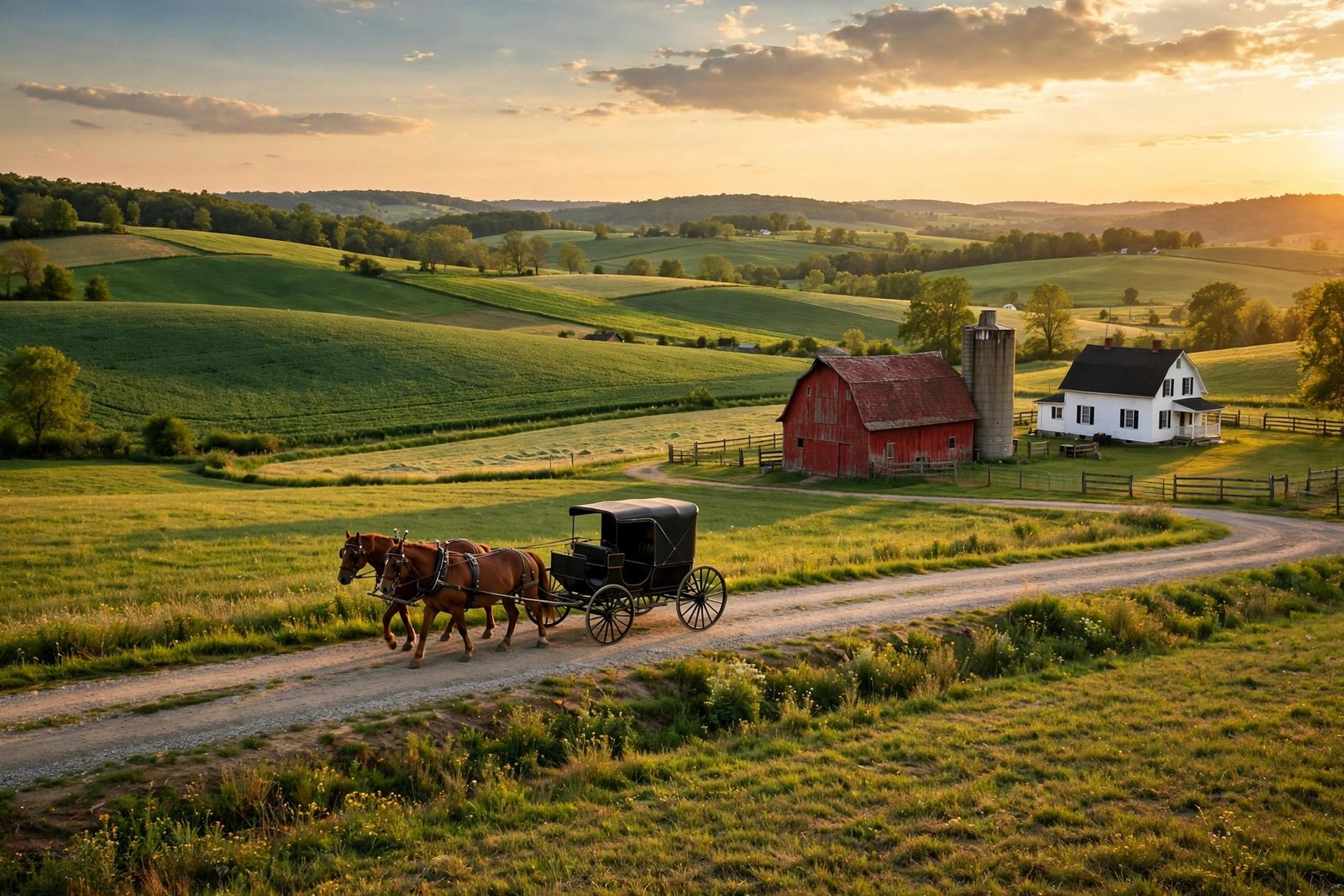
Imagine a life with no smartphones, no cars, no electricity bills — and no fear of missing out. That is the amish lifestyle in a nutshell: a deliberate, faith-driven way of living that has survived for more than three centuries in the heart of modern America. While the rest of the country chases the next upgrade, roughly 400,000 Amish across North America are quietly proving that a simpler life can be a deeply fulfilling one.
But the Amish are not a museum exhibit or a movie stereotype. They are farmers, carpenters, shopkeepers, and parents navigating real questions about technology, teenagers, and the future — just on very different terms than the rest of us. Whether you are planning a trip to Pennsylvania Dutch Country or simply curious how they live, here is an honest, respectful look at the Amish way of life.
The Roots of the Amish Lifestyle
The amish lifestyle did not begin in America at all. It began in Europe in the 1500s, when a group called the Anabaptists broke away from mainstream Christianity over the belief that baptism should be a conscious adult choice, not an infant ritual. In 1693, a Swiss bishop named Jacob Amman led a stricter split from the Mennonites, insisting on plain dress, separation from the world, and the practice of shunning members who broke church rules. His followers became known as the Amish.
Facing persecution in Europe, Amish families began immigrating to America in the 1700s, drawn by William Penn’s promise of religious tolerance in Pennsylvania. They settled on fertile farmland, built tight-knit communities, and farmed the way their grandparents had. Three hundred years later, their descendants still live on much of that same land — most famously in Lancaster County, Pennsylvania, where the clip-clop of horse-drawn buggies is part of everyday traffic.
The Ordnung: The Rules Behind the Amish Lifestyle
At the heart of the amish lifestyle is the Ordnung — the unwritten set of rules that governs each church district. The Ordnung is not one universal rulebook; it varies from community to community, which is why some Amish groups are stricter than others. In general, though, it covers the big questions: no car ownership, no grid electricity in the home, plain dress, and limits on technology.
The logic is not about fearing technology itself. The Amish ask a practical question most of us never ask: will this tool bring our family and community closer together, or pull us apart? A telephone in a shared barn phone shack might be acceptable for a business emergency; a smartphone in every teenager’s pocket is not. Some Amish contractors now use power tools and even computers for business — with batteries charged off the grid — while keeping their homes free of televisions and the internet. The line is drawn community by community, and it moves slowly and deliberately.
Plain dress is another visible part of the Ordnung. Men wear dark trousers, suspenders, and broad-brimmed hats, growing beards after marriage but no mustaches — a tradition dating to a time when mustaches were associated with the military. Women wear solid-colored dresses with aprons and prayer coverings on their heads. The point is humility: no one dresses to show off wealth or status.
A Day in Amish Life
An Amish day starts early — often before sunrise. On a farm, that means milking cows, feeding animals, and getting children off to the one-room schoolhouse. Amish children typically attend school only through the eighth grade, a practice the U.S. Supreme Court upheld in the 1972 case Wisconsin v. Yoder on religious-freedom grounds. After that, teenagers learn a trade or work on the family farm.
Work is central to Amish identity, and much of it is physical: farming, carpentry, quilting, and craftsmanship. Barn raisings remain a beloved tradition — when a family needs a new barn, dozens of neighbors show up and raise the frame in a single day, with women preparing enormous shared meals. It is community in action, and it is one reason Amish-made furniture and quilts are prized across America for their quality.
Evenings are family time: shared meals, reading, visiting with neighbors. Without television or social media competing for attention, family bonds run deep. Many visitors to Amish country — including fans of our guide to small town life in America — say this unhurried rhythm is what stays with them longest.
Rumspringa: Amish Teens and the Big Decision
One of the most misunderstood parts of Amish life is Rumspringa — a Pennsylvania Dutch term roughly meaning “running around.” Starting around age 16, Amish teenagers enter a period when church rules are relaxed and they are free to experience the outside world: modern clothes, cars, parties, and jobs among non-Amish people.
Contrary to the wild portrayals on television, most Rumspringa experiences are fairly tame — and the outcome surprises many outsiders. After a few years of freedom, the large majority of Amish youth choose to be baptized into the church and remain Amish for life. It is a remarkable vote of confidence: having seen the modern world up close, most decide their community’s way of life is the better one.
Amish Food, Quilts, and Craftsmanship
Amish kitchens are legendary, and Amish food culture draws visitors from across the country. Think shoofly pie, whoopie pies, chicken pot pie (the Pennsylvania Dutch slippery-noodle kind), homemade breads, and preserves put up from summer gardens. Many Amish families sell their goods at farmers markets — a tradition we explored in our guide to farmers markets in America — where their produce, baked goods, and jams are perennial bestsellers.
Then there are the quilts. Amish quilting is world-famous, with bold geometric patterns stitched by hand over hundreds of hours. A single quilt can take months to complete, and the finest examples sell for thousands of dollars. Amish furniture carries the same reputation: solid hardwood, mortise-and-tenon joinery, built to last generations. In a throwaway culture, Amish craftsmanship is a quiet argument for buying less and buying better — a value shared by the hardworking growers behind American farming.
Visiting Amish Country: How to Be a Respectful Guest
Millions of Americans visit Amish country each year, and the Amish are generally welcoming — if visitors follow a few simple rules of respect:
- Ask before photographing. Many Amish believe posed photographs violate the biblical command against graven images. Candid shots of buggies from a distance are one thing; sticking a camera in someone’s face is another. When in doubt, don’t shoot.
- Drive carefully. In Lancaster County and Holmes County, Ohio — the largest Amish settlement — horse-drawn buggies share the roads with cars. Slow down, give them space, and never honk.
- Buy local. Amish bakeries, furniture shops, and quilt stores are the real deal. Your dollars support the community directly.
- Respect Sunday. Most Amish businesses are closed on Sundays for worship and rest. Plan around it.
- Keep it genuine. The Amish are not actors in a theme park. A friendly wave and normal courtesy go a long way — much like the neighborly spirit celebrated in our piece on American front porch culture.
What the Amish Lifestyle Teaches the Rest of Us
You do not have to trade your car for a buggy to learn from the amish lifestyle. Its core questions are universal: Does this purchase make my life better or just busier? Am I spending my evenings with people or with screens? Is my community something I participate in, or just live near?
Critics of the modern world and admirers of this plain way of life often point to the same evidence: strong families, low stress, skilled hands, and a community that shows up — literally, with hammers and casseroles — when someone is in need. The Amish population keeps growing, roughly doubling every twenty years, which suggests that for hundreds of thousands of Americans, this old way of life is not a relic. It is a choice — and one they keep making, generation after generation.
Curious to see it for yourself? Plan a respectful trip to Lancaster County or Holmes County, browse a farmers market, and watch a community that measures wealth in family, faith, and craftsmanship rather than gadgets. And if this glimpse into Amish life fascinated you, share it with a friend — and keep exploring the many ways Americans live, right here on Beauty of USA.