
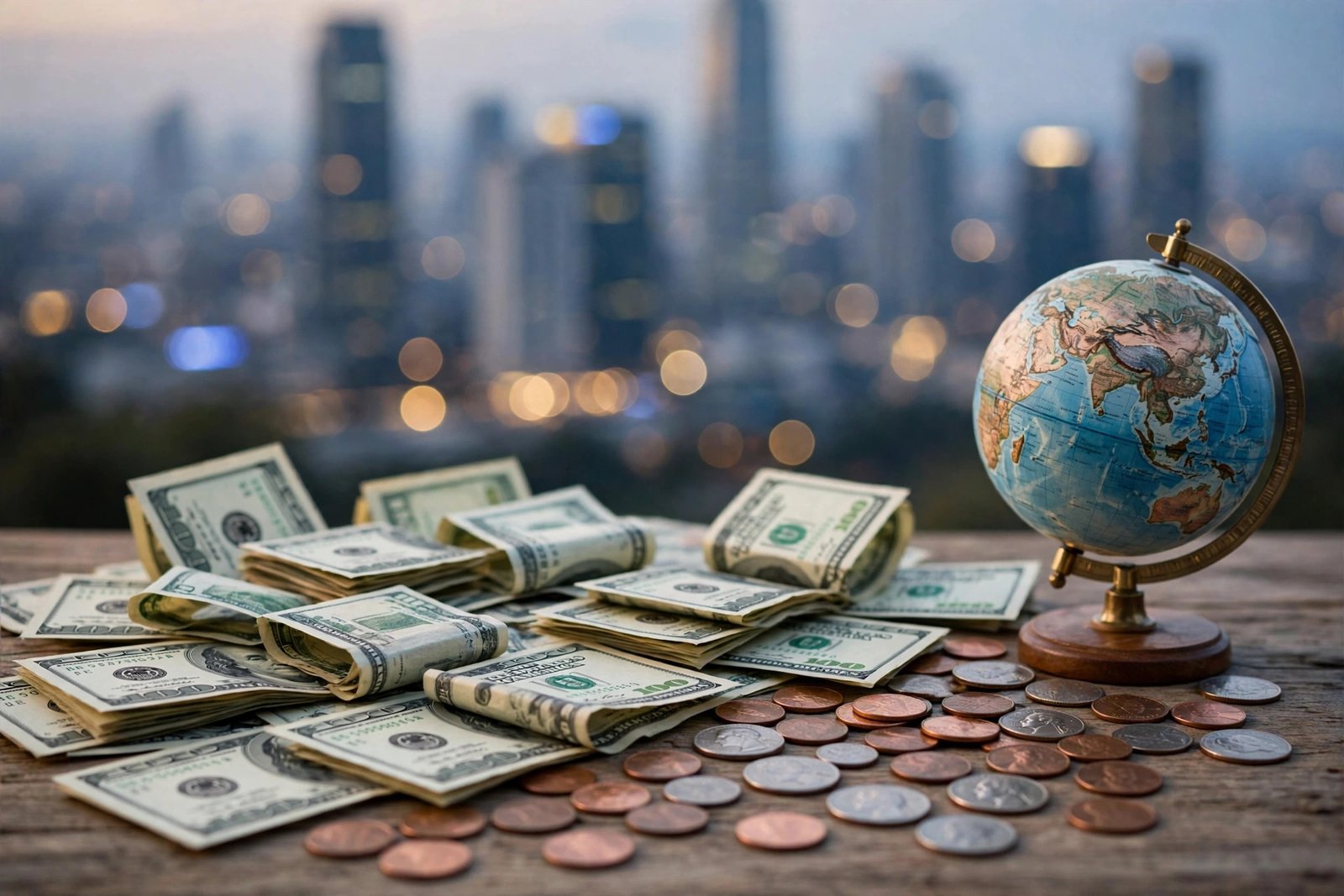
Walk into a market in almost any country on Earth, and the green banknote in the vendor’s hand will look familiar. From oil deals in the Middle East to electronics trade in Asia, the American dollar quietly powers transactions far beyond the borders of the United States. That reach is what economists call US dollar global power, and it shapes prices, politics, and everyday life for billions of people who never set foot in America.
But why did one country’s currency become the world’s default? The answer is a mix of history, trust, and sheer economic size. The United States has the world’s largest economy, deep and open financial markets, and a long record of political stability. Together, those strengths turned the dollar into the currency the world reaches for first, and that position brings real advantages back home to American families, businesses, and travelers.
What US Dollar Global Power Means
When people talk about US dollar global power, they are describing the dollar’s role as the world’s main reserve currency. Central banks around the world hold dollars in their reserves, much like a household keeps savings in the bank. Governments, companies, and investors use dollars to settle international trade, price major commodities, and borrow money across borders.
This role matters because it lowers costs. When two countries trade in dollars, neither side has to convert through a third currency or worry as much about wild swings in a smaller currency’s value. A copper mine in Chile can sell to a factory in South Korea, and both sides can price the deal in dollars with confidence that banks everywhere will accept the payment.
The dollar’s dominance also shows up in the financial system. A large share of international loans, bonds, and trade invoices are denominated in dollars. That means demand for dollars stays high even when the American economy slows, because the rest of the world still needs dollars to do business with one another.
How the Dollar Became the World’s Reserve Currency
The dollar did not become the world’s currency by accident. Its rise began in the middle of the twentieth century. In 1944, as World War II was drawing to a close, representatives from 44 countries met at Bretton Woods, New Hampshire, and agreed on a new international monetary system. Under that system, other currencies were pegged to the dollar, and the dollar itself was convertible into gold at a fixed rate.
The arrangement reflected a simple reality: after the war, the United States held a large share of the world’s gold reserves and produced a large share of the world’s goods. Other nations wanted a stable anchor for rebuilding their economies, and the dollar provided it. Even after President Richard Nixon ended the dollar’s convertibility into gold in 1971, the dollar kept its central role, because the institutions, habits, and trust built over decades did not disappear overnight.
Since then, the dollar’s position has been reinforced by the depth of American financial markets. United States Treasury securities are widely viewed as among the safest investments in the world, and investors from every continent buy them. That steady demand keeps the dollar at the center of global finance, much as a busy airport stays busy because everyone already flies through it.
Why Countries and Businesses Choose the Dollar
Trust is the dollar’s greatest asset. A currency is only useful if people believe it will hold its value and be accepted tomorrow. The dollar benefits from the size of the American economy, the independence of the Federal Reserve, and the rule of law that protects contracts and property. Businesses planning a deal months in advance want that kind of predictability.
Another reason is liquidity. American financial markets are the deepest in the world, meaning huge sums can be bought and sold quickly without moving prices dramatically. A central bank that needs to sell Treasury bonds in a crisis can do so fast. A company that needs to raise dollars can usually find a buyer. Few other currencies offer that combination of size and speed.
Energy trade adds another layer. Oil and many other commodities are commonly priced in dollars on world markets, so countries that buy and sell energy need dollars on hand. This creates a constant, practical demand for the currency that has little to do with politics and everything to do with how global trade actually works.
The Dollar in Everyday Global Trade
Consider a smartphone assembled from parts made in several countries. The screen might come from one nation, the chip from another, and the final assembly from a third. Pricing each step in dollars simplifies the whole chain. Suppliers know what they will be paid, buyers know what they will pay, and banks in each country can clear the payments without extra conversions.
Travelers feel this too. In many countries, hotels, tour operators, and money changers quote prices in dollars alongside the local currency. For American tourists, that familiarity is convenient, and it is one reason the dollar is often called the world’s most recognizable currency. For a deeper look at the places where American travelers spend those dollars, see our guide to the most beautiful lakes in the USA and our Route 66 road trip guide, two journeys that run on the same currency the world trusts.
For American exporters, the dollar’s role cuts both ways. A strong dollar makes American goods more expensive abroad, which can hurt manufacturers and farmers selling overseas. At the same time, it makes imports cheaper for American consumers, holding down prices on everything from electronics to clothing. Policymakers constantly weigh that trade-off.
Challenges to US Dollar Global Power
No currency holds the top spot forever, and the dollar faces real challenges. Other major economies, including China and the eurozone, have promoted their own currencies for international trade. Some countries have experimented with settling energy deals in currencies other than the dollar, and digital payment technology is making it easier to move money across borders without traditional banking channels.
Domestic debates also matter. Large government debts and political arguments over the debt ceiling have, at times, raised questions abroad about American reliability. Yet each episode so far has ended with the dollar’s role intact, in part because no rival currency offers the same combination of scale, openness, and safety. The eurozone lacks a single unified bond market, and China’s currency is not freely convertible, which limits both as full replacements.
History offers perspective here. The British pound was the world’s dominant currency in the nineteenth century before the dollar gradually replaced it over decades, not overnight. Currency shifts tend to be slow, driven by trade patterns, economic size, and trust built over generations rather than by a single event.
What It Means for Americans
The dollar’s global role brings tangible benefits home. Because the world wants dollars and Treasury securities, the United States government can borrow more cheaply than most countries. Lower borrowing costs can translate into lower interest rates for mortgages, car loans, and business investment, though many other factors affect those rates too.
American businesses also benefit. Companies that sell abroad can often invoice in their own currency, avoiding the cost and risk of converting payments. That is a quiet advantage for exporters, from large manufacturers to small firms selling products online to customers overseas.
None of this happens by itself. US dollar global power is maintained by the everyday choices of traders, investors, and central banks that keep choosing the dollar because it works. Every time a foreign company prices a contract in dollars or a central bank adds Treasury securities to its reserves, it reinforces the network effect that keeps the dollar at the center of world finance. That network effect is self-reinforcing: the more people use the dollar, the more useful it becomes for the next user.
There are responsibilities as well. Decisions by the Federal Reserve ripple worldwide: when American interest rates rise, borrowing costs rise in other countries too, and money can flow out of emerging economies. That is why central bankers around the world watch Washington closely, and why American economic policy is, in effect, global economic policy.
For ordinary Americans, the most visible benefit is stability. A currency the world trusts tends to hold its purchasing power better over time, and the dollar’s global demand helps cushion the economy against shocks. It is one of the quiet foundations of American prosperity, easy to overlook precisely because it works so well.
Conclusion: The Dollar’s Power Is Built on Trust
The story of the dollar is ultimately a story of trust earned over decades: a large and open economy, deep financial markets, stable institutions, and a currency that businesses and governments everywhere can rely on. US dollar global power, in the end, is not decreed by any government; it is granted daily by millions of market participants who choose the dollar because it is stable, liquid, and accepted everywhere.
Want to explore more of what makes America strong? Read our facts about the Grand Canyon and discover the natural wonders that draw visitors from every corner of the globe. And if this guide helped you understand the dollar’s role, share it with a friend who wonders why the world runs on green.