
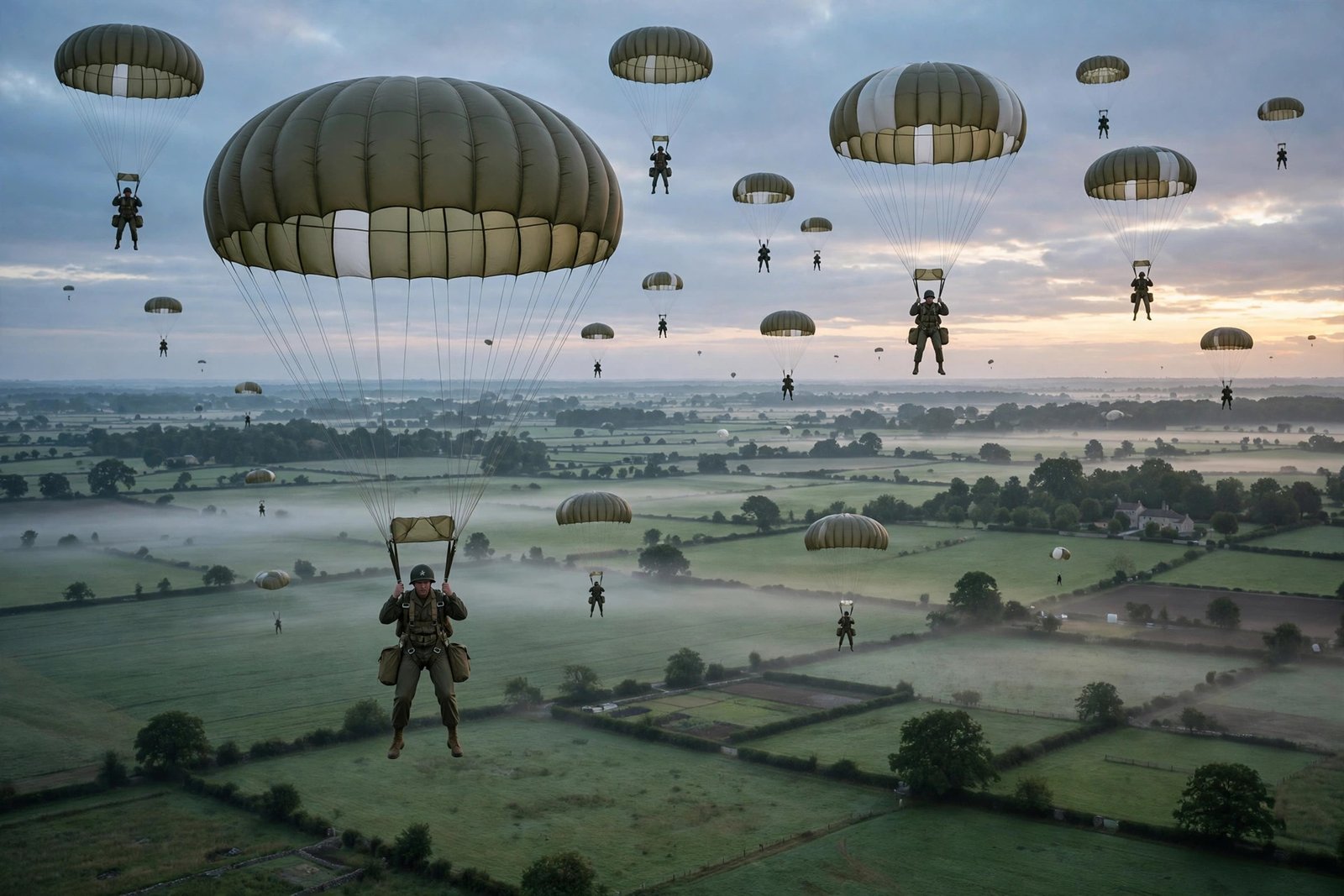
Few military units in American history carry the weight of the 101st Airborne Division. Known as the Screaming Eagles, these paratroopers became legends not through legend-making, but through plain, documented courage. If you are searching for 101st Airborne true stories, you are looking for something real: men who jumped into the dark over Normandy, held a frozen Belgian town against impossible odds, and carried a motto — Rendezvous with Destiny — that proved truer than anyone could have imagined.
This is their story, told honorably. The division’s shoulder patch shows a bald eagle’s head in white on a black shield, and it has been worn by generations of soldiers who earned it the hard way. What follows is the real record of the 101st Airborne true stories that shaped America.
The Birth of the Screaming Eagles
The 101st Airborne Division was activated in August 1942 at Camp Claiborne, Louisiana. Its first commanding general, Major General William C. Lee, is credited with coining the division’s enduring motto: Rendezvous with Destiny. He told his men they had no history, but they had a destiny — and they would earn it.
Airborne warfare was brand new. The idea was bold and dangerous: drop infantry by parachute behind enemy lines, have them hold key ground until ground forces could break through and link up. The paratroopers trained relentlessly. They ran the famous Currahee mountain course in Georgia as part of their qualification — three miles up, three miles down — building the stamina and unit cohesion that would carry them through the war.
The division was built around parachute infantry regiments — the 501st, 502nd, and 506th — plus glider-borne infantry and supporting artillery, engineer, and medical units. Glider troops rode silent wooden aircraft into combat landings, a different kind of bravery that deserves its own respect.
101st Airborne True Stories from Normandy
On the night of June 5–6, 1944, the pathfinders of the 101st Airborne dropped into Normandy ahead of the D-Day landings. Their job was to mark the drop zones with lights and beacons so the main force could find its way. Many were scattered by anti-aircraft fire and bad weather, but they lit what they could and fought their way inland.
In the early hours of June 6, the main body of the division parachuted into the Cotentin Peninsula behind Utah Beach. The drops were widely scattered — troopers landed miles from their intended zones. Rather than give up, they improvised. Small groups of men who had never served together formed ad hoc squads, found officers, located their objectives, and moved toward them anyway.
The division’s key missions included seizing the causeways leading inland from Utah Beach so the amphibious forces could move off the beach, and destroying German artillery batteries. The paratroopers fought through the flooded marshes of Normandy, took town after town, and by the end of the first day had accomplished much of what was asked of them — scattered, outnumbered, and exhausted.
One of the most documented small-unit actions came later, but the pattern of D-Day itself — junior soldiers taking charge, squads forming from strangers, objectives seized without waiting for orders — defined everything the division would do afterward. For more stories of ordinary soldiers rising on that fateful day, see our D-Day true stories of US soldiers.
Carentan and the Fight Across France
After D-Day, the 101st fought its way to the town of Carentan, a critical link between the Utah and Omaha beachheads. The battle was fought through hedgerows — the thick, ancient earthen walls of Normandy farmland that made every field a fortified position. The paratroopers took the town, then held it against German counterattacks.
The division was pulled out of Normandy in July 1944, having suffered heavy casualties. It rested, refitted, and prepared for the next operation: a massive daylight airborne assault into the Netherlands as part of Operation Market Garden in September 1944.
Operation Market Garden and Holland
In Holland, the 101st Airborne jumped in daylight — a very different experience from the night drop over Normandy. The division seized bridges and held a corridor through which Allied armor was supposed to race toward Germany. The paratroopers fought along the corridor, holding ground against determined German attacks, and stayed in the line far longer than planned when the operation’s timetable broke down.
The fighting in Holland was brutal and costly. When the division was finally relieved, its men were worn down — which made what happened next even more remarkable.
101st Airborne True Stories from Bastogne
In December 1944, Germany launched a massive surprise offensive through the Ardennes — the Battle of the Bulge. The 101st Airborne, still refitting and missing much of its equipment, was rushed by truck to the Belgian town of Bastogne, a vital road junction the Germans needed to take.
What happened there became the division’s most famous chapter. Surrounded, outnumbered, short on ammunition, medical supplies, and winter clothing, the Screaming Eagles and the attached units with them held Bastogne against repeated assaults. Temperatures plunged. Food ran short. The wounded suffered in cellars and aid stations while the town was shelled.
When the Germans demanded the surrender of Bastogne, the acting division commander, Brigadier General Anthony McAuliffe, answered with a single word that has been documented ever since: “Nuts.” The siege held. On the day after Christmas, General Patton’s tanks broke through from the south, and the road to Bastogne was open. The 101st had held the line when it mattered most.
The stand at Bastogne is one of the most honored 101st Airborne true stories because it showed what the division was: surrounded and freezing, it refused to break. The cost was high, and the town’s civilians suffered terribly alongside the troops — a fact the veterans themselves always remembered.
The Road into Germany and the War’s End
After Bastogne, the division pushed on into Germany through the winter and spring of 1945. The paratroopers fought through the Rhineland, crossed into the heart of Germany, and in the war’s final days moved into Bavaria, where elements of the division reached Berchtesgaden, the mountain retreat associated with the Nazi leadership.
When the war in Europe ended in May 1945, the 101st Airborne had fought in some of the most famous campaigns of the war. Its battle record — Normandy, Holland, the Ardennes — placed it among the most decorated divisions in the Army. The division was inactivated after the war, but its legacy was only beginning.
Real Units and Real Men
The 101st Airborne true stories that endure are carried by the regiments and the soldiers who lived them:
- The 506th Parachute Infantry Regiment — its E Company became widely known decades later through Stephen Ambrose’s book and the miniseries it inspired, but the regiment’s combat record in Normandy, Holland, and Bastogne was real long before any camera arrived.
- The 502nd Parachute Infantry Regiment — jumped into Normandy and fought through every major campaign, earning a reputation for toughness in the hedgerows and beyond.
- The 501st Parachute Infantry Regiment — fought alongside its sister regiments in every campaign, including the bitter fighting around Bastogne.
- The glider infantry and support troops — the artillerymen, engineers, medics, and glider riders whose bravery matched the paratroopers’ but rarely got the headlines.
The division’s Medal of Honor recipients and distinguished heroes are part of the official record — their citations are public documents. To read about the nation’s highest military honor and the men who earned it, see our Medal of Honor stories.
The Division After World War II
The 101st Airborne was reactivated and has served in every era since. It fought in Vietnam as an airmobile division, served in the Gulf War, and deployed repeatedly to Iraq and Afghanistan in the 21st century. Today’s Screaming Eagles wear the same eagle patch their grandfathers wore over Normandy.
The division is headquartered at Fort Campbell, Kentucky. The bald eagle patch remains one of the most recognized insignia in the American military — a symbol that means the same thing now as it did in 1944: volunteers who go first.
Why These Stories Still Matter
101st Airborne true stories matter because they are about ordinary Americans doing extraordinary things without being asked to be extraordinary. The paratroopers of 1944 were draftees and volunteers in their late teens and early twenties. They were scared. They jumped anyway.
There is a quieter lesson in these stories too. The veterans of the 101st rarely boasted. Many never spoke of the war at all. The telling of these stories fell to historians, families, and fellow soldiers — which is why telling them accurately and honorably matters so much. Every detail here comes from the documented record: the drops, the battles, the motto, the reply at Bastogne. Nothing needs embellishment.
For more stories of American courage in the same war, read our Tuskegee Airmen true stories — another chapter of World War II heroism that deserves to be remembered.
Visiting the Legacy
If these stories move you, there are respectful ways to connect with them:
- Normandy, France — the drop zones, the causeways, and the cemeteries are preserved and open to visitors. Standing where they landed is a powerful experience.
- Bastogne, Belgium — the town maintains memorials and museums honoring both the soldiers and the civilians of the siege.
- Fort Campbell, Kentucky — the division’s home, where the legacy is a living thing carried by serving soldiers.
- Memorial Day and Veterans Day — the simplest tribute: remember, thank a veteran, and teach the next generation what the patch means.
Conclusion: Rendezvous with Destiny
General Lee told his men they had a rendezvous with destiny. They kept it — over Normandy, in Holland, and in the snow around Bastogne. The 101st Airborne true stories are not myths. They are the documented record of a division that went first and held the line, and of the young Americans who made that record with their courage.
If this story moved you, share it. Tell someone about the Screaming Eagles today. And if you know a veteran — of any unit, any era — thank them. That is the CTA that matters: remember them, honor them, and pass the story on. Explore more American military history here on Beauty of USA, and keep the rendezvous alive.