
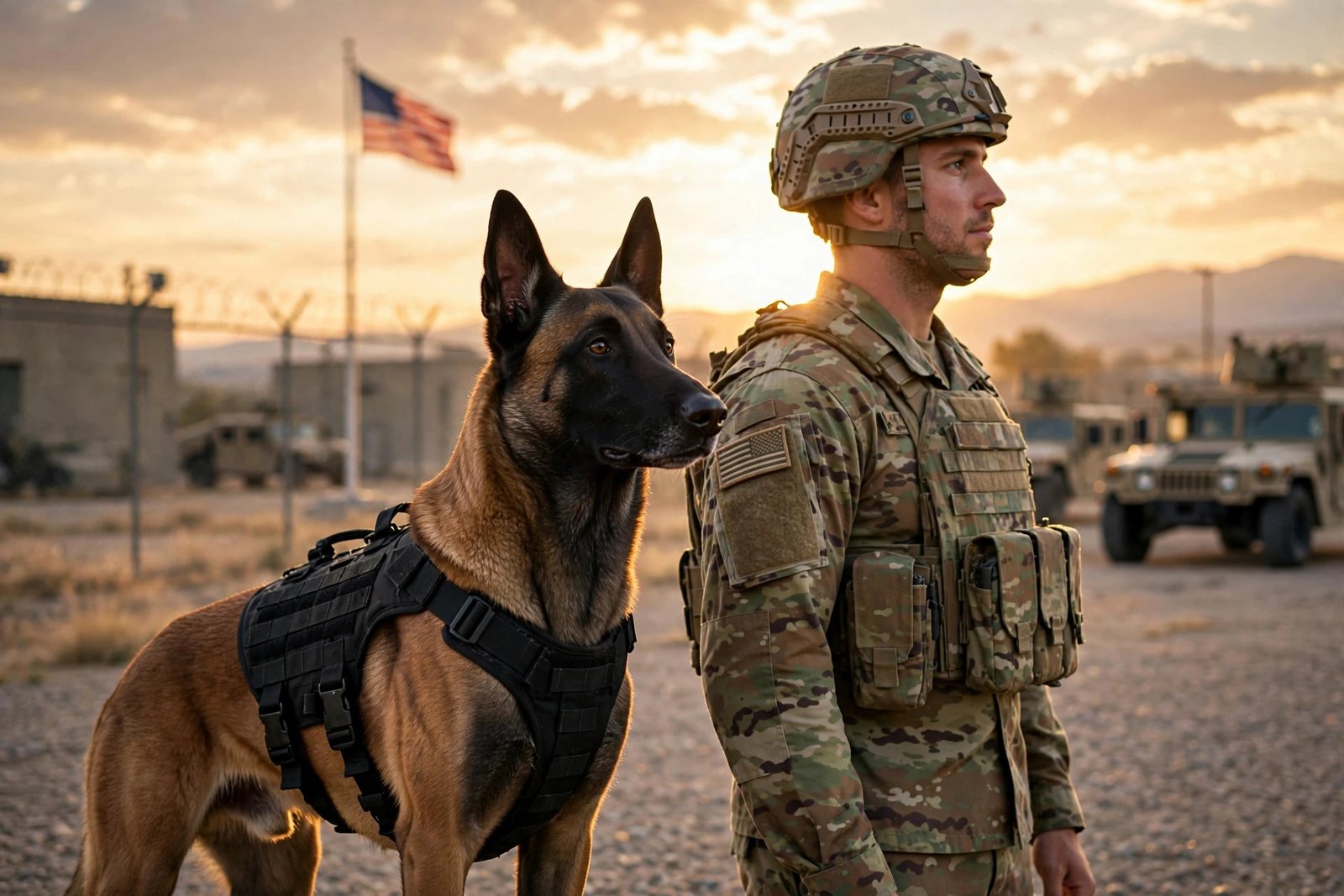
Long before drones and night-vision goggles, some of America’s most loyal soldiers walked on four paws. These military working dogs true stories stretch from the muddy trenches of World War I to the mountain valleys of Afghanistan, and every one of them is about courage – the kind that never asked for a medal, a rank, or a single headline. For more than a century, dogs have served beside American troops as scouts, sentries, messengers, and lifesavers, often placing their own bodies between their handlers and danger.
Today’s military working dogs are elite professionals: superb athletes with noses thousands of times more sensitive than a human’s, partnered with handlers they would give their lives to protect. But the tradition began humbly, with strays and volunteers – ordinary dogs who did extraordinary things. If tales of battlefield bravery move you, you’ll also want to read our stories of Medal of Honor recipients – the human heroes these dogs served beside.
How Military Working Dogs Earned Their Place in American History
Dogs have followed armies into battle for thousands of years, but the American story is special because it was built from the ground up. Dogs marched with Civil War regiments as mascots and companions. When the United States entered World War I in 1917, the Army had no official canine program at all – so soldiers simply brought their dogs to war, smuggling them aboard troop ships and into the trenches of France. Commanders quickly noticed something remarkable: the dogs were genuinely useful. They could hear incoming shells before the men could, smell poison gas before the alarms sounded, and slip through barbed wire carrying messages no human runner could deliver alive. What began as companionship became a military capability – and it never went away.
Military Working Dogs True Stories From World War I: Sergeant Stubby
The most famous dog in American military history started life as a stray. In the summer of 1917, a short, brindle-coated mutt – usually described as a bull terrier mix – wandered onto the training grounds at Yale University, where the 102nd Infantry Regiment was drilling before shipping out to France. Private J. Robert Conroy took a liking to the little dog, named him Stubby for his stubby tail, and smuggled him aboard the troop ship to Europe. By the time the regiment reached the front, Stubby was a soldier in everything but name.
Over eighteen months of service, Stubby took part in seventeen battles across four offensives. He learned to warn his unit of incoming artillery by the sound of the shells, and – most famously – he could detect mustard gas attacks early, rousing sleeping soldiers so they could reach their masks in time. Once, he caught a German infiltrator who was mapping Allied trenches, seizing the man by the seat of his trousers and holding him until American soldiers arrived. He located wounded men in no-man’s-land by listening for their cries, and he was twice wounded himself – once by shrapnel, once by gas – recovering in a Red Cross hospital before returning to the line.
For his service, Stubby was promoted to the rank of sergeant – the first dog ever given rank in the United States Army. After the war he became a national celebrity, meeting Presidents Woodrow Wilson, Calvin Coolidge, and Warren G. Harding, and serving as the mascot of the Georgetown Hoyas. When he died in 1926, his remains were preserved and eventually donated to the Smithsonian Institution, where you can still see him today at the National Museum of American History in Washington, D.C.
Chips: The Most Decorated Dog of World War II
World War II brought America’s first official war dog program, and its breakout star was a German shepherd-collie-husky mix named Chips, donated to the Army by the Wren family of Pleasantville, New York. Chips served with the 3rd Infantry Division across North Africa, Sicily, Italy, France, and Germany, working as a sentry dog whose fierce alertness made him invaluable on night guard duty.
His defining moment came during the invasion of Sicily in 1943. When his patrol came under fire from a concealed Italian machine-gun nest, Chips broke away from his handler, charged the position, and seized one of the gunners – forcing the entire crew to surrender. He was wounded in the fight but refused to leave his post. For his actions, Chips was awarded the Silver Star and the Purple Heart – but the decorations were later revoked, because Army policy barred animals from receiving military medals. History, if not the Army of 1943, had the last word: in 2018, Chips was posthumously awarded the Animals in War and Peace Distinguished Service Medal. He died in 1946, remembered as the most decorated war dog of the Second World War.
Smoky and Rin Tin Tin: The Unlikely Heroes
Not every hero was bred for battle. Smoky was a tiny Yorkshire terrier found in a foxhole in the New Guinea jungle in 1944. Adopted by Corporal William A. Wynne, she accompanied him through the Pacific campaign – and pulled off one of the war’s most remarkable small-scale engineering feats. At an airfield in Luzon in the Philippines, she ran a telegraph wire through a narrow seventy-foot culvert, a job that would have taken a construction crew days of digging. Her work kept vital communications – and the planes that depended on them – running. Smoky survived the war and became one of America’s first therapy dogs, visiting wounded soldiers in hospitals. She is still celebrated as one of the smallest soldiers ever to serve.
And then there is Rin Tin Tin, the German shepherd puppy Corporal Lee Duncan pulled from a bombed kennel in Lorraine, France, in September 1918. Duncan brought him home to California, where Rin Tin Tin became one of the biggest stars of 1920s Hollywood and is widely credited with helping save Warner Bros. studio in its early years. A persistent Hollywood legend claims he received the most votes for Best Actor at the very first Academy Awards – a great story, but unverified, and best filed under legend rather than fact. What is fact is remarkable enough: a war rescue who became an American icon.
Military Working Dogs True Stories From Vietnam
The Vietnam War saw the largest deployment of American war dogs in history – roughly four thousand served as scout and sentry dogs, walking point on jungle patrols and guarding air bases through the night. Their senses saved countless lives. And one of them, a German shepherd named Nemo, showed exactly what that loyalty could cost.
In December 1966, Viet Cong attackers struck Tan Son Nhut Air Base. Nemo alerted his handler, Airman Second Class Robert Throneburg, to the approaching enemy before the assault began. In the firefight that followed, both were wounded – Nemo took a bullet to the snout that cost him an eye. Bleeding and half-blind, he crawled to his handler’s side and guarded him until medics arrived. Both survived. Nemo was retired with honors at Lackland Air Force Base, among the first war dogs ever officially retired rather than discarded.
That last word matters, because Vietnam also holds the darkest chapter in this history. Military dogs were classified as equipment, and when American forces withdrew, only a few hundred of the thousands who served came home – most were euthanized or left behind. The public outcry that followed changed everything: in 2000, President Clinton signed Robby’s Law, opening the door for retired military dogs to be adopted, and later laws required the military to bring its dogs home from combat zones. Today, handlers – including many of the female heroes of the U.S. military – get first priority to adopt the partners they served beside.
Military Working Dogs True Stories From the Modern Era: Cairo, Conan, and Layka
The war on terror gave military working dogs their most secretive – and most celebrated – missions. Cairo, a Belgian Malinois assigned to SEAL Team 6, was part of the May 2011 raid in Abbottabad, Pakistan – Operation Neptune Spear – that killed Osama bin Laden. His jobs were to track anyone who tried to flee the compound and to detect explosives, and his presence on that historic mission was later confirmed in reporting about the raid. Cairo became a living symbol of the quiet professionals – human and canine – who carry out America’s most dangerous assignments.
Eight years later, another Belgian Malinois made headlines. Conan took part in the October 2019 raid in Syria targeting ISIS leader Abu Bakr al-Baghdadi, chasing him into a tunnel where the terrorist leader died. Conan was injured by exposed electrical wires during the mission but recovered fully. President Trump declassified the dog’s photograph and later honored Conan at the White House – a rare public moment for a community that usually works in the shadows.
Perhaps the most moving modern story belongs to Layka. In May 2012 in Afghanistan, during a raid on an enemy compound, insurgents opened fire and her handler, Staff Sergeant Julian McDonald, was shot. Layka attacked the gunman, taking four bullets herself, and kept fighting until the threat was over – almost certainly saving her handler’s life. Army surgeons saved Layka but had to amputate one of her legs. McDonald later adopted her, and the three-legged veteran became a national symbol of the bond between a handler and a military working dog.
How Military Dogs Are Trained Today
The heart of the modern program beats at Joint Base San Antonio-Lackland in Texas, home of the 341st Training Squadron – the military’s premier dog-training school. Belgian Malinois and German shepherds are the most common breeds, prized for their drive, intelligence, and athleticism, with Dutch shepherds and Labradors filling specialized detection roles. Training lasts for months and covers patrol work, explosive and narcotics detection, tracking, and controlled aggression. But ask any handler what matters most, and the answer is never the drills – it is the bond. A handler and dog train, deploy, and often live as a team, learning to read each other so completely that the dog can sense danger before the human sees it. In a firefight, that trust runs both ways.
Modern military working dogs specialize in several roles:
- Patrol and sentry work: guarding installations and accompanying foot patrols.
- Explosive detection: sniffing out mines, IEDs, and hidden weapons caches.
- Narcotics detection: supporting military law-enforcement missions.
- Tracking and search: following scent trails and locating missing personnel.
- Specialized search: clearing buildings and compounds ahead of troops.
What Happens to Military Dogs After Service?
When a military working dog’s service ends – usually around age eight to ten – the first question is always adoption, and the dog’s own handler gets first priority. Thanks to the legal reforms that followed Vietnam, retired dogs are now brought home and placed in loving homes rather than treated as surplus equipment. Many live out their years as beloved family pets; some go on to second careers as therapy or service dogs. The military’s adoption program routinely has long waiting lists – a fitting tribute to animals that spent their working lives protecting the people who now line up to protect them.
Conclusion: Why These Stories Endure
These military working dogs true stories endure because they are about the purest form of service: loyalty without agenda, courage without calculation. From Sergeant Stubby in the trenches to Cairo in Abbottabad, America’s war dogs never enlisted, never asked for glory, and never once let their humans down. If this history moved you, share it – and explore more of America’s remarkable past here on Beauty of USA, where the country’s bravest stories, human and canine alike, are always worth remembering.