
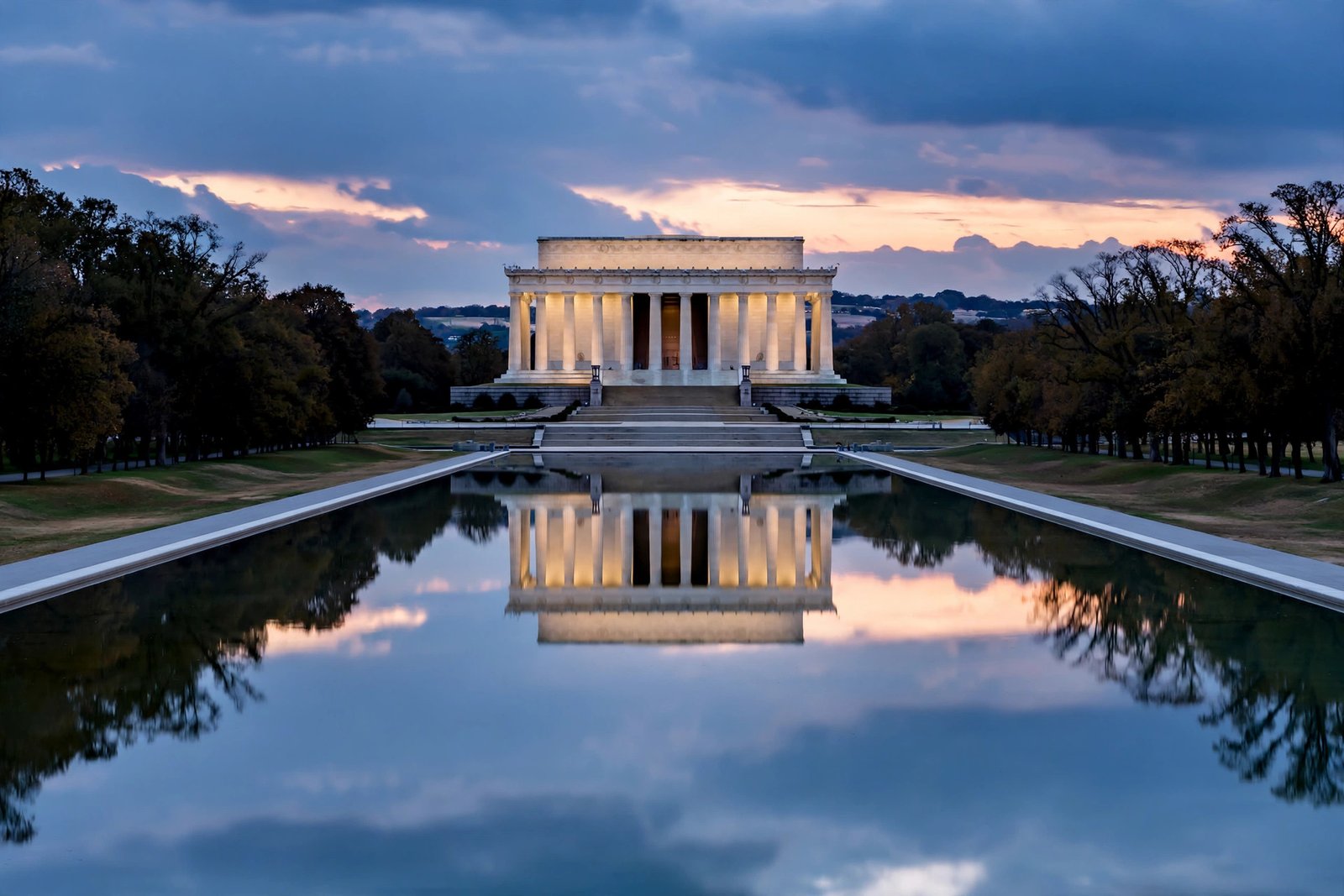
Standing at the west end of the National Mall in Washington, D.C., the Lincoln Memorial is one of the most recognized buildings in America, and its Lincoln Memorial history is as dramatic as the man it honors. A giant seated statue of Abraham Lincoln gazes east across the Reflecting Pool toward the Washington Monument and the Capitol, as if still watching over the nation he saved. Every year, millions of visitors climb its steps, read the words carved into its walls, and stand where history was made.
But the memorial we see today was not inevitable. It took decades of debate, a national competition, and years of construction before it opened in 1922, nearly six decades after Lincoln’s death. Its story involves great artists, powerful speeches, and moments that changed the course of civil rights in America. Here is the full story behind one of the nation’s most beloved landmarks.
Lincoln Memorial History: From Idea to Icon
The idea of a memorial to Abraham Lincoln began almost immediately after his assassination in April 1865, but for decades Americans could not agree on what form it should take. Some wanted a grand monument in Washington; others argued for a memorial highway, a university, or a statue in his home state of Illinois. Fundraising efforts stalled, plans changed, and years passed without a decision.
The turning point came in the early 1900s, when the McMillan Plan for the beautification of Washington, D.C., proposed a monument to Lincoln at the western end of the National Mall, on what was then marshy land along the Potomac River. Congress authorized the memorial in 1911, and a national competition selected the design of architect Henry Bacon, who envisioned a Greek temple: a dignified, timeless structure that would express the permanence of the Union Lincoln had preserved.
That choice of a Greek temple was deliberate. The Doric columns, the marble, and the classical proportions were meant to suggest democracy itself, reaching back to ancient Greece, the birthplace of democratic government. Bacon’s design was not flashy or modern; it was solemn, and it has aged beautifully because of that restraint.
Building a Temple for a President
Construction of the Lincoln Memorial began in 1914 on reclaimed land along the Potomac. Building on soft, marshy ground was a major engineering challenge, and workers had to drive deep foundations before the marble structure could rise. The memorial was built largely from marble: white Colorado marble for the exterior, with Indiana limestone and marble from other states used inside, a quiet tribute to the reunited nation.
The memorial was completed in 1922 at a cost of about 3 million dollars, a large sum at the time. It was dedicated on May 30, 1922, a date chosen to coincide with Memorial Day. President Warren G. Harding spoke at the dedication, and among those in attendance was Robert Todd Lincoln, the president’s only surviving son, who was 78 years old. The presence of Lincoln’s son at the dedication of his father’s memorial gave the ceremony a poignancy that newspapers across the country noted.
The dedication itself reflected the unfinished business of Lincoln’s legacy. The audience was segregated, and the seating arrangements of that day are a sobering reminder that the equality Lincoln fought for had not yet been achieved. That contradiction would later make the memorial a powerful stage for the civil rights movement, as we will see.
The Statue, the Columns, and the Words on the Walls
The heart of the memorial is the seated statue of Abraham Lincoln, sculpted by Daniel Chester French. The statue stands 19 feet tall and was carved from 28 blocks of white Georgia marble. French worked on the design for years, studying Lincoln’s face and figure, and the result is considered one of the great achievements of American sculpture.
Look closely at Lincoln’s hands, and you will notice they are not mirror images. One hand is clenched, symbolizing strength and resolve, while the other is open, symbolizing compassion. Whether French intended this symbolism exactly is debated by historians, but the detail has become part of the statue’s legend and is one of the first things guides point out to visitors.
The memorial is ringed by 36 Doric columns, one for each state in the Union at the time of Lincoln’s death in 1865. Above the columns, the names of those 36 states are inscribed, and on the attic above, the names of the 48 states in the Union when the memorial was dedicated in 1922. Later, plaques were added for Alaska and Hawaii, the 49th and 50th states, so the memorial now acknowledges all fifty states.
Inside, the walls carry two of Lincoln’s greatest speeches. On the south wall is the Gettysburg Address, delivered on November 19, 1863, at the dedication of the Soldiers’ National Cemetery at Gettysburg, Pennsylvania. On the north wall is the Second Inaugural Address, delivered on March 4, 1865, just weeks before his death, with its famous appeal: “with malice toward none, with charity for all.”
Above the statue, an inscription reads: “IN THIS TEMPLE AS IN THE HEARTS OF THE PEOPLE FOR WHOM HE SAVED THE UNION THE MEMORY OF ABRAHAM LINCOLN IS ENSHRINED FOREVER.” The words were written by Royal Cortissoz, and they capture the memorial’s purpose in a single sentence. Two murals by Jules Guerin, one above each speech, add allegorical scenes of unity and emancipation to the chamber.
Lincoln Memorial History and the Fight for Civil Rights
No part of Lincoln Memorial history is more moving than its role in the civil rights movement. In 1939, the great contralto Marian Anderson was denied permission to sing at Constitution Hall by the Daughters of the American Revolution because of her race. With the support of First Lady Eleanor Roosevelt, Anderson instead gave a free open-air concert at the Lincoln Memorial on Easter Sunday, April 9, 1939, before a crowd of about 75,000 people. She opened with “My Country, ‘Tis of Thee,” and the performance became a landmark moment in the struggle against segregation.
Then, on August 28, 1963, the memorial hosted the March on Washington for Jobs and Freedom, when an estimated 250,000 people gathered at the Mall. It was from the memorial’s steps that Dr. Martin Luther King Jr. delivered his “I Have a Dream” speech, calling on America to live up to the promise of freedom that Lincoln had defended a century earlier. King deliberately chose the memorial as his setting, linking the civil rights movement to Lincoln’s legacy in front of the whole nation.
Today, the spot where King stood is marked by an inscription on the memorial’s steps, and visitors often pause there to reflect. The memorial has since hosted countless demonstrations, vigils, and celebrations, and it remains one of America’s most important stages for free speech and public assembly.
Lincoln himself would likely have appreciated the irony and the justice of it: a memorial built to a man who freed enslaved people became the place where their descendants demanded full equality. If you enjoy stories of American landmarks, you may also like our history and facts of the Statue of Liberty and our guide to Yellowstone National Park facts.
Legends, Myths, and Little-Known Details
Like all great landmarks, the Lincoln Memorial has attracted its share of legends, and it is worth separating fact from folklore. One popular story claims that Lincoln’s face is visible in the hair or the back of the statue’s head, supposedly carved there by French as a tribute. Historians and the National Park Service do not support this claim; the shapes visitors see are natural features of the marble carving, not a hidden portrait.
Another legend holds that the memorial’s steps were designed with a special number in mind. The memorial does have a long flight of steps, and visitors sometimes count them, but the famous number associated with Lincoln is not the steps: it is the 87 years of “four score and seven years ago,” the opening of the Gettysburg Address, carved on the wall inside.
- The memorial appears on the back of the five-dollar bill, a small tribute to its status as a national icon.
- It has appeared in countless films, including the famous scene in Forrest Gump where the title character reunites with Jenny in the Reflecting Pool.
- At night, the memorial is floodlit, and the view across the Reflecting Pool to the Washington Monument is one of the most photographed scenes in Washington.
- The memorial is open 24 hours a day, and visiting at dawn or late at night, when the crowds thin, is a favorite tip among Washington locals.
One genuine and moving detail is the memorial’s place in presidential history. Presidents have visited the memorial for moments of reflection and protest alike, and it has served as a backdrop for inaugurations, memorial services, and national mourning. It belongs to no party and no era; it belongs to all Americans.
Visiting the Lincoln Memorial Today
The Lincoln Memorial sits at the western end of the National Mall, at 2 Lincoln Memorial Circle NW, and it is free to visit at any hour. The National Park Service maintains the site, and rangers offer talks that explain the memorial’s history and symbolism. The site is fully accessible, with elevators and ramps for visitors who cannot climb the steps.
For the best experience, arrive early in the morning or in the evening, when the light is beautiful and the crowds are smaller. Take time to read both speeches in full, not just the famous lines, and to look up at the murals and the inscription. Walk around the exterior to see the state names and the views of the Potomac, and then walk east along the Reflecting Pool toward the World War II Memorial and the Washington Monument for one of the great walks in America.
From its long-delayed beginnings to its dedication in 1922, from Marian Anderson’s concert to Martin Luther King Jr.’s dream, the Lincoln Memorial history is really the story of America itself: its ideals, its failures, and its continuing effort to live up to its promises. Stand before the statue, read the words on the walls, and you will understand why, more than a century after it opened, this quiet temple on the Potomac still moves millions of visitors to silence, and sometimes to tears.