
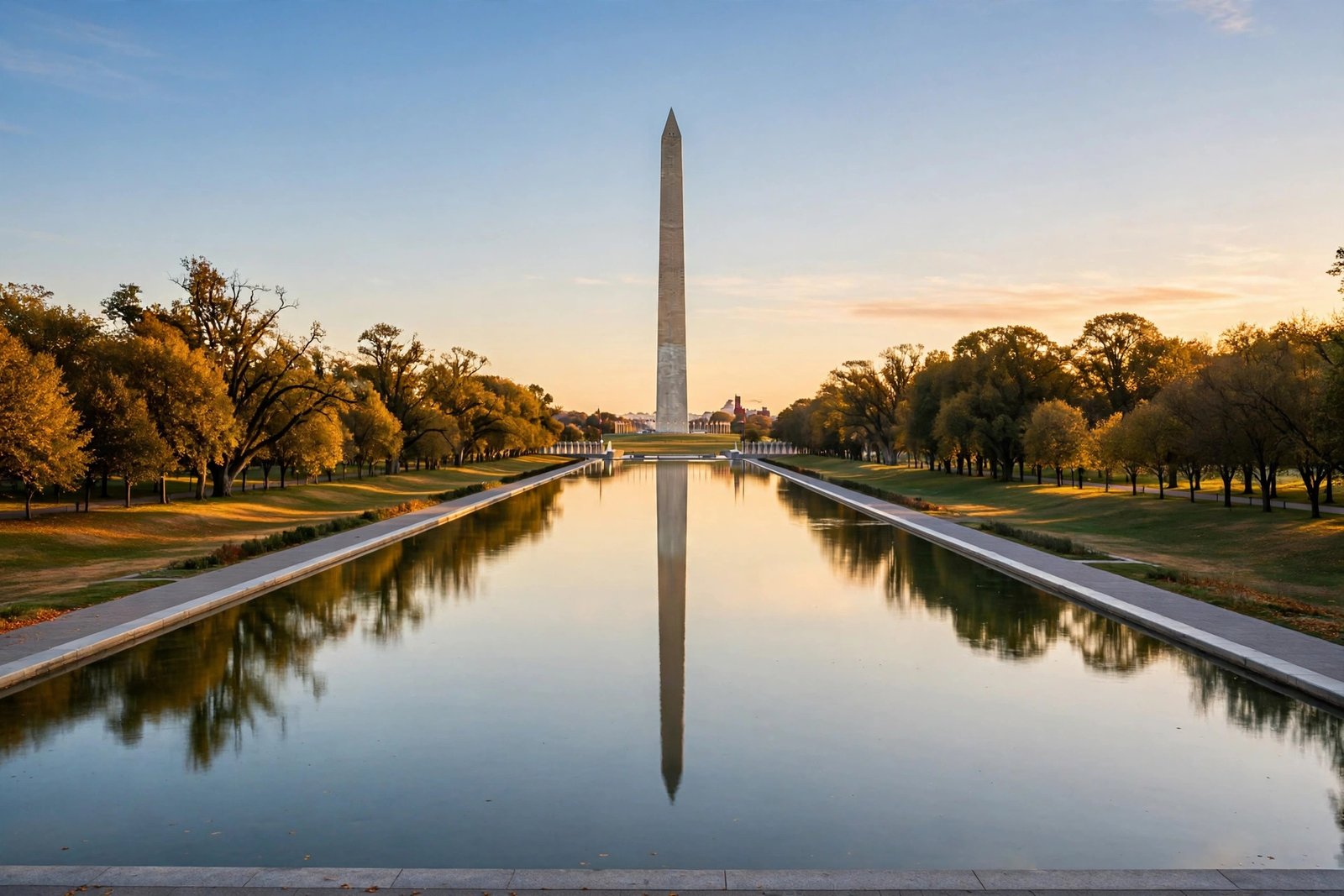
Standing at the center of the National Mall in Washington, D.C., a slender white obelisk rises 555 feet into the sky, visible from across the city. Washington Monument history is a story of ambition, interruption, war, and renewal — a monument that took nearly 40 years to finish and almost never happened at all. Today it is one of America’s most recognizable landmarks, but behind its clean, simple lines lies a surprisingly dramatic past.
When you look at the monument today, it is easy to assume it was built in one smooth effort. It was not. Construction started, stopped for more than two decades, and resumed under very different circumstances, leaving a visible change in the stone about one-third of the way up. That seam is not a flaw to hide; it is a clue to the nation’s own turbulent history in the 1800s.
In this guide, you will learn why the monument was proposed, who built it, why it stalled, how it was finally completed, and what to know before you visit. Whether you are planning a trip to the capital, studying American history, or simply curious about famous landmarks, this story is worth knowing.
Washington Monument History: Why Construction Stalled for Decades
The idea for a monument to George Washington dates back to his own lifetime. As early as 1783, Congress discussed honoring the first president with a statue or memorial. After Washington died in 1799, the idea gained new urgency, but disagreements about design, location, and cost delayed any action for decades. It was not until 1833 that the Washington National Monument Society was formed by private citizens to raise money and lead the project.
The Society chose a design by architect Robert Mills, which originally called for a tall obelisk surrounded by a circular colonnade with statues of Revolutionary War heroes. The grander version was later simplified, largely for cost reasons, leaving the obelisk we know today. Construction began on July 4, 1848, with the laying of the cornerstone in a ceremony attended by large crowds. At the time, the site was low, marshy ground near the Potomac River, and engineers had to build a deep foundation to support the enormous weight of the stone tower.
For the first few years, work moved steadily, funded by private donations. Then trouble arrived. Donations slowed, costs rose, and political disputes within the Monument Society created turmoil. In 1854, construction stopped when funds ran out, with the shaft only about 150 feet tall. The unfinished stump stood on the Mall for more than 20 years, a visible reminder of a project the young nation could not yet finish.
The pause was not just about money. The years that followed included rising sectional tensions, the Civil War, and Reconstruction. The country had more urgent priorities than finishing a monument, and the half-built tower became a symbol of a divided nation. During the Civil War, the grounds around the monument were used by Union forces, and the unfinished structure stood as a silent witness to the conflict. This long interruption is one of the most important chapters in Washington Monument history, because it explains the most visible feature of the monument itself.
How the Monument Was Finally Completed
In 1876, the year of America’s centennial, Congress finally took over the project and provided federal funding to complete it. The U.S. Army Corps of Engineers, under Lieutenant Colonel Thomas Lincoln Casey, took charge of construction. Engineers first strengthened the foundation, which had settled unevenly, and then resumed building upward using marble from a different quarry than the original stone.
That change in stone source is why the monument has two tones. Below about 150 feet, the marble is slightly darker and rougher; above that line, it is lighter and smoother. Visitors who look closely can still see the difference today. Rather than trying to hide the seam, historians point to it as evidence of the monument’s interrupted story.
Work proceeded steadily in the late 1870s and early 1880s. On December 6, 1884, workers set the capstone — a small aluminum pyramid — at the top of the shaft. At the time, aluminum was a rare and precious metal, chosen partly as a symbol of American ingenuity. The monument was dedicated on February 21, 1885, and opened to the public in 1888, after an elevator and staircase were completed inside.
When finished, the Washington Monument was the tallest structure in the world, at 555 feet 5 and one-eighth inches tall. It held that title briefly until the Eiffel Tower surpassed it in 1889. Even today, it remains the tallest freestanding stone structure in the world and, by a District of Columbia law, no building in the city may be taller than the monument under most circumstances, which is why Washington’s skyline stays low and the monument dominates views across the Mall.
Washington Monument History in the Modern Era
In the twentieth century, the monument became a central gathering place for national life. It stands at the crossroads of the National Mall, between the Lincoln Memorial to the west and the U.S. Capitol to the east. Major events, marches, celebrations, and protests have taken place on the grounds around it, and its image has appeared in countless photographs, films, and postcards.
One of the most famous moments in the monument’s modern story came in 1963, when hundreds of thousands of people gathered for the March on Washington for Jobs and Freedom. The monument and the Mall around it served as a backdrop and meeting point for a movement that changed American history. Since then, the grounds have hosted Independence Day fireworks, presidential inaugurations viewed from the Mall, concerts, and national memorial events.
The monument has also survived natural and human challenges. On August 23, 2011, a magnitude 5.8 earthquake centered in Virginia shook Washington and cracked stones near the top of the monument. The damage forced a closure of nearly three years while engineers inspected, repaired, and reinforced the structure. The monument reopened on May 12, 2014, after extensive restoration work that preserved its historic character.
Understanding Washington Monument history helps visitors appreciate that the structure is not just a photo stop. It is a working piece of history that has been repaired, protected, and reinterpreted as the nation around it has changed. Preservation work continues today, with regular inspections and maintenance to protect the marble from weather, pollution, and the passage of time. For another landmark story on the Mall, read our guide to the Lincoln Memorial and its own long path from idea to icon.
Inside the Monument: What Visitors See
Inside the monument, an elevator carries visitors to an observation level near the top, about 500 feet above the ground. From there, windows offer views in all directions: the White House to the north, the Capitol to the east, the Lincoln Memorial and Potomac River to the west, and the Jefferson Memorial and Tidal Basin to the south. On a clear day, the panorama helps visitors understand the layout of the capital in a single glance.
Visitors who once climbed the 897 steps to the top will find that the stairs are now closed to the public for safety and preservation reasons, though the iron staircase remains inside as a historic feature. The elevator ride itself is part of the experience, passing the interior walls where commemorative stones donated by states, organizations, and foreign governments are set into the shaft. Those stones, many dating to the 1800s, carry inscriptions, symbols, and messages honoring Washington.
At the base, the monument grounds include a ring of 50 American flags, representing the 50 states, which fly around the plaza. The surrounding area is open lawn, popular for picnics, kite flying, and casual walks. Because the monument sits in the middle of the Mall, it is easy to combine a visit with nearby museums of the Smithsonian Institution, the World War II Memorial, and other landmarks within walking distance.
Tickets to the observation level are free but timed, and they are distributed through the National Park Service. During busy seasons, especially spring during cherry blossom season and summer, tickets can sell out early in the day, so planning ahead is important. Visitors should expect airport-style security screening before entering, and bags are checked at the entrance.
Visiting Tips and Nearby Landmarks
The best time to visit depends on what you want to see. Early morning offers quieter grounds and softer light for photographs. Late afternoon and sunset can be spectacular, as the white marble glows in warm light. At night, the monument is illuminated and visible from across the city, making an evening walk on the Mall a memorable experience even without going inside.
Families should plan for walking, sun, and water, especially in summer. The Mall is large, and distances between landmarks are longer than they appear on a map. Comfortable shoes, sunscreen, and refillable water bottles make the day easier. The nearby Smithsonian museums offer free entry and air-conditioned breaks, which are welcome on hot days.
For history lovers, a walk from the Washington Monument to the Lincoln Memorial follows the path of the Reflecting Pool and passes the World War II Memorial, one of the most moving sites on the Mall. Continuing east leads to the National Air and Space Museum, the National Museum of American History, and the Capitol. Each stop adds another layer to the story of the nation the monument honors.
Understanding Washington Monument history also deepens a visit to other presidential memorials. The Lincoln Memorial, the Jefferson Memorial, and Mount Rushmore each tell a different part of the American story, in different styles and eras. Comparing them — a simple obelisk, a classical temple, a lakeside rotunda, and a mountainside carving — shows how each generation chose to remember its leaders. For a mountain memorial with its own unfinished and dramatic history, see our article on Mount Rushmore.
Conclusion: A Monument That Mirrors America
The Washington Monument endures because its story mirrors America itself: ambitious beginnings, long interruptions, division, perseverance, and eventual completion. The change in stone halfway up is not a mistake to overlook, but a reminder that great national projects are rarely finished in a straight line. They pause, they struggle, and sometimes they are completed by a later generation with new tools and new determination.
On your next visit to Washington, D.C., take a moment to look closely at that seam in the marble, to ride to the top, and to stand on the grounds where so much history has unfolded. Share this guide with someone planning a capital trip, and add the monument to your list of must-see American landmarks. It is more than a tall tower — it is a timeline in stone.