
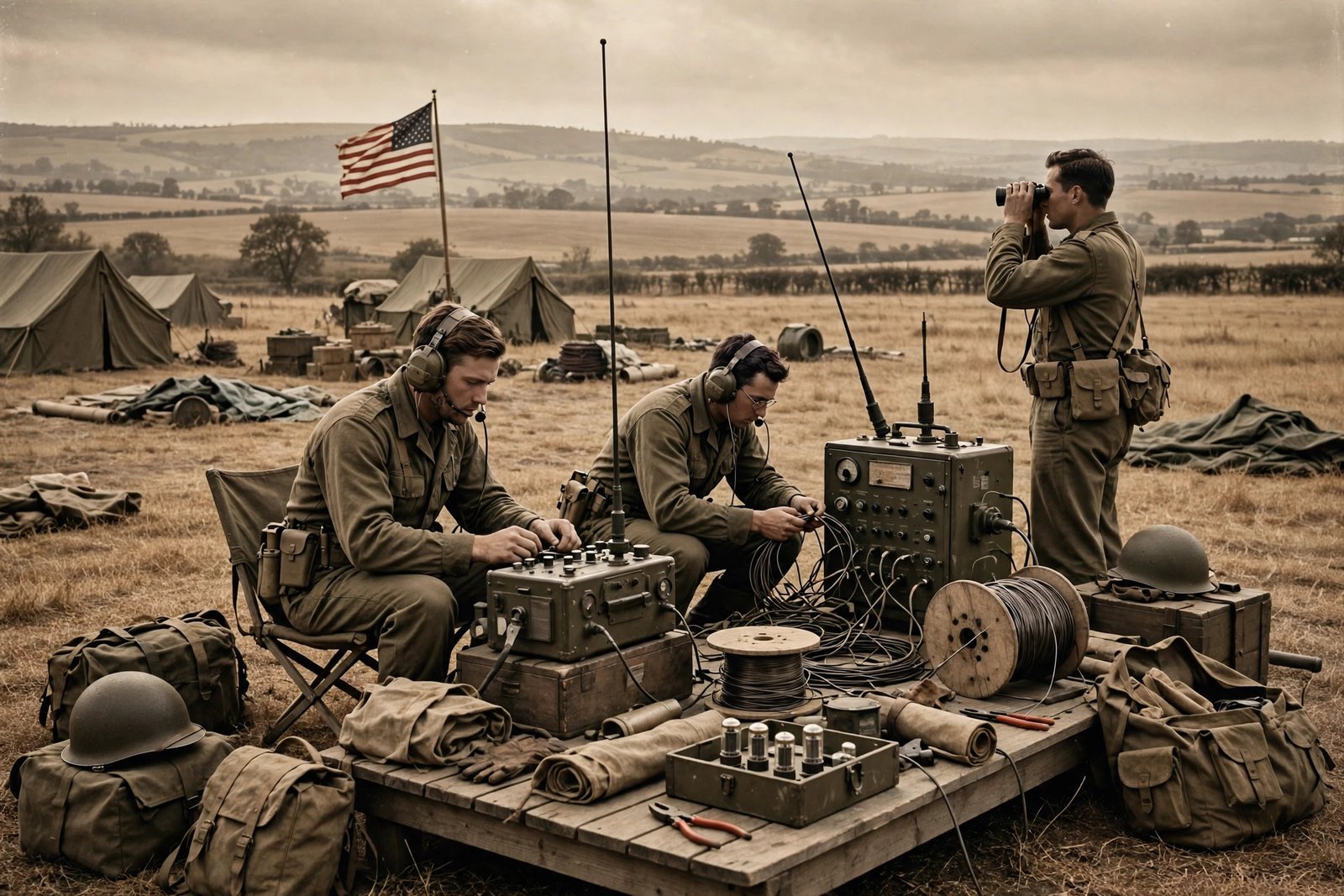
Long before radios crackled in a soldier’s ear or satellites beamed orders across a continent, armies faced a much simpler problem: how do you tell a distant unit what to do, and do it fast enough to matter? The US Army Signal Corps was created to answer that question, and its story runs through nearly every major chapter of American military history. From flags waved on Civil War hillsides to telephone wires strung under fire and radio networks that held an invasion force together, signal soldiers have carried the messages on which battles, and lives, depended.
This is not a story about a single hero or a single battle. It is the story of a branch whose job has always been connection itself. When communication worked, commanders could move troops, call for support, warn of danger, and coordinate forces spread across miles of difficult ground. When it failed, units were left blind and alone. That simple truth explains why signal work has mattered so much, for so long, and why it continues to matter today.
In this guide, we look at the real, well-documented contributions of the Signal Corps, from its early experiments with visual signaling to its vital role in the Second World War. Along the way, you will see how a small technical branch grew into a force that helped shape how modern armies communicate.
How the US Army Signal Corps Began
The origins of organized military signaling in the United States reach back to the years before the Civil War, when officers began to experiment with ways to send messages across distances faster than a rider on horseback could travel. One of the most important early ideas was a system of flag signals that could be read with a telescope from a distant hilltop. The concept was simple, but it required trained observers, clear lines of sight, and a shared code that both sender and receiver understood.
As the nation moved toward civil war, the need for reliable battlefield communication became impossible to ignore. Armies were growing larger, battlefields were growing wider, and commanders could no longer rely on couriers alone to keep control of forces spread over miles. A dedicated signal organization offered a solution: specialists whose entire job was to observe, transmit, and receive information quickly and accurately.
The Signal Corps was formally established during the Civil War era, and its early members served as the eyes and voice of their commanders. They climbed hills, towers, and rooftops to watch enemy movements, then passed what they saw to headquarters. In an age without radio, that work was both dangerous and essential. A signal station was often exposed, visible to the enemy, and hard to defend, yet the information it sent could change the course of a day’s fighting.
Wigwag Flags and the Civil War
The most famous early Signal Corps method was known as wigwag signaling. Using a single flag, moved to the left, right, or front in a set pattern, a trained signalman could spell out letters and words. At night, a torch could replace the flag. With a telescope, a receiving station miles away could read the message and write it down for a commander.
Wigwag signaling sounds old-fashioned today, but on a Civil War battlefield it was a genuine breakthrough. It allowed commanders to share news of enemy movements, request reinforcements, or warn a neighboring unit of danger without waiting for a courier to ride through contested ground. Messages that might have taken an hour on horseback could sometimes be sent in minutes.
Signal stations also played a vital observation role. From high ground, signalmen could watch roads, rivers, and troop movements and report what they saw. That kind of timely observation mattered in an era when maps were imperfect and scouts could not be everywhere at once. The work demanded patience, sharp eyesight, and calm under fire, because a station that kept signaling during a battle was often in plain view of the enemy.
The Civil War also taught hard lessons about communication. Weather, smoke, terrain, and distance could all break a visual link. Signalmen learned to place stations carefully, to repeat messages when needed, and to combine different methods when one method failed. Those practical lessons would carry forward as technology changed, and they remain relevant to communicators today: no single method works in every condition, so flexibility matters.
The US Army Signal Corps in World War II
By the Second World War, the Signal Corps had grown far beyond flags and telescopes. Radio, telephone, telegraph, photography, and even early radar-related work all fell within its broad responsibilities. Armies now moved faster, fought over larger areas, and depended on coordination between infantry, armor, artillery, and air power. None of that coordination was possible without reliable communications.
Signal soldiers laid wire, operated switchboards, repaired radios, and ran message centers under conditions that ranged from deserts to jungles to frozen European fields. Wire crews worked at night and in bad weather, often close to the fighting, because a telephone line was only useful if it actually reached the unit that needed it. Radio operators, meanwhile, had to keep transmissions clear and secure while moving with the forces they supported.
The branch also played a major role in training and technology. As new radios and equipment arrived, signal units had to learn them quickly, teach others to use them, and keep them working with limited spare parts. That combination of technical skill and field toughness became a hallmark of signal service. A signal soldier might be an electrician, a lineman, a radio repairman, or a telephone operator, but the mission was always the same: keep the commander connected to the force.
Readers interested in the wider human story of American service members may also enjoy these accounts of courage and endurance: US Army Rangers true stories, Medal of Honor stories, and incredible true stories of US soldiers.
D-Day and the Fight to Stay Connected
The Allied landings in Normandy in June 1944 offer a powerful example of why signal work mattered. An amphibious invasion is one of the most complex operations an army can attempt. Ships, landing craft, infantry, armor, engineers, and air support all had to work together, often in poor weather and under fire, across beaches and inland roads that were unfamiliar and contested.
Communications were central to that effort. Landing forces needed to report which beaches were secured, where resistance was strongest, and where reinforcements and supplies were most urgently needed. Higher headquarters needed that information to make decisions, and units ashore needed orders, fire support, and coordination with neighboring forces. When equipment was lost in the surf or damaged on landing, signal soldiers had to improvise, repair, and re-establish links as quickly as possible.
The D-Day story also shows a broader truth about signal service: it is often invisible when it works. A successful radio net or telephone line does not draw attention to itself. People notice communication only when it breaks down. Signal soldiers therefore worked in a profession where good performance looked like nothing special at all, just a commander able to reach a subordinate, a unit able to call for help, or a coordinated attack unfolding as planned.
- Observation: signal stations watched and reported enemy movement long before modern sensors existed.
- Speed: visual signals, then wire and radio, cut the time needed to pass urgent orders.
- Coordination: reliable links allowed infantry, artillery, armor, and air support to act together.
- Resilience: when one method failed, signal soldiers switched methods, repaired lines, or found another route.
Technology That Changed the Battlefield
Across its history, the Signal Corps has been closely tied to new technology. The telegraph, the telephone, the radio, and later forms of electronic communication each arrived first as a civilian invention and then had to be adapted for military use. That adaptation was rarely simple. Equipment had to survive mud, rain, heat, and rough handling. It had to be simple enough for soldiers to operate under stress, and reliable enough to work when lives depended on it.
The US Army Signal Corps also became known for its photographers and filmmakers in wartime, documenting operations and providing commanders with visual information. That photographic work, like communications work, required technical skill and a willingness to operate near the action. Over time, the branch’s responsibilities expanded to include areas such as electronic warfare and information systems, reflecting how central communication had become to every aspect of warfare.
What did not change was the core mission. Whether the tool was a flag, a field telephone, or a radio set, the purpose remained the same: give commanders a clear picture of the battlefield and give units a way to act together. Technology changed the tools, but not the need.
Why Signal Soldiers Still Matter Today
Modern soldiers carry radios, use satellite links, and rely on digital networks that would have seemed like science fiction to a Civil War signalman. Yet the basic challenge has not gone away. Forces still operate over wide areas, in difficult terrain, and against adversaries who try to disrupt communications. Keeping networks running, secure, and usable under pressure remains a demanding job.
Today’s signal professionals work with computers, networks, and satellite systems, but they still need the field skills of earlier generations: the ability to set up equipment quickly, troubleshoot under stress, and keep working when conditions are poor. They also need to protect communications from interference and intrusion, a concern that has only grown as networks have become more complex.
For anyone studying American military history, the Signal Corps offers a useful reminder. Wars are often remembered for charges, battles, and famous leaders, but they are also won or lost on quieter work: a message delivered on time, a line repaired in the dark, a radio net kept alive through a long night. That work rarely makes headlines, yet without it, courage and firepower alone are hard to direct.
If you want to explore more of this history, start with museum exhibits, official Army histories, and well-sourced books on military communications. Look for accounts that explain both the technology and the people who used it. Then share what you learn: the story of the US Army Signal Corps deserves a wider audience, and it is a story best told accurately, with respect for the facts and for the men and women who carried the message.