
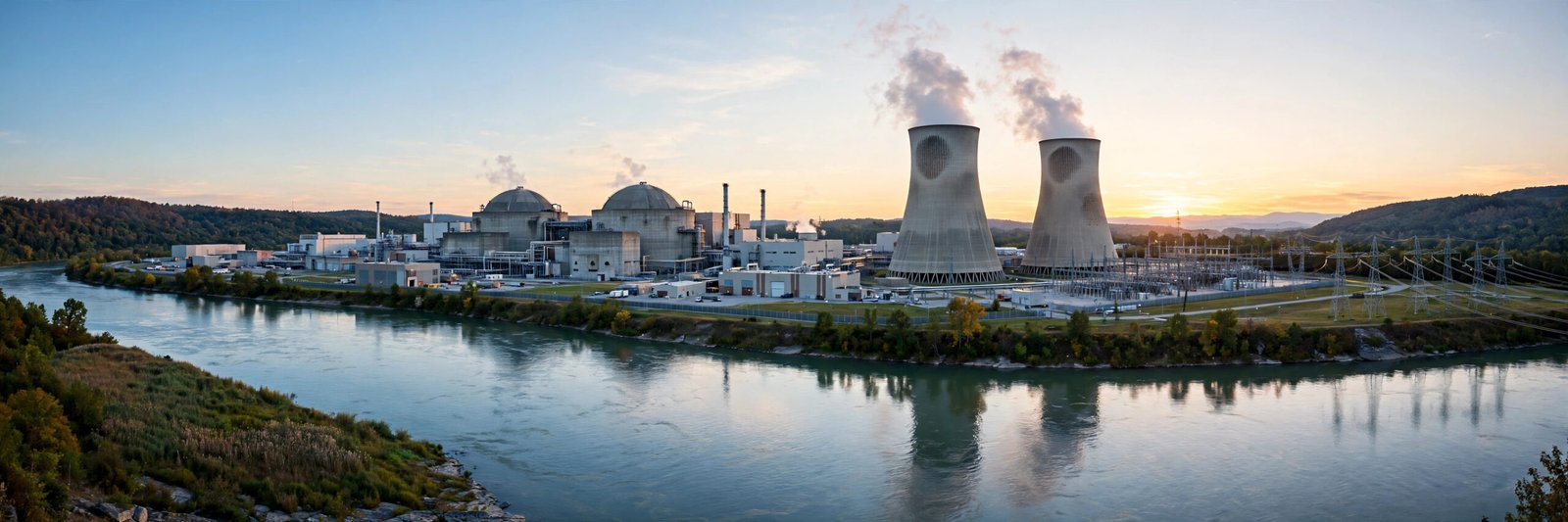
When the lights stay on during a heat wave, a winter storm, or a calm night when the wind has stopped and the sun has set, there is a good chance that a quiet workhorse is helping to keep them on. That workhorse is US nuclear power, a source of electricity that runs day and night, in almost any weather, and produces power without releasing carbon dioxide while it operates. For many Americans, nuclear energy feels distant and technical, something that happens behind fences and cooling towers far from daily life. In reality, it is woven into everyday routines, from charging a phone to running a hospital, a school, or a factory, and it has been part of the American energy story for more than six decades.
This guide explains how nuclear plants work, why they matter for clean and reliable electricity, where they fit in the wider energy mix, how safety is handled, and what the future may hold. You do not need a physics degree to follow along. The basic idea is surprisingly simple, and the questions people ask most often are the same ones worth answering clearly: Is it safe? Is it clean? Why does it cost so much to build? And why is it getting fresh attention after years of debate?
How US Nuclear Power Works
At its heart, a nuclear power plant is a steam plant. The heat does not come from burning coal or gas. It comes from splitting atoms, a process called fission. Inside a reactor, uranium fuel pellets are arranged in long rods. When a neutron strikes a uranium atom, the atom splits and releases a large amount of heat, along with more neutrons that go on to split other atoms. That chain reaction is carefully controlled with control rods that absorb neutrons and slow the reaction when needed.
The heat warms water into steam, the steam spins a turbine, and the turbine drives a generator that makes electricity. In many American plants, the water that cools the reactor is kept separate from the water that becomes steam, and the tall cooling towers people often picture are simply releasing water vapor, not smoke. The process is steady rather than dramatic. A plant can run for months at a time at full power, stopping only for planned refueling and maintenance.
One of the most important features of this design is energy density. A small amount of uranium fuel can produce a very large amount of electricity, which is why a single plant can power hundreds of thousands of homes. Fuel is loaded in assemblies that stay in the reactor for years, and refueling happens on a planned cycle rather than every day. That long, steady run is part of why nuclear plants are often described as baseload power, meaning power that is available around the clock.
Why US Nuclear Power Matters for Clean Energy
Nuclear plants produce electricity without burning fuel, so they do not release carbon dioxide or air pollutants during operation. That matters because electricity demand keeps growing, from homes and businesses to data centers, electric vehicles, and factories that are switching away from fossil fuels. At the same time, the country is trying to cut emissions. A source that can run at any hour, in any season, helps fill the gaps left by weather-dependent sources.
Solar and wind power have grown quickly and play a central role in the clean energy transition. They are at their best when the sun shines and the wind blows, and they need storage, transmission, or backup power for the hours when they do not. Nuclear energy complements them by providing steady, carbon-free electricity through the night and through long cloudy or calm stretches. Think of it less as a competition between technologies and more as a team: variable renewables, storage, and firm sources such as nuclear working together to keep the grid reliable while emissions fall.
That steady output also matters for energy security. Fuel can be stored on site for long periods, plants are located across the country, and their output does not depend on daily fuel deliveries or on the weather in a single region. For grid operators who must balance supply and demand every second, a large, stable source of power is a valuable anchor.
Where Nuclear Energy Fits in America Today
America has dozens of operating commercial nuclear reactors spread across many states, from the East Coast and the Midwest to the South and the West. Some states rely on nuclear for a large share of their electricity, while others have only one plant or none at all. Together, nuclear plants supply roughly one-fifth of the electricity generated in the United States and about half of the country’s carbon-free electricity. Those shares are why debates about closing or extending the life of existing plants carry such weight: losing a large nuclear plant can remove a big block of clean electricity all at once, and replacing it quickly is not easy.
The largest nuclear plant in the country by output is Palo Verde in Arizona, a desert site that shows nuclear plants are not limited to rainy or coastal regions. In recent years, new reactors have also come online in Georgia, the first new large reactors built in the United States in more than three decades. Those projects were long and expensive, and they became a case study in both the promise and the difficulty of building big nuclear plants today. At the same time, several older plants have received license extensions that allow them to keep operating safely for additional decades, provided they meet strict inspection and maintenance standards.
For readers interested in how American power shows up in other fields, the story connects naturally to other strengths of the country, from the quiet reach of the US submarine fleet to the organized missions of the US Space Force. Energy, defense, and technology all depend on the same foundation: reliable power, skilled people, and long-term planning.
Safety, Waste, and the Questions People Ask
No honest guide to US nuclear power can skip safety. American plants are regulated by the Nuclear Regulatory Commission, an independent federal agency that sets rules, inspects plants, and can order shutdowns when standards are not met. Plants are built with multiple layers of protection, including a thick containment structure around the reactor, backup cooling systems, backup power supplies, and trained operators who drill for emergencies. Operators are licensed, plants are inspected regularly, and problems must be reported.
History shapes public trust, and the most famous American accident remains Three Mile Island in Pennsylvania in 1979, when a partial meltdown damaged a reactor but released only a small amount of radiation and caused no confirmed injuries. The accident led to major reforms in training, procedures, and oversight. It also left a lasting impression that still colors conversations today, even though plant designs, controls, and safety culture have changed a great deal since then. Accidents in other countries, including Chernobyl and Fukushima, are often raised in American debates, but they involved different reactor designs, different regulations, and different circumstances, and American regulators and operators studied each event closely.
Waste is the other long-running question. Used nuclear fuel is highly radioactive at first and must be shielded and cooled, first in pools of water and later in sturdy dry casks stored on plant sites. The volume is small compared with other energy wastes: all of the used fuel from American commercial reactors would fill a modest space compared with the mountains of ash or the emissions produced by fossil fuels over the same period. Still, the country has not opened a permanent underground repository, and that unresolved political question remains one of the industry’s biggest challenges. Until a permanent site is chosen and built, secure on-site storage remains the working solution.
Cost is a practical question too. Running an existing nuclear plant is often competitive, but building a new large plant is expensive and slow, partly because of complex engineering, strict safety requirements, and the fact that the United States builds so few of them that each project can feel like starting over. That is one reason smaller, factory-built reactor designs have attracted so much interest: if reactors can be made in repeatable modules, costs and timelines might come down.
The Future of Nuclear Energy in America
The next chapter of US nuclear power is likely to look different from the last one. Alongside large plants, developers are working on small modular reactors, which are designed to be smaller, simpler, and built in factories before being shipped to a site. Supporters say these designs could power smaller grids, industrial sites, or remote communities, and could be added in stages as demand grows. Critics note that none of these designs has yet been built at commercial scale in the United States, so costs and timelines remain uncertain.
There is also renewed interest in keeping existing plants running longer. Extending a plant’s life avoids building replacement power, preserves skilled jobs, and keeps a large source of clean electricity online. Communities near plants often support extension because plants bring steady employment, tax revenue, and local spending, while also supporting schools and services. At the same time, any extension must pass safety review, and older plants need investment in maintenance and upgrades.
Research into advanced fuels, better materials, and even fusion, the process that powers the sun, continues in national laboratories and universities. Fusion remains a long-term research goal rather than a near-term power source, but progress in experiments has kept interest alive. For the coming decade, the practical debate will focus on a simpler set of choices: which existing plants to keep, whether new reactors can be built on time and on budget, and how nuclear fits alongside wind, solar, batteries, and transmission upgrades.
Whatever path the country chooses, the basic appeal of nuclear energy is easy to understand. It offers large amounts of steady, carbon-free electricity from a small footprint, with fuel that lasts for years and plants that can run through storms, heat waves, and cold snaps. The challenges are real too: high upfront costs, long build times, waste storage politics, and public trust that must be earned plant by plant, inspection by inspection. A clear-eyed view holds both sides at once.
Visiting and Learning More
Many Americans first encounter US nuclear power through a cooling tower on the horizon or a school lesson about atoms. Some plants offer visitor centers or community programs, and national laboratories and science museums run exhibits that explain fission in hands-on ways. If you live near a plant, local emergency information is published by county and state agencies, and it is worth knowing where to find it, just as you would know evacuation routes for floods or storms. Learning how your own electricity is made, whatever the mix in your state, is a useful habit in an era when energy choices affect bills, jobs, and the climate.
America’s landscapes and landmarks tell a similar story of scale and variety, from remote wilderness to busy cities. If you enjoy exploring the country behind the headlines, a look at the most beautiful national parks in the USA is a good reminder of what clean air, open land, and careful stewardship protect. Energy policy can feel abstract, but its results show up in the places people love to visit and the communities they call home.
Conclusion
Nuclear energy is not a simple hero or a simple villain in the American energy story. It is a powerful, proven technology with real strengths and real trade-offs, and its future will be shaped by engineering, economics, regulation, and public confidence. Understanding how it works, why it matters for clean and reliable power, and what questions remain open is the first step toward a thoughtful opinion. The next time the lights stay on through a still, dark night, you will know one of the quiet sources that may be helping to keep them glowing.
What do you think about the role nuclear energy should play in America’s future? Share this guide with someone who is curious about clean energy, explore more stories about American strength and ingenuity on Beauty of USA, and keep learning about the technologies shaping the grid we all rely on.