
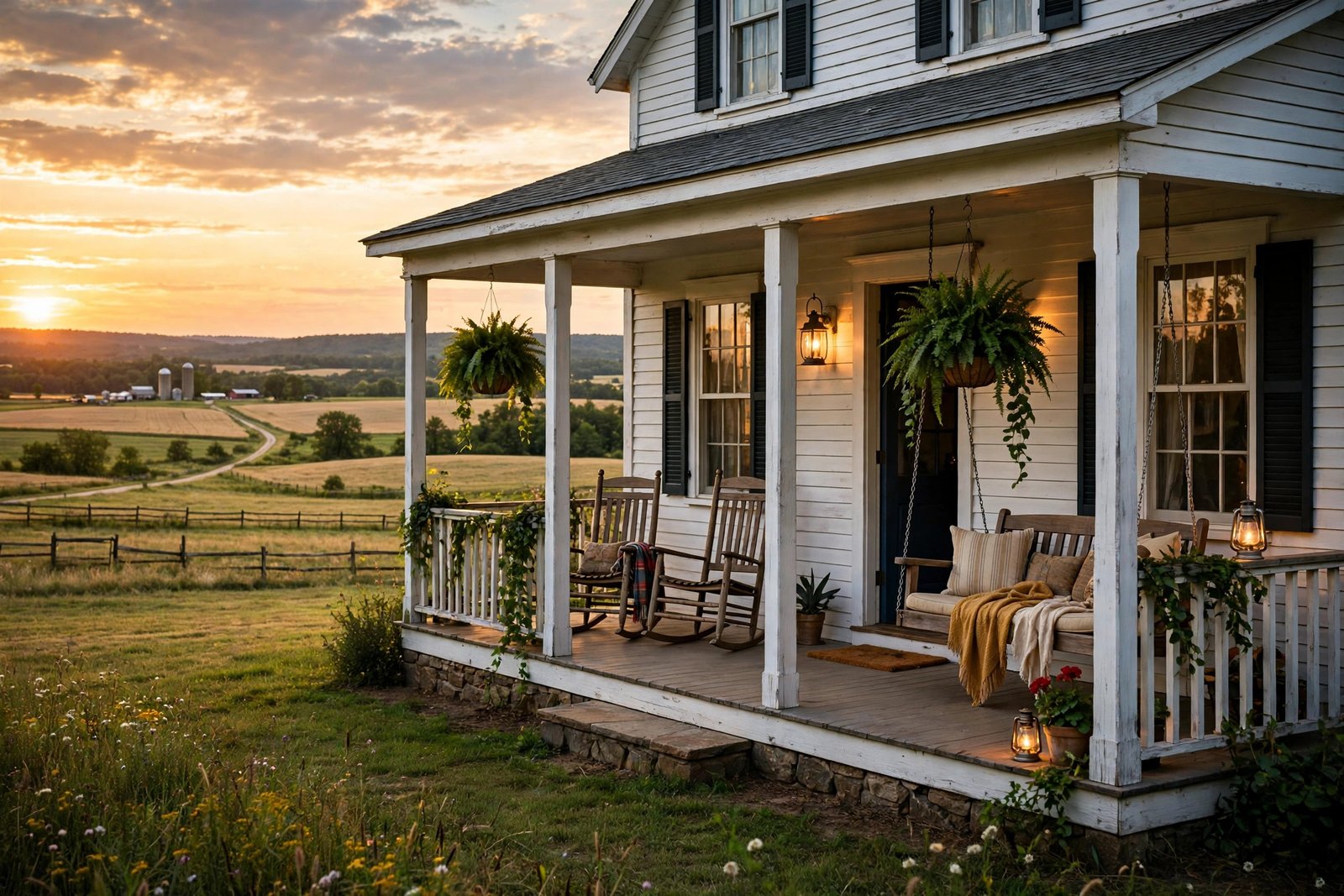
There is a particular kind of American evening that needs no invitation: the air cooling off, crickets tuning up, and neighbors drifting out to their porches to watch the world slow down. Few American rituals are as simple or as beloved as sitting on the front porch as the day fades — a glass of lemonade in hand, a rocking chair in motion, nowhere to be. American front porch culture is more than an architectural quirk. It is a way of life built around neighbors, storytelling, and the radical act of slowing down.
For well over a century, the front porch has been America’s outdoor living room — the place where private life meets public life, where gossip is traded, marriages are courted, babies are rocked, and the news of the neighborhood is delivered one rocker at a time. This is the story of how the porch shaped American life, why it nearly disappeared, and why it is coming back.
American Front Porch Culture: A Brief History
The front porch as Americans know it took shape in the 19th century, as builders began adding covered outdoor spaces to homes across the country. In the decades before air conditioning, the porch was often the coolest room in the house — a shaded, breezy space where families escaped the summer heat. Elaborate wraparound porches became signatures of Victorian and Queen Anne homes, while simpler stoops and galleries fronted farmhouses and city rowhouses alike. The porch was, in effect, an outdoor parlor: furnished, decorated, and used daily.
Sleeping porches deserve a special mention. In the early 20th century, before electric cooling, many American homes had screened porches or upstairs sleeping porches where families slept through hot summer nights to catch the breeze. The porch wasn’t a luxury add-on; for much of American history, it was a practical necessity — and a social one. It sat between the private world of the home and the public world of the street, and everything important seemed to happen there.
The Golden Age of Porch Sitting
The golden age of American front porch culture ran roughly from the late 1800s through the middle of the 20th century. Evenings followed a familiar rhythm: after supper, families carried their chairs out front, and the porch became command central. Neighbors strolled by and stopped to talk. Children played in the yard within earshot. Stories were told and retold — family lore, local legends, the day’s gossip. In an era before television dominated the evening, the porch was the entertainment.
Games and pastimes lived on the porch too. Checkers and cards on a small table, whittling, shelling and snapping vegetables for dinner, and — on the grandest porches — dancing to a wind-up phonograph. Kids learned to play instruments within earshot of the whole street, and more than a few American musicians trace their first audience to a porch full of neighbors.
The furniture of the porch became iconic in its own right: the rocking chair, the porch swing, the wicker settee. Shelling peas, shucking corn, snapping beans — summer kitchen work moved outdoors. Teenagers courted on porch swings under the watchful eyes of parents inside. Traveling salesmen, politicians, and preachers all knew that the way to an American’s attention was through the front porch. It was, quite literally, where America sat down together.
Southern Porches: Charleston Piazzas and Beyond
Nowhere is porch culture deeper than in the American South, where the heat made the porch essential and the social life made it sacred. In Charleston, South Carolina, historic homes are famous for their double piazzas — long, columned porches stacked two stories high, typically oriented to catch the ocean breeze. The piazza (the local word for porch) is a point of civic pride, and Charleston’s streetscapes of shuttered, fern-draped piazzas are among the most photographed in America.
New Orleans has its own version: the gallery, the city’s term for the deep, often iron-railed porches and balconies that front Creole townhouses and shotgun houses. From Savannah to Natchez, the Southern porch follows the same formula: deep shade, ceiling fans, rocking chairs, and hanging ferns. And then there is the haint blue ceiling — the pale blue-green paint applied to porch ceilings across the Lowcountry. Gullah Geechee tradition holds that the color confuses or repels haints, or restless spirits, keeping them from crossing into the home. Whether taken as folklore or simply a beloved custom, haint blue is one of the South’s most distinctive porch signatures.
Porch Decor and Holiday Traditions
The porch has always been a canvas. Rocking chairs and welcome mats are just the beginning: seasonal decorating turns porches into neighborhood landmarks. Fall brings mums, pumpkins, and corn stalks; winter brings wreaths, garlands, and lights; summer brings flags, ferns, and flower boxes. Patriotic displays — bunting on the Fourth of July, flags on Memorial Day — turn the porch into a statement of identity. For many families, decorating the porch for the holidays is a tradition as fixed as the holidays themselves.
Storytelling may be the porch’s greatest tradition. Before radio and television, the porch was where family history was passed down — grandparents telling the old stories, uncles spinning tall tales, the whole clan weighing in. Front-porch music has its own lineage too: guitars, banjos, and harmonicas on summer evenings, the roots of countless American musical traditions strummed out within earshot of the street.
The porch sits at the heart of American home life, alongside other traditions we love writing about — from American diner culture to Thanksgiving traditions and the spectacle of state fair season.
Why American Front Porch Culture Faded
So why did the porch go quiet? The decline began after World War II, and it had several causes. Air conditioning moved family life indoors, into the coolest room of the house — the living room. Television gave the evening a new center of gravity, and it was inside. The automobile reshaped the house itself: attached garages and driveways pushed the front door — and the porch — to the side, while backyards and patios became the new outdoor living space. Suburban lots turned their sociable faces inward, and the street-facing porch slowly became ornamental rather than essential.
The result was a subtle but real loss. Without the porch, the casual, unplanned encounters of neighborhood life — the wave, the chat over the railing, the borrowed cup of sugar — grew rarer. Streets got quieter. Neighbors became strangers. The porch hadn’t just been furniture; it had been infrastructure for community.
The Revival of Porch Living
But the porch is coming back. The revival has many parents: the farmhouse design trend that put wraparound porches on magazine covers; the New Urbanist movement, which in the 1980s began designing walkable towns — Seaside, Florida, is the famous example — with front porches as deliberate engines of community; and, more recently, a simple rediscovery. During the pandemic years, when indoor gathering was off the table, Americans remembered the porch as the perfect in-between space. Porch concerts, porch drop-offs, and socially distanced porch visits reminded a generation what the space was for.
Today’s revival of American front porch culture is visible everywhere: new homes with deep, furnished porches; old homes with their porches restored; and a thriving market for rocking chairs, swings, and outdoor furniture. The porch swing, once a relic, is a bestseller again. The lesson of the last century seems to be sinking in: the porch wasn’t quaint. It was wise.
How to Create Your Own Porch Space Today
You don’t need a Victorian wraparound to join in. Any stoop, landing, or small porch can become a sitting space. Start with comfortable seating — a rocking chair, a bench, even sturdy folding chairs — and a small table for drinks. Add light: a warm porch light or string lights turn the space inviting after dark. Add life: potted plants, a hanging fern, a doormat with personality.
Then use it. The real secret of American front porch culture was never the furniture — it was the habit. Sit out in the evening. Wave at walkers. Learn your neighbors’ names. Keep a pitcher of lemonade or sweet tea in the fridge through the summer. Put the phone down. The porch works its magic slowly, one evening at a time, and the neighborhood you build is the one you sit out in.
Some porches become tiny community hubs all on their own. The Little Free Library movement — small book-sharing boxes mounted on posts, which began in Wisconsin in 2009 and has since spread across the country — turned countless front yards and porches into neighborhood exchanges. A bowl of dog treats by the steps, a chalkboard with the day’s greeting, a basket of garden surplus: small gestures like these are the modern equivalent of the old porch wave, and they work just as well.
From haint blue ceilings in Charleston to porch swings in the Midwest, American front porch culture endures because it answers something permanent: the human need to be outside, unhurried, and among neighbors. So tonight, when the air cools off, pull up a chair and sit a spell. The porch is waiting — it always has been. Share this with someone who loves a good porch evening.