
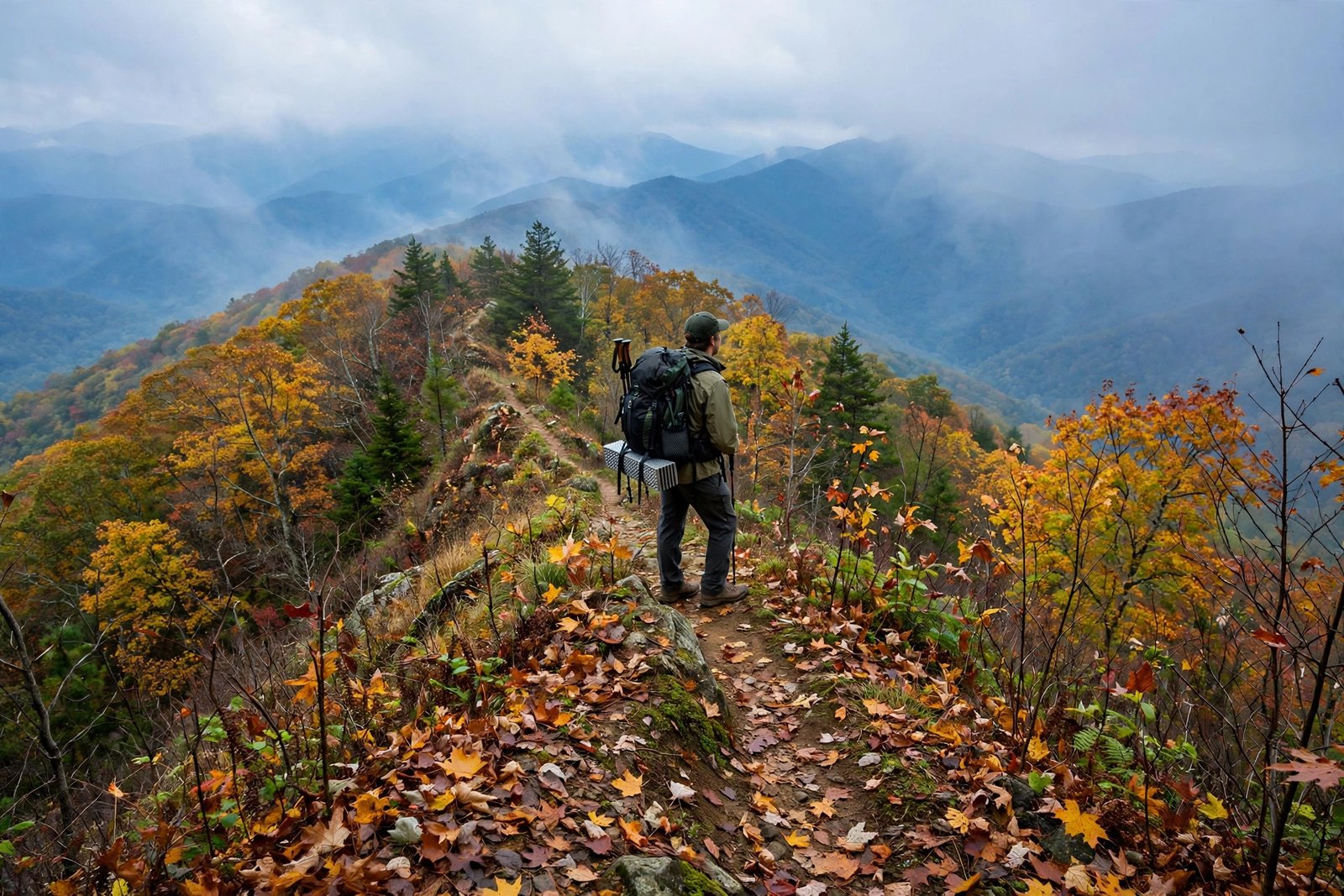
Stretching from a wooded mountain in Georgia all the way to a rugged peak in Maine, the Appalachian Trail is one of the great walking adventures on Earth, and these Appalachian Trail facts reveal why millions of people dream of setting foot on it.
Every year, around three million people walk at least part of the trail. Some come for an afternoon stroll near a road crossing. Others spend months walking its full length, carrying everything they own on their backs. Whatever the scale of the adventure, the trail offers the same reward: quiet forests, sweeping mountain views, and a rare sense of simplicity that is hard to find anywhere else in modern American life.
The trail is not a single park or a single path built by one person. It is a long chain of footpaths, shelters, and volunteer effort stitched together across the eastern United States. It passes through small towns, over high ridgelines, and past some of the oldest mountains on the planet. Understanding it begins with the basics: where it goes, how it came to be, and what it feels like to walk it.
Appalachian Trail Facts: The Route at a Glance
The Appalachian Trail runs about 2,190 miles from Springer Mountain in Georgia to Mount Katahdin in Maine. The exact mileage shifts slightly from year to year as the route is rerouted around erosion, land changes, and trail improvements, so guidebooks in different years may quote slightly different totals. What never changes is the scale: this is a journey longer than a walk from New York to Denver, done entirely on foot.
Along the way, the trail crosses 14 states: Georgia, North Carolina, Tennessee, Virginia, West Virginia, Maryland, Pennsylvania, New Jersey, New York, Connecticut, Massachusetts, Vermont, New Hampshire, and Maine. Virginia claims the longest share, with more than 500 miles of trail, which is why many thru-hikers say Virginia feels endless. West Virginia contributes the shortest stretch, only a few miles around Harpers Ferry, a town that holds a special place in trail culture as the unofficial midpoint and home of the Appalachian Trail Conservancy headquarters.
The trail is marked by white rectangular blazes painted on trees, rocks, and posts. Hikers learn to follow these simple marks the way drivers follow road signs. Side trails to shelters, water sources, and viewpoints are usually marked in blue. The system is deliberately simple, and it has guided generations of walkers through dense forest and open summits alike.
Elevation is a constant companion. The trail climbs and descends the equivalent of Mount Everest many times over across its full length. The highest point is Clingmans Dome in Tennessee, at 6,643 feet, while the northern terminus, Mount Katahdin, rises 5,267 feet above sea level and demands a steep, rocky climb to finish. Hikers in the White Mountains of New Hampshire face some of the most exposed and weather-beaten miles, where above-treeline ridges and sudden storms test even experienced walkers.
How the Trail Was Born
The idea for the trail came from Benton MacKaye, a forester and regional planner who proposed a long-distance footpath along the Appalachian Mountains in a 1921 article. His vision was not only about recreation. He imagined a chain of camps and communities where city workers could escape into nature, rest, and reconnect with the outdoors. The idea caught on with hiking clubs up and down the East Coast, and volunteers began linking existing trails and cutting new ones.
By 1937, the trail was officially completed as a continuous footpath from Georgia to Maine, an extraordinary achievement built largely by volunteers. In 1968, it became one of the first National Scenic Trails under the National Trails System Act, giving it federal recognition and protection. Today, the Appalachian Trail Conservancy works alongside the National Park Service, the U.S. Forest Service, state agencies, and dozens of local trail clubs to maintain and protect it.
One of the trail’s most famous milestones came in 1948, when Earl Shaffer of Pennsylvania became the first person to report a complete thru-hike, walking the entire trail in a single journey. At the time, many people doubted it could be done. Shaffer’s walk proved it was possible and helped inspire the thru-hiking tradition that continues today. In the decades since, thousands of hikers have completed the journey, some in a single season and others over many years, one section at a time.
Among the most loved Appalachian Trail facts for history buffs is that the trail passes through landscapes shaped by centuries of American life, from old farmsteads and stone walls in New England to Civil War-era towns in the mid-Atlantic. Walking it is therefore not only a nature experience but also a slow journey through the country’s past, taken at three miles an hour.
Surprising Appalachian Trail Facts About Wildlife and Seasons
The trail crosses an astonishing range of habitats. Southern sections wind through rhododendron tunnels and hardwood forests alive with songbirds in spring. Mid-Atlantic ridges offer dry oak forests and rocky overlooks. New England brings spruce and fir forests, moose country, and alpine zones where only low, hardy plants survive above the treeline. Few footpaths anywhere in the world pass through so many ecosystems in a single route.
Wildlife encounters are part of the experience, and black bears are the animals hikers talk about most. Bears live along much of the trail, especially in the Smokies, the Shenandoah Valley, and New Jersey. Attacks are extremely rare, but hikers are expected to store food properly, use bear boxes or cables where provided, and never approach or feed wildlife. Deer, wild turkeys, salamanders, and countless songbirds are far more common sights, and patient walkers may also spot foxes, porcupines, and even a moose in Maine or New Hampshire.
One of the lesser-known Appalachian Trail facts is how dramatically the seasons change the experience. Spring brings wildflowers and rushing streams but also mud and black flies in the north. Summer offers long daylight and lush green tunnels, along with heat, humidity, and afternoon thunderstorms. Autumn is many hikers’ favorite season, when the hardwood forests turn gold and red and the air grows crisp. Winter transforms the high mountains into a serious undertaking, with snow, ice, and short days that only well-prepared hikers should attempt. If you love fall color, our guide to the best autumn road trips in the USA pairs beautifully with a trail visit.
Water is another seasonal story. Springs and streams are plentiful in spring but can run low in a dry late summer, so hikers learn to check guidebooks, carry enough capacity, and treat all water before drinking. Shelters spaced roughly a day’s walk apart offer a roof and a place to meet fellow hikers, though many walkers prefer tents for privacy and flexibility.
Thru-Hiking, Section Hiking, and Trail Culture
A thru-hike, walking the entire trail in one continuous journey, typically takes five to seven months. Most northbound hikers start in Georgia in spring and aim to reach Katahdin before it closes in mid-October. Southbound hikers start in Maine in summer and walk toward Georgia. Only a minority of those who start finish, and that is part of the trail’s mystique: it is a genuine challenge of endurance, planning, and resilience.
Section hiking is the other great tradition. Many people complete the trail over years or decades, walking one stretch at a time during vacations and weekends. There is no deadline and no single right way to do it, which is why the trail welcomes everyone from retirees to college students to families with children. Day hikers, who make up the vast majority of trail users, simply enjoy short stretches near trailheads, overlooks, and state parks.
Trail culture has its own language. Thru-hikers often adopt trail names, playful nicknames given by fellow hikers. Trail magic, unexpected kindness from strangers such as a cooler of cold drinks at a road crossing or a ride into town, is a beloved tradition. Trail towns along the route, from Damascus, Virginia, to Hanover, New Hampshire, welcome hikers with hostels, diners, resupply stores, and a warm familiarity with muddy boots and big backpacks.
Preparation matters more than gear. Successful hikers train with loaded packs, learn to read maps and weather, and practice the Leave No Trace principles that protect the trail: pack out all trash, camp on durable surfaces, respect wildlife, and be considerate of other visitors. The trail survives because millions of users treat it gently, and because thousands of volunteers maintain it every year, clearing blowdowns, rebuilding steps, and repainting blazes.
Planning Your Own Visit
You do not need to commit to a thru-hike to enjoy the trail. Some of the most rewarding experiences are short: a sunset from McAfee Knob in Virginia, one of the most photographed spots on the entire route; a walk through the Smokies in spring; or a fall day on a New Hampshire ridge. National parks and forests along the route, including Shenandoah and the Great Smoky Mountains, offer easy access points and ranger guidance. For more inspiration, see our roundup of the most beautiful national parks in the USA.
Before you go, check current conditions with the Appalachian Trail Conservancy or the relevant park, carry the ten essentials, and tell someone your plan. Start with a distance that matches your fitness, bring more water than you think you need, and remember that mountain weather can change fast. Good footwear, broken in before the trip, matters more than almost any other item.
These Appalachian Trail facts are just the start of what this footpath offers. Whether you walk a mile or all 2,190, you will come away with a deeper appreciation for America’s eastern mountains, the volunteers who keep the path open, and the simple joy of putting one foot in front of the other. Lace up, pick a section, and discover your own piece of the trail. And if you want more surprises about the country it crosses, explore our collection of surprising facts about the USA before you head out.