
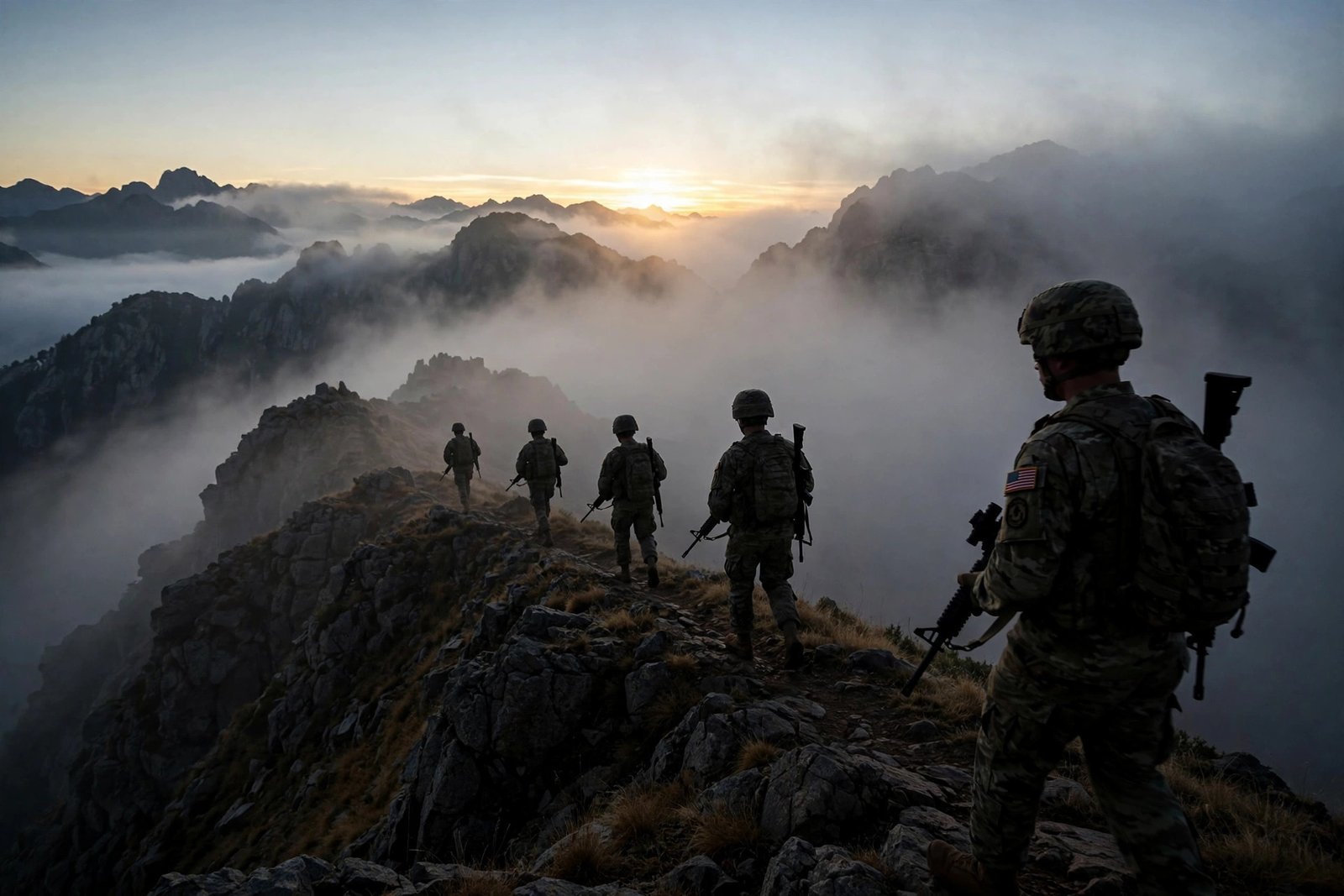
On the morning of June 6, 1944, a group of young American soldiers looked up at cliffs rising more than 100 feet above the English Channel and began to climb. German defenders fired down on them. Ropes slipped. Ladders broke. Men fell. Those who reached the top kept fighting. That morning at Pointe du Hoc has become one of the most famous US Army Rangers stories ever told, and it captures something essential about these soldiers: they do the hardest jobs, in the worst conditions, and they do not quit.
US Army Rangers stories are not just war stories. They are stories about training so hard it breaks most people who try it, about brotherhood forged under pressure, and about ordinary young Americans who discover they are capable of extraordinary things. From the beaches of Normandy to the mountains of Afghanistan, Rangers have carried out some of the most difficult missions in American military history. Their motto, “Rangers Lead the Way,” is not a slogan. It is a promise.
In this article, we will walk through the history of the Rangers, share some of their best-known true stories, and look at what makes these soldiers different. Whether you are a military history fan, a veteran, or simply someone who loves stories of courage, these accounts will stay with you long after you finish reading.
What Makes an Army Ranger?
Before we dive into the stories, it helps to understand what a Ranger actually is. The U.S. Army Rangers are an elite light infantry force. Today, the 75th Ranger Regiment is the Army’s premier direct-action raid force, made up of highly trained soldiers who specialize in missions like airfield seizures, raids on high-value targets, and reconnaissance behind enemy lines.
Becoming a Ranger is one of the hardest challenges in the American military. It starts with the Ranger Assessment and Selection Program, a grueling course designed to test physical fitness, mental toughness, and character. Those who pass earn the right to serve in the Regiment and wear the tan beret. Many Rangers also attend Ranger School, the Army’s famous leadership course at Fort Benning, Georgia, known for weeks of little sleep, little food, and constant physical and mental stress. Graduates earn the Ranger Tab, a small cloth badge that carries enormous respect across the entire Army.
Not every Ranger School graduate serves in the 75th Ranger Regiment, and not every soldier in the Regiment has attended Ranger School, but both paths demand the same qualities: endurance, discipline, teamwork, and the refusal to give up. The Ranger Creed, which every Ranger memorizes, sums it up. Its opening lines declare that a Ranger is a more elite soldier who arrives at the cutting edge of battle by land, sea, or air, and its closing lines promise that fellow Rangers will never be left behind. That creed is not recited as a formality. Rangers live by it, and many of their most famous stories are stories of men risking everything to honor it.
The Rangers’ history stretches back to colonial America, when Rogers’ Rangers fought as a frontier scouting force in the French and Indian War. The modern Ranger tradition, however, was born in World War II, when the first Ranger battalions were formed to take on missions too dangerous for conventional units. That is where our stories begin.
US Army Rangers Stories From World War II
Some of the most powerful US Army Rangers stories come from World War II, when the Ranger battalions were brand new and were thrown into the hardest fighting of the war. The first Rangers were volunteers, and their commander, Major William Darby, trained them with a harsh program modeled on the British Commandos. Darby’s Rangers first saw combat in North Africa, then fought their way through Sicily and Italy, earning a reputation for toughness that spread through the entire Army.
But it was on D-Day, June 6, 1944, that the Rangers earned a permanent place in American legend. At Pointe du Hoc, a cliff-top position on the Normandy coast, German guns threatened the Allied landing beaches. The 2nd Ranger Battalion was given the job of scaling the cliffs and destroying the guns. Under heavy fire, the Rangers climbed ropes and ladders up the sheer rock face. When they reached the top, they found that the guns had been moved inland. The Rangers pushed forward, found the guns, and destroyed them. They then held the position for two days against repeated German counterattacks, cut off from the main force and running low on ammunition. Their stand at Pointe du Hoc is still studied in military schools today, and it is one of the most retold Ranger stories of all time.
Another legendary mission came later in the war, on the other side of the world. In January 1945, the 6th Ranger Battalion carried out the Raid at Cabanatuan in the Philippines, marching behind enemy lines to free more than 500 American and Allied prisoners of war from a Japanese prison camp. The prisoners had been held for years, many of them survivors of the Bataan Death March, and they were starving. The Rangers, working with Filipino guerrillas, slipped past Japanese patrols, stormed the camp at night, and brought the prisoners out. It was one of the most successful rescue missions in American military history, and not a single prisoner was lost during the raid itself. The Cabanatuan raid shows the other side of the Ranger mission: not just destroying targets, but saving lives.
Across Europe and the Pacific, the World War II Rangers built a legacy that later generations would inherit. By the end of the war, the Ranger battalions had been disbanded, but their spirit lived on. When the Korean War broke out, Ranger companies were formed again. In Vietnam, long-range patrol units carried the Ranger name. And in 1984, the 75th Ranger Regiment was formally established, giving the Rangers a permanent home in the modern Army.
The Battle of Mogadishu and the Ranger Ethos
If Pointe du Hoc defined the Rangers of World War II, the Battle of Mogadishu defined the modern Regiment. On October 3, 1993, American forces in Somalia, including Rangers from the 75th Ranger Regiment, launched a mission to capture lieutenants of a Somali warlord in the capital city of Mogadishu. What was supposed to be a quick raid turned into an all-night battle after two U.S. Black Hawk helicopters were shot down in the city.
The story of that battle became famous through the book and film “Black Hawk Down,” but the real story is even more remarkable than the movie. For hours, Rangers and other special operations soldiers fought their way through hostile streets to reach the crash sites. They refused to leave the fallen behind. Wounded men kept fighting. Pilots and crew members who survived the crashes were protected at terrible cost. By the time the force was extracted the next morning, 18 American service members had been killed and many more wounded, but the Rangers’ determination to reach their comrades and bring them home never wavered.
The Battle of Mogadishu is often told as a story about a mission gone wrong, but inside the Ranger community it is remembered as a story about the Ranger Creed in action. The creed says, “I will never leave a fallen comrade to fall into the hands of the enemy.” In Mogadishu, Rangers honored that promise under the worst possible conditions. That is why the battle remains one of the most studied and most honored Ranger stories in the Regiment’s history, and why the lessons learned there shaped how the military plans urban operations to this day.
Modern US Army Rangers Stories
After the September 11, 2001 attacks, the 75th Ranger Regiment became one of the most heavily deployed units in the American military. Rangers were among the first American forces on the ground in Afghanistan, and the Regiment deployed again and again over the next two decades, carrying out raids, seizing airfields, and hunting high-value targets. Because so much of this work was classified, many modern Ranger stories will not be told in full for years. But some have already become public, and they are as remarkable as anything from the past.
One of the most famous modern Rangers was Pat Tillman. Tillman was a professional football player who walked away from a lucrative NFL career after the 9/11 attacks to enlist in the Army. He became a Ranger in the 2nd Battalion, 75th Ranger Regiment, and deployed to Afghanistan, where he was killed in 2004. Tillman’s story became famous because of the sacrifice he made: a man who had fame and fortune chose to serve, and gave his life doing it. His death was a tragedy, and the Army’s handling of its circumstances was later widely criticized. But Tillman’s own choice, to put service above self, remains an inspiration, and his foundation continues to support veterans and military families today.
Countless other modern Ranger stories are less famous but no less powerful. There are stories of Rangers jumping into combat zones in the dead of night, of medics treating wounded comrades under fire, of young squad leaders making split-second decisions that saved lives. Many of these stories are told quietly, in the Regiment’s halls and in veterans’ gatherings, because Rangers tend to credit the team rather than themselves. Ask a Ranger about his proudest moment and he will usually talk about what his unit did, not what he did. That humility is part of the culture, and part of why these stories resonate so deeply.
The Regiment has also made history in other ways. In recent years, women have earned the Ranger Tab by graduating from Ranger School, a milestone that opened a new chapter in the story of this storied force. The standards did not change. The women who earned the tab met the same grueling requirements as every graduate before them. Their achievement is a reminder that the Ranger tradition is not about who you are, but about what you can endure and what you are willing to give for the people beside you.
The Ranger Creed: Words Rangers Live By
No account of the Rangers is complete without the Ranger Creed. Written in 1974, the creed has six stanzas, and every Ranger knows it by heart. It begins with the declaration that a Ranger is a more elite soldier, and it moves through promises about proficiency, discipline, and courage. Its most famous line comes near the end: “I will never leave a fallen comrade to fall into the hands of the enemy and under no circumstances will I ever embarrass my country.”
The creed matters because it turns values into vows. Many organizations have mission statements. The Ranger Creed is different. It is spoken aloud, from memory, by soldiers who have proven they mean it. When Rangers talk about the creed, they talk about it as a standard they measure themselves against every day, in training and in combat. The creed’s demand for readiness, “to move further, faster, and fight harder than any other soldier,” is not about showing off. It is about being able to do the job when lives depend on it.
For civilians, the Ranger Creed offers a window into a world most of us will never experience. It explains why Rangers train the way they do, why they hold themselves to such a harsh standard, and why their stories so often come down to the same themes: preparation, teamwork, and refusing to quit. The creed is also why Ranger stories matter beyond the military. They remind us that character is built long before it is tested, and that the people who perform best under pressure are usually the people who prepared hardest when nobody was watching.
What Civilians Can Learn From Ranger Stories
You do not have to be a soldier to take lessons from US Army Rangers stories. The principles that make Rangers effective apply to any hard challenge in life. First, preparation beats talent. Rangers are not superhuman. They are ordinary people who train relentlessly until hard things become routine. Second, the team comes first. Ranger missions succeed because every member trusts the others completely, and that trust is built through shared hardship. Third, standards matter most when nobody is watching. Rangers hold themselves to the creed even in training, even when it would be easier to cut corners, because they know that habits formed in training decide what happens in combat.
There is also a lesson about purpose. Rangers volunteer for one of the hardest jobs in the world because they believe the mission matters. That sense of purpose carries them through training that breaks most people and through missions that would terrify anyone. Whatever your own mission is, whether it is raising a family, building a business, or serving your community, purpose is what keeps you going when things get hard. The Rangers simply show that truth at its most extreme.
If you want to explore more stories of American strength and service, you can read our look at why the USA military is considered the strongest in the world, which puts the Rangers in the context of the broader armed forces. And for a different kind of American story, our article on the history and facts of the Statue of Liberty shows how another symbol of American resolve came to stand watch over New York Harbor.
Honoring the Rangers
The best way to honor the Rangers is to remember their stories accurately and to support the people who lived them. Veterans’ organizations, military charities, and memorial events all play a role. If you know a Ranger, thank them, but know that many will deflect the praise to their unit. That is the culture. They served as part of something bigger than themselves, and they carry that identity long after they leave the service.
Visitors to Fort Benning, Georgia, can learn more about the Rangers at the National Infantry Museum, which tells the story of the American infantryman from the Revolution to today, including the Ranger tradition. Memorials across the country honor Rangers who gave their lives in service, from the Ranger Memorial at Fort Benning to the markers at Pointe du Hoc in Normandy, where the cliffs still bear the scars of the battle. These places matter because they turn stories into something you can stand beside.
The Rangers’ story is still being written. New generations of volunteers are stepping forward, enduring the same brutal selection, and earning the same tan beret. Their missions may not be public for years, but when the stories do emerge, they will sound familiar: hard training, harder missions, and soldiers who refused to leave anyone behind. That is the thread that runs through every generation of US Army Rangers stories, from the cliffs of Normandy to the mountains of Afghanistan and beyond.
Conclusion: Rangers Lead the Way
Ranger stories endure because they are about more than war. They are about what people can do when they commit to something bigger than themselves, prepare relentlessly, and refuse to quit. From Pointe du Hoc to Cabanatuan, from Mogadishu to the mountains of Afghanistan, Rangers have shown again and again that courage is not the absence of fear. It is doing the job anyway, for the people beside you.
If these stories moved you, share this article with someone who loves American history. Explore more stories of courage and service on Beauty of USA, and take a moment to remember the Rangers who gave everything so that others could go home. Rangers Lead the Way, and their stories lead us too.