
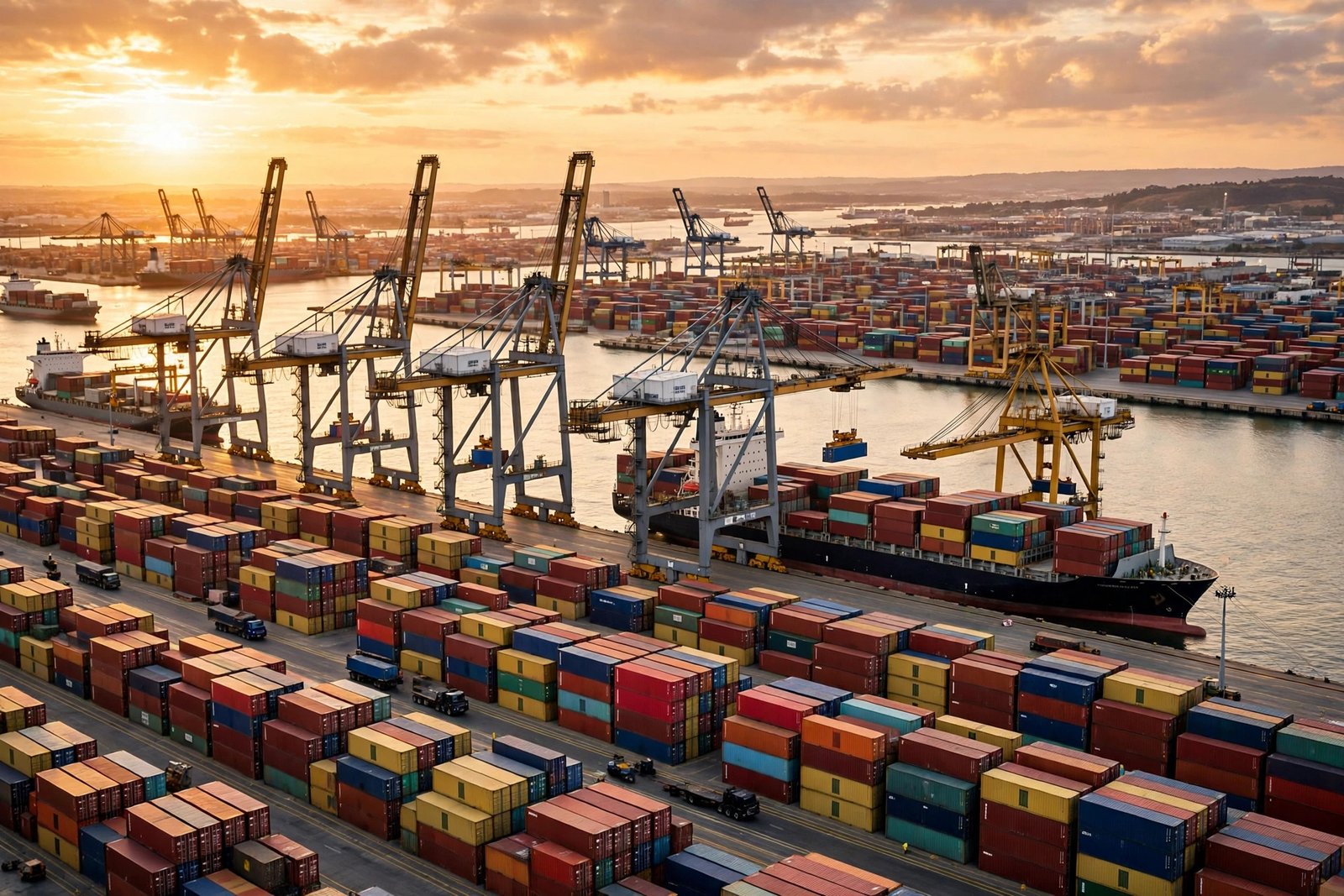
Every day, enormous container ships glide into American harbors carrying everything from sneakers and smartphones to coffee beans and car parts. At the same time, other vessels load up with grain, machinery, and manufactured goods bound for ports on the other side of the planet. This constant movement is no accident. It is the work of a vast network of harbors, terminals, dockworkers, truck drivers, and rail crews, and it is how US ports power world trade, keeping the American economy connected to nearly every country on Earth.
Most Americans rarely think about ports unless a news story mentions a backlog or a delay. Yet the truth is that ports touch almost every part of daily life. The phone in your pocket, the fruit in your kitchen, the clothes in your closet, and even the parts inside your car probably spent time on a ship before they reached you. Understanding how US ports power global commerce is understanding how modern life itself works.
How US Ports Power the Global Economy
The United States is the largest economy in the world, and its ports are the gateways through which much of that economic might flows. Goods arriving by sea enter through coastal terminals, then fan out across the country by truck and train. Goods leaving the country follow the reverse path, traveling from farms, factories, and warehouses to the waterfront and then on to buyers abroad. Without this system, American trade would slow to a crawl.
Ports do far more than load and unload ships. They are logistics hubs where cargo is sorted, stored, inspected, and transferred between modes of transport. A single container might arrive by ship, move onto a train, and finish its journey on a truck, all coordinated through the port. This seamless handoff is one of the reasons the American supply chain, for all its occasional strains, remains one of the most capable in the world.
The scale is hard to grasp. Major American ports handle millions of containers every year, and the value of the cargo passing through them runs into trillions of dollars. That flow supports manufacturers who depend on imported parts, farmers who export crops to overseas markets, and retailers who stock their shelves with goods from around the globe. When US ports power trade efficiently, prices stay steadier, shelves stay fuller, and businesses can plan with confidence.
The Biggest US Ports Powering Trade
America’s port system stretches across three coasts plus the Gulf of Mexico and the Great Lakes, and each region plays a distinct role. The busiest container ports on the West Coast serve as the front door for trade with Asia, while East Coast and Gulf ports handle heavy volumes with Europe, Latin America, and beyond.
- Los Angeles and Long Beach, California: Together, these neighboring ports form the largest container gateway in the United States, handling a huge share of imports from Asia and serving as a critical link for goods headed across the country.
- New York and New Jersey: The busiest port complex on the East Coast, serving the densely populated Northeast and offering deep-water access for some of the world’s largest vessels.
- Savannah, Georgia: One of the fastest-growing ports in the country, known for its efficient terminals and strong rail connections into the Southeast and Midwest.
- Houston, Texas: A Gulf Coast giant that handles containers, energy products, and industrial cargo, reflecting Texas’s role as an economic powerhouse.
- Seattle and Tacoma, Washington: Pacific Northwest gateways that connect American exporters, including agricultural producers, with markets across the Pacific.
Beyond these giants, dozens of smaller ports each serve their own vital niches. Some specialize in automobiles, others in bulk grain, energy, or cruise passengers. Together they form a network that gives American businesses options and resilience, so that if one gateway faces disruption, cargo can shift elsewhere.
What Moves Through US Ports
The cargo passing through American ports tells the story of the modern economy. On the import side, consumer electronics, clothing, furniture, toys, and auto parts arrive in vast quantities. Industrial machinery, chemicals, and raw materials feed factories across the country. Food products, from coffee to seafood to tropical fruit, arrive fresh from distant climates.
On the export side, American farms send soybeans, corn, wheat, and meat to buyers worldwide. Manufacturers ship aircraft parts, medical equipment, vehicles, and high-tech machinery. Energy exports, including liquefied natural gas and refined petroleum products, have grown into a major part of the picture as well. Each shipment represents American jobs and American know-how reaching global markets.
This two-way flow is what makes ports so central to prosperity. Imports give American consumers choice and value. Exports give American producers customers far beyond the domestic market. The balance between the two shifts with the economy, but the ports themselves remain the constant, physical link between America and the world. For a broader look at the economic engine behind it all, see how the US economy became the largest world power.
Jobs, Communities, and the Ripple Effect
Ports are also powerful job creators, and their impact reaches far beyond the waterfront. Dockworkers, crane operators, truck drivers, rail workers, warehouse staff, customs brokers, and logistics managers all depend directly on port activity. Around every major port, a whole ecosystem grows: restaurants, hotels, repair shops, and suppliers that serve port workers and visiting crews.
The ripple effect extends inland too. A container unloaded in California may be carried by train to a distribution center in the Midwest, creating jobs at every stop. A shipment of grain loaded in the Gulf may have been grown by farmers hundreds of miles away and trucked to the terminal by drivers from small towns. In this way, port activity supports livelihoods in places that never see the ocean.
Port cities themselves often take on a distinctive character shaped by trade. Their neighborhoods, restaurants, and cultural life reflect the global connections that flow through their harbors. From the seafood markets near fishing terminals to the international districts that grew up around shipping, ports leave a visible mark on American culture and community life.
Challenges Facing US Ports Today
For all their strength, American ports face real challenges. Ships have grown dramatically larger, and not every terminal can handle the newest generation of mega-vessels. Channels must be dredged, cranes must be taller, and yards must be smarter to keep pace. Investment in infrastructure is a constant need, and ports compete fiercely for funding and for shipping lines’ business.
Labor relations and workforce shortages also matter. Ports depend on skilled workers, and disruptions, whether from labor disputes, storms, or global events, can ripple quickly through supply chains. The world saw this clearly in recent years, when congestion at ports contributed to shortages and price increases felt by ordinary shoppers. Those episodes were a reminder of just how much everyday life depends on ports running smoothly.
Environmental concerns add another layer. Ports are working to cut emissions from ships, trucks, and cargo equipment, with many terminals adopting cleaner fuels, electric cranes, and shore power that lets docked ships plug in instead of running their engines. Balancing growth with cleaner air and water for nearby communities is one of the defining tasks for ports in the years ahead.
The Future: How US Ports Power Tomorrow’s Trade
Looking ahead, technology is reshaping how US ports power world trade. Automated cranes and yard equipment, digital tracking systems, and artificial intelligence tools for scheduling are helping terminals move cargo faster and more predictably. Real-time data lets shippers know exactly where a container is, reducing uncertainty and waste across the supply chain.
At the same time, shifting trade patterns are redrawing the map. Growth in Gulf and East Coast ports reflects changing routes and new manufacturing centers, while West Coast ports continue to invest to defend their position. Nearshoring, the trend of companies moving production closer to the United States, is boosting trade with Mexico and Canada and reshaping cargo flows through southern and border gateways.
Energy is another frontier. As America produces and exports more energy, ports are adapting to handle new kinds of cargo, from liquefied natural gas to components for wind and solar projects. America’s energy strength and its port strength go hand in hand, as explored in America’s rise as an energy superpower.
None of this happens by itself. It takes sustained investment, smart planning, and the daily work of thousands of people. But the payoff is enormous: a port system that keeps American goods moving, American workers employed, and American consumers connected to the best the world has to offer.
The next time you pick up a product, check its label and imagine its journey. Chances are it crossed an ocean, passed through an American port, and rode a truck or train to reach you. That journey is the quiet engine of the modern economy, and it is why US ports power world trade in ways that touch every American life. Share this story with someone who has never thought about where their stuff comes from, and explore more about the forces shaping America on Beauty of USA for a fresh look at American life, culture, and power.