
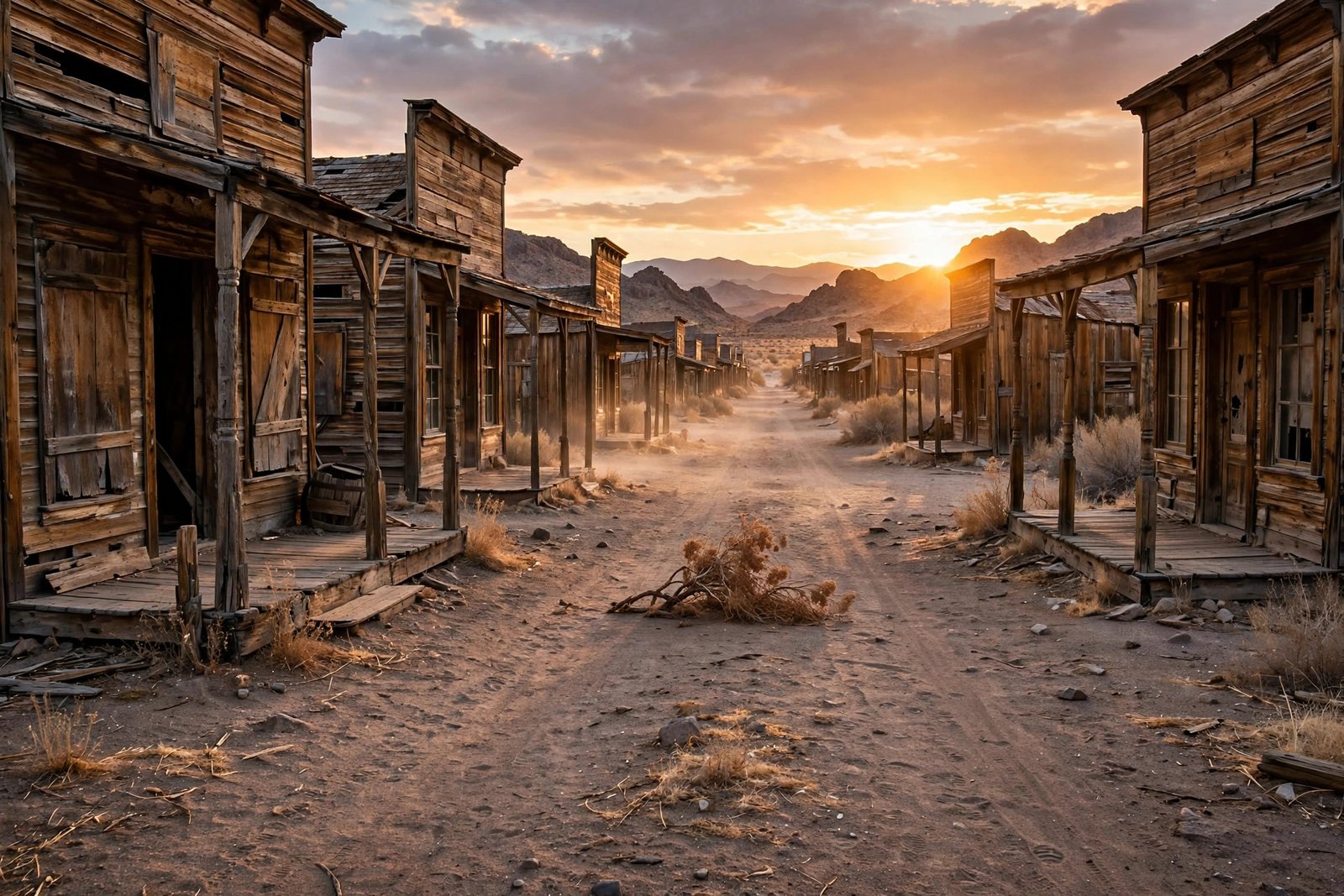
Stand on the empty main street of Bodie, California, on a still October morning, and you will hear the wind whistle through the cracks of a wooden saloon that has not poured a drink in more than a century. The dust on the counter is real. The rust on the nails is real. That is the strange power of ghost towns in america: they are not movie sets or theme parks, but the genuine leftovers of boom-and-bust dreams, preserved by dry desert air and decades of quiet.
Across the American West, thousands of towns were born the day somebody shouted about gold, silver, or copper — and died the day the ore ran out. Some, like Bodie, were locked in a state of arrested decay, frozen almost exactly as their last residents left them. Others, like Tombstone and Virginia City, refused to die at all and reinvented themselves as living museums. All of them carry stories of luck, greed, courage, and loss that read like the best Western novels — except they really happened.
In this guide, we walk through five of the most fascinating ghost towns in the country, share the true stories behind each one, and add practical tips for visiting them yourself. If you love hidden corners of the country, do not miss our roundup of 12 hidden gems in the USA most Americans never visit.
What Makes Ghost Towns in America So Fascinating
Few travel experiences match the feeling of stepping into a town that time forgot. A ghost town is not simply an old place — it is a place where the ordinary business of life stopped all at once, leaving dishes on tables, tools in workshops, and newspapers dated to the last week anyone bothered to print. Ghost towns in america fascinate us because they are three-dimensional history: you do not read about the gold rush, you walk through it.
Most of these towns followed the same dramatic script. First came the strike — a prospector’s lucky pan of gold or a glinting vein of silver. Then came the rush: tents, saloons, assay offices, churches, and newspapers appearing in a matter of months. At their peak, towns like Bodie and Virginia City rivaled San Francisco in rowdiness and ambition. Then the ore played out, the mines flooded, or the railroad chose another route, and the population drained away almost as fast as it had arrived.
What draws modern visitors is not just the ruins, but the stories:
- Real stakes: fortunes were made and lost overnight, and ordinary people gambled everything on a single claim.
- Honest history: these towns show the American West without the Hollywood filter — hard, dusty, and human.
- Adventure: many sit in stunning desert or mountain landscapes that are worth the drive alone.
- Mystery: every empty building invites the same question — who lived here, and why did they leave?
Bodie, California: The Town Frozen in Time
Few places on earth match Bodie. Gold was discovered here in 1859, but the town truly exploded after rich strikes at the Standard Consolidated Mine in the mid-1870s. By 1879 and 1880, Bodie was home to roughly 10,000 people, with dozens of saloons, a Chinatown, a red-light district, and a reputation for lawlessness so fierce that the park rangers still tell the story of a little girl who, on learning her family was moving to Bodie, prayed a farewell to God before heading to Bodie.
When the mines declined in the early 1900s, Bodie emptied out — but it did not disappear. In 1962 it became Bodie State Historic Park, and today about 170 of the town’s original buildings still stand, preserved in what rangers call a state of arrested decay. Inside the homes and workshops, you can peer through the windows at furniture, bottles, and schoolbooks exactly where their owners left them. It is the crown jewel of American ghost towns, and the closest thing to time travel you will find in the United States.
Plan carefully: Bodie sits at about 8,400 feet in the Sierra Nevada, and the last three miles of road are unpaved. Winters are brutal, and the road is often closed by snow. The reward for a summer or fall visit is one of the most atmospheric places in the country — go early in the morning, when the light is golden and the crowds are thin.
Calico, California: A Silver Town Reborn
Silver made Calico, and falling silver prices nearly erased it. The strike came in 1881 in the Calico Mountains of the Mojave Desert, and within a few years the town counted hundreds of mines, a population in the low thousands, and the full swagger of a genuine boomtown. When silver prices collapsed in the 1890s, Calico emptied almost overnight, leaving its wooden buildings to bake in the desert sun.
What happened next makes Calico different from most ghost towns. In 1951, Walter Knott — the founder of Knott’s Berry Farm — bought the town and began restoring it. He later donated it to San Bernardino County, and it became Calico Ghost Town Regional Park. In 2005, the state designated Calico as California’s official silver rush ghost town. One honest note for visitors: many of Calico’s buildings are recreations or heavy restorations rather than untouched originals, so it feels more like a lively heritage park than a frozen ruin. That is exactly why families love it.
Today Calico offers mine tours, gunfight reenactments, and old-style shops set against classic Mojave Desert scenery. It is an easy day trip from Southern California and a perfect first ghost town for kids — the history is real, even if the buildings wear a fresh coat of paint.
St. Elmo, Colorado: The Town That Never Quite Died
High in the Rocky Mountains, at nearly 10,000 feet, sits St. Elmo — one of Colorado’s best-preserved ghost towns. Founded in 1880 as a mining and railroad town serving the region’s gold and silver mines, including the rich Mary Murphy Mine, St. Elmo swelled to roughly 2,000 residents in the 1890s. It had hotels, saloons, dance halls, and a rail line connecting it to the world below.
The railroad stopped running in 1922, the mines closed, and the town slowly emptied. But St. Elmo never became a ruin. The general store and Home Comfort Hotel stayed open under the Stark family until the late 1950s, and caretakers have preserved the town ever since. Walk the dirt main street today and you will see one of the most complete collections of original 1880s frontier buildings anywhere — the schoolhouse, the church, the old jail — all weathered to a perfect silver-gray.
St. Elmo is also a wildlife hotspot: chipmunks and hummingbirds swarm around the old general store, and the surrounding mountains offer hiking and four-wheel-drive trails. Because many buildings are privately maintained, visitors are asked to respect fences and stay out of closed structures — a small price for one of the most photogenic historic towns in the West.
Virginia City, Nevada: The Comstock Lode Legend
Virginia City is the heavyweight of them all. The 1859 discovery of the Comstock Lode — a staggeringly rich vein of silver and gold — turned a dusty hillside into one of the richest cities in the world. By the mid-1870s, some 25,000 people lived here, with mansions, an opera house, and the famous Territorial Enterprise newspaper, where a young Samuel Clemens first used the pen name Mark Twain in 1863.
A great fire in 1875 destroyed much of the town, but Virginia City rebuilt, and when the mines finally faded, the town did something unusual: it stayed alive. Strictly speaking, Virginia City is not a true ghost town at all — people still live and work here. But walk the wooden boardwalks of C Street, ride the Virginia and Truckee Railroad, and tour the old mines, and you will understand why it belongs on every ghost town list. The Comstock story is inseparable from the story of the Old West itself.
For more true tales from the mining frontier, explore our true story of the California Gold Rush — the event that set the whole boomtown cycle in motion.
Tombstone, Arizona: The Town Too Tough to Die
Tombstone owes its existence — and its name — to prospector Ed Schieffelin, who found silver here in the late 1870s despite warnings that the only thing he would find in Apache country was his tombstone. The town he founded in 1879 boomed spectacularly, and its name became legend on October 26, 1881, when the famous gunfight at the O.K. Corral pitted the Earp brothers and Doc Holliday against the Clanton and McLaury brothers.
Like every boomtown, Tombstone eventually fell on hard times: the mines flooded, fires swept the business district, and the population collapsed. But the town adopted the motto The Town Too Tough to Die — and lived up to it. Today Tombstone is a thriving tourist destination with reenactments, historic saloons, and the famous Boothill Graveyard, where the weathered markers tell their own blunt stories.
Like Virginia City, Tombstone is not a deserted ruin but a living one, which makes it ideal if you want ghost town history with modern comforts. If the Wild West era grips you, our collection of wild west true stories goes deeper into the real people behind the legends.
How to Visit the Best Ghost Towns in America
Exploring ghost towns is one of the great American road trip adventures, but a little preparation goes a long way. The most rewarding historic towns sit in remote deserts and high mountains, where services are few and the weather can change fast. Keep these tips in mind:
- Check road conditions first. The road to Bodie is rough and often closed in winter; mountain towns like St. Elmo can be snowbound into June.
- Bring everything you need. Water, food, fuel, and a spare tire — most ghost towns have no services at all.
- Stay out of old mines. Abandoned mine shafts and tunnels are extremely dangerous and often illegal to enter.
- Take only pictures. Removing artifacts from state parks and historic sites is illegal — and it robs the next visitor of the discovery.
- Respect private property. Some ghost towns sit on private land; honor fences and no-trespassing signs.
- Visit in spring or fall. Desert towns are scorching in summer; mountain towns can be snowy into early summer.
The golden rule of ghost town travel: leave everything exactly as you found it. These fragile places survive only because visitors treat them with care.
Why Ghost Towns in America Still Matter Today
Ghost towns are more than tourist attractions — they are cautionary tales written in wood and stone. Every abandoned main street is a reminder that boom-and-bust economies have real human costs: the miners, merchants, teachers, and children who built full lives on the promise of a single resource, then watched it vanish. In an age of gold-rush thinking about everything from tech stocks to cryptocurrency, the lesson feels freshly relevant.
They also preserve the stories of ordinary Americans who rarely made it into the history books. The Chinese laborers of Bodie, the schoolteachers of St. Elmo, the shopkeepers of Calico — their lives are etched into the buildings they left behind. That is why the stories of these abandoned towns deserve to be told carefully and truthfully, legend separated from fact, and it is why walking these streets still moves people more than a century later.
Start Your Own Ghost Town Adventure
From the frozen streets of Bodie to the living history of Tombstone, the ghost towns of the American West offer something no theme park can: the real thing. Pick one town, plan a road trip, and go see history standing in the open air. For one more true tale of desert treasure and obsession, read our legend of the Lost Dutchman gold mine.
Have you visited a ghost town? Share your photos and stories in the comments — and keep exploring Beauty of USA for more true stories from every corner of the country.