
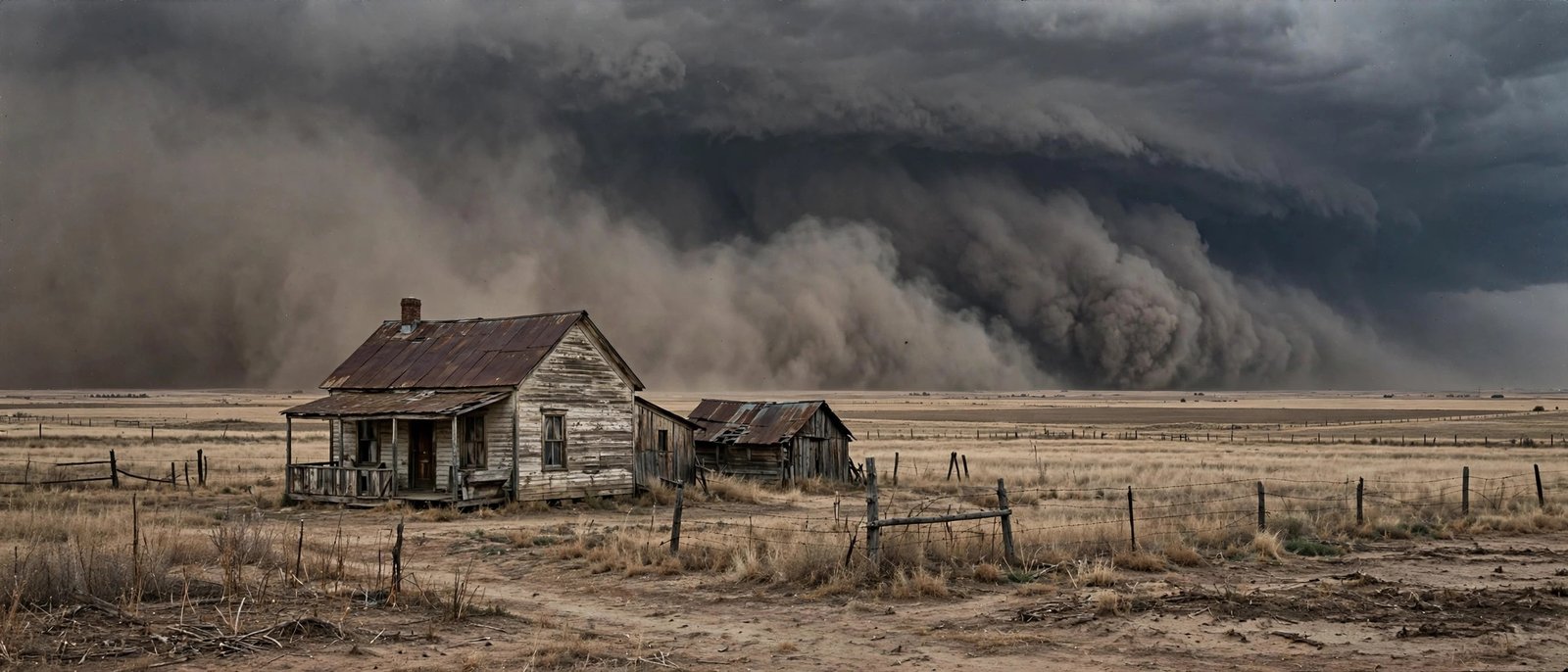
On April 14, 1935, the sky over the Southern Plains turned black at midday. A wall of dust a mile high rolled across Oklahoma and the Texas Panhandle, swallowing farms, towns, and daylight itself. Newspapers called it Black Sunday — and it became the defining image of the Dust Bowl, the ecological catastrophe that turned America’s breadbasket into a desert of blowing soil. This is the true dust bowl history: how it happened, who endured it, and what it taught a nation.
For nearly a decade, dust storms stripped the topsoil from millions of acres across five states, drove hundreds of thousands of families from their homes, and reshaped American farming forever. Understanding this chapter of American history is not just a lesson in the past — it is a warning about what happens when ambition outruns the land’s limits.
Dust Bowl History: What Caused the Disaster?
The story begins not with a drought, but with a boom. During World War I, wheat prices soared as Europe’s farms were torn apart by war. Across the Southern Plains, settlers and speculators plowed up millions of acres of native grassland to plant wheat, chasing profits that seemed endless. The deep-rooted prairie grasses that had held the soil in place for thousands of years were ripped out by the steel plow.
When wheat prices collapsed after the war, farmers plowed even more land to make up the difference in volume — a desperate gamble that left the soil exposed and fragile. Then, in the early 1930s, the rains stopped. A severe, years-long drought settled over the Plains, and without the anchoring grasses or moisture to hold it down, the fine topsoil simply took to the wind.
The result was the “black blizzards”: towering dust storms that could stretch a mile into the sky and travel hundreds of miles. Static electricity generated by the swirling dust was so strong that people reported getting shocked shaking hands, and cars stalled when dust clogged their engines. These storms were not freak accidents of nature — they were the predictable consequence of farming practices that ignored the ecology of the Plains.
Dust Bowl History: A Timeline of the Dark Years
The disaster unfolded over most of a decade, each year bringing new hardships:
- 1930–1931: Drought begins across the Southern Plains. Wheat withers in the fields, but most farmers hold on, expecting the rains to return.
- 1932: Dust storms begin in earnest. Newspapers in the Oklahoma and Texas panhandles start reporting “dusters” that darken the noon sky.
- 1933: President Franklin D. Roosevelt takes office and launches New Deal relief programs. The Civilian Conservation Corps puts young men to work on conservation projects.
- 1934: The worst drought year. Researchers have since found that the 1934 drought was the most severe North America had seen in a thousand years. On May 11, a massive dust storm swept all the way to the East Coast, dimming the skies over New York and Washington, D.C.
- 1935: Black Sunday, April 14 — the most infamous dust storm of the decade. Later that year, Congress passes the Soil Conservation Act, creating the Soil Conservation Service.
- 1936: A brutal heat wave compounds the misery, with record temperatures baking the already ruined land across the Midwest.
- 1937–1938: Government conservation efforts expand, but severe storms still strike. The human toll keeps climbing.
- 1939–1940: Rainfall finally returns to more normal patterns, and the worst of the Dust Bowl era comes to an end.
This timeline shows a catastrophe that built slowly and ended slowly — not a single event, but a grinding decade that tested everyone it touched.
Black Sunday: The Day the Sky Turned Black
April 14, 1935, started as a clear, beautiful spring day across the Plains — which made what happened next all the more terrifying. By mid-afternoon, a cold front colliding with the drought-baked earth kicked up a dust cloud estimated at a mile high and hundreds of miles wide. It moved across the Panhandles at terrifying speed, and in its path, day turned to night.
People caught outdoors described choking, blinding darkness. Chickens went to roost at 3 p.m., thinking night had fallen. Those who survived told of wet towels pressed over faces, of lamps lit at noon, of a fine silt that worked its way through every crack of every house. The storm became the single most famous day of the decade, and journalists who witnessed it gave the era its name: the Dust Bowl.
Dust Pneumonia and Daily Life in the Storms
Between the great storms, families lived in a world coated in dust. It sifted through window frames no matter how tightly they were sealed, settled in food, in beds, in lungs. Mothers hung wet sheets over windows and doors to filter the air. Children walked to school with handkerchiefs tied over their mouths — when school was even in session.
The health toll was devastating. “Dust pneumonia,” a respiratory illness caused by inhaling fine soil particles, killed children, the elderly, and the already weakened. Hospitals filled with patients struggling to breathe. Livestock died by the thousands, their lungs clogged with silt; cattle that survived often went blind from the scouring dust.
Farm life, once the pride of the Plains, became a daily battle against an enemy that could not be shot, plowed, or prayed away. Many families simply gave up — abandoning mortgaged farms and joining the long migration west. For stories of how Americans endured the wider economic catastrophe of the era, read our Great Depression true stories that endure.
The Great Migration: Okies on the Road West
As farms failed, hundreds of thousands of displaced families packed what they could into old cars and trucks and headed west, most famously to California. They followed Route 66 — the “Mother Road” — in a migration that ranks among the largest internal movements in American history. Roughly 2.5 million people left the Plains states during the 1930s, and several hundred thousand made it all the way to California.
The migrants, often derisively called “Okies” regardless of which state they came from, found that California’s promise was largely a mirage. Work was scarce, wages were pitiful, and entire families lived in squalid roadside camps and ditch-bank shantytowns. Yet they endured, picking fruit and cotton for pennies, building the labor force that would power California’s agricultural boom.
Their story was immortalized by two landmark works of American art. Photographer Dorothea Lange’s 1936 portrait “Migrant Mother,” showing Florence Owens Thompson with her children in a California pea-pickers’ camp, became the defining image of Depression-era suffering. Three years later, John Steinbeck’s novel The Grapes of Wrath gave the migration its epic literary voice, following the fictional Joad family from Oklahoma to California. Both remain essential reading on this era of American history.
The New Deal Fights Back: Saving the Soil
The federal government did not watch passively. President Roosevelt, who called the Dust Bowl “a national menace,” made soil conservation a centerpiece of the New Deal’s response. The Civilian Conservation Corps — young men employed by the government — planted trees, built terraces, and taught contour plowing across the Plains.
The most ambitious effort was the Prairie States Forestry Project, often called the “shelterbelt” program: a plan to plant a living wall of trees from North Dakota to Texas to break the wind. Over several years, workers planted more than 200 million trees in shelterbelts across the Plains states — one of the largest environmental engineering projects in American history, and many of those windbreaks still stand today.
In 1935, Congress passed the Soil Conservation Act and created the Soil Conservation Service, led by soil scientist Hugh Hammond Bennett — remembered as the father of soil conservation. Bennett spent years warning that America was losing its topsoil, and the Dust Bowl proved him tragically right. The agency he built taught farmers techniques that are now standard practice: crop rotation, terracing, strip cropping, and leaving protective cover on fields. These reforms are a hopeful chapter of the era — proof that policy and science could repair what greed and ignorance had broken. They also laid the groundwork for the productive, sustainable agriculture described in our piece on how American farming feeds the world.
Why Dust Bowl History Still Matters Today
The rains returned by the end of the 1930s, and with World War II came renewed demand for wheat — but the lessons of the Dust Bowl were not forgotten. Modern American agriculture practices no-till farming, precision irrigation, and soil health monitoring that would have seemed like science fiction to a 1930s wheat farmer.
Yet the warning at the center of this story feels freshly relevant. Aquifers like the Ogallala are being drawn down, extreme weather is intensifying, and the temptation to squeeze maximum yield from fragile land has not disappeared. The Dust Bowl stands as America’s starkest reminder that the land is not an inexhaustible factory — it is a living system, and it keeps the accounts.
The small towns of the Plains carry this memory in their bones. Many never fully recovered their populations, but their resilience became part of the American character — the same small-town endurance explored in our guide to small town life in America.
10 Key Facts From Dust Bowl History
- The Dust Bowl struck the Southern Plains — mainly Oklahoma, the Texas Panhandle, Kansas, Colorado, and New Mexico — during the 1930s.
- Black Sunday, April 14, 1935, was the most infamous single dust storm of the decade.
- Deep plowing of native grassland during the WWI wheat boom set the stage for disaster.
- Researchers have found the 1934 drought was the worst in North America in a thousand years.
- A May 1934 dust storm carried Plains soil all the way to New York and Washington, D.C.
- About 2.5 million people left the Plains states during the 1930s.
- Dust pneumonia, caused by inhaling soil particles, killed many — especially children and the elderly.
- The shelterbelt project planted more than 200 million trees from North Dakota to Texas.
- Hugh Hammond Bennett, the “father of soil conservation,” led the federal response.
- John Steinbeck’s The Grapes of Wrath (1939) immortalized the migrant experience.
The Dust Bowl was America’s darkest agricultural decade — a man-made disaster born of a wheat boom, deepened by drought, and endured by some of the toughest people this country has ever produced. Their story, preserved in photographs, novels, and the windbreaks still standing on the Plains, deserves to be remembered. If this account moved you, share it with someone who loves American history — and explore more true stories from our nation’s past here on Beauty of USA.