
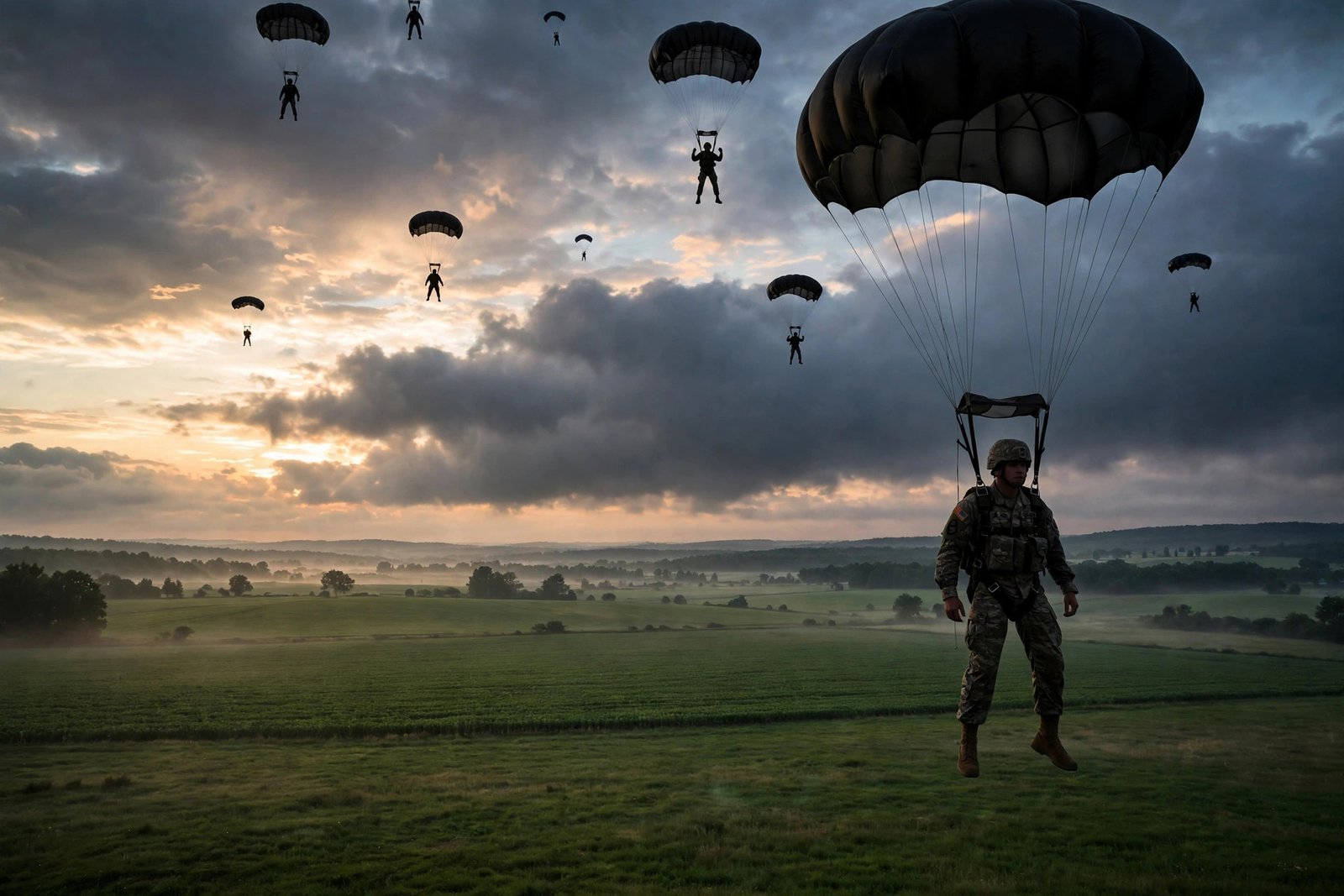
Some military units earn a nickname. The 82nd Airborne Division earned a legend. Known as the All Americans, these paratroopers have jumped into some of the most famous battles in history, and 82nd Airborne true stories have been told and retold by veterans, families, and historians for more than a century. What makes these stories endure is not just the drama of jumping from an airplane into enemy territory. It is the ordinary young Americans behind them, men who trained hard, trusted each other completely, and kept going when everything went wrong.
This guide brings together the real history of the division, from its roots in World War I to its modern deployments, and explains why the All Americans remain one of the most respected units in the United States Army. If you love American military history, you will also enjoy our related reads on fellow airborne soldiers and the soldiers of D-Day.
82nd Airborne True Stories Begin in World War I
The 82nd Division was organized in 1917, as the United States prepared to enter World War I. Its soldiers came from every state in the Union, which is how the unit earned its nickname, the All Americans. The division’s shoulder patch, a red, white, and blue double-A, became a symbol of that national character, and it remains one of the most recognizable insignia in the Army today.
In France, the division fought in the St. Mihiel offensive and the Meuse-Argonne offensive, two of the largest and hardest battles of the war. The fighting was brutal, fought across muddy fields, shattered forests, and fortified German positions. The division earned a reputation for toughness and discipline, qualities that would define it for the next hundred years.
One of the most famous soldiers of the war served in the 82nd. Alvin York, a corporal from Tennessee, became one of the most decorated American soldiers of World War I after a remarkable action in the Argonne Forest in October 1918, when he and a small group of fellow soldiers captured a large number of German prisoners. York’s story became a national legend, and it is still taught as an example of courage under fire. His service is a reminder that the 82nd’s history began long before anyone jumped from an airplane.
Sicily and Italy: The Division Learns to Jump Into Battle
Between the world wars, the Army experimented with airborne warfare, and the 82nd was reorganized as an airborne division in 1942. Paratroopers and glider troops trained intensively, learning to jump, to fight in small scattered groups, and to hold their ground until heavier forces could reach them. It was dangerous work, and the training alone demanded extraordinary nerve.
The division’s first combat jump came in Sicily in July 1943, during the Allied invasion of the island. High winds and navigation problems scattered the paratroopers across the countryside, and many landed far from their planned drop zones. Instead of giving up, small groups of troopers found each other, attacked targets of opportunity, and sowed confusion behind enemy lines. That ability to improvise became a hallmark of airborne operations.
Next came Italy. The 82nd fought at Salerno and later at Anzio, where airborne troops were used as regular infantry in grinding, costly fighting. These campaigns are sometimes overshadowed by Normandy, but they mattered enormously. They proved that airborne soldiers could do more than jump. They could hold a line, attack a fortified position, and endure weeks of combat alongside any infantry division in the Army.
D-Day and Normandy: The Night the Sky Filled With Parachutes
On the night of June 5 to 6, 1944, the 82nd Airborne dropped into Normandy ahead of the seaborne landings on D-Day. The mission was to seize causeways, bridges, and road junctions behind Utah Beach so that troops landing from the sea could move inland. Once again, the drops were widely scattered. Anti-aircraft fire, low clouds, and inexperienced aircrews spread the paratroopers across the Norman countryside in the dark.
One of the most famous 82nd Airborne true stories comes from the town of Sainte-Mere-Eglise, one of the first French towns liberated on D-Day. Private John Steele’s parachute caught on the church steeple, leaving him hanging above the town square as fighting raged below. Steele survived, was eventually cut down, and later rejoined his unit. Today, a mannequin in a paratrooper’s uniform hangs from the church steeple in his honor, and visitors from around the world come to see it. It is a powerful reminder that history happened to real people in real places.
Elsewhere in Normandy, small groups of paratroopers fought fiercely at places like La Fiere bridge, a narrow causeway crossing that became the scene of repeated attacks and counterattacks. Soldiers who had never met before the jump fought side by side, sharing ammunition, weapons, and information. The division’s performance in Normandy helped make the D-Day landings succeed, and it cemented the paratroopers’ reputation for courage.
82nd Airborne True Stories From Operation Market Garden
In September 1944, the Allies launched Operation Market Garden, an ambitious plan to seize a series of bridges in the Netherlands and open a route into Germany. The 82nd was assigned to capture the bridges at Grave and Nijmegen. The fighting was intense, and the division’s paratroopers once again found themselves in the middle of a battle where everything depended on speed and nerve.
The most famous episode came at Nijmegen, where American paratroopers crossed the wide Waal River in small canvas boats while under heavy German fire. The crossing was made in daylight, with almost no cover, and many of the boats were hit. Yet the troopers pressed on, reached the far bank, and helped secure the bridge. The Waal crossing is still studied in military schools as an example of bravery and determination, and it remains one of the proudest chapters in the division’s history.
Market Garden ultimately did not achieve all of its objectives, and the war continued into the winter. But the 82nd’s performance in the Netherlands added another layer to its legend. Veterans of the campaign often said that the hardest part was not the jump itself, but the days of fighting that followed, when paratroopers armed mainly with light weapons faced tanks, artillery, and determined defenders.
The Battle of the Bulge: Holding the Line
When Germany launched its surprise winter offensive through the Ardennes in December 1944, the 82nd was rushed to the front to help stop the advance. The Battle of the Bulge was fought in bitter cold, snow, and fog, and the paratroopers arrived with little winter equipment. They dug in, held key road junctions, and helped blunt the German attack.
The conditions were miserable. Food was scarce, vehicles struggled on icy roads, and wounded soldiers faced long waits for evacuation. Yet the division held its positions and launched counterattacks when the weather cleared. By the time the Bulge was reduced, the 82nd had added another major battle honor to a list that already included Sicily, Naples-Foggia, Normandy, and the Rhineland.
After the Bulge, the division pushed into Germany itself, and by the spring of 1945 the war in Europe was coming to an end. The 82nd had spent much of the war in combat, and its veterans returned home with stories they would carry for the rest of their lives. Many of them stayed in touch through veterans’ associations, keeping the bonds of their wartime service alive for decades.
From Grenada to Afghanistan: The Modern All Americans
The 82nd did not fade into history after World War II. It remained on active duty, based at Fort Bragg in North Carolina, now known as Fort Liberty, and it served as America’s rapid-response force, ready to deploy anywhere in the world on short notice. That role has kept the division busy in every generation since.
In 1983, elements of the division took part in the operation in Grenada. In 1989, paratroopers jumped into Panama during Operation Just Cause. In 1990 and 1991, the division deployed to Saudi Arabia and Iraq for Operations Desert Shield and Desert Storm. Each deployment brought new challenges, from jungle and desert fighting to peacekeeping and humanitarian missions.
After the attacks of September 11, 2001, the division deployed repeatedly to Iraq and Afghanistan. These were long, difficult wars, fought in cities, mountains, and deserts, and the division’s soldiers served multiple tours. The modern chapter of 82nd Airborne true stories includes patrols under fire, efforts to train local security forces, and the heavy toll of repeated deployments on soldiers and families. It also includes the quiet professionalism of a unit that continues to answer the call, generation after generation.
The division’s motto, All the Way, captures that spirit. It is shouted in greeting, printed on unit items, and repeated at ceremonies. For the soldiers who wear the double-A patch, it is both a promise and a standard: whatever the mission, they will see it through.
Why These Stories Still Matter
There are several reasons the 82nd’s history continues to fascinate Americans. First, the stories are unusually well documented. Veterans wrote memoirs, historians interviewed participants, and museums preserved uniforms, weapons, and photographs. Second, the division’s battles connect directly to the biggest events of the twentieth century, from D-Day to the liberation of Europe.
Third, the stories are human. Behind every famous battle are young soldiers who were scared, tired, homesick, and determined all at once. Their letters home, their friendships, and their sacrifices are what turn military history into something personal. That is why visitors still stand quietly in the church square at Sainte-Mere-Eglise, and why families still travel to Normandy to walk the fields where their grandfathers landed.
- Visit a museum to see real artifacts, not just photographs.
- Read a veteran memoir for a first-person view of airborne combat.
- Walk a battlefield with a guide who can explain what happened where.
- Share the stories with younger family members before they are lost.
Where to Experience 82nd Airborne History Today
If you want to explore this history in person, start at Fort Liberty in North Carolina, home of the 82nd Airborne Division War Memorial Museum, which displays artifacts from the division’s long history. Nearby in Fayetteville, the Airborne and Special Operations Museum tells the broader story of airborne and special operations forces, with exhibits that bring the Normandy drops and later campaigns to life. Learn more through the Army’s official pages at army.mil and the museum foundation at asomf.org.
In Europe, the Normandy beaches, the town of Sainte-Mere-Eglise, and the bridges at Nijmegen all offer powerful, moving visits. Many of these sites are free or inexpensive to explore, and local museums add context that no book can fully replace. If you are planning a trip, pair your visit with our guide to Medal of Honor stories for even more American heroism.
Conclusion: Carry the Story Forward
The 82nd Airborne Division’s history is still being written. New soldiers earn the double-A patch every year, and the division continues to train, deploy, and serve around the world. The best way to honor the veterans who built this legacy is simple: learn their stories, tell them accurately, and pass them on. Whether you visit a museum, read a memoir, or simply share this article with someone who loves American history, you help keep the All American spirit alive.
Do you have a family connection to the 82nd Airborne? Share this article with your family, start a conversation about your own history, and plan a visit to one of the museums above. The paratroopers gave their all, all the way. The least we can do is remember.