
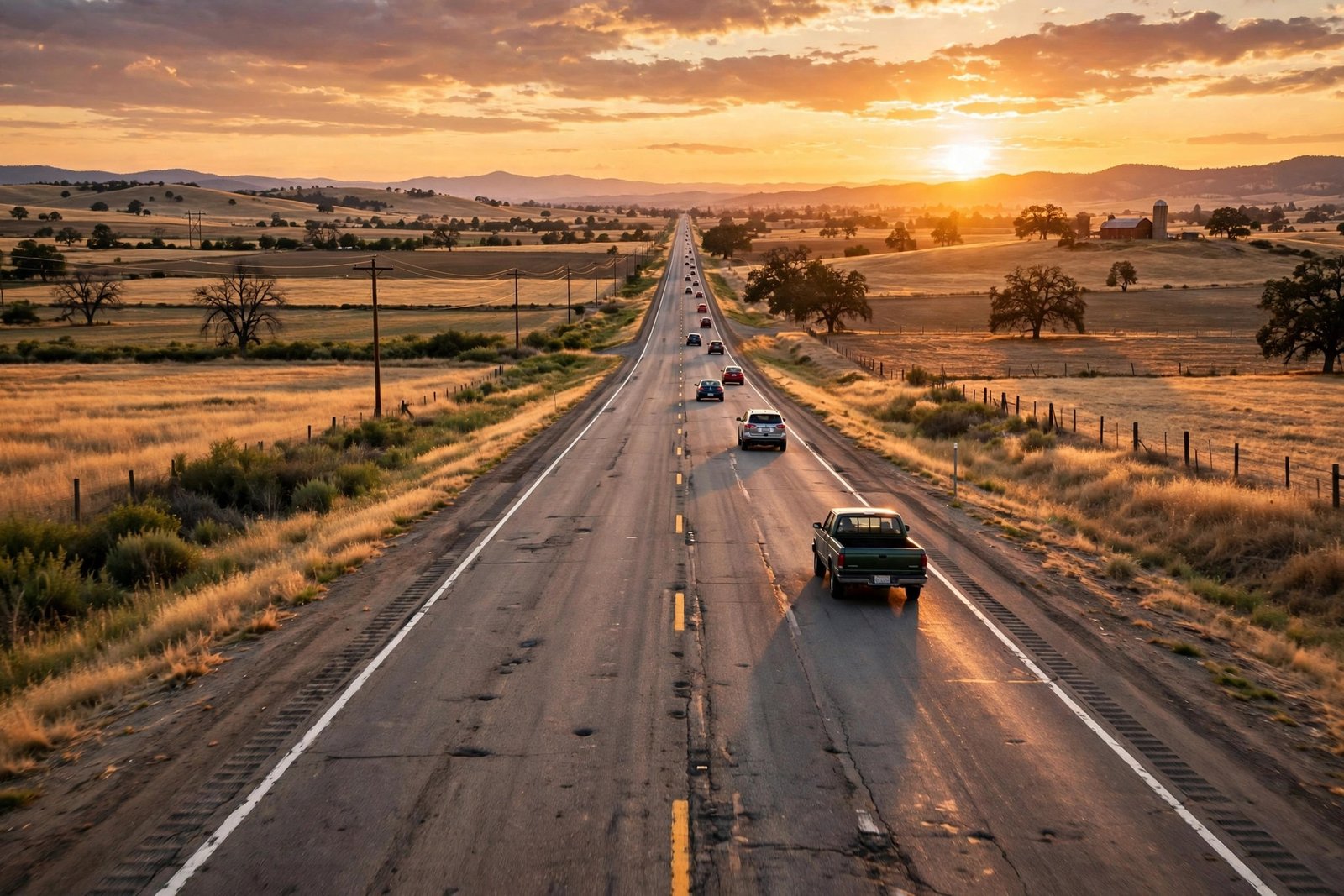
Every time you slide behind the wheel in the United States, you do something so automatic you probably never think about it: you pull out onto the right side of the road. It feels natural, obvious, almost like a law of nature. But it is not. Around the world, millions of drivers in Britain, Australia, Japan, and India do the exact opposite, keeping left. So why America drives on the right, when its closest cultural cousin, Britain, drives on the left? The answer is a fascinating mix of wagon drivers, a French emperor, practical safety, and one very early American law.
This is not just a trivia question for road trip games. The side of the road a country drives on shapes its cars, its road signs, its roundabouts, and even the design of its highways. The story of how America picked the right side takes us back to muddy colonial roads, giant freight wagons, and a decision made in Pennsylvania more than two centuries ago. Buckle up — this ride through history explains a habit you practice every single day.
Why America Drives on the Right: The Wagon Story
The most widely accepted explanation for why America drives on the right begins with the big freight wagons of the 1700s. Long before trucks and highways, goods moved across the young country in heavy Conestoga wagons pulled by teams of horses. These wagons were the eighteen-wheelers of their day, hauling flour, tools, and supplies between farms, mills, and ports.
The driver of a Conestoga wagon did not sit up front on a bench the way a stagecoach driver did. Instead, the teamster typically sat on the left rear horse, or walked alongside the team on the left, so that his right hand stayed free to crack the whip. Sitting on the left gave him the best view of the wagon’s right side, which was the side most likely to scrape against an oncoming wagon on a narrow road. Naturally, teamsters began keeping to the right so they could see oncoming traffic clearly and judge the passing distance.
This was not a law at first. It was simply a habit that made sense. When two heavy wagons met on a rutted dirt road, the driver on the left horse could watch the gap on his right and steer safely past. Over time, as more and more wagon traffic used the same routes, keeping right became the unwritten rule of the American road. It was practical, it was safer, and everybody doing the same thing prevented collisions.
The contrast with Britain is telling. In Britain, riders on horseback traditionally kept left so that their right hand, the sword hand, stayed free toward a stranger approaching from the opposite direction. In an age when highwaymen and armed travelers were a real concern, passing on the left let a rider defend himself. America, a newer country built around freight wagons rather than mounted swordsmen, developed a different habit for a different reason.
How the Right Side Became Law in America
Habit became law in 1792, when Pennsylvania passed what is generally regarded as the first keep-right traffic law in the United States. The law applied to the Philadelphia and Lancaster Turnpike, a major wagon route, and required all traffic to keep to the right. It was a simple rule for a busy road, and it stuck.
Other states followed. New York adopted a keep-right rule in 1804, and New Jersey followed in 1813. As the country expanded westward, new territories and states wrote right-hand traffic into their road rules from the start. By the time automobiles arrived in the early 1900s, driving on the right was already the settled American custom, and carmakers built their vehicles to match it, placing the driver on the left side of the car for the best view of oncoming traffic.
That early start matters. Once a country builds its roads, signs, intersections, and vehicles around one side, switching becomes enormously expensive and disruptive. America never had a reason to switch, so it never did. The rule that began with wagon drivers on a Pennsylvania turnpike became the rule for every interstate highway in the nation.
It is worth noting that this was a bottom-up story. Unlike some countries where a ruler simply decreed which side to drive on, America’s rule grew out of everyday work: teamsters solving a real problem on muddy roads. The law caught up with the practice, not the other way around. That is a very American way for a rule to be born.
Why America Drives on the Right While Britain Drives Left
If America inherited so much from Britain — its language, its legal system, its love of tea turned into a rebellion — why did it not inherit left-hand driving too? The short answer is timing. By the time Britain formalized left-hand traffic, America was already an independent country making its own rules.
Britain’s left-hand tradition goes back centuries, to the days of riders passing each other on narrow lanes, sword hands ready. Britain eventually wrote that custom into law, and its colonies and former colonies around the world — from Australia to India to parts of Africa — carried left-hand driving with them. America, which broke away in 1776, was free to keep the wagon drivers’ right-hand habit instead.
There is also a famous story that Napoleon Bonaparte helped spread right-hand traffic across Europe. The tale goes that Napoleon, who was left-handed, ordered his armies to march and ride on the right, and the countries his armies occupied adopted the practice. Historians debate how much of this is legend and how much is fact, but it is true that much of continental Europe drives on the right today, while Britain and its former empire largely kept the left.
For the United States, the French connection is less important than the wagon story. America chose the right side for its own practical reasons, before Napoleon reshaped Europe’s roads. The two stories converged on the same side, which is part of why right-hand traffic became the global majority.
The Rest of the World Follows America’s Lead
Today, most of the world’s countries drive on the right, including nearly all of continental Europe, the Americas, and much of Asia. Only about a quarter of countries, including the United Kingdom, Ireland, Australia, New Zealand, Japan, India, and several African nations, still drive on the left. If you have ever rented a car abroad and felt a jolt of panic at a roundabout, you know how deeply this habit is wired into a driver.
Some countries have switched sides over the years, and the stories show just how big a job it is. Sweden famously switched from left to right in 1967, on a day known as Dagen H, after years of planning. Traffic stopped, signs were changed overnight, and drivers adjusted with remarkable calm. Iceland switched the following year. But such switches are rare, because they require changing road markings, signs, intersections, and public habits all at once.
For American travelers, this means one useful rule of thumb: when you drive abroad, check the side of the road before you start the car, not after you pull out of the rental lot. And when visitors come to the United States, the same advice applies in reverse. American roads, from small-town main streets to massive interstates, all assume right-hand traffic, and the whole system — from highway ramps to the driver’s seat position — is built around it.
The global split also creates some fascinating border crossings. At a few places in the world, drivers must switch sides at the border, sometimes using special crossover bridges or intersections. The United States never faces this problem with its neighbors, since both Canada and Mexico also drive on the right, making cross-border road trips seamless in that respect at least.
What Driving on the Right Means for Travelers Today
Understanding the history is fun, but the practical payoff is real, especially for visitors and new drivers. Here are a few things the right-hand rule shapes on American roads:
- Driver position: In American cars, the driver sits on the left, giving the best view of oncoming traffic and the center line.
- Passing: On highways, you normally pass on the left, returning to the right lane when the way is clear.
- Roundabouts: Traffic flows counterclockwise, entering to the right and yielding to vehicles already in the circle.
- Turning: Right turns on red are generally allowed after a full stop unless a sign says otherwise, a rule that only makes sense in a right-hand system.
- Pedestrian habits: Americans instinctively look left first when crossing a street, because that is where the nearest traffic comes from.
For anyone planning a classic American road trip, the right-hand rule is part of the adventure. From the open highways of the West to the historic routes of the East, driving on the right is the thread that ties the whole network together. If you want inspiration for your next journey, check out our American Road Trip Bucket List or the legendary Route 66 Road Trip Guide. And if you are curious how the highways themselves were built, our guide to the US Interstate Highway System tells that story.
New drivers should also remember that the rule is not just about which side you drive on — it is about predictability. Every other driver on the road expects you to keep right, pass left, and follow the same patterns. That shared expectation is what keeps millions of vehicles moving safely every day.
Conclusion: A Habit Born on Muddy Roads
So, why America drives on the right comes down to a simple, human story. Teamsters on heavy wagons sat on the left so they could see and steer safely, and keeping right became the natural habit. Pennsylvania turned that habit into law in 1792, other states followed, and by the automobile age the right side was simply the American way. No emperor decreed it, no parliament debated it for decades — it grew from the daily work of ordinary people moving goods across a young country.
The next time you merge onto a highway or turn onto a quiet country road, spare a thought for those wagon drivers. Every mile you drive on the right is a small tribute to their practical wisdom. And if this story surprised you, share it with a fellow road tripper — or better yet, plan your next drive and experience America’s right-hand roads for yourself. Happy travels, and keep right!