
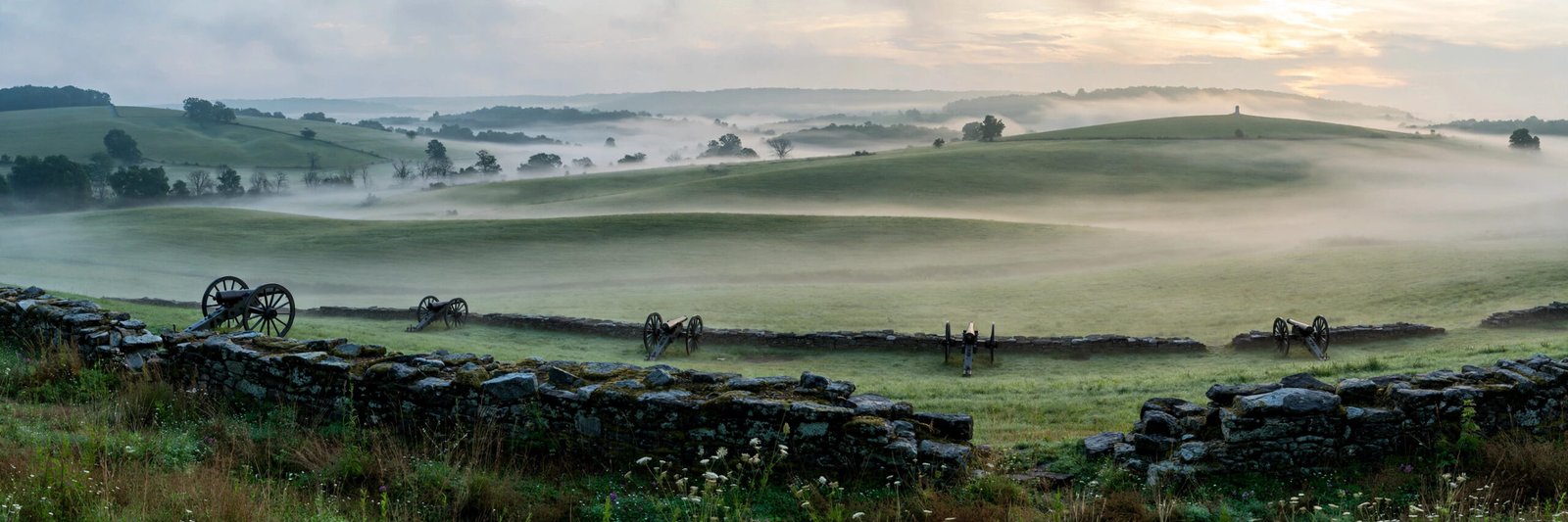
On a hot July morning in 1863, in a small Pennsylvania farming town, two great armies collided almost by accident — and the next three days changed America forever. The Battle of Gettysburg, fought from July 1 to July 3, 1863, was the largest battle ever fought on North American soil, and many historians call it the turning point of the Civil War. This is the true story of those three days: the confusion, the courage, the blunders, and the ordinary people caught in the middle.
Gettysburg was not supposed to happen where it did, or even when it did. Neither army planned to fight there. But roads, chance encounters, and decisions made under pressure turned a quiet crossroads town into a name every American schoolchild knows. Walk the battlefield today and you can still stand where soldiers stood, on ground that still remembers.
The Battle of Gettysburg Begins: July 1, 1863
The story starts with an invasion. In the summer of 1863, Confederate General Robert E. Lee led the Army of Northern Virginia north into Pennsylvania. His goals were practical and bold: gather supplies from rich Pennsylvania farmland, relieve pressure on war-torn Virginia, and win a major victory on Northern soil that might shake Northern morale and encourage foreign support for the Confederacy.
The Union Army of the Potomac, newly placed under General George G. Meade just days before the battle, moved north to meet him. On the morning of July 1, Confederate infantry advancing toward Gettysburg ran into Union cavalry under Brigadier General John Buford west of town. Buford’s troopers, fighting dismounted with repeating carbines, held the high ground long enough for Union infantry to arrive. It was a delaying action that mattered enormously: it bought time for the Union army to occupy the strong defensive positions south of town.
As the day wore on, more Confederate troops arrived, and the Union lines west and north of Gettysburg were pushed back through the town itself. It was a chaotic, frightening retreat through streets full of civilians. By evening, however, the Union army had regrouped on Cemetery Hill and Cemetery Ridge, a long, strong line of high ground shaped roughly like a fishhook. That position, held through the rest of the battle, would prove decisive.
Meanwhile, the people of Gettysburg — farmers, shopkeepers, teachers, and families — watched their town become a battlefield. Many sheltered in cellars as bullets flew overhead. Homes became field hospitals. The town’s residents, including free Black residents who feared capture by Confederate forces, faced terror and uncertainty. Their stories are part of the battle too, and they remind us that war is never only about generals and maps.
Day Two: Little Round Top and the Fight for the High Ground
On July 2, Lee attacked the Union left flank, aiming to roll up the line anchored at the rocky hills called Little Round Top and Big Round Top. The fighting there was savage and confused, with units feeding into the battle piecemeal across boulder-strewn ground, peach orchards, and wheat fields that soon became famous by name: the Peach Orchard, the Wheatfield, Devil’s Den.
The most famous stand of the day came at Little Round Top, where Colonel Joshua Lawrence Chamberlain and the 20th Maine Infantry held the far left end of the Union line. When his men ran low on ammunition and Confederate troops pressed up the slope again and again, Chamberlain ordered a desperate downhill bayonet charge. It worked. The 20th Maine held the hill, and the Union left did not break. Chamberlain, a college professor from Maine before the war, later received the Medal of Honor for his actions that day.
Elsewhere on July 2, the fighting was just as brutal. In the Wheatfield, control of a single field changed hands multiple times. In the Peach Orchard, a Union corps pushed forward into an exposed salient and was battered. By nightfall, the Union line still held, though barely, and both armies counted terrible losses. Lee, believing the Union center must be weakened after so much fighting on the flanks, decided to strike there on the third day.
That decision set up one of the most famous moments in American military history — and one of the most tragic.
Pickett’s Charge: The Battle of Gettysburg Reaches Its Climax
On the afternoon of July 3, after a massive artillery bombardment — one of the largest ever seen on the continent — about 12,500 Confederate soldiers stepped out of the woods west of Gettysburg and marched across nearly a mile of open ground toward the Union center on Cemetery Ridge. The assault, known as Pickett’s Charge after Major General George Pickett, whose division formed part of the attacking force, is one of the most storied episodes of the Civil War.
The attackers marched in neat lines under a storm of artillery and rifle fire. Some reached the Union line at a low stone wall, in a spot later called the Angle, where fierce hand-to-hand fighting broke out. For a brief moment, Confederate troops breached the line — the high-water mark of the Confederacy, as historians call it. But Union reinforcements rushed in, the breach was sealed, and the survivors staggered back across the field. The attack had failed, at dreadful cost.
Lee met the retreating men and, by many accounts, told them the fault was his. That night, the Confederate army began its long, painful retreat south toward Virginia, through rain and mud, with a wagon train of wounded stretching for miles. Meade, criticized later for not pursuing more aggressively, chose not to risk his own battered army in a counterattack. The invasion of the North was over.
The scale of the loss is hard to grasp. The Battle of Gettysburg produced roughly 51,000 casualties — killed, wounded, captured, or missing — across both armies in just three days. It remains one of the bloodiest battles in American history, and the fields around Gettysburg were left covered with the dead and wounded, cared for in makeshift hospitals in barns, churches, and homes.
Aftermath and the Gettysburg Address
In the months after the battle, Gettysburg faced a grim task: burying the dead and caring for the wounded. A national cemetery was created for the Union fallen, and on November 19, 1863, President Abraham Lincoln traveled to Gettysburg to dedicate it. His speech, the Gettysburg Address, lasted only a few minutes — about 270 words — but it reframed the war as a struggle for a new birth of freedom and for government of the people, by the people, for the people.
Lincoln’s words endure because they gave meaning to the sacrifice. The soldiers at Gettysburg, he said, had already consecrated the ground far above any power of words to add or detract. The living, he argued, must be dedicated to finishing the work they had begun. Few speeches in American history are quoted more often, and the Address is still read aloud at the battlefield every year on its anniversary.
Historians debate exactly how decisive Gettysburg was — the war continued for nearly two more years, and other victories mattered too. But combined with the Union victory at Vicksburg, which fell on July 4, 1863, Gettysburg marked a turning point: after the summer of 1863, the Confederacy never again mounted a major invasion of the North, and the war’s momentum shifted, slowly and bloodily, toward the Union.
If you want to understand how this battle fits into the wider American story, explore our 10 Forgotten Moments in American History, and for Lincoln’s legacy in stone, read about Lincoln Memorial History. For another founding-era turning point, see the Boston Tea Party True Story.
Visiting the Battle of Gettysburg Today
Today, Gettysburg National Military Park preserves much of the battlefield, and it is one of the most visited historic sites in America. Visitors can walk Little Round Top, stand at the stone wall at the Angle, drive the auto tour route, and see the monuments — more than a thousand of them — placed by states and regiments to mark where their soldiers fought.
- Start at the visitor center: The museum and the famous cyclorama painting give a powerful overview of the three days before you head out to the field.
- Walk Little Round Top: Standing where the 20th Maine fought makes Chamberlain’s desperate charge feel real in a way no book can match.
- Visit the Angle and the stone wall: This quiet spot was the climax of Pickett’s Charge and the high-water mark of the Confederacy.
- See the Soldiers’ National Cemetery: This is where Lincoln gave the Gettysburg Address, and it remains a place of solemn reflection.
- Take a guided tour: Licensed battlefield guides bring the ground to life with stories of individual soldiers and decisions made under fire.
Whether you come for the history, the landscape, or a family trip, Gettysburg rewards a slow visit. The fields are peaceful now, full of birdsong and visitors, but the monuments and the stories keep the memory of those three July days alive.
Conclusion: Why Gettysburg Still Matters
The Battle of Gettysburg matters not because it was the biggest or the bloodiest battle, though it was both, but because it tested whether the American experiment could survive its greatest crisis — and because ordinary people, from Chamberlain’s Maine volunteers to the civilians of a small Pennsylvania town, rose to meet that test. The battle’s lessons about leadership, courage, and the cost of division still speak to us today.
If this true story moved you, plan a visit to Gettysburg, share this article with a history lover, and keep exploring America’s past with us. The ground at Gettysburg is waiting — and its story, told honestly, is one every American should know.