
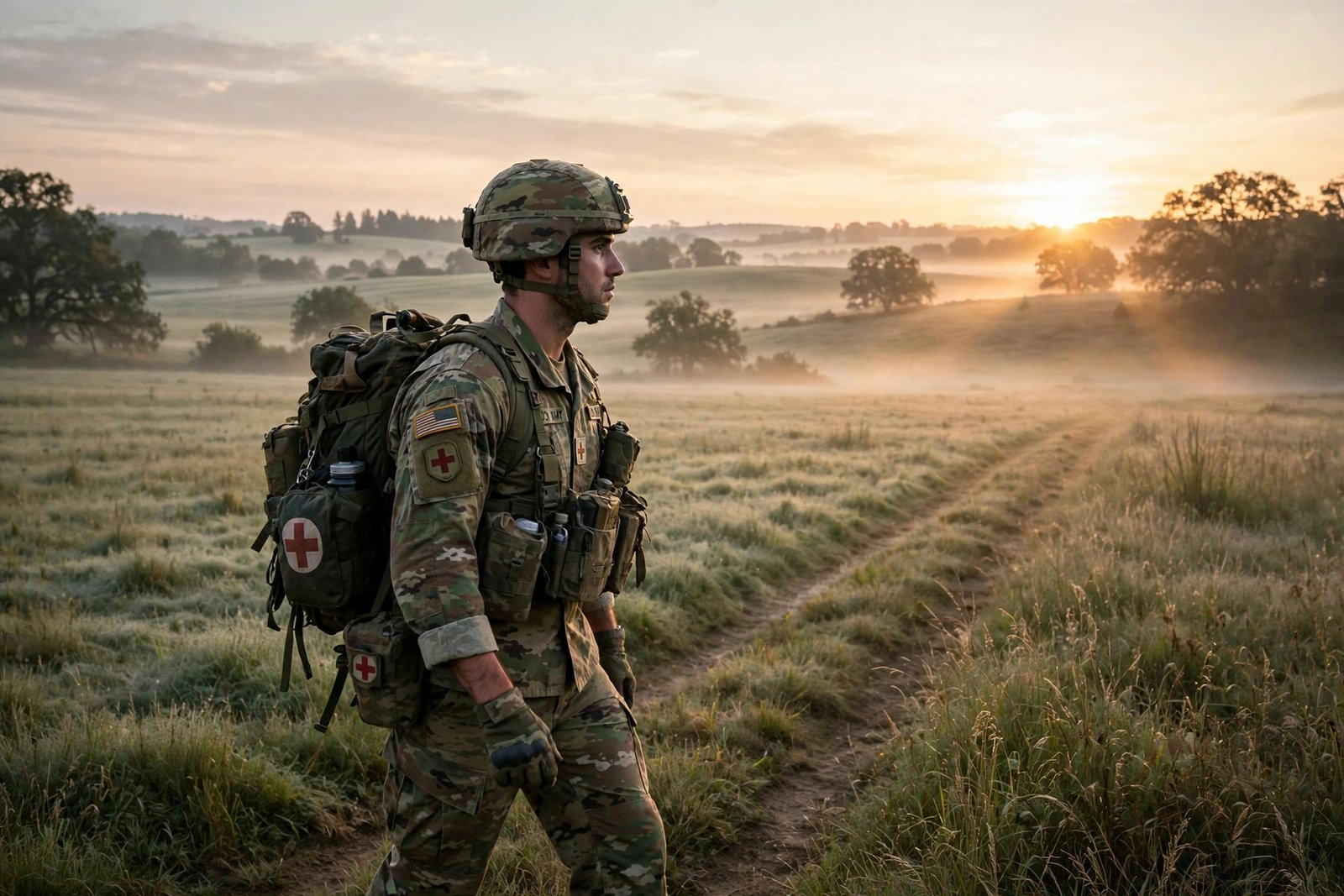
Some of the most powerful US Army medics true stories begin not with a weapon, but with a red cross on a helmet and a bag of bandages. On battlefields from Normandy to Okinawa, from the jungles of Vietnam to the mountains of Afghanistan, Army medics have run toward gunfire while everyone else was taking cover. Their job was never to take ground. It was to keep people alive long enough to go home.
What makes these stories so moving is their simplicity. A medic does not win a battle alone. A medic saves one person at a time, often under fire, often with little more than training, courage, and steady hands. This article looks at some of the best-known, verifiable stories of Army medics, and at what their service tells us about courage itself.
US Army Medics True Stories: Why They Matter
The US Army Medical Department dates back to 1775, when the Continental Congress established an Army hospital during the Revolutionary War. From that early beginning, the role of the Army medic grew into one of the most respected jobs in military service. Soldiers often call their medic “Doc,” a nickname that carries deep trust. When a soldier is wounded, the medic is the person they call for, and the person they remember for the rest of their lives.
US Army medics true stories matter because they show a different kind of heroism. Infantry stories often focus on capturing a hill or holding a position. Medic stories focus on a single life: a wounded soldier dragged to safety, a bleeding wound treated under fire, a calm voice in the middle of chaos. That focus on saving life, rather than taking it, is why medic stories resonate so strongly with Americans who have never served.
Many medics have received the Medal of Honor, the nation’s highest military decoration. The stories below are drawn from public military records and Medal of Honor citations, which are among the most carefully documented accounts in American history. Where details vary between retellings, this article sticks to the widely confirmed facts.
US Army Medics True Stories: Desmond Doss at Hacksaw Ridge
No discussion of US Army medics true stories is complete without Desmond Doss, a combat medic in World War II whose story later became the film Hacksaw Ridge. Doss was a Seventh-day Adventist from Virginia who registered as a conscientious objector. He refused to carry a weapon or work on Saturdays because of his religious beliefs, but he still wanted to serve his country. The Army assigned him as a medic with the 307th Infantry Regiment, 77th Infantry Division.
During the Battle of Okinawa in the spring of 1945, Doss’s unit fought to take the Maeda Escarpment, a steep cliff that soldiers nicknamed Hacksaw Ridge. The fighting was brutal. On one occasion, after his company was forced to retreat from the top of the escarpment, Doss stayed behind alone. Over many hours, he located wounded soldiers, dragged them to the edge of the cliff, and lowered them down on a rope-supported litter so they could be carried to safety.
According to his Medal of Honor citation, Doss saved an estimated 75 men that day. He worked entirely unarmed, in full view of enemy positions, and he refused to leave while wounded men remained. Later in the battle, Doss was wounded himself, first by a grenade blast and later by a sniper’s bullet that shattered his arm. Even then, he refused evacuation until other wounded men were treated first, and he crawled to an aid station after giving up his litter to another soldier.
Doss received the Medal of Honor from President Harry Truman in October 1945, becoming the first conscientious objector to receive the award. His story remains one of the most famous US Army medics true stories because it proves a powerful point: courage does not require a weapon.
Lawrence Joel: Calm Under Fire in Vietnam
Another of the great US Army medics true stories comes from Vietnam. Specialist Lawrence Joel served as a medic with the 1st Battalion, 503rd Infantry Regiment, 173rd Airborne Brigade. On November 8, 1965, during Operation Hump, his unit came under heavy attack in the jungles near Bien Hoa.
Joel was wounded in the leg early in the fighting, but he kept working. His Medal of Honor citation describes how he moved through heavy enemy fire to treat wounded soldiers, carrying supplies and dragging men to safer positions. Even after being wounded a second time, he continued to treat the injured, encouraging them and refusing to stop until the battle eased.
Joel later received the Medal of Honor from President Lyndon Johnson in 1967. He became the first living Black American since the Spanish-American War to receive the Medal of Honor, and his story is still taught to Army medics in training today. His calm under fire is a reminder that a medic’s greatest tool is often composure: the ability to think clearly while everything around them is falling apart.
Thomas Bennett: A Conscientious Objector Who Ran Toward Danger
Thomas W. Bennett was another conscientious objector who served as an Army medic in Vietnam. Like Doss, he chose to serve without carrying a weapon, driven by his religious convictions. He was assigned to the 1st Battalion, 14th Infantry Regiment, 25th Infantry Division.
On February 9, 1969, during an intense battle in the Pleiku region, Bennett repeatedly moved through heavy enemy fire to reach wounded soldiers. His citation records that he treated men in exposed positions, moved them to safety, and kept working even as the fighting grew more dangerous. He was killed while treating a wounded soldier, and he received the Medal of Honor posthumously.
Bennett’s story, like Doss’s, shows that the decision not to carry a weapon never meant a decision to stay safe. For these medics, conscience pointed them toward the wounded, not away from danger.
Medics in Iraq and Afghanistan
The tradition continued in America’s more recent wars. In Iraq and Afghanistan, Army medics, known by the military occupational specialty 68W, served as combat medics with infantry units, often on patrols where improvised explosive devices and ambushes were constant threats. Their training at Fort Sam Houston in Texas covers trauma care, from stopping severe bleeding to managing airways, and their skills have saved countless lives on the battlefield and in civilian life afterward.
Modern stories of Army medics often involve helicopter evacuations, tourniquets applied in seconds, and treatment given in the back of a moving vehicle. The tools have changed, but the core of the job has not: a medic still runs to the wounded, still works under pressure, and still puts another person’s life first. Many medics from these wars have gone on to careers in nursing, emergency medicine, and firefighting, carrying the same calling into civilian life.
What It Takes to Be an Army Medic
Becoming an Army medic is demanding. Recruits train in basic combat skills alongside their medical education, learning to treat trauma in conditions far rougher than any hospital. They practice under simulated gunfire, in darkness, and under time pressure, because real casualties do not wait for ideal conditions.
The qualities that make a great medic are not only technical. Veterans and trainers point to the same traits again and again:
- Composure: staying calm when a patient is panicking and the situation is dangerous.
- Speed: making fast, correct decisions about bleeding, breathing, and evacuation.
- Compassion: treating every wounded person, including enemy prisoners, with the same care.
- Endurance: carrying heavy medical gear over long distances and working through exhaustion.
- Humility: accepting that a medic’s best day is one nobody notices, because everyone survived.
That last quality is worth remembering. Medics rarely seek attention. Many of the most decorated medics were reluctant to talk about what they did, and their stories survived because the soldiers they saved told them.
How America Honors Its Medics
Americans honor Army medics in museums, memorials, and ceremonies, but the most lasting tribute is simpler: the soldiers who came home because a medic was there. The Army Medical Department Museum at Fort Sam Houston preserves the history of Army medicine, and Medal of Honor citations remain public records that anyone can read.
For readers who want to learn more, the stories of Doss, Joel, and Bennett are a good place to start. They are also a good reminder to thank the medics and corpsmen in our own communities: the veterans working as paramedics, nurses, and first responders today. If you found these stories moving, share this article with someone who should read them, and explore more true stories of American courage on our site. You can also read about the soldiers who fought beside these medics in our accounts of D-Day true stories, Battle of the Bulge true stories, and the 101st Airborne true stories.
Conclusion: The Quiet Heroes of Every Battlefield
US Army medics true stories remind us that heroism is not always loud. Sometimes it is a person with a medical bag, crawling through gunfire to reach a stranger, and refusing to leave until that stranger is safe. From Hacksaw Ridge to the jungles of Vietnam to the deserts and mountains of recent wars, medics have carried this tradition without fanfare and without exception.
The next time you hear a veteran say the word “Doc,” listen closely. Behind that simple nickname is often a story of a life saved, and a debt that can never fully be repaid. Share this article, leave a comment with a medic story from your own family, and keep exploring the true stories that make America worth celebrating.