
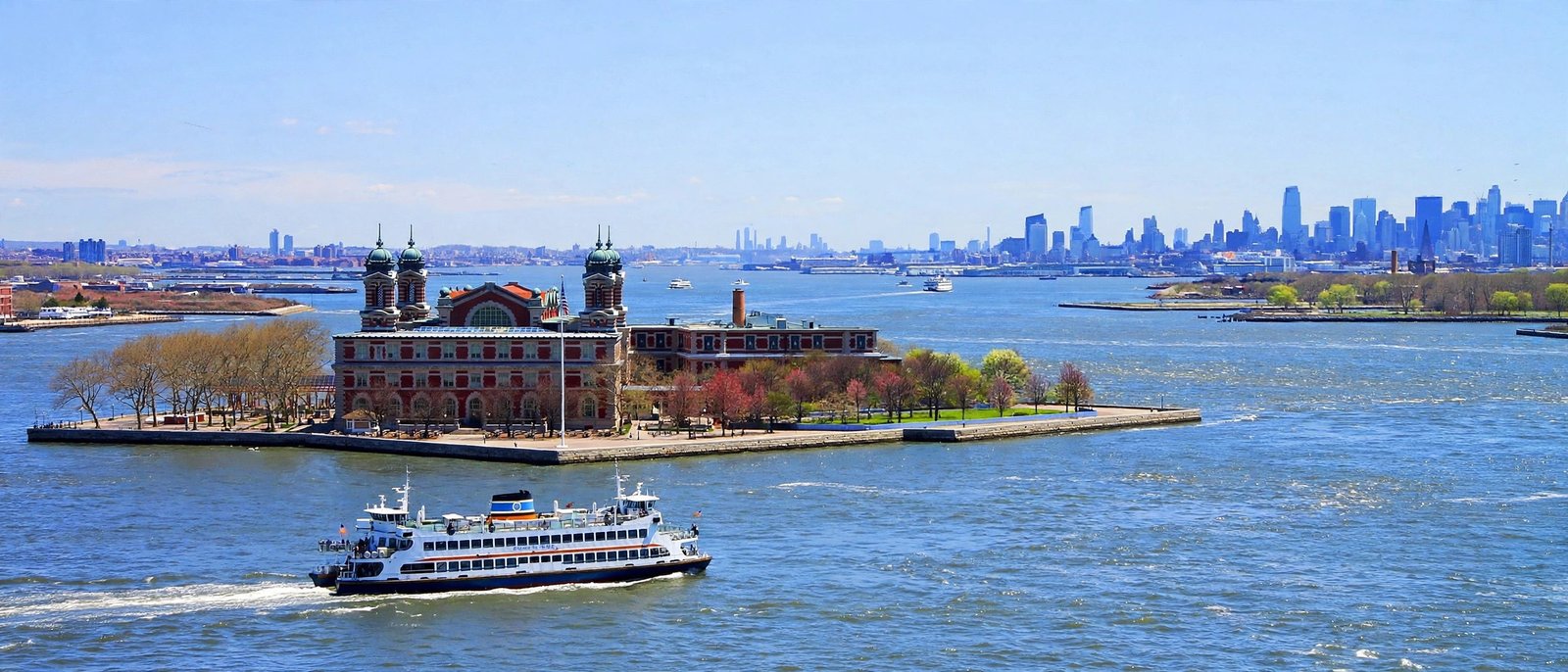
Between 1892 and 1954, about twelve million immigrants began their American lives in a single building on a small island in New York Harbor. They arrived by ferry, tired and hopeful, carrying everything they owned in bags and bundles, and they climbed a great staircase into a vast hall where their futures would be decided in a matter of hours. This ellis island history is one of the most moving chapters in the American story, because it is not about kings or generals. It is about ordinary families who crossed an ocean for a chance to work, learn, and belong.
Ellis Island sits near the Statue of Liberty, and the two landmarks are often visited together, but they tell different halves of the same story. The statue promised liberty. The island tested it, processed it, and, for the overwhelming majority, granted it. Roughly 98 percent of the people who arrived were admitted, most on the same day they landed. The rest faced detention, medical treatment, or, in a small number of cases, a return voyage. Understanding what happened inside that building explains how modern America was made.
Ellis Island History: The Island Before the Great Hall
Long before it welcomed immigrants, the island had several other lives. It was once known as Little Oyster Island, then as Gibbet Island, after the gallows that stood there in the 1760s. New York merchant Samuel Ellis purchased it in 1785, and it took his name. The federal government acquired it in 1808 and built Fort Gibson there, part of the harbor defenses that guarded New York. When the government needed a federal immigration station to replace the state-run Castle Garden in Manhattan, the island was the natural choice: close to the city, yet separate enough to control.
The first immigration station on Ellis Island opened on January 1, 1892. Its first immigrant was Annie Moore, a fifteen-year-old girl from County Cork, Ireland, who arrived with her two younger brothers to join their parents in New York. The original station was built of wood, and it burned to the ground in a fire on June 15, 1897. No lives were lost, but immigration records were destroyed, and the station had to be rebuilt. The fireproof Main Building that replaced it opened on December 17, 1900, and it is the building visitors walk through today.
Ellis Island History in the Peak Years
Immigration through Ellis Island reached its peak in the early 1900s, when steamships were bringing hundreds of thousands of people across the Atlantic every year. In 1907 alone, more than a million people passed through the station, and the single busiest day came on April 17, 1907, when 11,747 immigrants were processed. The island had to grow to meet the demand, expanding from its original 3.3 acres to about 27.5 acres using landfill, with new buildings for hospitals, dormitories, and administration rising on the new ground.
Not every passenger went through Ellis Island. Travelers in first and second class were usually inspected aboard their ships and allowed to land directly in Manhattan. It was the steerage passengers, traveling in the crowded lower decks, who were ferried to the island for inspection. After landing, they left their heavy baggage in the Baggage Room on the ground floor and climbed the steep stairs to the Registry Room, now called the Great Hall, a vast space about 200 feet long with a high vaulted ceiling. That room is where the famous scenes of American immigration took place.
The inspection itself was famously fast and famously feared. Doctors watched each arrival climb the stairs, looking for signs of illness or disability, and gave a quick physical check that became known as the six-second exam. Suspected health problems were marked in chalk on clothing: an E for eye problems, an H for heart trouble, and other letters for other conditions. Those marked went for further examination. After the medical check came a legal inspection, with inspectors asking as many as twenty-nine questions about identity, destination, work, money, and family. Most people passed both inspections within three to five hours. Those who did not could be detained for days or weeks while their cases were reviewed.
The Name-Change Myth and Other Truths
One of the most repeated stories about Ellis Island is also one of the least true. Family legend often says that an ancestor’s name was changed by an inspector at Ellis Island, usually because the official could not spell it or understand it. Historians have found that this almost never happened. Inspectors worked from passenger lists prepared at the port of departure, and they checked names against those manifests rather than inventing new ones. Name changes did happen, but they usually happened later, when immigrants themselves chose a simpler or more American-sounding name, or when clerks elsewhere recorded a name differently.
Daily life on the island was organized around waiting. Detainees slept in large dormitory rooms, ate in a communal dining hall, and exchanged money at the station’s facilities. Aid societies and religious organizations offered help, food, and advice in many languages. The Great Hall had a spot near the exit that became known as the Kissing Post, where families and sweethearts reunited after long separations and, according to tradition, exchanged joyful kisses. The post was both a real place and a symbol: for millions of people, it marked the moment when the journey ended and American life began.
Ellis Island History After the Gates Closed
Immigration through Ellis Island declined sharply after the Immigration Act of 1924 set strict national quotas that cut arrivals from southern and eastern Europe. The station shifted toward detention and deportation work, holding people whose cases were under review. By the middle of the century, the great wave of European immigration had ended, air travel had replaced ocean liners, and the station’s role had faded. Ellis Island closed as an immigration station on November 12, 1954, after sixty-two years of service.
The island then fell into disrepair for three decades, its buildings empty and decaying while the harbor moved on around it. Restoration work in the 1980s saved the Main Building, and the Ellis Island Immigration Museum opened on September 10, 1990, as part of the Statue of Liberty National Monument. Today the museum’s exhibits include the restored Great Hall, the Baggage Room, and artifacts from the immigration era. The American Immigrant Wall of Honor outside honors immigrants of all eras, and historians estimate that around 40 percent of Americans can trace their ancestry to someone who passed through Ellis Island. Visitors interested in the statue that greeted those ships can explore the history of the Statue of Liberty and these fascinating facts about US presidents who shaped the nation’s immigration story.
Visiting Ellis Island Today
Ellis Island is reached only by ferry, with boats departing from Battery Park in Manhattan and Liberty State Park in New Jersey. The same ferry ticket usually includes the Statue of Liberty, and visitors should allow at least half a day for both islands. Inside the museum, audio tours guide visitors through the Great Hall, the inspection rooms, and the dormitories, while the Peopling of America galleries trace immigration before and after the Ellis Island era. A separate hard-hat tour explores the unrestored hospital buildings on the island’s south side, where sick immigrants were treated in isolation wards.
- Book ferry tickets in advance: the first boats of the day are usually the least crowded.
- Allow extra time for security screening, which resembles airport screening.
- Search the free passenger records database in advance: you may find your own family’s arrival record.
Why Ellis Island Still Matters to America
This ellis island history matters because it is still personal for millions of families. The names on the Wall of Honor, the photographs in the museum, and the passenger records now searchable online are not abstractions. They are the arrival records of grandparents and great-grandparents, and for many visitors, walking through the Great Hall is a walk through their own family story. The island reminds Americans that immigration was not a single event but a daily reality, carried out one inspection, one question, and one reunion at a time.
If your family came through Ellis Island, search the records before you visit and bring what you find. If it did not, visit anyway, because the story belongs to the whole country. Walk the Great Hall, stand at the Kissing Post, and consider what it meant to cross an ocean on hope alone. For another chapter of the American story, read these White House facts and keep exploring the places that made this nation.