
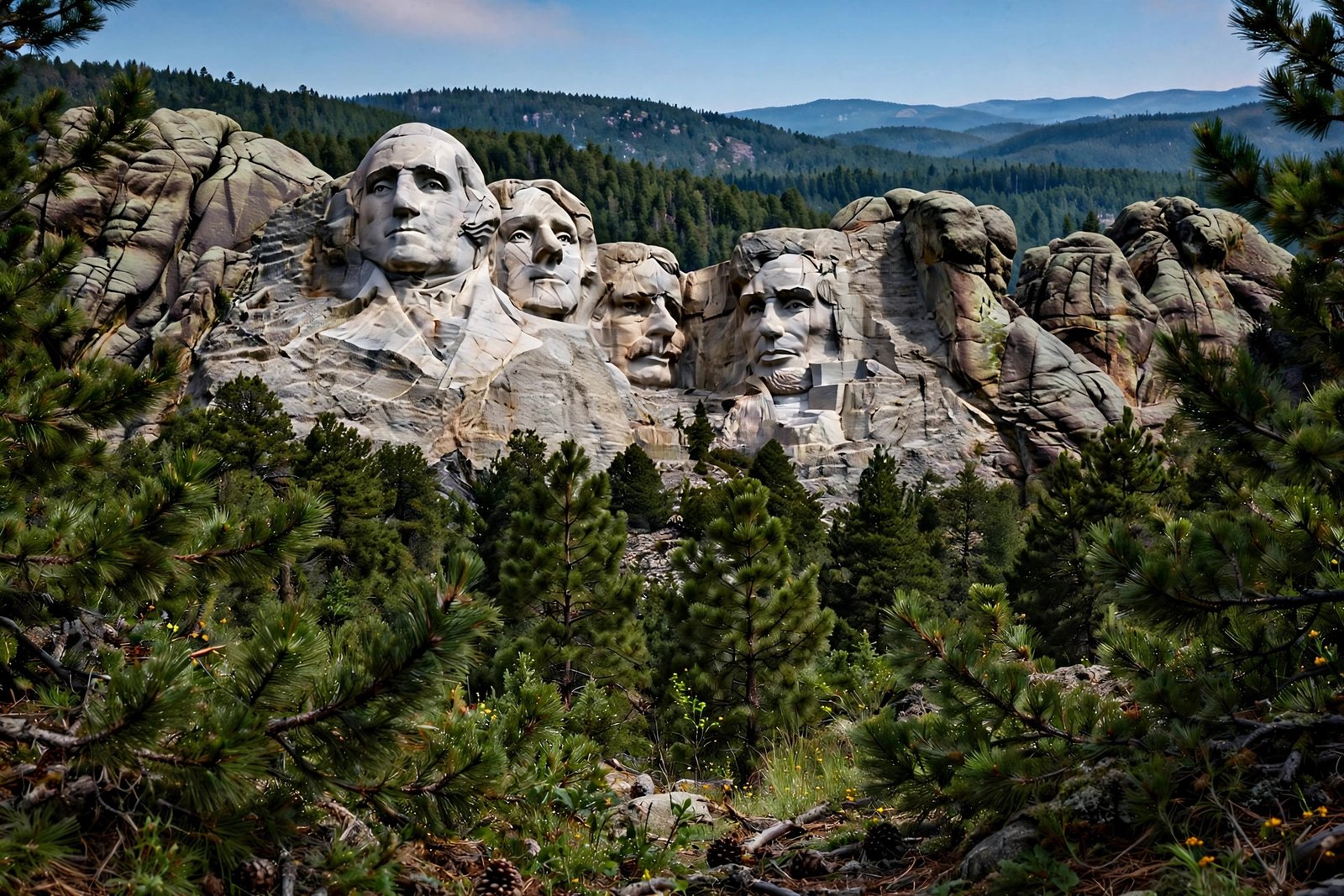
Four giant faces stare out over the Black Hills of South Dakota, and millions of visitors travel each year to stand beneath them. This Mount Rushmore history starts long before the first drill touched the rock, with an idea to bring travelers to a remote corner of the American West. It ends, more than a decade later, with one of the most recognized monuments in the world. In between lies a story of vision, danger, politics, artistry, and unfinished dreams.
Mount Rushmore National Memorial honors George Washington, Thomas Jefferson, Theodore Roosevelt, and Abraham Lincoln. Each face is about 60 feet tall, carved into the granite of a mountain that was once called the Six Grandfathers. The monument was meant to celebrate the birth, growth, preservation, and development of the United States, and each president was chosen to represent one of those ideas. Yet the mountain itself carries older meanings, and the full story includes the Lakota people, the gold rush, and a sculptor whose ambition was as large as the mountain he chose.
Mount Rushmore History Begins With an Idea
The idea for Mount Rushmore came from Doane Robinson, South Dakota’s state historian. In the early 1920s, Robinson wanted a spectacular attraction that would draw tourists to the Black Hills and support the local economy. He first imagined carving famous Western figures into the Needles, a dramatic cluster of granite spires. He wrote to sculptor Gutzon Borglum, who had already worked on large-scale projects, and invited him to visit South Dakota and consider the idea.
Borglum came, looked at the Needles, and said the rock was too thin and fractured for large carving. Instead, he chose Mount Rushmore, a larger and more solid granite mountain with a broad southeast-facing slope that caught the morning light. The mountain was named after Charles E. Rushmore, a New York lawyer who visited the Black Hills in 1885 and asked what the mountain was called. His companions jokingly said it would be named after him, and the name stuck. Borglum saw in that solid granite face the chance to carve something far bigger than Robinson had imagined.
Robinson had imagined Western heroes. Borglum had a different vision. He argued that the monument should honor national figures and national ideals, not only regional characters. He chose four presidents who, in his view, represented the founding, expansion, preservation, and development of the country. Washington stood for the birth of the nation. Jefferson stood for growth, including the Louisiana Purchase. Lincoln stood for preservation through the Civil War. Roosevelt stood for development, including the Panama Canal and conservation. That framework shaped every decision that followed.
Congress authorized federal funding for the project, and President Calvin Coolidge dedicated the site in 1927. Borglum himself gave a speech at the dedication, and workers began the long process of removing rock. The project would take 14 years, employ about 400 workers, and survive the Great Depression, funding battles, and Borglum’s own death before it was declared complete in 1941.
The Mountain and the People Who Came Before
To understand Mount Rushmore, it helps to understand the Black Hills themselves. The Lakota call the hills Paha Sapa, and the area has long held spiritual significance for the Lakota, Cheyenne, and other Indigenous peoples. The mountain now called Rushmore was known to the Lakota as the Six Grandfathers. The Treaty of Fort Laramie in 1868 recognized the Black Hills as part of the Great Sioux Reservation and set the land aside for the Lakota. When gold was discovered in the hills in the 1870s, prospectors and settlers flooded in, and the United States later took control of the land. The Lakota have continued to maintain that the Black Hills were taken unlawfully, and the dispute remains a live part of the monument’s story today.
The Black Hills gold rush changed the region forever. Towns like Deadwood and Lead grew quickly, railroads arrived, and mining reshaped the landscape. The same gold rush that brought settlers also brought the conflict that led to the loss of Lakota control of the hills. When visitors stand at Mount Rushmore today, they are standing in a landscape shaped by both natural forces and this difficult history. Honest accounts of the monument now include that context, and the National Park Service presents the Lakota perspective alongside the story of the carving.
The nearby Crazy Horse Memorial, still under construction, offers another perspective on the Black Hills. Begun in 1948, it honors the Lakota leader Crazy Horse and was intended in part as a response to Mount Rushmore. The contrast between the two monuments, one finished and one still being carved, reminds visitors that the Black Hills hold more than one story. For readers who enjoy the wider American story, our guide to facts about the Grand Canyon explores another landscape where geology and human history meet.
Mount Rushmore History: Carving the Mountain
One turning point in Mount Rushmore history was the decision to use dynamite to remove most of the rock. Workers drilled holes, packed them with explosives, and blasted away large sections of granite. About 90 percent of the rock was removed with dynamite, and the rest was shaped with drills, chisels, and a technique called honeycombing, in which workers drilled closely spaced holes and then broke out the remaining rock by hand. It was loud, dusty, and dangerous work, carried out on ropes and scaffolding high above the valley floor.
The most dramatic chapter of Mount Rushmore history unfolded on the side of the mountain itself. Workers, many of them local miners, hung from cables in bosun chairs and operated jackhammers in all kinds of weather. They followed Borglum’s models, which were scaled up from small plaster versions to the full-size faces using a pointing system. A large protractor-like device helped transfer measurements from the model to the mountain. Borglum insisted on precision, and he often climbed the scaffolding himself to inspect the work and direct changes.
Despite the danger, no workers died during the carving of Mount Rushmore, a fact the National Park Service notes with pride. Injuries did occur, and the work was hard and exposed. Men worked through South Dakota winters, summer storms, and the economic hardship of the Great Depression. For many, the project provided steady wages at a time when jobs were scarce. Their skill and courage are a central part of the monument’s story, and their names are remembered in park exhibits and oral histories.
The faces were dedicated in stages as they were finished. Washington’s face was dedicated in 1934, Jefferson’s in 1936, Lincoln’s in 1937, and Roosevelt’s in 1939. Each dedication drew crowds and national attention. Jefferson’s face had a complicated path: Borglum first began carving it to Washington’s right, but the rock there proved unsuitable, and the face was blasted off and recarved on the other side. The change is invisible to most visitors today, but it shows how much trial and error the mountain demanded.
Borglum, the Artist Behind the Faces
Gutzon Borglum was a complex figure, and his life is part of the monument’s story. Born in Idaho in 1867, he trained as an artist in California and Paris and built a reputation as a sculptor of public monuments. Before Mount Rushmore, he worked on the Confederate memorial at Stone Mountain in Georgia, a project he left after a dispute. His artistic talent was undeniable, and so was his ambition. He wanted Mount Rushmore to be the largest sculpture in the world, and he designed it to be seen from miles away.
Borglum’s vision went far beyond four faces. He planned a grand Hall of Records behind the monument, a vault carved into the mountain that would hold America’s founding documents and the story of the project. He also imagined a long inscription describing the history of the United States. Funding and time ran short, and neither the full inscription nor the finished Hall of Records was completed during his lifetime. The Hall of Records tunnel was later completed in a simplified form, and in 1998 porcelain enamel panels with the texts of the Declaration of Independence, the Constitution, and other documents were placed inside it.
Borglum died in March 1941, just months before the project was declared complete. His son, Lincoln Borglum, took over supervision and finished the remaining details, including polishing and sealing the faces. The National Park Service declared the memorial complete on October 31, 1941. The finished monument was simpler than Borglum’s grandest plans, but the four faces themselves were done, and they have gazed over the Black Hills ever since.
Borglum’s views and associations have also drawn scrutiny from historians. He held views that many people today find troubling, and his involvement with the Ku Klux Klan in the 1920s is part of the historical record. The National Park Service and historians present that context openly, so visitors can appreciate the artistry of the monument while understanding the full story of the man who made it. Mount Rushmore, like many American monuments, invites both admiration and honest reflection.
What the Four Faces Represent
Each face on Mount Rushmore was chosen to represent a chapter in the American story. George Washington, the first president, stands for the birth of the nation and the ideals of the Revolution. His face was the first to be completed, and it anchors the left side of the monument. Washington’s leadership in war and in the founding of the republic made him the natural starting point for Borglum’s design.
Thomas Jefferson, the third president, represents growth. As the author of the Declaration of Independence and the president who approved the Louisiana Purchase, Jefferson doubled the size of the young nation and helped define its democratic ideals. His face sits beside Washington’s, and his inclusion links the monument to the founding documents that still shape American life. For more on the symbols of the nation, see our guide to American flag facts and history, which traces another emblem from the founding era to today.
Abraham Lincoln, the sixteenth president, represents preservation. His leadership during the Civil War held the Union together and ended slavery. Lincoln’s face, with its distinctive beard, is one of the most recognizable on the mountain. His inclusion reflects the idea that the nation had to be preserved through its greatest crisis before it could continue to grow.
Theodore Roosevelt, the twenty-sixth president, represents development. His presidency saw the construction of the Panama Canal, the expansion of national parks and forests, and the growth of American power in the world. Roosevelt had a personal connection to the region, having ranched in the Dakotas as a young man. His face completes the group and points the monument toward the twentieth century.
Visiting Mount Rushmore Today
Mount Rushmore National Memorial welcomes more than two million visitors each year. The main viewing area is the Grand View Terrace, a broad plaza that faces the mountain and offers the classic view of the four faces. The Avenue of Flags, lined with the flags of all fifty states, leads visitors toward the terrace. The Lincoln Borglum Visitor Center and Museum includes exhibits on the carving, the workers, and the history of the Black Hills, along with Borglum’s original models.
The Presidential Trail is a short walking loop that brings visitors closer to the base of the mountain and offers different angles on the faces. The trail includes stairs and shaded sections, and it is a good way to appreciate the scale of the sculpture. Rangers offer talks and programs during the summer, and the evening lighting ceremony, held seasonally, illuminates the faces after dark. The ceremony includes a film, a ranger talk, and a flag-lowering, and it draws large crowds on summer nights.
Visitors should plan for mountain weather. The Black Hills sit at high elevation, and summer afternoons can bring thunderstorms. Mornings often offer the best light for photographs, since the faces look southeast and catch the early sun. The memorial is open year-round, though some facilities have reduced hours in winter. There is no entrance fee for the memorial itself, but parking is managed by a private concession and carries a fee. Nearby attractions include Custer State Park, the Needles Highway, and the Crazy Horse Memorial, all within easy driving distance.
The gold rush history of the Black Hills is still visible in nearby towns. Deadwood, once a rough mining camp, is now a historic district with museums, restored streets, and reenactments. Our account of the California Gold Rush true story explores a different gold rush, but the pattern is familiar: a discovery, a rush, and a region transformed forever. Together, these stories show how gold shaped the American West.
Conclusion: Why Mount Rushmore Still Matters
That is the heart of Mount Rushmore history: a bold idea, a hard mountain, and fourteen years of dangerous work that produced an icon. The monument was born from a desire to bring visitors to South Dakota, shaped by one sculptor’s towering ambition, and finished by the son who inherited it. It honors four presidents and four ideas, and it stands in a landscape with a deeper and more difficult history that deserves to be remembered too.
Mount Rushmore endures because it is both impressive and complicated. The faces are engineering marvels, carved with dynamite and hand tools into solid granite. The story behind them includes vision and controversy, artistry and ambition, celebration and loss. To visit the monument is to see all of those layers at once, and to leave with a richer understanding of the country it was built to honor.
If you go, take time to walk the Presidential Trail, visit the museum, and read about the workers who carved the mountain and the Lakota people whose homeland it stands in. Stay for the evening lighting ceremony if you can. Share this guide with someone planning a trip to South Dakota, and explore more stories about the places and people that make the USA unforgettable.