
The Homestead Act history of the United States is one of the most remarkable stories in American life. In 1862, in the middle of the Civil War, the federal government offered ordinary people a chance that had once belonged only to the wealthy: 160 acres of public land, free, in exchange for living on it and improving it. Millions of people took up that offer, and their farms, towns, schools, and churches reshaped the American West forever.
This is not just a story about land. It is a story about hope, hardship, courage, and inequality. It explains how prairies became farmland, how railroads and small towns grew, and how the map of the United States filled in during the second half of the nineteenth century.
Homestead Act History: The Law That Opened the West
President Abraham Lincoln signed the Homestead Act into law on May 20, 1862. The law allowed any adult citizen, or any person who intended to become a citizen, to claim 160 acres of surveyed public land. The claimant had to pay a small filing fee, live on the land, build a dwelling, and cultivate it for five years. After that period, the homesteader could receive full ownership, known as a patent, from the government.
The idea behind the law was simple and radical for its time. Instead of selling large tracts of public land to speculators and wealthy buyers, the government would give smaller parcels directly to settlers who would work the land themselves. Supporters believed this would create a nation of independent farmers, strengthen democracy, and settle the West with families rather than corporations.
The timing mattered. The country was at war, and the southern states that had long opposed homestead legislation were no longer represented in Congress. That political opening allowed the bill to pass. The first homestead claim under the new law is widely recorded as having been filed in Nebraska, and within a few years thousands of claims followed across Kansas, Nebraska, the Dakotas, and beyond.
The law did not operate alone. It worked alongside railroad expansion, which brought settlers west and carried their crops east. It also followed earlier land policies, including the Louisiana Purchase of 1803, which had doubled the size of the young nation and made western settlement possible. You can read more about that earlier turning point in our guide to Louisiana Purchase history.
Who Could Claim Land, and Who Was Left Out
On paper, the Homestead Act was unusually open for its era. It allowed single women, widows, and immigrants who had declared their intention to become citizens to claim land. It also allowed formerly enslaved people and free Black Americans to file claims after the Civil War, and thousands did, building communities across Kansas and other states.
In practice, the system was far from equal. Native American nations already lived on much of the land that the government called public. Treaties, forced removals, and military pressure had pushed many Indigenous peoples from their homelands before and during the homestead era, and the expansion of homesteading deepened that loss. Any honest account of westward expansion must recognize that one people’s opportunity came at another people’s great cost.
Other barriers also shaped who succeeded. Settlers needed money for tools, seed, animals, lumber, and travel, even though the land itself was nearly free. Poor families, recent immigrants, and single parents often struggled to survive the five-year proving period. Some gave up and returned east. Others stayed and built lasting farms, but only after years of debt and hard labor.
Women homesteaders deserve special attention. Widows, single women, and women who claimed land in their own names ran farms, raised families, and proved claims in a period when women’s property rights were still limited in many places. Their stories, preserved in letters, diaries, and local histories, show a West that was far more diverse than the familiar image of the lone male cowboy suggests.
Homestead Act History in the Lives of Ordinary Settlers
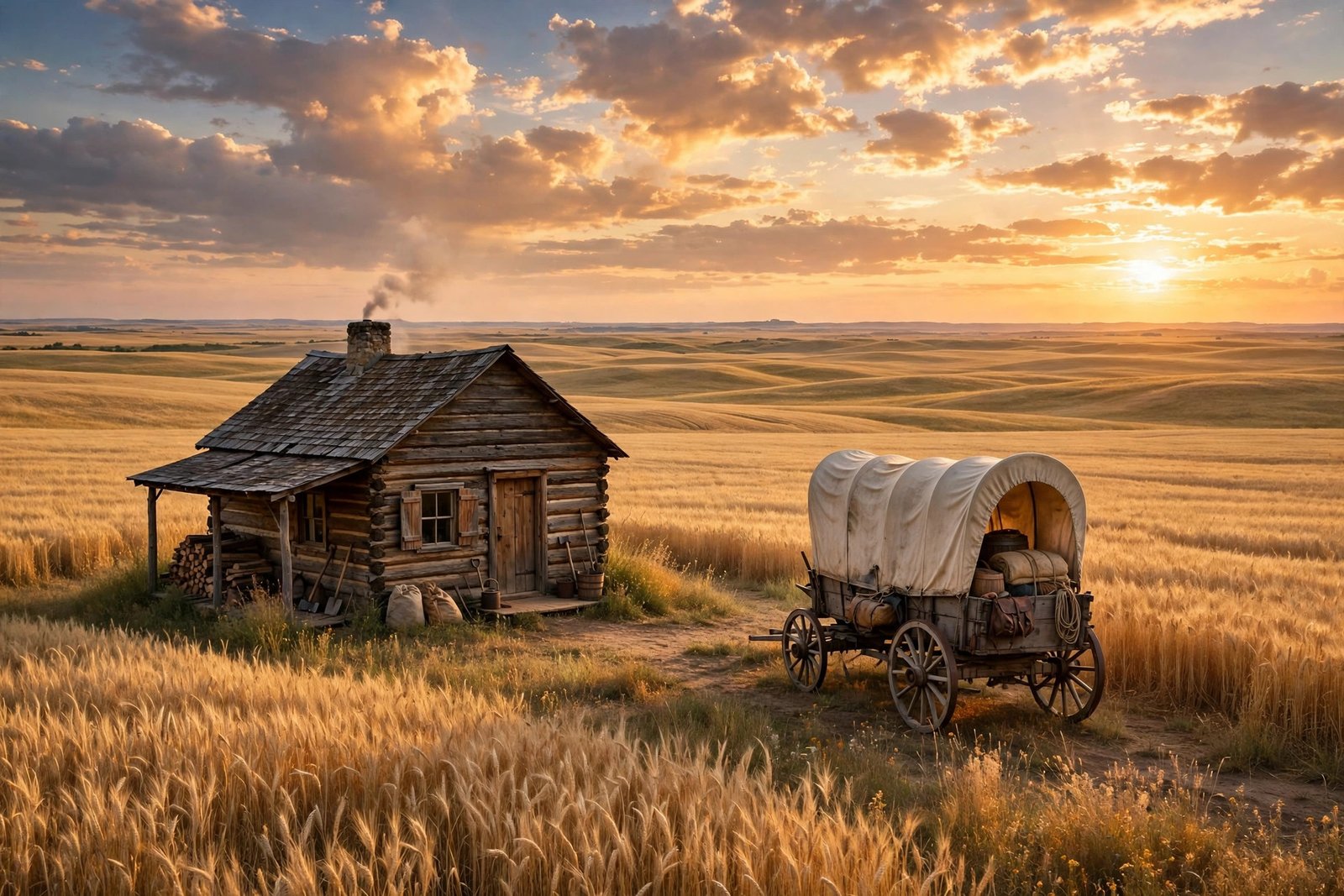
A central theme in Homestead Act history is the daily reality of proving a claim. A settler typically arrived with little more than a wagon, a few tools, and a hope for a better life. The first home was often a sod house on the treeless prairie, built from blocks of earth and grass, or a simple dugout carved into a hillside. These homes were cold in winter, hot in summer, and often leaked in rain, but they were a start.
Farming the prairie was backbreaking work. Settlers had to break tough sod with heavy plows, plant crops by hand, and protect their fields from drought, hail, grasshoppers, and prairie fires. Water was often scarce, and a single bad season could wipe out a year’s work. Families relied on neighbors, churches, and small-town stores for help, credit, and news.
Despite the hardship, homesteading communities grew quickly. Neighbors helped raise barns and houses. Families built one-room schools and small churches. Towns sprang up near railroads, offering blacksmiths, general stores, post offices, and grain elevators. Over time, dirt tracks became roads, and isolated claims became neighborhoods.
Children played an important role on homesteads. They herded animals, carried water, helped with planting and harvest, and walked long distances to school. Many homesteader children later wrote memoirs that remain some of the best sources for understanding pioneer life, not as a legend, but as lived experience.
The Five Years That Tested Every Family
The five-year residency requirement was the heart of the Homestead Act. A claimant had to live on the land, build a home, and make improvements such as breaking land, planting crops, and fencing fields. Government officials or witnesses could be called to confirm that the claimant had met these conditions before a patent was issued.
Not everyone completed the five years. Some claims were abandoned when crops failed or family members fell ill. Some settlers sold their improvements to newcomers and moved on. Others used later laws that allowed them to purchase their claim after a shorter period. Historians estimate that only a portion of all claims resulted in a final patent, which is a reminder that the West was settled by persistence as much as by policy.
Fraud and speculation also occurred. Some people filed claims with no intention of farming, hoping to sell timber, minerals, or land to others. The government tried to control this with inspections and rules, but enforcement on a vast frontier was difficult. Over time, Congress amended homestead laws to address abuses, adjust acreage for dry regions, and extend settlement into new areas.
- 160 acres was the standard claim under the original 1862 law.
- Five years of residence and improvement were required before full ownership.
- A small filing fee was charged, but the land itself was essentially free.
- Claimants had to be adults, citizens, or intending citizens.
- The law remained in effect, with amendments, for more than a century.
Later Laws, Larger Claims, and the Closing Frontier
As settlement moved into drier regions, 160 acres was often not enough to support a family. Congress responded with laws that offered larger claims in certain areas, such as the Enlarged Homestead Act of 1909, which allowed 320 acres in dry-farming regions, and later laws that allowed even larger claims for ranching in arid land.
The Timber Culture Act and the Desert Land Act also encouraged settlement, though they were sometimes used by speculators more than by genuine farmers. These laws show how homestead policy evolved as Americans learned that the West was not one uniform landscape, but a series of very different environments, from fertile prairies to deserts and mountains.
By the early twentieth century, the best farmland had largely been claimed, and the era of open homesteading was coming to an end. The Homestead Act was repealed in 1976, except in Alaska, where it continued until 1986. The last homestead patent in the contiguous United States and Alaska together marked the end of a policy that had lasted for more than 120 years.
In total, the federal government distributed hundreds of millions of acres through homestead laws. That scale is hard to grasp today. It means that millions of modern farms, towns, and counties trace their origins, directly or indirectly, to a homestead claim filed by an ancestor or an early settler.
Homestead Act History Also Includes Hard Truths
Any complete account must also face the costs of homesteading. The expansion of farms and ranches disrupted Indigenous hunting grounds, water sources, and sacred places. Treaties were broken, and Native nations were confined to reservations that were often far smaller and less fertile than their original homelands. This history is inseparable from the story of settlement, and it continues to shape land, law, and identity in the West today.
Environmental costs also followed. Breaking the prairie sod exposed soil to wind erosion. In the 1930s, drought and poor farming practices in parts of the Great Plains contributed to the Dust Bowl, when massive dust storms damaged farms and forced many families to leave. Later generations learned conservation methods, such as crop rotation, shelterbelts, and soil protection, partly from those hard lessons.
Economic inequality persisted as well. Railroad companies, land speculators, and large ranching operations often controlled the best land, water, and transport, while small homesteaders struggled. The romantic image of the independent farmer hides a more complicated reality of debt, dependence on banks and railroads, and markets that farmers could not control.
Recognizing these truths does not diminish the courage of individual homesteaders. It makes their stories more human, more honest, and more useful for understanding how America grew, and at what price.
What Homesteading Left Behind
The legacy of homesteading is visible across the American landscape. The grid of roads, fences, and fields across the Midwest and Great Plains follows the survey system that divided public land into townships and sections. Many small towns still carry the names of early settlers, railroad stops, or local landmarks from the homestead era.
Homestead sites have also become places of memory and learning. National parks, historic sites, and museums preserve sod houses, cabins, tools, and family records. The Homestead National Historical Park in Nebraska, for example, stands on the site associated with an early homestead claim and tells the story of settlement from many perspectives, including those of Indigenous peoples, immigrants, and women.
Family history is another living legacy. Millions of Americans can trace an ancestor who filed a homestead claim. Land records, census data, and local histories allow descendants to find the exact parcel their family once farmed, and sometimes to visit it today. For many families, that connection is a source of pride and curiosity.
For a broader look at the country these settlers helped build, see our collection of interesting facts about the USA, which covers the places, people, and stories that shaped the nation.
Conclusion: A Law That Changed a Continent
Homestead Act history reminds us that great change often begins with ordinary people making an extraordinary gamble. A family that left everything behind, traveled west in a wagon, and built a home from sod was not just seeking land. They were seeking a future, a community, and a place to belong.
The results were mixed, as all great human projects are. New farms and towns flourished, but Indigenous nations suffered, environments were transformed, and not every settler succeeded. Holding both truths together is the honest way to remember this chapter of American history.
If this story has sparked your interest, explore it further. Visit a homestead museum or historic site, look up your own family history, or read a pioneer memoir. The American West was not settled by legends alone. It was settled by real people, one 160-acre claim at a time, and their stories still shape the country today.