
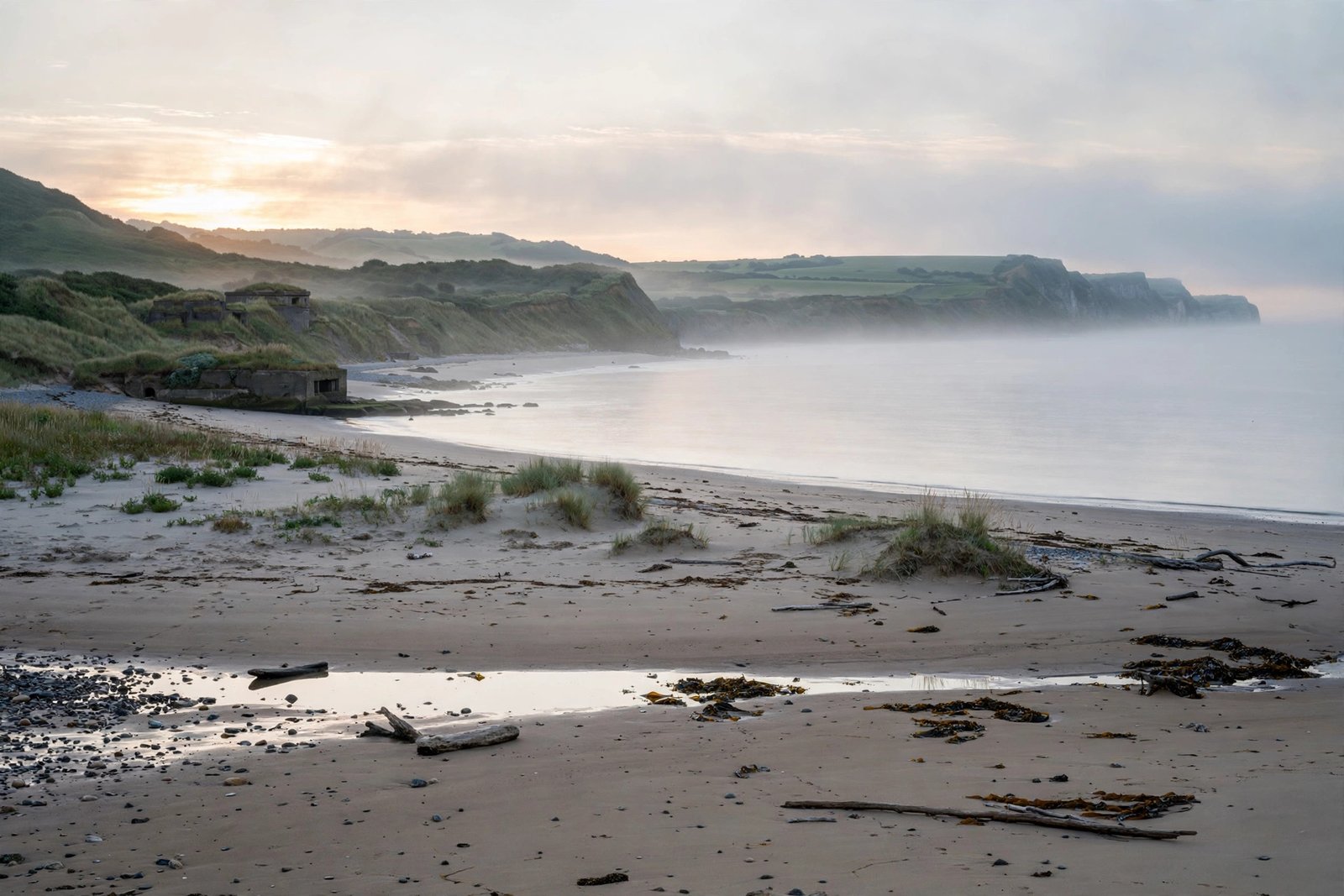
Before dawn on June 6, 1944, thousands of young American men crowded into landing craft in the dark waters of the English Channel. Many were teenagers. Most had never seen combat. Ahead of them lay five beaches in Normandy, France, defended by concrete bunkers, mines, and machine guns. Behind them lay everything they were fighting to protect. The D-Day true stories that came out of that morning are not Hollywood inventions. They are the real accounts of ordinary soldiers who did extraordinary things when fear, noise, and chaos closed in around them. In this article, we walk through the beaches, the cliffs, and the paratrooper drop zones where American soldiers landed, and we share the verified stories of the men who fought there. These stories still matter, because they show what courage looks like when it costs everything.
The Morning That Changed the World
By the spring of 1944, Nazi Germany occupied most of Western Europe. The Allies had spent months planning the largest amphibious invasion in history: Operation Overlord. Supreme Allied Commander Dwight D. Eisenhower made the final call to go on June 6, after bad weather forced a one-day delay from June 5. On that single day, more than 150,000 Allied troops crossed the Channel by sea and air to land in Normandy.
The invasion force hit five beaches. American troops assaulted Utah Beach and Omaha Beach on the western end. British and Canadian forces landed at Gold, Juno, and Sword beaches to the east. Behind enemy lines, American paratroopers from the 82nd and 101st Airborne Divisions dropped into the dark countryside to seize roads, bridges, and causeways before the beach landings began. The plan was enormous and complicated, and almost nothing went exactly as rehearsed. Landing craft drifted off course. Paratroopers were scattered across miles of farmland. At Omaha Beach, the first waves faced a storm of fire that nearly drove the invasion back into the sea.
Yet the landings held. By nightfall, the Allies had a foothold in France, and the liberation of Western Europe had begun. That foothold was paid for in blood, and the men who paid for it were not superheroes. They were farm boys, factory workers, teachers, and clerks who had answered the call and found themselves, on one gray morning, asked to do the hardest thing of their lives.
D-Day True Stories From Omaha Beach
Omaha Beach was the bloodiest of the five landing beaches. The men of the 1st Infantry Division and the 29th Infantry Division, including the 116th Infantry Regiment, came ashore into withering fire from German positions on the bluffs above. Many landing craft could not reach the shore because of obstacles and mines, and soldiers waded through deep water while carrying heavy packs. Men who fell in the surf often drowned before they ever reached the sand. Those who made it to the beach found almost no cover, just a long stretch of open shingle beneath the cliffs.
One of the most honored acts of that morning belonged to First Lieutenant Jimmie Monteith of the 16th Infantry Regiment. After landing with the first waves, Monteith moved up and down the exposed beach under heavy fire, organizing and leading groups of men forward, and repeatedly crossing open ground to direct tanks against enemy positions. He was killed while leading his men, and he was later awarded the Medal of Honor for his actions that day. His story is remembered because it captures what leadership looked like on Omaha: not shouting orders from safety, but walking into danger so others would follow.
Technician Fifth Grade John J. Pinder Jr., also of the 16th Infantry, carried vital radio equipment ashore and, despite being wounded, went back into the surf again and again to bring in more gear. He refused treatment so he could keep working, and he was killed while carrying out that mission. He too received the Medal of Honor. Private Carlton Barrett of the 18th Infantry spent the morning wading into the water again and again to pull drowning and wounded men to safety, ignoring the fire sweeping the beach. He survived, and he was awarded the Medal of Honor as well. These men are remembered not for a single dramatic moment, but for choosing, again and again, to go back into danger for someone else.
As the morning wore on, small groups of soldiers began to fight their way up the bluffs through the draws and ravines, and American destroyers came dangerously close to shore to fire directly at German gun positions. Slowly, painfully, the beachhead was won. For readers who want more stories of valor in the Pacific, our collection of Iwo Jima true stories carries the same spirit of sacrifice on a very different battlefield.
D-Day True Stories From Utah Beach and the Airborne
Utah Beach, the westernmost landing beach, went differently. Strong currents pushed the landing craft of the 4th Infantry Division about 2,000 yards south of their planned beach. There, on the spot, Brigadier General Theodore Roosevelt Jr., the assistant division commander and the oldest man in the landing force, made a decision that became famous. Surveying the situation, he concluded that the new landing spot was workable, and he is widely quoted as saying, ‘We will start the war from right here.’ His calm leadership helped turn an accident of navigation into an advantage, and Utah Beach was secured with far fewer casualties than Omaha. Roosevelt, who had landed with a cane and a pistol, was later awarded the Medal of Honor for his actions on D-Day.
Behind the beaches, the airborne landings were chaos. Paratroopers of the 82nd and 101st Airborne Divisions jumped in darkness, and clouds, enemy fire, and inexperienced pilots scattered them across the Norman countryside. Many men landed miles from their drop zones, alone or in tiny groups, surrounded by hedgerows and flooded fields. Instead of waiting, they gathered whoever they could find and fought toward their objectives. Small bands of paratroopers seized causeways, cut telephone wires, and ambushed German columns, sowing confusion far out of proportion to their numbers.
One of the best-known airborne stories belongs to Private John Steele of the 505th Parachute Infantry Regiment, 82nd Airborne. His parachute snagged on the church steeple at Sainte-Mere-Eglise, leaving him dangling above the town square while fighting raged below. He survived, was taken prisoner, and later escaped to rejoin his unit. The church in Sainte-Mere-Eglise still honors his story today. Another famous action came at Brecourt Manor, where Lieutenant Dick Winters of Easy Company, 506th Parachute Infantry Regiment, 101st Airborne, led a small group of men in an assault on a German artillery battery that was firing on Utah Beach. Winters and his men knocked out the guns in a textbook small-unit action that is still studied by military historians. You can read more about decorated heroes in our Medal of Honor stories collection.
Pointe du Hoc: The Rangers Climb
Between Utah and Omaha beaches stood Pointe du Hoc, a rocky cliff rising about 100 feet above the sea. German guns there could fire on both beaches, so the 2nd Ranger Battalion, under Lieutenant Colonel James Earl Rudder, was given one of the most dangerous missions of the day: scale the cliffs and silence the guns.
The Rangers crossed the Channel in small landing craft, and when they reached the base of the cliff, they fired rocket-propelled grappling hooks and rope ladders up the rock face and began to climb while German defenders dropped grenades and cut ropes from above. The Rangers who reached the top found that the big guns had been moved inland, so they pushed inland, found the guns in an orchard, and destroyed them. Then, cut off and surrounded, they held their position for two days against repeated counterattacks until relief arrived. The Rangers at Pointe du Hoc suffered heavy losses, but their climb remains one of the most storied feats of the entire invasion.
Today, the cratered ground at Pointe du Hoc is preserved much as the battle left it, and visitors can still walk among the concrete bunkers and bomb craters. Standing on that cliff edge, looking up from the waterline, is the fastest way to understand what the Rangers faced. The climb looks impossible even now, in peacetime, with no one shooting back.
The Bedford Boys and the Cost at Home
No account of D-Day is complete without the story of Bedford, Virginia. Company A of the 116th Infantry Regiment drew some of the deadliest water at Omaha Beach, in a sector known as Dog Green. The company was filled with young men from small towns, and Bedford, a quiet community in the Blue Ridge foothills, sent a group of friends and brothers who had joined the National Guard together before the war.
On the morning of June 6, Bedford lost 19 of its sons on the beaches of Normandy. The news reached the small town in the days that followed, and the grief touched nearly every family and street. Bedford’s loss, proportionally, was among the heaviest suffered by any American community on D-Day, and it is why the National D-Day Memorial was built in Bedford. The memorial stands there today as a place of remembrance and education, honoring the Allied forces who landed on June 6, 1944. The story of the Bedford Boys is a reminder that D-Day was not only a military operation. It was a day when ordinary American towns paid an extraordinary price.
Medics, Engineers, and Unsung Courage
The famous stories of D-Day usually belong to infantrymen and officers, but the landings could not have succeeded without the men whose jobs rarely make the movies. Combat medics waded ashore unarmed, carrying only bandages and morphine, and worked on the open beach under fire, dragging wounded men to shelter and marking the dead. Combat engineers went in with the first waves to blow up beach obstacles with Bangalore torpedoes and explosives, clearing paths for the men behind them while exposed to direct fire. Naval gunfire support crews and landing craft coxswains made run after run into the beaches, delivering men and supplies and carrying out the wounded.
There were also quiet acts of mercy that never earned a medal. Soldiers shared water, carried strangers, and held the hands of dying men they had just met. Chaplains moved among the wounded, offering comfort and last rites in the middle of the battle. The Army even sent one paratrooper home after learning that his brothers had been killed in action, a decision that later inspired the film Saving Private Ryan. These are the threads that make D-Day true stories so enduring: they are not only about fighting, but about the bonds between soldiers who refused to leave each other behind.
What These Stories Teach Us Today
More than eighty years have passed since June 6, 1944, and the generation that landed at Normandy has nearly left us. What remains is the record they left: letters home, interviews, unit histories, and the memorials that mark the beaches where they fought. When we read D-Day true stories, we are not just studying history. We are learning how ordinary people respond when everything depends on them.
The lessons are practical as well as inspiring. Leadership on D-Day was not about rank; it was about whoever stepped forward first. At Omaha Beach, junior officers and sergeants rallied scattered men and got them moving. At Utah Beach, a general calmly adapted to a landing in the wrong place. In the hedgerows, paratroopers who could not find their units formed new ones on the spot. The invasion succeeded because thousands of small decisions, made under fire by people nobody remembers, added up to one great one.
If these stories move you, there is no better way to honor them than to keep them alive. Visit the National D-Day Memorial in Bedford, Virginia, or the beaches and cemeteries of Normandy. Talk to a veteran, or read a veteran’s memoir. Share these stories with your family, and explore our incredible true stories of US soldiers to discover more accounts of courage from every era of American history. The men of D-Day did not fight for fame. They fought for the person next to them, and for the country waiting back home. Remembering their names is the least we can do.