
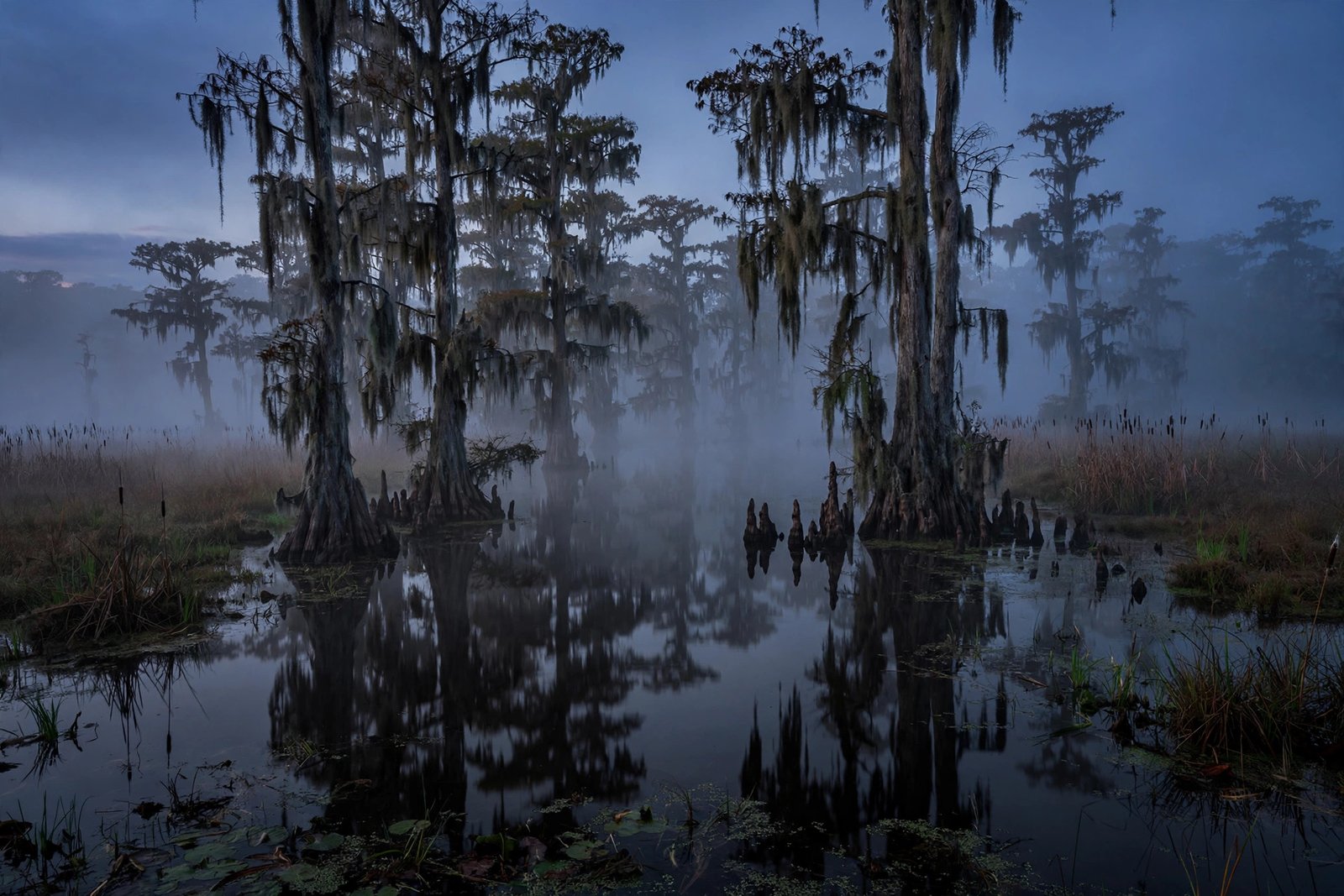
Deep in Florida’s swamps, where cypress knees rise out of black water and alligators slide silently through the mangroves, locals say something else walks the wetlands. It stands on two legs, towers well over six feet tall, and smells so foul that hunters claim they smelled it long before they ever saw it. This is the skunk ape legend — the Sunshine State’s own version of Bigfoot, a creature of folklore that has fascinated, frightened, and amused Floridians for generations.
But what is the skunk ape, really? Is it a flesh-and-blood animal hiding in the Everglades, a case of mistaken identity, or simply one of America’s most colorful tall tales? In this guide, we wade into the murky waters of the skunk ape legend — separating folklore from fact, tracing the most famous reported encounters, and hearing what scientists and wildlife experts actually say about Florida’s smelly swamp ape.
What Is the Skunk Ape Legend?
The skunk ape is a legendary ape-like creature said to inhabit the swamps, marshes, and forests of Florida. According to the folklore, it is a large, hairy, bipedal animal that walks upright like a human but is covered head to toe in dark, matted hair. Descriptions in reported accounts consistently mention a powerful build, long arms, and a face that looks part ape, part human.
The creature’s name comes from its most distinctive trait: a terrible, overpowering odor. Witnesses in the legends describe a stench like rotten eggs, wet dog, skunk spray, or garbage — a smell so strong it can be detected from a distance. Some versions of the tale say the smell comes from the animal itself; others suggest it wallows in swamp mud and decaying vegetation.
The skunk ape legend is often compared to Bigfoot, and the two share obvious similarities — both are large, hairy, upright-walking cryptids reported in wild places. But Florida’s version has its own flavor. Reports usually describe the skunk ape as somewhat smaller than the typical Bigfoot, more ape-like than human-like, and far smellier. It is also closely tied to a specific landscape: the wetlands of South Florida, especially the Everglades and Big Cypress.
It is important to be clear about one thing from the start: there is no confirmed scientific evidence that the skunk ape exists. No specimen, skeleton, clear photograph, or DNA sample has ever been verified. Everything below about the creature itself comes from folklore and unverified reports — the legend, not established fact. What is real and verifiable is the tradition itself: the stories people have told, the investigations they have launched, and the place the creature holds in Florida culture. If you enjoy American cryptids, you may also like our guide to the Bigfoot legend explained.
Where Did the Skunk Ape Legend Begin?
Like many folk legends, the skunk ape does not have a single neat origin point. Stories of large, ape-like wild men in the southeastern United States go back a long way, and Florida’s swamps have always been a place where the unknown feels close. The modern skunk ape legend took shape in the 20th century, as Florida’s population grew and more people ventured into — and lived near — the wild edges of the Everglades.
The legend gained serious momentum in the late 20th century, when a handful of widely publicized reports put the creature on the map. One of the most famous episodes came in 2000, when a set of photographs said to have been taken near Myakka River State Park began circulating. The grainy images appeared to show a large, dark, ape-like animal, and they were widely covered by local media and national outlets interested in odd news. The photos — often called the Myakka skunk ape photographs — remain the most well-known visual evidence associated with the legend, though skeptics note that the images are blurry and could show a number of ordinary things. No one has ever proven what, if anything, is in them.
Another major boost for the legend came from a roadside attraction in Ochopee, Florida, in the heart of the Everglades region: the Skunk Ape Research Headquarters. Its founder, Dave Shealy, has spent decades investigating reported sightings across South Florida and promoting the idea that the creature is real. Whether or not you believe the claims, the headquarters has become a genuine piece of Florida roadside culture — part gift shop, part museum, part alligator exhibit — and a symbol of how deeply the legend is woven into the region’s identity.
Folklorists who study the skunk ape legend point out that it follows classic patterns of American folklore. Swamps are mysterious, hard-to-navigate places where visibility is poor and strange sounds are common. In that kind of environment, a splashing alligator, a startled black bear, or an unfamiliar animal glimpsed at dusk can easily become a monster in the retelling. Add decades of campfire stories, local media coverage, and the human love of a good mystery, and a legend is born.
Where the Skunk Ape Supposedly Roams
According to the folklore, the skunk ape’s territory centers on South Florida’s great wetlands. The Everglades — the vast, slow-moving river of grass stretching across the southern tip of the peninsula — is the creature’s legendary heartland. Reports and stories place it among the sawgrass marshes, cypress domes, and mangrove forests of Everglades National Park and the surrounding conservation areas.
Big Cypress National Preserve, which borders the Everglades to the north, is another hotspot in the stories. This half-million-acre preserve of swamps and pine flatwoods is remote, difficult to access, and rich in wildlife — exactly the kind of place where a legend can thrive. The Myakka River area, Green Swamp Wilderness Preserve in central Florida, and the Ocala National Forest have all appeared in various reported accounts as well.
Some versions of the legend extend the creature’s range beyond Florida into the swamps of Georgia, Alabama, and Louisiana, where similar “swamp ape” stories circulate under different names. But Florida remains the skunk ape’s undisputed home in the popular imagination. For travelers drawn to mysterious places, our roundup of mysterious places in the USA includes several Florida locations tied to the legend.
The Most Famous Skunk Ape Reports
Every legend has its landmark stories, and the skunk ape legend is no exception. The following accounts are the ones most often repeated by believers and chroniclers of the phenomenon. Remember: these are reported encounters, not verified facts. They are presented here as folklore — the stories people tell — not as evidence.
The Myakka photographs (2000). As mentioned above, these anonymously submitted photographs, said to have been taken near Myakka River State Park, are the most famous images linked to the legend. They show a dark, hunched, ape-like figure that some believers consider the best visual evidence for the creature. Skeptics counter that the images are too blurry to identify and note the absence of any follow-up evidence from the location.
The 1970s sighting wave. Believers’ chronologies of the legend often cite a cluster of reported encounters in the 1970s, when suburban expansion pushed new neighborhoods up against the edges of the Everglades and Big Cypress. Residents described large, foul-smelling animals raiding garbage, peering through windows, and crossing roads at night. These stories follow a familiar cryptid pattern — the wild creature pushed into contact with civilization — and they cemented the skunk ape’s reputation as a suburban legend as much as a wilderness one.
Ongoing Everglades reports. To this day, local media in South Florida occasionally report new alleged sightings — a hunter’s trail-camera image, a boater’s distant glimpse, a family scared by something large moving through the mangroves at night. Each new report rekindles interest, and each tends to follow the same arc: excitement, speculation, and no conclusive evidence. The legend endures precisely because the swamp is so vast and so difficult to search thoroughly.
What is striking about these reports, taken together, is how consistent the core details remain: the size, the upright walk, the dark hair, and above all, the smell. Folklorists see this consistency as evidence of a shared storytelling tradition. Believers see it as evidence of a real animal. Both readings tell us something interesting about how legends work.
What Scientists and Experts Say About the Skunk Ape Legend
The scientific mainstream is clear: there is no credible evidence that the skunk ape exists as a real animal. Primatologists and wildlife biologists point out that Florida has no native ape species, that no physical remains of such a creature have ever been found despite extensive development and wildlife study in the region, and that large unknown primates are extremely difficult to keep hidden in the modern era of trail cameras and smartphones.
So what are people seeing? Experts offer several plausible explanations for the reports behind the skunk ape legend:
- Misidentified black bears. Florida is home to the Florida black bear, a real subspecies of the American black bear. A bear standing on its hind legs, glimpsed briefly in poor light or through vegetation, can look surprisingly humanoid — tall, dark, and shaggy. Bears also have a strong odor, especially in warm, wet conditions. Wildlife officials consider this the most likely explanation for many reports.
- Escaped or released exotic animals. South Florida has a long history of exotic animals escaping from private collections, roadside zoos, and the pet trade — from pythons to monkeys. An escaped chimpanzee or orangutan, disoriented in a swamp, could easily fuel a monster story. Several such escapes have been documented in Florida over the decades.
- The power of suggestion and folklore. Once a legend exists, people interpret ambiguous experiences through it. A strange splash in the night, an unfamiliar smell, a shadow between the cypress trees — in skunk ape country, these become skunk ape encounters. Psychologists note that this pattern appears in every cryptid tradition in the world.
None of this makes the legend less interesting. The skunk ape legend is a genuine piece of American folklore, and folklore is worth studying on its own terms — as a window into how communities relate to wild places, how stories evolve, and how mystery survives in an age of satellite maps and camera traps.
The Skunk Ape in Florida Culture
Real or not, the skunk ape is undeniably real as a cultural phenomenon. In South Florida, the creature is a local celebrity. The Skunk Ape Research Headquarters in Ochopee draws curious road-trippers driving the Tamiami Trail between Miami and Naples. Local news stations run skunk ape segments. The creature appears in documentaries, podcasts, and television programs about American cryptids and unexplained mysteries.
The legend also serves as a kind of mascot for the wild Florida that is rapidly disappearing. Every skunk ape story is, in a sense, a story about the Everglades — about a landscape so vast and strange that it feels capable of hiding anything. In that way, the legend does genuine cultural work: it keeps people talking about, visiting, and valuing one of America’s most extraordinary ecosystems.
There is a lesson here for travelers. You do not need to believe in the skunk ape to enjoy skunk ape country. The real Everglades needs no embellishment — it is already one of the most remarkable wild places in the United States.
Visiting Skunk Ape Country: The Real Wildlife of the Swamps
If the legend inspires you to explore South Florida’s wetlands, you are in for a treat — because the actual wildlife is spectacular. Everglades National Park and Big Cypress National Preserve are home to alligators, American crocodiles, Florida panthers (an endangered subspecies of cougar), bobcats, river otters, manatees, and the Florida black bear — the very animal behind many skunk ape reports. Birders can spot roseate spoonbills, wood storks, and dozens of heron and egret species. For a wildlife-focused trip, see our guide to Everglades National Park wildlife.
A few practical tips for exploring the region safely:
- Visit in the dry season (December to April). Wildlife concentrates around remaining water, mosquitoes are fewer, and hiking is far more pleasant.
- Keep your distance from alligators. They are wild predators. Observe from boardwalks and designated trails, never feed them, and keep pets and small children close.
- Bring binoculars and a camera. Much of the Everglades’ wildlife is best seen at a distance — wading birds, deer, and the occasional panther or bear.
- Drive the Tamiami Trail and Loop Road. These scenic routes cut through prime wetland habitat and offer excellent wildlife viewing from the car.
- Respect the environment. Stay on marked trails and boardwalks. The Everglades is a fragile ecosystem and a UNESCO World Heritage site.
And if you catch a whiff of something foul on the breeze? It is almost certainly swamp gas, a startled animal, or the rich organic funk of the wetlands themselves — not a legendary ape. But it makes a good story either way.
Conclusion: Why the Skunk Ape Legend Endures
The skunk ape legend endures because it sits at the intersection of two powerful human impulses: our fascination with mystery and our love of wild places. Florida’s swamps are genuinely strange and wonderful — a landscape where the water flows almost invisibly, where prehistoric-looking reptiles still rule, and where the line between the known and the unknown feels thin. A legend like the skunk ape gives that feeling a shape, a smell, and a name.
So is the skunk ape real? Science says almost certainly not. But as folklore — as a story that Floridians tell about their home, their swamps, and the wild things at the edge of the known — the skunk ape is absolutely real, and it is not going anywhere.
Plan your own trip into legend country: explore the Everglades and Big Cypress, keep your eyes open and your camera ready, and share your experience in the comments. Did you see something strange in the swamp — or just an unforgettable sunset over the sawgrass? Either way, we want to hear about it. And if you love American mysteries, browse our Legends section for more folklore from across the USA.