
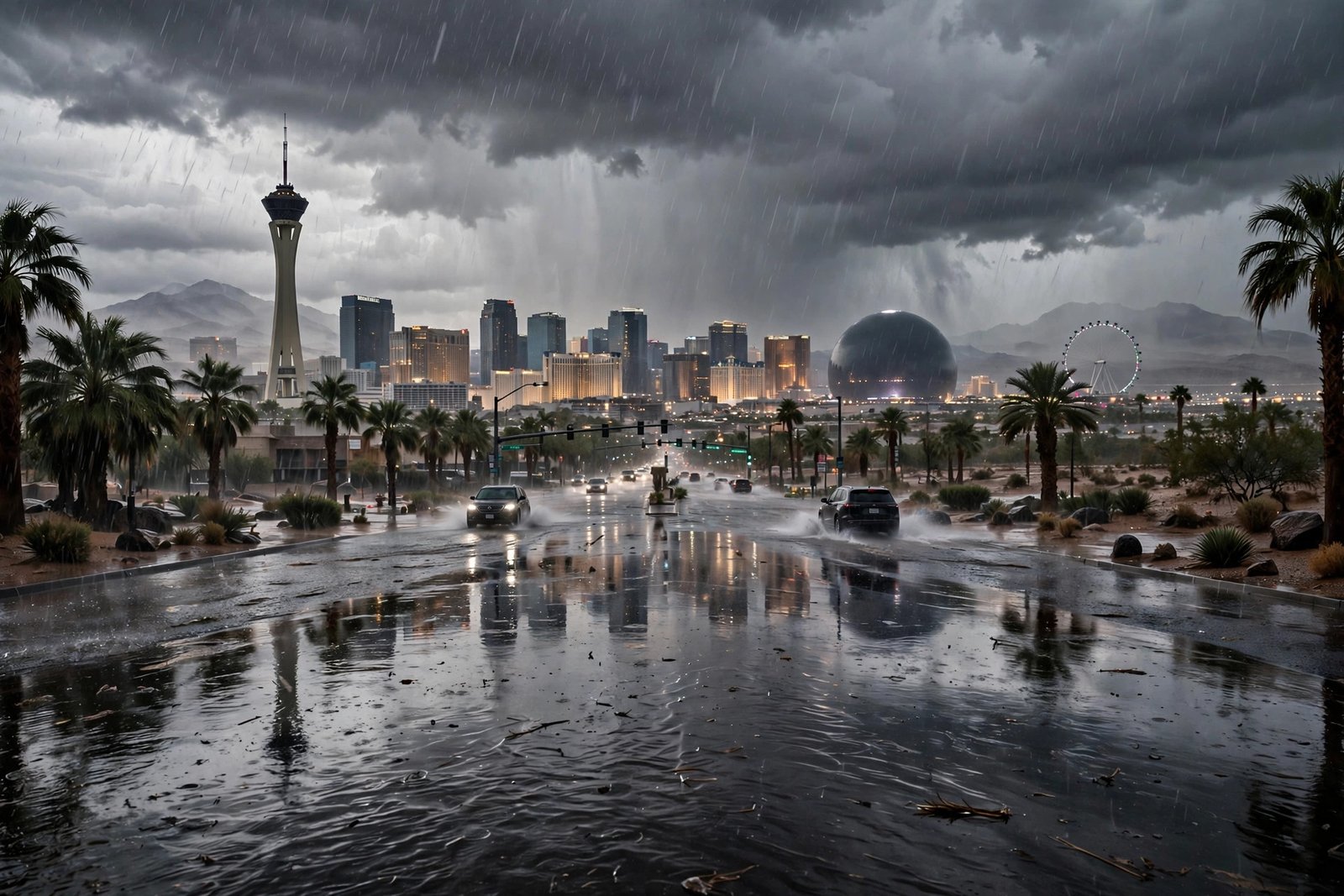
In mid-October 2026, desert streets turned into rivers in a matter of hours. Tropical Storm Rachel Las Vegas flooding stunned residents and visitors alike when the remnants of a tropical storm pushed moisture into southern Nevada and dropped a record amount of rain on a city built for sunshine, not storms. Videos of water surging through intersections, pooling in parking lots, and sweeping across roadways spread across social media within hours, leaving millions of viewers asking the same question: how does a desert city flood like this?
According to news reports, including coverage from ABC News Live, Las Vegas saw flooding across city streets as the storm’s remnants moved through the region, and the city set a rainfall record. This article explains what happened, why desert cities flood so fast, how people reacted online, and what you should know to stay safe when floodwater rises. We stick to what was broadly reported and to well-established flood science, and we avoid speculation about details that officials had not confirmed.
Tropical Storm Rachel Las Vegas: What Happened
Tropical Storm Rachel began as a tropical storm over the Pacific. As the system weakened, its leftover moisture moved north and east into the American Southwest, a pattern that can bring unusual bursts of heavy rain to places that normally see very little of it. When that moisture reached southern Nevada in mid-October 2026, Las Vegas was hit with heavy rainfall that overwhelmed streets and drainage in parts of the city.
News reports described flooding across Las Vegas streets, with water covering roadways and turning intersections into temporary ponds. ABC News Live reported on the flooding and noted that the city hit a rainfall record, a remarkable milestone for one of the driest major cities in the United States. In a city that averages only a few inches of rain in an entire year, a single storm dumping a record amount of rain in a short period is enough to cause widespread disruption.
For visitors, the timing made the flooding even more surprising. Las Vegas is a city people associate with bright sun, pool parties, and desert heat, not with rain boots and flooded roads. Tourists who had arrived expecting clear skies instead found themselves filming rising water from hotel windows and sidewalks. For longtime residents, the event was a reminder that the desert can deliver extreme weather in both directions, from record heat to record rain.
Emergency and city crews in desert cities prepare for these moments, because flash flooding is a known hazard in the Southwest. Reports described the familiar response: drivers urged to avoid flooded roads, low-lying areas watched closely, and cleanup beginning once the water receded. The full picture of the storm’s impact takes time to assess, and officials typically confirm details gradually, so early reports focused on the most visible facts: heavy rain, flooded streets, and a new rainfall record.
Why Tropical Storm Rachel Las Vegas Caused So Much Flooding
It seems strange that a place famous for dryness could flood so badly, but deserts are actually some of the most flood-prone landscapes on Earth. The reason comes down to how desert ground handles water. Much of the soil around Las Vegas is hard-packed and rocky, and in many places it is covered by a natural crust. When rain falls gently over a long time, some of it soaks in. When a huge amount falls quickly, the ground cannot absorb it fast enough, so most of the water runs off the surface instead.
Cities make that runoff even faster. Streets, sidewalks, rooftops, and parking lots are impervious surfaces, meaning water cannot soak through them at all. Rain that lands on a roof or a highway has only one place to go: downhill, into gutters, storm drains, and washes. In a desert city, the drainage system is designed for brief bursts of rain, not for a tropical moisture surge that keeps dumping water hour after hour. When the volume of water exceeds what the drains can carry, streets become the overflow path.
The terrain around Las Vegas adds to the problem. The city sits in a valley surrounded by mountains, and water from the surrounding high ground drains toward the valley floor. Washes, the dry channels that carry water only during storms, can fill in minutes when heavy rain falls upstream. A wash that looks bone dry in the morning can become a fast-moving stream by the afternoon, even if it is not raining directly overhead at that spot. That is one of the most dangerous features of desert flooding: the water can arrive suddenly, from rain that fell miles away.
Tropical moisture made this event different from an ordinary desert thunderstorm. Summer monsoon storms in the Southwest are usually brief and local, dumping rain on one neighborhood while another stays dry. The remnants of a tropical storm, by contrast, can spread deep moisture over a wide area and keep the rain coming for hours. When a whole valley receives heavy rain at once, every wash, drain, and low spot fills at the same time. That is how a city in the middle of a desert ends up with flooded streets in every direction.
The Viral Videos and Public Reaction
Within hours of the flooding, Tropical Storm Rachel Las Vegas clips were everywhere online. Videos shared on social media showed water rushing down streets, cars creeping through flooded intersections, and sheets of rain hammering the Strip area. Some clips showed water pouring through parking lots and pooling around buildings. Others showed pedestrians wading through ankle-deep water or filming from covered walkways as the rain kept falling. The footage spread quickly because it was so unexpected: a desert gambling capital turned into a water world, at least for a day.
Public reaction online mixed shock, humor, and concern. Many viewers said they had never seen Las Vegas look like that, and some joked that the city’s famous fountains had expanded to cover the whole town. Others shared memories of past desert floods and warned newcomers to take the water seriously. Locals posted practical advice alongside the dramatic clips, reminding drivers not to enter flooded roads and telling visitors to stay put until the water drained. That mix of amazement and neighborly warning is a familiar pattern when extreme weather goes viral.
Viral weather videos do more than entertain. They also teach. Millions of people who had never thought about desert flooding watched it happen in real time and learned that dry places can flood fast. Weather reporters and emergency officials often use these moments to repeat safety messages, because a dramatic video reaches people who would never read a flood safety pamphlet. In this case, the footage carried a clear lesson: even in a city built for sunshine, water is a force to respect.
It is worth remembering that viral clips can also mislead. A short video shows one street at one moment, not the whole city. Some clips circulating during major weather events turn out to be old footage from earlier storms, and dramatic captions are not always accurate. The reliable picture of the Las Vegas flooding came from established news coverage, including ABC News Live, which reported the street flooding and the rainfall record, rather than from any single unverified clip. When extreme weather trends online, checking a trusted news source before resharing is always the smart move.
Why Desert Cities Flood So Fast
Flash flooding is one of the most dangerous weather hazards in the United States, and desert cities are especially vulnerable. The National Weather Service has long warned that flash floods can develop within minutes of heavy rain, and that most flood deaths happen in vehicles when drivers try to cross flooded roads. The science behind that warning is straightforward, and the Tropical Storm Rachel Las Vegas event showed every part of it in action.
First, desert soils absorb water slowly. The ground in and around Las Vegas includes rock, gravel, and compacted soil, and in many areas a hard mineral crust forms on the surface. When rain hits that surface, it beads and runs rather than soaking in. In a forest or a grassy field, soil and plants slow the water down and give it time to sink into the ground. In the desert, there is little vegetation to intercept the rain, so nearly all of it becomes runoff almost immediately.
Second, desert terrain concentrates water. Canyons, washes, and mountain slopes act like funnels, gathering rain from a large area and pouring it into a narrow channel. A wash can go from dry to dangerous in minutes, and the water in it moves with surprising speed and power. Just a few inches of fast-moving water can knock a person off their feet, and a foot or two of water can float a car. That is why officials repeat a simple rule: never drive or walk into floodwater, no matter how shallow it looks.
Third, desert cities sit downstream of their own watersheds. Rain that falls on the mountains around Las Vegas does not stay in the mountains. It flows downhill into the valley, through neighborhoods and across roads. A storm can be over by the time the water arrives, which is why flash floods sometimes strike under clearing skies. People who see sunshine and assume the danger has passed may be standing in the path of water that is still on its way.
Fourth, urban growth changes the math. Every new road, rooftop, and parking lot replaces absorbent ground with pavement. That means more runoff, moving faster, with fewer places for water to go. Modern desert cities build extensive flood-control systems, including detention basins, channels, and dams, to manage this runoff. Those systems handle most storms well, but a record rainfall event can exceed what any system was designed to carry. When that happens, streets and low-lying areas take the overflow, which is exactly what reports described in Las Vegas.
Flood Safety: What to Do When Streets Flood
Flooding is frightening, but knowing what to do before it happens makes a real difference. The single most important rule comes from the National Weather Service: Turn Around, Don’t Drown. Most flood deaths occur when people drive into flooded roads, often because the water looks shallow or the road looks passable. It is not worth the risk. Floodwater hides dips, debris, and washed-out pavement, and a road that looks fine can disappear beneath a car in seconds.
If you are driving and encounter a flooded street, stop and turn around. Do not try to guess the depth, and do not follow another vehicle through the water. If your car stalls in floodwater, leave it and move to higher ground if you can do so safely. If you are on foot, never walk through moving water, and keep children and pets away from washes, drainage channels, and flooded areas. Water that looks calm can still be deep and fast.
Before a storm, a few simple steps help. Check the weather forecast before traveling in the desert, especially during monsoon season and whenever tropical moisture is in the forecast. Know whether your route crosses washes or low-water crossings, and have an alternate route in mind. Keep your phone charged and sign up for local emergency alerts so you get flash flood warnings in real time. If you are staying in a hotel or rental in a desert city, ask the front desk about local flood-prone areas, and park on higher ground when heavy rain is expected.
At home, keep important documents in a waterproof container, and know how to shut off utilities if flooding threatens. If water enters your home, avoid walking through it, since floodwater can carry contaminants and hide electrical hazards. After a flood, wait for officials to say it is safe before returning to flooded areas, and watch for damaged roads and weakened structures. These are the same steps emergency officials recommend for any flash flood, in the desert or anywhere else.
What This Means for Las Vegas and Desert Travel
The Tropical Storm Rachel Las Vegas flooding is a reminder that Las Vegas weather has two faces. The city is famous for sunshine, and most days deliver exactly that. But the Southwest’s desert climate also produces dramatic extremes, from heat waves to monsoon downpours to the occasional tropical moisture surge. Travelers who understand both faces can enjoy the city without being caught off guard.
For visitors, the practical lesson is simple: check the forecast, even in the desert. A sunny morning does not guarantee a dry afternoon when tropical moisture is moving into the region. If heavy rain is forecast, plan indoor activities, avoid driving through low-lying areas, and give yourself extra travel time. Many of the city’s best attractions, from shows and museums to restaurants and shopping, are indoors, so a rainy day in Las Vegas can still be a great day.
For road trippers, the lesson extends beyond the city. The desert highways around Las Vegas cross washes and low-water crossings, and rural stretches may have no alternate route. Anyone driving through the Southwest after heavy rain should watch for road closures, obey barricades, and never drive around them. A barricade is there because the road ahead is unsafe, even if the water has started to recede. For more desert driving inspiration, see our Route 66 road trip guide, which covers classic desert highway travel across the American Southwest.
The flooding also highlights how cities adapt to a changing climate. Desert cities across the Southwest continue to invest in flood control, from larger storm drains to detention basins that hold runoff and release it slowly. Homeowners and businesses can help by keeping drains clear, avoiding building in known flood paths, and carrying flood insurance even if their property is not in a high-risk zone. Flooding, after all, does not only happen in mapped flood zones, and desert storms do not always follow the old patterns.
And for all the disruption, the event also showed a familiar American instinct: neighbors helping neighbors, strangers sharing warnings, and a city shaking off a wild day and getting back to work. Las Vegas has weathered flash floods before, and it will weather them again. The city remains one of the most beautiful places in America, a desert oasis of lights, mountains, and red rock scenery, and a single record storm does not change that. If anything, the flooding reminded the world that the desert is a living landscape, powerful and unpredictable, and worth respecting.
Conclusion: A Record Storm, a Lasting Lesson
Tropical Storm Rachel Las Vegas flooding will be remembered as the day a desert city set a rainfall record and the world watched its streets fill with water. The viral videos captured the shock, but the deeper story is about how desert cities work: hard ground, fast runoff, washes that fill in minutes, and drainage systems tested by a tropical surge. Understanding that science is the first step toward staying safe when the next storm arrives.
If this story was useful to you, share it with someone planning a trip to Las Vegas or the Southwest, and remember the rule that saves lives: Turn Around, Don’t Drown. For more on the American landscapes that make this country extraordinary, from desert canyons to secret waterfalls across the USA, keep exploring Beauty of USA, and tell us in the comments about your own experience with desert weather.