
In the spring of 1803, the United States was a small, debt-ridden republic clinging to the Atlantic coast — and President Thomas Jefferson was about to gamble its future on a single handshake. The story of the louisiana purchase history is one of the most astonishing in American history: Napoleon Bonaparte, the most powerful ruler in Europe, suddenly offered to sell France’s entire claim to the interior of North America. The price was just $15 million. The result was a treaty that doubled the size of the United States overnight, launched the Lewis and Clark expedition, and set the young nation on the road to becoming a continental power. No president before or since has ever bought this much land for so little money — and no single deal has shaped America’s destiny quite like this one. Here is the real story of how it happened, why France sold, and why it still matters more than two centuries later.
To grasp why this deal was so extraordinary, picture America in 1803. The nation stretched from the Atlantic Ocean to the Mississippi River — and not one inch farther west. Beyond the river lay a vast, mysterious territory claimed by France, inhabited by Native American nations, and largely unknown to American citizens. Whoever controlled the Mississippi and the port of New Orleans controlled the economic lifeline of the entire western frontier, because farmers west of the Appalachian Mountains depended on the river to ship their crops to market.
Louisiana Purchase History: What Did America Actually Buy?
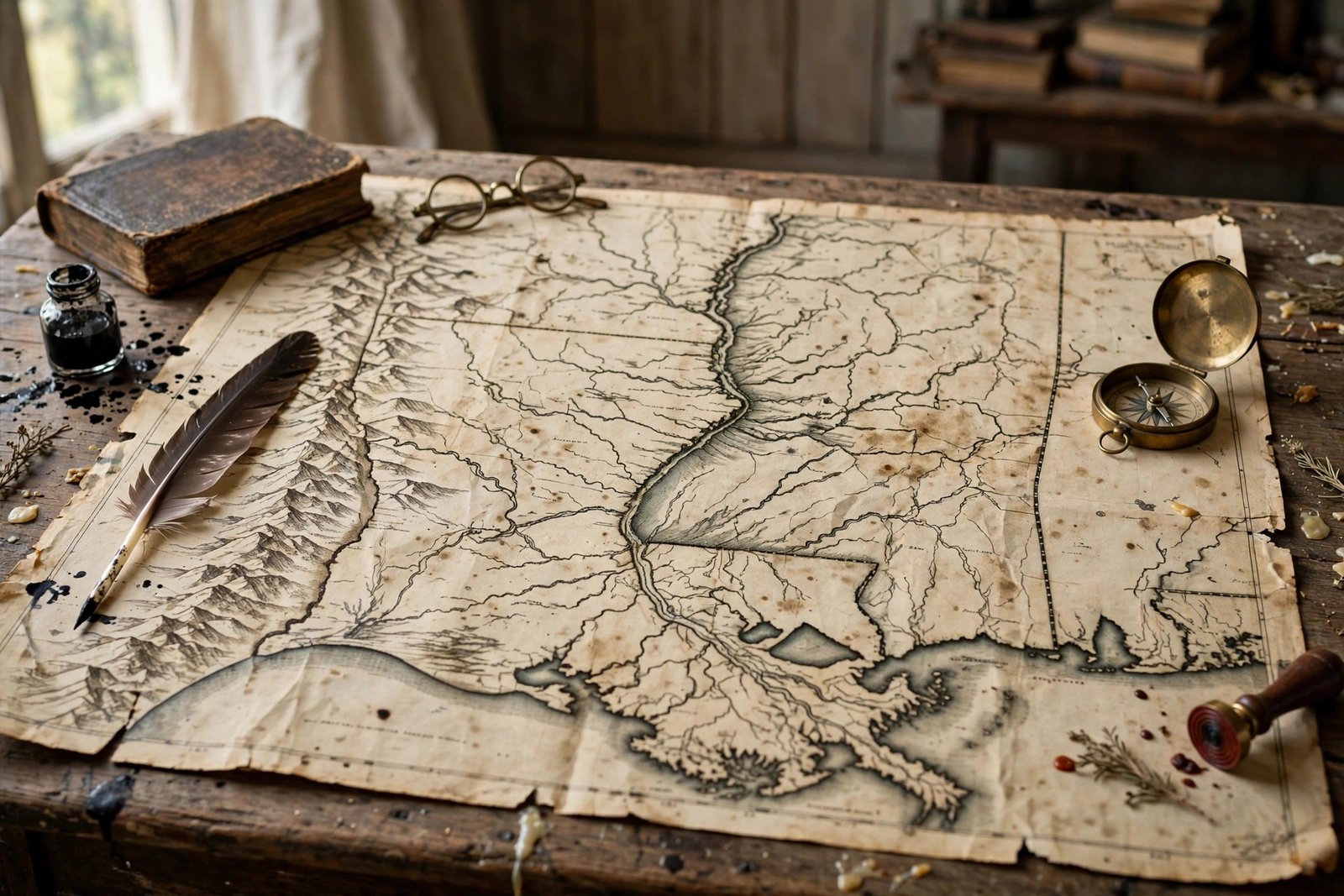
For $15 million, the United States acquired roughly 828,000 square miles of territory — an area nearly as large as the entire country east of the Mississippi at the time. The purchase covered the whole western watershed of the Mississippi River, stretching from the Gulf of Mexico in the south to the Canadian border in the north, and from the Mississippi River westward to the Rocky Mountains. Most importantly, it gave America full control of the vital port of New Orleans, the gateway through which the grain, cotton, and goods of the entire frontier flowed to world markets.
The price works out to roughly three cents an acre — perhaps the greatest bargain in real-estate history. At a single stroke, the young republic doubled in size. Within a generation, this territory would be carved into all or part of fifteen future states, including Louisiana, Arkansas, Missouri, Iowa, Oklahoma, Kansas, Nebraska, Minnesota, and the Dakotas. It was the single largest addition of territory in the nation’s history, and it transformed the United States from a coastal nation into a continental one.
Why Napoleon Was Suddenly Willing to Sell
Napoleon’s decision to sell stunned everyone in Europe, but it made cold sense once you look at his situation. France had only recently regained Louisiana in a secret 1800 agreement with Spain known as the Treaty of San Ildefonso, and Napoleon dreamed of rebuilding a French empire in the Americas. That dream died in the Caribbean. France’s attempt to retake the colony of Saint-Domingue — modern-day Haiti — collapsed in disaster as disease ravaged the French expeditionary force, and the colony’s revolutionaries fought the army to a standstill.
With war against Britain looming again in 1803, Napoleon needed every soldier and every franc he could find for the fight in Europe. A distant American wilderness that France could not defend was suddenly a liability, not an asset. Selling it to the Americans would raise desperately needed cash and, just as usefully, put a fast-growing rival on Britain’s doorstep. When the American envoys arrived in Paris hoping to buy just the city of New Orleans, they were met with an offer they never expected: take the whole territory.
The Mississippi Crisis That Started It All
Americans had a very personal reason to want New Orleans. Under an agreement called Pinckney’s Treaty, signed with Spain in 1795, American merchants had won the “right of deposit” at New Orleans — the right to store goods there duty-free while awaiting ocean transport. In 1802, Spain revoked that right, and panic swept through the western frontier. Farmers in Kentucky, Tennessee, and Ohio suddenly feared their livelihoods would rot on the riverbanks.
Jefferson responded by sending James Monroe to Paris with instructions to join the American minister already there, Robert Livingston, and to offer up to $10 million for New Orleans and its surroundings. It was a modest, practical mission: secure the port, keep the peace, and go home. Neither envoy had any authority to buy half a continent. When France offered the entire Louisiana territory, Livingston and Monroe faced a once-in-history choice — and they seized it, negotiating a treaty far beyond their instructions and trusting that Jefferson and Congress would back them up.
Louisiana Purchase History: The $15 Million Handshake
The negotiations moved with startling speed. France’s foreign minister, Talleyrand, floated the idea of selling all of Louisiana, and the American envoys — realizing this chance might never come again — hammered out terms with Napoleon’s finance minister, François Barbé-Marbois. The treaty was signed in Paris on April 30, 1803. The headline price was $15 million: about $11.25 million paid directly to France, plus the United States’ agreement to assume roughly $3.75 million in claims that American citizens held against the French government.
News crossed the Atlantic slowly, and when it reached Washington, Jefferson was both thrilled and uneasy. The envoys had wildly exceeded their instructions, and the Constitution said nothing about a president buying foreign territory. Still, the opportunity was too great to refuse. Jefferson announced the treaty to the American people on July 4, 1803, and the Senate ratified it in October of that year. Formal transfer ceremonies followed: Spain handed Louisiana back to France in a brief ceremony, and on December 20, 1803, the French flag came down in New Orleans and the Stars and Stripes went up.
Jefferson’s Constitutional Dilemma
One of the most fascinating parts of this story is that Thomas Jefferson himself doubted he had the right to do it. Jefferson was a strict believer in interpreting the Constitution narrowly, and he could find no clause authorizing the federal government to acquire foreign land. He briefly considered asking for a constitutional amendment to bless the purchase — but feared that delay would give Napoleon time to change his mind.
In the end, Jefferson chose pragmatism over philosophy, arguing that the treaty-making power of the presidency covered the deal. The opposition Federalists howled that the purchase was unconstitutional and warned that the new western states would dilute the power of the East. Their protests changed nothing. The Senate’s ratification and the smooth transfer of the territory settled the matter, and the purchase set a lasting precedent: from then on, no one seriously questioned the federal government’s power to acquire new territory.
Lewis and Clark: Mapping the New America
Even before the deal was finalized, Jefferson had been planning an expedition to explore the West. The Corps of Discovery, led by Meriwether Lewis and William Clark, set out from St. Louis in 1804 and spent more than two years traveling to the Pacific Ocean and back. Their journey mapped rivers, mountain passes, and Native American nations that few Americans had ever seen, and their journals became the first scientific survey of the lands the nation had just bought.
The expedition was Jefferson’s way of turning a paper claim into real knowledge — and real presence. Traders, settlers, and soldiers would follow the paths Lewis and Clark blazed. Decades later, the wagons of the Oregon Trail would roll across the very lands acquired in this deal, carrying hundreds of thousands of pioneers toward new lives in the West.
What the Louisiana Purchase History Teaches Us Today
More than two centuries later, the fingerprints of this deal are everywhere. The fifteen states carved from the territory hold some of America’s most beloved landscapes and cities — from the jazz clubs of New Orleans to the wheat fields of Kansas to the badlands of the Dakotas. Mount Rushmore itself rises from the Black Hills of South Dakota, territory that became American through this very purchase, and one of the four faces carved into the mountain is Jefferson’s own.
Historians consistently rank the purchase among the decisive turning points in how America became a superpower. It secured the Mississippi, removed a European empire from America’s western border, and gave the young republic the room it needed to grow into a continental nation. It also proved something about American leadership: that bold, decisive action — even action that stretches the rules — can change a nation’s destiny.
The enduring lesson of the louisiana purchase history is that opportunity favors the prepared. Jefferson wanted only a port city; he ended up with half a continent because his envoys were ready to act when history knocked. If you love stories like this, keep exploring — Beauty of USA is full of the true tales, hidden places, and turning points that made America what it is today. Share this article with a fellow history lover, and subscribe so you never miss the next chapter of America’s story.
- Date signed: April 30, 1803, in Paris
- Price: $15 million — about three cents an acre
- Land gained: roughly 828,000 square miles, doubling the nation’s size
- Seller: France, under Napoleon Bonaparte
- American negotiators: Robert Livingston and James Monroe
- Announced: July 4, 1803; ratified by the Senate that October
- Transferred: December 20, 1803, in New Orleans
- Legacy: all or part of fifteen U.S. states, plus the Lewis and Clark expedition