
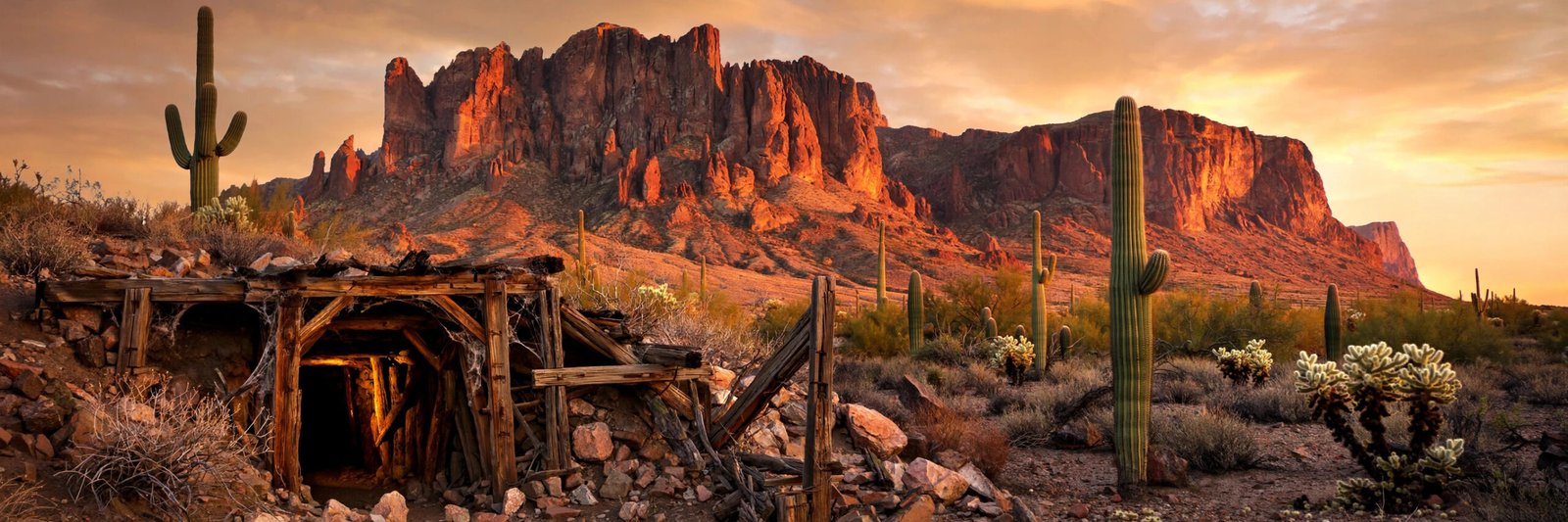
Few American tales grip the imagination like the Lost Dutchman Gold Mine legend. Somewhere in the jagged Superstition Mountains east of Phoenix, Arizona, a fortune in gold is said to wait for the lucky — or doomed — prospector who finds it. For more than 130 years, treasure hunters have chased the story, and some never came home. But how much of the tale is documented history, and how much is pure folklore? This guide separates fact from legend, so you can enjoy one of America’s greatest mysteries without falling for its myths.
The Lost Dutchman Gold Mine Legend Begins With Jacob Waltz
Every version of the story starts with a real man: Jacob Waltz. Despite the nickname, Waltz was not Dutch — he was a German immigrant (“Dutchman” was a common 19th-century American corruption of “Deutsch,” meaning German). He lived in the Phoenix area in the late 1800s and, according to neighbors, occasionally paid for supplies with gold ore that looked unusually rich.
Documented fact: Jacob Waltz was a real person who died in Phoenix on October 25, 1891. On his deathbed, he reportedly described the location of a rich gold mine in the Superstition Mountains to Julia Thomas, a neighbor who ran a bakery and ice cream shop. What exactly he said — and whether the mine was real — is where documented fact ends and legend begins. No verified written record of his deathbed directions survives; everything comes from secondhand accounts passed down by people who claimed to have heard the story.
Waltz himself left behind no map and no written claim. If he truly found gold, he may have been working an old Spanish or Mexican diggings, high-grading ore from someone else’s mine, or simply salting his story to impress listeners. Historians still debate all three possibilities, and honest researchers will tell you the truth is unknown.
Fact vs. Legend: The Peralta Family Story
Many retellings of the Lost Dutchman Gold Mine legend add a dramatic backstory: a wealthy Mexican Peralta family supposedly mined rich gold deposits in the Superstitions in the 1840s, only to be ambushed and massacred by Apaches while hauling ore out. The tale usually ends with one survivor escaping to Mexico with a map — a map that later generations of treasure hunters claimed to possess.
This is legend, not documented fact. There is no verified historical record of a Peralta mining operation or massacre in the Superstition Mountains. The story appears to have been stitched together from older Spanish and Mexican mining folklore of the Southwest, where tales of lost padres’ mines and hidden Jesuit treasure were already common. That does not make it impossible — Spanish and Mexican prospectors did work parts of Arizona — but no documents, mine workings, or artifacts have ever confirmed the Peralta version of events.
The Peralta story matters because it became the engine of the legend. Once treasure hunters believed an entire family’s fortune was hidden in the mountains, the search stopped being about one old prospector’s tale and became a full-blown gold rush of the imagination. If you enjoy untangling American folklore, you may also like our look at the Bigfoot legend explained, where we apply the same fact-versus-folklore test.
Julia Thomas and the Maps That Launched a Thousand Searches
Documented fact: Julia Thomas was a real person, and after Waltz’s death she genuinely believed she knew where the mine was. She organized expeditions into the Superstitions, drew and sold copies of maps purporting to show the mine’s location, and spent years — and a great deal of money — searching. Her efforts were widely reported in Arizona newspapers of the 1890s, which is how the story first reached a national audience.
Thomas’s maps are a perfect case study in how legends grow. Each copy was hand-drawn, each slightly different, and each new owner added their own “corrections.” Within a few years, dozens of contradictory maps were circulating, all claiming to reveal the same mine. Treasure hunters were essentially following copies of copies of a dying man’s remembered directions — a recipe for a century of failure.
Other early searchers included partners and rivals who each claimed Waltz had confided in them. The result was a tangle of competing claims that made the legend richer and the actual facts murkier with every retelling. Newspaper coverage loved it: a mysterious German, a dying confession, beautiful but deadly mountains. The Lost Dutchman Gold Mine legend was becoming America’s favorite treasure story.
The Lost Dutchman Gold Mine Legend Moves Into the Superstition Mountains
The setting is as famous as the story. The Superstition Mountains rise sharply from the desert floor about 40 miles east of Phoenix, a maze of volcanic cliffs, hidden canyons, and brush-choked ravines. Landmarks like Weavers Needle — a dramatic rock spire visible for miles — appear in nearly every treasure map, usually as the key reference point. Legend says the mine lies in the shadow of the Needle; fact says the Needle is simply the most recognizable feature in a very confusing landscape.
Documented fact: The mountains are real, rugged, and genuinely dangerous. Summer temperatures are brutal, water is scarce, cliffs are unforgiving, and getting lost is easy. This is not legend — the Superstition Wilderness has a long record of hikers and prospectors needing rescue. Much of the legend’s “curse” can be explained by harsh desert reality.
Popular books cemented the tale in the 20th century. Treasure writers published dramatic accounts — including Barry Storm’s Thunder Gods Gold in the 1940s — that blended the Waltz story, the Peralta massacre, and new “clues” into page-turning narratives. Each book sold the dream a little harder and moved the “certain” location a little further. Similar myth-making surrounds other American tales, like the true story behind the Legend of Sleepy Hollow.
Disappearances and Deaths That Fed the Legend
Nothing sustains a treasure legend like real tragedy, and the Superstitions have supplied it. Documented fact: In 1931, Adolph Ruth — a Washington, D.C. area man obsessed with the Peralta version of the story — entered the mountains carrying maps he believed showed the old family mine. He did not come out. His skull was found months later, and the rest of his remains were recovered the following year. Newspapers at the time reported the skull showed signs of a violent death, and debate about exactly what happened to Ruth continues to this day.
Ruth’s death was real, but its meaning is legend. Some said he was murdered for his maps; others said he died of heat and exposure and animals scattered the remains. What is certain is that his fate electrified the story: here was proof, people said, that the mine was real enough to kill for. In truth, it was proof only that the desert kills the unprepared — a lesson the mountains keep teaching.
Over the decades, other searchers have died or vanished in the range. Each incident gets folded into the legend as evidence of a “curse,” while search-and-rescue records tell a plainer story of dehydration, falls, and disorientation. The romance of the Lost Dutchman Gold Mine legend survives because mystery is more appealing than misadventure.
Why Hasn’t Anyone Found It? What the Surveys Say
If a gold mine rich enough to match the legend existed in the Superstitions, modern geology should have found traces of it. The U.S. Geological Survey and generations of prospectors have combed the range with far better tools than Waltz ever had. Small gold occurrences exist in the region — Arizona has many minor gold deposits — but nothing matching the fabled bonanza has ever been documented.
Legend has answers for this, of course: the mine is hidden behind a false cliff face, buried by an earthquake-triggered rockslide, or deliberately concealed by those who know. These explanations are unfalsifiable, which is exactly why they survive. A serious assessment has to weigh two possibilities honestly: either Waltz’s mine was a small, worked-out pocket whose location died with him, or the richest parts of the story were embroidered from the start.
There is also a legal reality modern hunters cannot ignore: much of the range is designated wilderness, where mechanized prospecting and digging are restricted. The romantic era of wandering the canyons with a pickaxe is over. For a broader tour of how American legends mix truth and tall tales, see the true stories behind famous American legends.
Visiting the Superstition Mountains Today
You do not need to find gold to enjoy the Superstitions — the mountains themselves are the real treasure, and they are spectacular. Here is how to experience the legend safely and legally:
- Lost Dutchman State Park: At the western base of the mountains, this park offers campgrounds, picnic areas, and trailheads with stunning views of the Superstition ridgeline. It is the easiest, safest way to stand where the legend lives.
- Peralta Trail: One of the most popular hikes, climbing to a saddle with sweeping views of Weavers Needle. Go in cooler months, carry far more water than you think you need, and tell someone your plan.
- Goldfield Ghost Town: A reconstructed 1890s mining town near Apache Junction with mine tours, a narrow-gauge railroad, and Old West shops — a fun, family-friendly taste of the prospecting era without any desert risk.
- Superstition Mountain Museum: Exhibits on the area’s mining history and the Dutchman story, including artifacts from the search era.
- Desert safety rules: Hike October through April if possible, start at dawn, carry at least a gallon of water per person per day in heat, stay on marked trails, and never enter abandoned mine shafts — they are unstable and can contain deadly gases.
The Apache Trail (State Route 88) scenic drive winds along the mountains’ edge past Canyon Lake and Tortilla Flat, offering jaw-dropping desert scenery from the comfort of your car. It is a reminder that the Superstitions do not need hidden gold to be worth the trip.
Conclusion: The Real Treasure of the Lost Dutchman Gold Mine Legend
So what should you believe about the Lost Dutchman Gold Mine legend? Believe this: Jacob Waltz was real, Julia Thomas really searched, Adolph Ruth really died, and the Superstition Mountains are really as wild and beautiful as the stories say. Treat the Peralta massacre, the exact deathbed directions, and the precise location under Weavers Needle as what they are — legend, passed down and polished by more than a century of storytellers.
The mine may have been real and small, or mostly imagined; either way, the legend itself became the treasure. It inspired books, movies, songs, and countless desert adventures. It draws visitors from around the world to one of Arizona’s most dramatic landscapes. And it reminds us that America’s best stories are the ones we keep telling — as long as we are honest about which parts we know and which parts we dream.
Your turn: Have you hiked the Superstitions or visited Lost Dutchman State Park? Share your experience in the comments, explore more of our American legends coverage, and if this mystery captured your imagination, subscribe for more true stories behind America’s greatest folklore — told straight, with facts labeled as facts.