
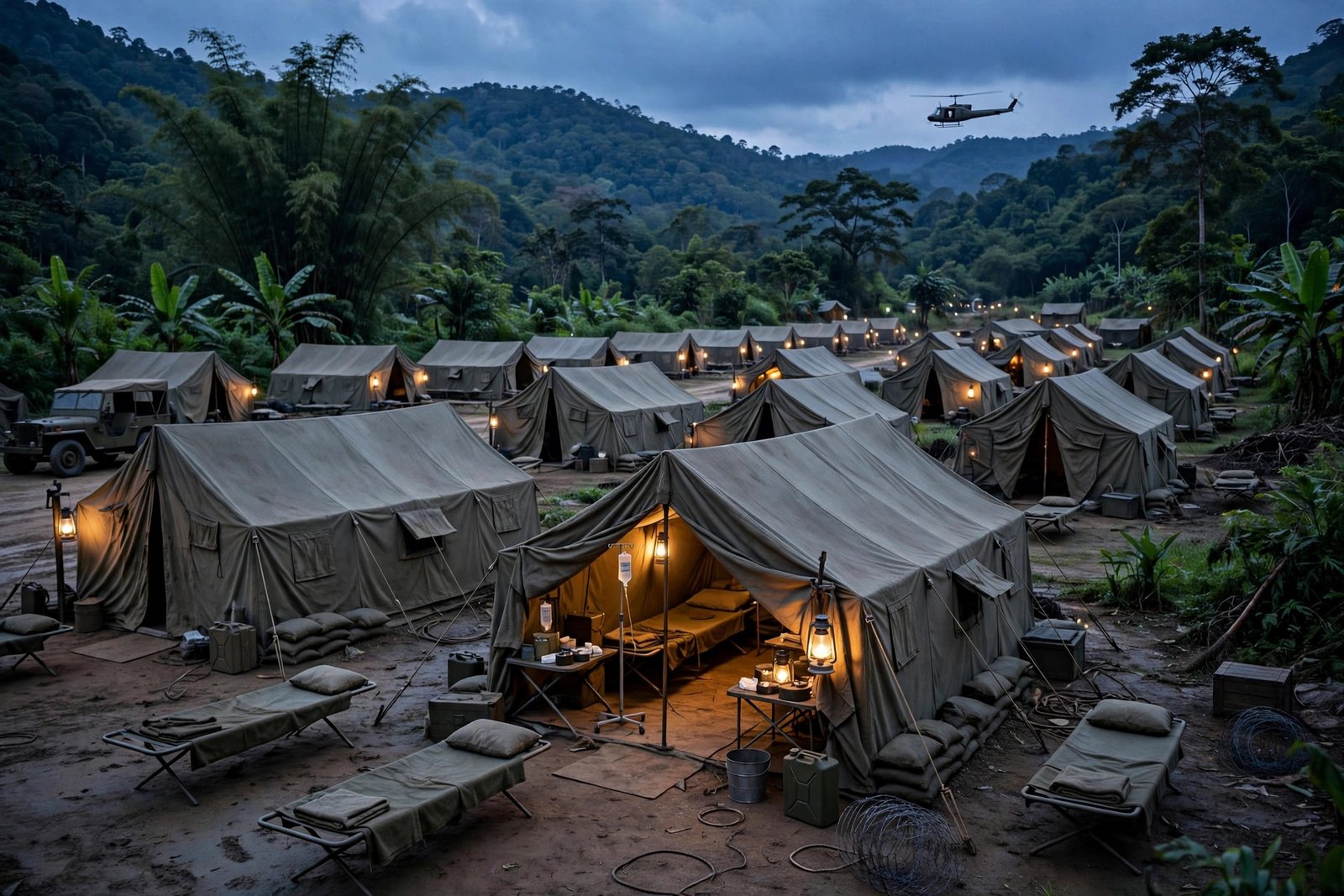
US Army nurses Vietnam true stories are among the most moving chapters of the Vietnam War. Far from home, young women in uniform worked around the clock in field hospitals and evacuation hospitals, saving lives under conditions most Americans can barely imagine. They were not carrying rifles into battle, but they stood at the very heart of the war — in operating rooms, in triage wards, and beside the beds of wounded soldiers who needed them most.
These nurses arrived in Vietnam as volunteers and as officers of the Army Nurse Corps. Many were in their early twenties. Most had trained in civilian hospitals back home, where the worst emergencies were car accidents and heart attacks. Nothing had prepared them for the scale of combat casualties, the heat, the monsoon rains, or the emotional weight of caring for soldiers their own age. Yet they stayed, they adapted, and they became a lifeline for an entire generation of American troops.
US Army Nurses Vietnam True Stories: Arriving in a War Zone
For most Army nurses, the journey to Vietnam began with orders that arrived suddenly and changed everything. One week they were working a ward in the United States; the next they were on a long flight across the Pacific, landing at a busy air base in a country at war. The heat hit first, then the noise — helicopters overhead, distant artillery, and the constant movement of a military machine at full stretch.
The nurses were assigned to evacuation hospitals, field hospitals, and surgical hospitals spread across South Vietnam. Some served at large, relatively well-equipped facilities near major bases. Others worked at smaller hospitals closer to the fighting, where the wards were tents with dirt floors and the operating rooms ran on generators. Wherever they served, the routine was the same: long shifts, too many patients, and too little sleep.
Many nurses later recalled that their first days were the hardest. The sheer number of casualties was shocking. Helicopters, known as Dustoffs, brought wounded soldiers directly from the battlefield to the hospital helipad, sometimes within minutes of being hit. Nurses learned to move fast, to stay calm, and to make decisions quickly. A nurse who hesitated could cost a life, so hesitation was a luxury nobody could afford.
It is worth remembering that these women were soldiers as well as caregivers. They wore uniforms, followed military discipline, and lived under the same threat as everyone else on base. Hospitals were sometimes attacked, and nurses learned to take cover during rocket and mortar attacks just like the rest of the troops. Their courage was quiet and steady — the kind that shows up shift after shift, night after night.
Life in the Evacuation Hospitals
Daily life in a Vietnam evacuation hospital followed a rhythm dictated by the war. When fighting was heavy, the wards filled within hours. When it eased, there was time for paperwork, for restocking supplies, and for writing letters home — letters that rarely described the worst of what the nurses had seen.
The wards themselves were open, crowded places. Rows of beds or cots held young men recovering from surgery, waiting for evacuation to hospitals in Japan or back in the United States, or simply too ill to move. Nurses changed dressings, monitored vital signs, managed intravenous fluids and blood transfusions, and comforted soldiers who were frightened, in pain, or grieving for friends who had not survived.
- Triage: When casualties arrived in waves, nurses helped sort patients by urgency so surgeons could treat the most critical cases first.
- Operating room duty: Many nurses assisted in surgery, handing instruments, monitoring anesthesia, and keeping the surgical team supplied through operations that lasted for hours.
- Post-operative care: After surgery, nurses watched for bleeding, infection, and shock, often caring for dozens of patients at once.
- Ward management: Senior nurses ran entire wards, supervising enlisted medics and corpsmen and making sure every patient received care.
- Emotional support: Nurses wrote letters for soldiers who could not write, held hands, listened, and offered the human comfort that medicine alone could not provide.
The work was physically exhausting. Shifts of twelve hours were common, and during major offensives nurses worked far longer. The tropical climate made everything harder — heat, humidity, and monsoon mud were constant companions. Supplies sometimes ran short. Yet the standard of care remained remarkably high, and the survival rate for soldiers who reached a hospital alive was a testament to the skill of the medical teams.
The Work: Triage, Surgery, and Long Nights
If there is one image that defines the experience of Army nurses in Vietnam, it is the night shift in a busy hospital. Under harsh lights, with helicopters landing outside and new patients arriving on stretchers, nurses moved from bed to bed with practiced efficiency. They checked wounds, changed blood bags, adjusted drips, and spoke softly to men who were waking from anesthesia far from home.
Triage was one of the most difficult parts of the job. When far more wounded arrived than the surgical teams could handle at once, someone had to decide who went to surgery first. Nurses were often part of those decisions, and the responsibility weighed heavily. They carried those choices with them long after the war ended.
Surgery itself was intense. Combat wounds from bullets, shrapnel, and mines were severe and complex. Operating teams worked through the night, sometimes performing operation after operation without a break. Nurses in the operating room had to anticipate the surgeon’s needs, keep instruments ready, and stay focused while exhausted. It was demanding, technical work, and the nurses performed it with extraordinary competence.
But the work was not only about wounds. Tropical diseases, including malaria and dysentery, filled hospital beds too. Nurses cared for Vietnamese civilians as well as American troops in some hospitals, treating children and families caught in the war. They also cared for prisoners of war, following the same professional ethic that every patient deserved care regardless of uniform.
For readers who want more accounts of courage in uniform, the stories of female US military heroes show how women have served across generations, while incredible true stories of US soldiers capture the bravery of the troops these nurses worked so hard to save.
US Army Nurses Vietnam True Stories of Courage Under Fire
The courage of Army nurses in Vietnam was not the stuff of headlines. It was the courage of staying at a patient’s bedside during a mortar attack, of finishing a dressing change while alarms sounded, of returning to the ward the morning after losing patients the night before. That steady, daily bravery is what veterans remember most about the nurses they knew.
One widely documented figure is Sharon Lane, an Army nurse who served at the 312th Evacuation Hospital at Chu Lai and was killed in a rocket attack in June 1969. She was the only American servicewoman killed by direct enemy fire in Vietnam, and her story is often told as a reminder that nurses shared the dangers of war. Her sacrifice is honored at the Vietnam Veterans Memorial in Washington, D.C., where her name appears alongside the more than 58,000 others lost in the war.
Eight American military women died in Vietnam, all of them nurses — seven from the Army and one from the Air Force. Their names are part of the memorial’s story, and their service is a solemn reminder that the cost of war fell on caregivers as well as combat troops. The vast majority of nurses came home, but they carried the war with them in ways that were not always visible.
Many veterans have said that the nurses were the first friendly, caring faces they saw after being wounded — sometimes the first women they had spoken to in months. A nurse’s voice, a cool cloth, a few kind words: these small acts of humanity mattered enormously to soldiers who had just lived through the worst moments of their lives. For some wounded men, the memory of a nurse’s kindness became one of the few good memories they carried out of Vietnam.
The Emotional Cost of Caring
The emotional toll on Army nurses in Vietnam was immense, and it is a central part of their true stories. Nurses formed bonds with their patients quickly — and lost them just as quickly. A soldier a nurse had talked with in the evening might be gone by morning. Another might be evacuated and never heard from again, leaving the nurse to wonder for years whether he survived.
Unlike combat troops, who at least shared their experiences with the men in their units, nurses often grieved privately. The next shift always needed them, and there was little time or space to process loss. Many nurses learned to keep going by focusing on the next patient, the next task, the next life that could still be saved. That coping strategy worked in the war zone, but it made the return home harder.
Nurses also faced a painful paradox: they saved lives, but they could not save everyone, and the war itself went on regardless of their efforts. Some struggled with guilt, wondering whether a different decision might have changed an outcome. Others found meaning in the lives they did save — in soldiers who went home, married, raised families, and lived full lives because a nurse had been there at the critical moment.
It took decades for the country to fully recognize this burden. For years after the war, the service of women in Vietnam was overlooked in public memory, overshadowed by debates about the war itself. Nurses came home to a country that often did not want to talk about Vietnam at all, and many kept their stories to themselves for a long time.
Coming Home: A Quiet Return
Homecoming for Army nurses was often lonely. Unlike combat units, which sometimes returned together, nurses usually came home individually, on ordinary commercial flights, to families who had only the vaguest idea of what they had experienced. There were no parades. There were few questions, and sometimes the questions that were asked were hostile, reflecting the divisions the war had caused at home.
Many nurses went straight back to work in civilian hospitals, where colleagues could not understand why a young nurse seemed older than her years, or why certain sounds and smells unsettled her. Yet US Army nurses Vietnam true stories kept surfacing in quiet conversations between veterans, who told their families about the nurses who had cared for them when it mattered most. The skills they had gained in Vietnam — calm under pressure, speed, decisiveness — made them excellent nurses, but the memories stayed. Post-traumatic stress affected nurses as surely as it affected combat veterans, though it was recognized in them even later.
Over time, nurses began to find one another again. Reunions, veterans’ organizations, and oral history projects gave them a place to tell their stories and be heard. Many discovered that sharing their experiences, even decades later, brought relief. They learned that they were not alone in what they carried, and that their service mattered to the soldiers they had saved and to the country they had served.
The Vietnam Women’s Memorial and Lasting Recognition
A turning point in public recognition came with the Vietnam Women’s Memorial in Washington, D.C., dedicated in 1993. The memorial, championed for years by former Army nurse Diane Carlson Evans, depicts three women caring for a wounded soldier. It stands near the Vietnam Veterans Memorial wall and honors the women — most of them nurses — who served in Vietnam. For many nurses, the dedication was the first time the nation had publicly said thank you.
Diane Carlson Evans served as an Army nurse in Vietnam and spent years advocating for a memorial to women’s service. Her campaign faced skepticism and delay, but she persisted, and the memorial now stands as a permanent tribute. Visitors leave flowers, letters, and mementos there, and veterans often seek out the nurses’ memorial as a place of gratitude and healing.
Today, the stories of Army nurses in Vietnam are preserved in museums, in oral histories, and in books written by the nurses themselves. The Army Nurse Corps continues to honor this heritage, and nursing schools teach the Vietnam experience as part of the history of military medicine. The lessons those nurses learned — about triage, trauma care, and evacuation medicine — helped shape modern military and civilian emergency care.
Their legacy also lives on in the veterans they saved. Every soldier who came home because a nurse held pressure on a wound, spotted a dangerous change in vital signs, or simply refused to give up on a difficult case is part of that legacy. The numbers are impossible to count, but the gratitude is easy to find: ask any Vietnam veteran about the nurses, and the answer is almost always the same — they were angels, they were heroes, and they never left our side.
Why These Stories Still Matter
US Army nurses Vietnam true stories matter because they complete the picture of the war. War is not only fought by those who carry weapons; it is also endured and eased by those who heal. The nurses’ stories remind us that courage takes many forms, that service is not measured only in combat, and that compassion under fire is one of the highest forms of bravery.
They also matter because they honor women veterans more broadly. Women have served in every American war, often without the recognition their male counterparts received. Telling the nurses’ stories is one way to correct that imbalance and to make sure future generations understand the full scope of who served.
Finally, these stories matter for the nurses themselves. Many are now elderly, and their firsthand accounts are irreplaceable. Listening to them, preserving their histories, and teaching them to young people is a way of saying that their service was seen, that it counted, and that it will not be forgotten.
US Army nurses Vietnam true stories deserve to be told and retold, not left in old photo albums and forgotten letters. If this story moved you, share it with someone who should hear it. Visit the Vietnam Women’s Memorial if you ever travel to Washington, D.C., and take a moment at the wall to remember the nurses whose names are there. Support organizations that serve women veterans, and when you meet a veteran — nurse or soldier — take the time to say thank you. That simple act means more than you may ever know.