
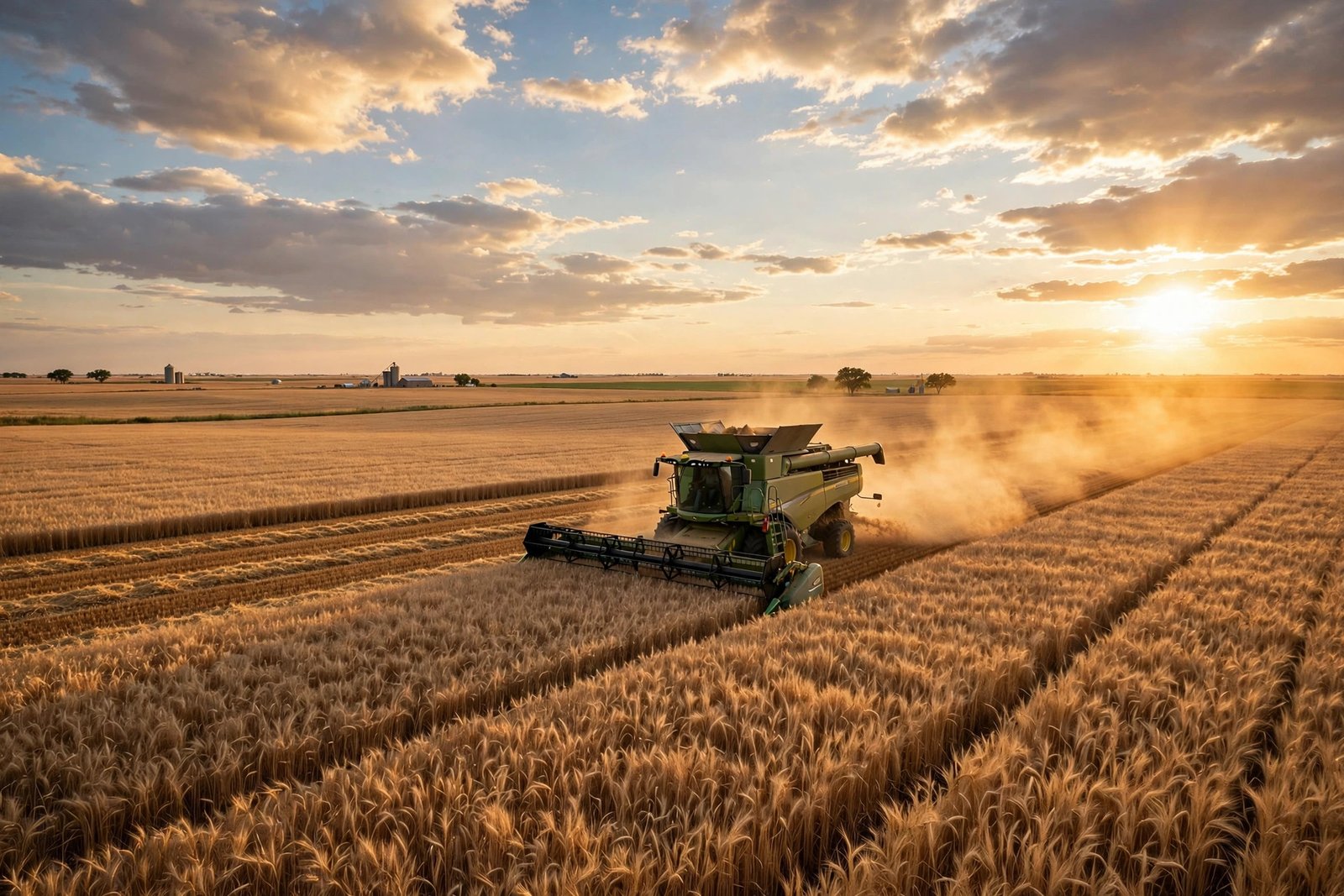
When people talk about American farming world power, they usually think of satellites, aircraft carriers, and Wall Street. They forget the other foundation of global influence: the quiet fields of Iowa, the wheat plains of Kansas, and the cattle ranches of Texas. Every single day, American farmers produce enough food not only to feed the United States but to ship calories, grain, and protein to dinner tables on nearly every continent. This is how American farming feeds the world — and why agriculture remains one of the deepest sources of American strength.
The United States is one of the largest food producers and exporters on the planet. From corn and soybeans to wheat, beef, poultry, dairy, and tree nuts, American farms supply a share of global trade that few countries can match. Understanding America’s agricultural strength means understanding how soil, science, and stubborn ingenuity turned a continent into the most productive farmland system in human history.
The Scale of American Farming World Power: By the Numbers
Farming in America operates on a scale that is hard to grasp. The country has roughly two million farms spread across the country, covering about 900 million acres of farmland — close to two-fifths of all land in the United States. A single American farmworker today produces many times more food than a worker did a century ago, and American farms consistently rank among the most productive in the world per worker.
Consider what this scale actually means in practice:
- Corn: The United States is the world’s largest producer of corn (maize), growing tens of billions of bushels in a typical year, mostly across the Midwest Corn Belt.
- Soybeans: America is one of the top soybean producers and exporters in the world, with the crop grown mainly in the Midwest and Mississippi Delta.
- Wheat: Winter wheat from Kansas and surrounding states makes the U.S. a major global wheat exporter.
- Beef, poultry, and dairy: American livestock and dairy production ranks among the largest in the world, feeding both domestic markets and buyers abroad.
- Tree nuts and specialty crops: California alone grows a large share of the world’s almonds and significant volumes of walnuts, pistachios, and citrus.
These are not estimates from a single lucky harvest — they are the normal, repeated output of a system that has been refined for generations. That reliability is itself a form of power: when American farms deliver steady harvests year after year, global markets price food with American supply in mind.
Technology: The Engine of America’s Farming Power
Walk onto a modern American farm and you will find equipment that looks closer to aerospace than to the horse-drawn plows of a century ago. GPS-guided tractors can plant rows with inch-level precision. Satellite imagery and drones monitor crop health across thousands of acres. Soil sensors tell farmers exactly where water and fertilizer are needed, cutting waste and raising yields.
Precision agriculture — the practice of managing fields at the level of individual square meters rather than whole acres — has become standard on many American operations. Yield monitors on combines record harvest data in real time, building year-by-year maps that guide planting decisions. Variable-rate technology adjusts seed and fertilizer rates on the go, matching inputs to the needs of each patch of soil.
Behind the machinery is equally important biological science. American-developed corn hybrids and improved seed varieties have pushed yields dramatically higher over the decades. Plant breeding — both conventional and modern — has produced varieties that resist pests, tolerate drought, and convert fertilizer into grain more efficiently. U.S. agricultural universities and research programs have exported this knowledge worldwide, training agronomists who now work on every continent.
This is why American farming world power is not just about land. It is about the knowledge embedded in every seed, every machine, and every management decision. The United States did not simply inherit good soil; it built a research and innovation pipeline that keeps raising what that soil can do.
The Heartland: Where the Breadbasket Sits
The center of gravity for American agriculture is the Midwest — the famous Corn Belt stretching across Iowa, Illinois, Nebraska, Minnesota, Indiana, and neighboring states. The region’s deep, dark soils formed under ancient prairie grasses, and its climate gives corn and soybeans the warm, wet summers they need.
Iowa consistently leads the nation in corn production. Kansas is the heart of winter wheat country. Texas leads in cattle ranching. California’s Central Valley, with its Mediterranean climate and massive irrigation systems, grows a staggering diversity of fruits, vegetables, and nuts. The Mississippi Delta produces soybeans, rice, and cotton. Each region specializes in what its soil and climate do best — and that specialization, connected by rivers, railroads, and highways, makes the whole system astonishingly efficient.
Transportation is an underappreciated part of the story. The Mississippi River carries enormous volumes of grain from the interior to Gulf ports, where ocean-going vessels load it for Asia, Latin America, the Middle East, and beyond. American farmers do not just grow food; they move it to world markets at some of the lowest logistics costs on earth.
For a traveler, the beauty of this heartland is real too. The endless green rows of summer corn, the golden waves of wheat at harvest, the red barns and white silos against a huge sky — these are among the most iconic landscapes in America. You can see them for yourself along the back roads of the Midwest, where small towns still organize their year around planting and harvest.
Feeding the World: American Farming World Power in Global Trade
Here is where American farming world power becomes truly global. The United States is one of the world’s largest agricultural exporters, and American grain, meat, and dairy flow into markets across Asia, Latin America, the Middle East, and Africa. When harvests are strong in the American Midwest, global food prices feel it. When drought strikes the Plains, commodity markets everywhere take notice.
A few facts capture the scale of this reach:
- The United States is typically the world’s largest corn exporter, with shipments going to countries across Asia and Latin America.
- American soybeans are a major feed ingredient for livestock industries in Asia, especially China.
- U.S. wheat moves to buyers across Latin America, the Middle East, and Asia.
- American beef, poultry, and pork are exported in large volumes to markets including Mexico, Canada, and countries across Asia.
- The United States is also a major source of international food aid, with American-grown commodities reaching communities in need around the world.
This export strength is also a pillar of the American economy. Agricultural exports generate billions of dollars in farm income and support jobs far beyond the farm gate — in transportation, processing, storage, and ports. For more on the economic engines that drive the country, see our look at why the USA’s power reaches every corner of the globe.
Food power also shapes diplomacy. Countries that depend on imported grain pay close attention to American harvests and American trade policy. The ability to feed the world is, quietly, one of the most effective tools of influence the United States has ever possessed.
Family Farms: The People Behind the Harvest
Despite the scale of the operation, the backbone of American agriculture remains the family farm. The U.S. Department of Agriculture reports that the vast majority of American farms — roughly 97 percent — are family owned and operated, including large commercial operations run by extended families.
These are people who read the sky, know their soil field by field, and work seasons that start before dawn. Farming in America is often a multigenerational commitment: grandparents bought the first acres, parents expanded them, and the current generation runs GPS-guided machinery their grandparents could never have imagined. That continuity of care — land improved over decades rather than mined for a single season — is part of why American farmland stays so productive.
Farm communities have their own deep culture: county fairs, harvest festivals, 4-H programs for kids, and small-town diners where the weather forecast is serious business. The human side of this agricultural strength is worth remembering whenever we talk about exports and yields. Behind every statistic is a family making bets on the weather, the markets, and the future.
Challenges on the Horizon
American agricultural dominance is real, but it is not guaranteed forever. Farmers face rising costs for land, equipment, and inputs. Finding enough workers for labor-intensive crops remains a persistent challenge. Water is a growing concern in the western states, where drought and competing demands for rivers and aquifers have forced hard conversations about irrigation.
Climate pressures add more uncertainty: heavier downpours in some regions, longer dry spells in others, and shifting pest and disease patterns. Trade policy shifts can open or close export markets overnight. And each generation of farmers must decide whether the family farm can continue — young farmers face steep barriers in land prices and start-up costs.
Yet the history of American agriculture is a history of meeting exactly these kinds of challenges. The Dust Bowl of the 1930s taught hard lessons about conservation that led to shelterbelts and soil-protection programs. The productivity revolution of the late 20th century came from research and grit. Today’s farmers are adapting with cover crops, no-till practices, water-efficient irrigation, and data-driven decisions. If the past is any guide, American farms will keep finding ways to grow more food with fewer inputs.
Conclusion: The Quiet Strength of American Fields
American farming world power does not march in parades or sit on aircraft carriers. It grows in the soil, one season at a time. The United States feeds its own people abundantly and sends surplus harvests across the oceans, stabilizing global food supplies and supporting millions of livelihoods — from the Iowa corn grower to the port worker on the Gulf, to the baker in Cairo or the feed mill operator in Southeast Asia.
The next time you drive through the Midwest at harvest time and see the golden fields rolling to the horizon, remember what you are looking at: not just a beautiful landscape, but one of the greatest productive achievements in human history — and one of the quietest forms of American power. For more stories of American strength and innovation, explore our articles on American inventions that changed the world and the best national parks in the USA that protect the wild landscapes these farms surround.
Share this article with someone who thinks American power is only about the military — and let them see the fields that feed the world.